
- Home
- Services
- Portfolio
- About
- Service AreasFort Lauderdale, FL
- Web Design
- Redesign
- WordPress
- Ecommerce
- Landing Pages
- SEO Services
- Local SEO
- GBP
- Google Ads
- PPC
- Digital Marketing
- Internet Marketing
- Advertising
- Tracking
- Dental Marketing
- Medical Marketing
- HVAC Marketing
- Roofing Marketing
- Pest Control Marketing
- Home Services Marketing
- Plumbing Marketing
- Electrical Marketing
- Landscaping Marketing
- Remodeling Marketing
Pembroke Pines, FL- Web Design
- Redesign
- WordPress
- Ecommerce
- Landing Pages
- SEO Services
- Local SEO
- GBP
- Google Ads
- PPC
- Digital Marketing
- Internet Marketing
- Advertising
- Tracking
- Dental Marketing
- Medical Marketing
- HVAC Marketing
- Roofing Marketing
- Pest Control Marketing
- Home Services Marketing
- Plumbing Marketing
- Electrical Marketing
- Landscaping Marketing
- Remodeling Marketing
Hialeah, FL- Web Design
- Redesign
- WordPress
- Ecommerce
- Landing Pages
- SEO Services
- Local SEO
- GBP
- Google Ads
- PPC
- Digital Marketing
- Internet Marketing
- Advertising
- Tracking
- Dental Marketing
- Medical Marketing
- HVAC Marketing
- Roofing Marketing
- Pest Control Marketing
- Home Services Marketing
- Plumbing Marketing
- Electrical Marketing
- Landscaping Marketing
- Remodeling Marketing
Hollywood, FL- Web Design
- Redesign
- WordPress
- Ecommerce
- Landing Pages
- SEO Services
- Local SEO
- GBP
- Google Ads
- PPC
- Digital Marketing
- Internet Marketing
- Advertising
- Tracking
- Dental Marketing
- Medical Marketing
- HVAC Marketing
- Roofing Marketing
- Pest Control Marketing
- Home Services Marketing
- Plumbing Marketing
- Electrical Marketing
- Landscaping Marketing
- Remodeling Marketing
Miramar, FL- Web Design
- Redesign
- WordPress
- Ecommerce
- Landing Pages
- SEO Services
- Local SEO
- GBP
- Google Ads
- PPC
- Digital Marketing
- Internet Marketing
- Advertising
- Tracking
- Dental Marketing
- Medical Marketing
- HVAC Marketing
- Roofing Marketing
- Pest Control Marketing
- Home Services Marketing
- Plumbing Marketing
- Electrical Marketing
- Landscaping Marketing
- Remodeling Marketing
Coral Springs, FL- Web Design
- Redesign
- WordPress
- Ecommerce
- Landing Pages
- SEO Services
- Local SEO
- GBP
- Google Ads
- PPC
- Digital Marketing
- Internet Marketing
- Advertising
- Tracking
- Dental Marketing
- Medical Marketing
- HVAC Marketing
- Roofing Marketing
- Pest Control Marketing
- Home Services Marketing
- Plumbing Marketing
- Electrical Marketing
- Landscaping Marketing
- Remodeling Marketing
Pompano Beach, FL- Web Design
- Redesign
- WordPress
- Ecommerce
- Landing Pages
- SEO Services
- Local SEO
- GBP
- Google Ads
- PPC
- Digital Marketing
- Internet Marketing
- Advertising
- Tracking
- Dental Marketing
- Medical Marketing
- HVAC Marketing
- Roofing Marketing
- Pest Control Marketing
- Home Services Marketing
- Plumbing Marketing
- Electrical Marketing
- Landscaping Marketing
- Remodeling Marketing
Davie, FL- Web Design
- Redesign
- WordPress
- Ecommerce
- Landing Pages
- SEO Services
- Local SEO
- GBP
- Google Ads
- PPC
- Digital Marketing
- Internet Marketing
- Advertising
- Tracking
- Dental Marketing
- Medical Marketing
- HVAC Marketing
- Roofing Marketing
- Pest Control Marketing
- Home Services Marketing
- Plumbing Marketing
- Electrical Marketing
- Landscaping Marketing
- Remodeling Marketing
Sunrise, FL- Web Design
- Redesign
- WordPress
- Ecommerce
- Landing Pages
- SEO Services
- Local SEO
- GBP
- Google Ads
- PPC
- Digital Marketing
- Internet Marketing
- Advertising
- Tracking
- Dental Marketing
- Medical Marketing
- HVAC Marketing
- Roofing Marketing
- Pest Control Marketing
- Home Services Marketing
- Plumbing Marketing
- Electrical Marketing
- Landscaping Marketing
- Remodeling Marketing
Plantation, FL- Web Design
- Redesign
- WordPress
- Ecommerce
- Landing Pages
- SEO Services
- Local SEO
- GBP
- Google Ads
- PPC
- Digital Marketing
- Internet Marketing
- Advertising
- Tracking
- Dental Marketing
- Medical Marketing
- HVAC Marketing
- Roofing Marketing
- Pest Control Marketing
- Home Services Marketing
- Plumbing Marketing
- Electrical Marketing
- Landscaping Marketing
- Remodeling Marketing
Deerfield Beach, FL- Web Design
- Redesign
- WordPress
- Ecommerce
- Landing Pages
- SEO Services
- Local SEO
- GBP
- Google Ads
- PPC
- Digital Marketing
- Internet Marketing
- Advertising
- Tracking
- Dental Marketing
- Medical Marketing
- HVAC Marketing
- Roofing Marketing
- Pest Control Marketing
- Home Services Marketing
- Plumbing Marketing
- Electrical Marketing
- Landscaping Marketing
- Remodeling Marketing
Miami Gardens, FL- Web Design
- Redesign
- WordPress
- Ecommerce
- Landing Pages
- SEO Services
- Local SEO
- GBP
- Google Ads
- PPC
- Digital Marketing
- Internet Marketing
- Advertising
- Tracking
- Dental Marketing
- Medical Marketing
- HVAC Marketing
- Roofing Marketing
- Pest Control Marketing
- Home Services Marketing
- Plumbing Marketing
- Electrical Marketing
- Landscaping Marketing
- Remodeling Marketing
Lauderhill, FL- Web Design
- Redesign
- WordPress
- Ecommerce
- Landing Pages
- SEO Services
- Local SEO
- GBP
- Google Ads
- PPC
- Digital Marketing
- Internet Marketing
- Advertising
- Tracking
- Dental Marketing
- Medical Marketing
- HVAC Marketing
- Roofing Marketing
- Pest Control Marketing
- Home Services Marketing
- Plumbing Marketing
- Electrical Marketing
- Landscaping Marketing
- Remodeling Marketing
West Palm Beach, FL- Web Design
- Redesign
- WordPress
- Ecommerce
- Landing Pages
- SEO Services
- Local SEO
- GBP
- Google Ads
- PPC
- Digital Marketing
- Internet Marketing
- Advertising
- Tracking
- Dental Marketing
- Medical Marketing
- HVAC Marketing
- Roofing Marketing
- Pest Control Marketing
- Home Services Marketing
- Plumbing Marketing
- Electrical Marketing
- Landscaping Marketing
- Remodeling Marketing
Tamarac, FL- Web Design
- Redesign
- WordPress
- Ecommerce
- Landing Pages
- SEO Services
- Local SEO
- GBP
- Google Ads
- PPC
- Digital Marketing
- Internet Marketing
- Advertising
- Tracking
- Dental Marketing
- Medical Marketing
- HVAC Marketing
- Roofing Marketing
- Pest Control Marketing
- Home Services Marketing
- Plumbing Marketing
- Electrical Marketing
- Landscaping Marketing
- Remodeling Marketing
Weston, FL- Web Design
- Redesign
- WordPress
- Ecommerce
- Landing Pages
- SEO Services
- Local SEO
- GBP
- Google Ads
- PPC
- Digital Marketing
- Internet Marketing
- Advertising
- Tracking
- Dental Marketing
- Medical Marketing
- HVAC Marketing
- Roofing Marketing
- Pest Control Marketing
- Home Services Marketing
- Plumbing Marketing
- Electrical Marketing
- Landscaping Marketing
- Remodeling Marketing
Boca Raton, FLMargate, FLCoconut Creek, FLMiami Beach, FLHomestead, FLKendall, FLDoral, FLBoynton Beach, FLThe Hammocks, FLNorth Lauderdale, FLOakland Park, FLDelray Beach, FLNorth Miami, FLHallandale Beach, FLFontainebleau, FLKendale Lakes, FLWellington, FLJupiter, FLTamiami, FLPalm Beach Gardens, FLLauderdale Lakes, FLCooper City, FLCountry Club, FLParkland, FLCoral Gables, FLDania Beach, FLCutler Bay, FLNorth Miami Beach, FLGreenacres, FLLake Worth Beach, FLPrinceton, FLRoyal Palm Beach, FLSouth Miami Heights, FLRichmond West, FLRiviera Beach, FLWest Little River, FLGolden Glades, FLAventura, FLMiami Lakes, FLWestchester, FLLeisure City, FLCoral Terrace, FLPalm Springs, FLPalmetto Bay, FLHialeah Gardens, FLSunny Isles Beach, FLIves Estates, FLWest Park, FLSweetwater, FLPinecrest, FLSunset, FLPinewood, FLWilton Manors, FLOpa-locka, FLLighthouse Point, FLBelle Glade, FLNaranja, FLPalmetto Estates, FLBrownsville, FLKey Biscayne, FLOlympia Heights, FLMiami Springs, FLFlorida City, FLSouth Miami, FLThree Lakes, FLGladeview, FLNorth Palm Beach, FLMiami Shores, FLSouthwest Ranches, FLKings Point, FLLauderdale-by-the-Sea, FLHillsboro Beach, FLSea Ranch Lakes, FLLazy Lake, FL - Blog
- Contact
Marketing for Roofing Companies
A roofing lead is not one kind of lead. A homeowner with water coming through the ceiling at 10pm, a buyer whose insurer wants a roof certificate before closing, and a property manager comparing bids on a flat roof all search differently, decide differently and are worth different amounts. Marketing that treats them as one audience wastes budget on all three.
This page explains how roofing demand behaves in South Florida and how we build search marketing around it. We are a South Florida agency, and we work with roofing companies here and across the country.

How buyers in this industry actually search
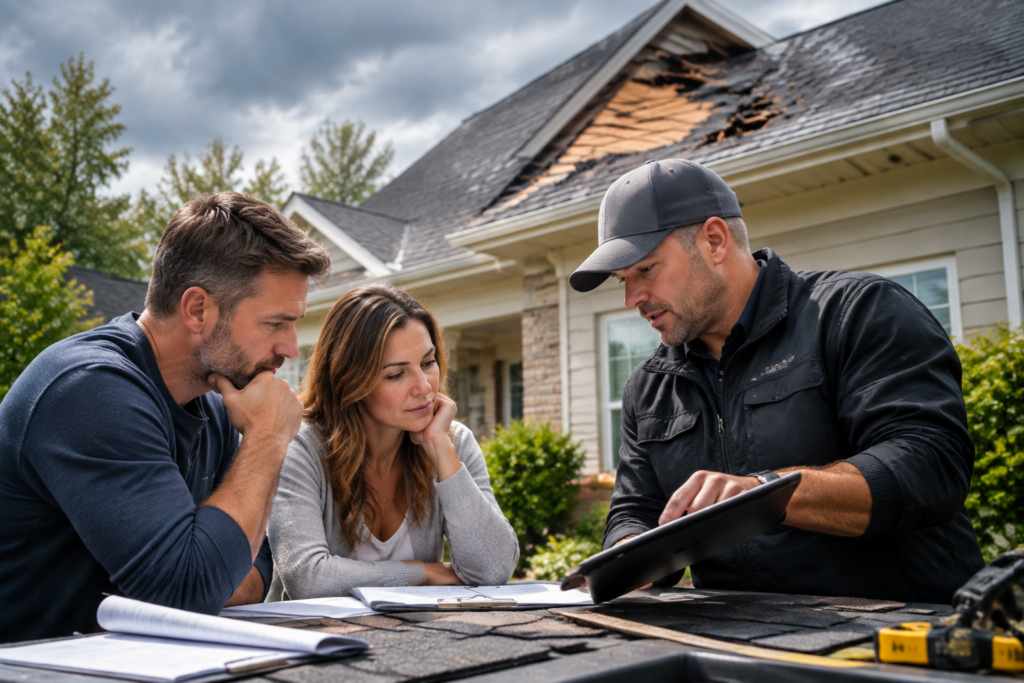
Roofing demand splits into four kinds of search. Each one needs different handling.
- Emergency. "Roof leak repair near me", "emergency roof tarp". Searched on a phone, often at night, often minutes after the leak starts. The buyer calls the first two or three results that look real. Price comes second to who answers.
- Storm-driven. "Roof damage after hurricane", "storm damage roofer". Demand spikes within hours of a named storm, and the searcher is often opening an insurance claim at the same time. Hurricane season runs June 1 to November 30. Out-of-area contractors arrive in the same weeks, so local proof carries weight.
- Researched replacement. "Tile vs shingle roof", "roof replacement cost", "metal roof Florida". Weeks of reading. Price-led at the start, trust-led at the end. Usually two decision makers, and in condos and HOA communities, a board.
- Insurance-driven. "Roof inspection for insurance", "roof certification". Florida insurers often price or non-renew based on roof age, so a roof can become urgent on paper before it ever leaks. Timing follows the insurer's letter or the closing date, not the weather.
Emergency and storm searches are single decision makers deciding in minutes. Replacement is a committee deciding over weeks. Commercial work adds a property manager, an owner and sometimes a lender. One website has to serve all of them without confusing any of them.
What that means for the site
One “Roofing Services” page cannot rank for every term above, and it cannot answer every buyer. Google matches a page to a query, so each query type needs its own page.
A page for each service.
Repair, replacement, tile, shingle, metal, flat and commercial, inspection and certification, storm damage. Each answers its own question, such as what a tile re-roof involves and what drives its cost.
A page for each area you serve.
Written with real local content: the permitting office, the common roof types, the kinds of jobs you do there. The same page with the city name swapped is a near-duplicate, and Google treats near-duplicates as thin.
A fast path for the emergency caller.
A tap-to-call number at the top of every mobile page, your real hours, and what happens when they call. If nobody answers at night, use an answering service and say so.
Your license number in plain sight.
After a storm, the buyer's first filter is whether you are licensed. Show the number and link to the state lookup.
Image-heavy pages that still load.
Roofing sites are full of job photos. A page that takes several seconds on a phone loses the caller with a leak.
See how we structure sites for multi-city service businesses on our web design services page.
The compliance line on insurance claims
Florida regulates who may handle an insurance claim, and roofing marketing sits close to that line. In general terms:
A roofer may inspect the roof, document the damage and give an estimate.
A roofer may not act as the homeowner's public adjuster. Negotiating the claim amount with the insurer takes a public adjuster license.
A roofer may not advertise or offer to pay, waive or rebate the homeowner's deductible.
Assignment of benefits is barred on residential property policies issued on or after January 1, 2023, which removes the arrangement much older roofing copy described.
What that means for the profile and the map
For “roofer near me” searches, the map results sit above the organic listings. Your Google Business Profile does most of the work there.
Categories
Roofing contractor as primary, with secondary categories only for services you actually sell.
Service-area setup
If you work from job sites and not a storefront, set the profile up as a service-area business and hide the address. Google allows this. Do not use a virtual office or a P.O. box as a location. Google's guidelines exclude both, and suspended profiles leave the map.
Reviews
Ask after every completed job and reply to every review. Do not ask only your happiest customers. Google prohibits selective review requests.
Photos
Real jobs, before and after, with the city named in the caption. After a storm, post the work you are doing in the areas you serve.
Consistency
The same business name, phone number and service areas on your site, your profile and the directories buyers check.
The campaign structure that fits this industry
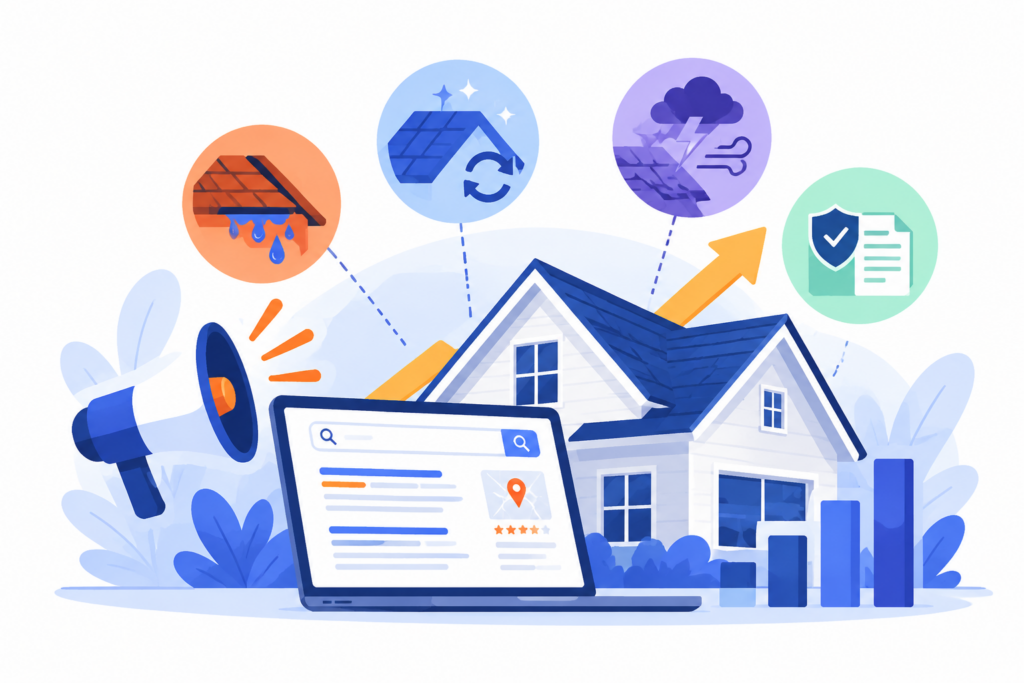
If you run roofing on Google Ads as a single campaign, you are mixing three different buyers under one budget. We split it.
- Emergency repair campaign. Leak and repair terms, call-only ads and call extensions, and an ad schedule that matches when someone actually answers the phone.
- Replacement campaign. Research and comparison terms, a landing page for each roof type, and a longer conversion window because these buyers take weeks.
- Storm campaign. Built and approved before June 1, then held paused. It goes live within hours of a named storm reaching your counties and goes off when demand falls. Building it after the storm means ad approvals and learning periods during the peak.
- Negative keywords. Jobs, salary, supplies, wholesale, DIY, shingle brands you do not install, and cities you do not serve.
- Local Services Ads where available. These need license and insurance verification and charge per lead instead of per click. We test them beside search, not instead of it.
Ads catch the emergency and storm buyer, who cannot wait for rankings. Organic search does more of the work for the researched and insurance-driven buyer, who reads before calling. The two feed each other, which is why we build them together.
What we measure
In roofing, a lead is usually a phone call. A report built on clicks and form fills misses most of the business.
- Call tracking by source. A separate number per campaign, keyword group and page, so we can see what produced each call.
- Call quality. A 20-second call is not a lead. We set a minimum length with you and log the outcome of each call.
- Job type. Repair, replacement, claim inspection, commercial. A repair call and a re-roof call are not worth the same, so we do not count them the same.
- Multi-touchpoint attribution. A replacement buyer may click an ad, read your cost guide a week later, search your name, then call. Last-click credits the name search. We show the whole path.
- Booked inspections and signed jobs. With data from your job software or CRM, we report cost per booked inspection and cost per signed job, not cost per click.
- Missed calls. An unanswered emergency call is a job you paid for and lost.

Where most Roofing Companies marketing goes wrong
One page for every service and city
It cannot rank for forty terms, and it answers none of them well.
Launching the storm campaign after the storm
Every roofer bids at once, clicks cost more, and new campaigns are still in review.
Claim promises in the copy
We handle your insurance" and "free roof" language invites ad disapprovals and creates exposure under the rules above.
Counting clicks and form fills
The emergency buyer calls. If the report ignores calls, it hides the cost of the leads that matter.
Voicemail after 6pm
Emergency leak searches peak when the office is closed. Ads that route to voicemail pay for calls nobody answers.
Buying shared leads
The same homeowner gets four calls, and price becomes the only difference.
A borrowed address on the profile
A virtual office or P.O. box risks suspension. A service-area setup avoids the problem.
Treating residential and commercial as one audience
A homeowner reads a cost guide. A property manager wants proof of insurance, references and a bid format.

What it costs
There are three costs, and owners are often quoted only one.
- Agency fees. Website builds: $5,000–$15,000. SEO: $1,500–$4,000 per month. Google Ads management: $750–$2,000 per month.
- Ad spend. Paid to Google, not to us. Roofing clicks are expensive because each job is worth a lot. Expect a cost per click in the range of $25–$75 in South Florida, and expect it to rise after a storm.
- Your own capacity. Marketing that works also needs someone to answer the phone and run the inspection.
To find what you can afford per lead, take your average job value, multiply by your close rate on inspections, and then by the share of that value you are willing to spend on acquisition. That number, not a generic budget, sets the ad spend. Price also moves with the number of cities, the number of service lines, and whether you want a storm campaign built.
Questions we get from Roofing Companies owners
Can you promise page one, or a set number of leads?
No. Rankings depend on competitors, Google’s changes and the state of your current site. We can describe the work and what typically follows from it. We do not guarantee a position, a traffic number or a lead volume.
How long before SEO produces calls?
It depends on how much competition you face and what shape your site and profile are in today. SEO is measured in months, not weeks. Ads produce calls sooner because they do not depend on rankings, which is why emergency campaigns usually start first.
Should we only advertise during hurricane season?
Usually not. Leaks and inspections happen year round, and an account with history performs better when the storm burst arrives. We run a steady emergency and replacement campaign, then add the storm campaign on top.
Can our ads say we work with your insurance company?
That is a question for your attorney. Wording that implies you will negotiate the claim, cover the deductible or guarantee a payout runs into Florida’s rules. Safer wording describes the inspection and documentation you provide.
Do we need a public address to show up on the map?
Not if you work from job sites. A service-area business profile lets you list the areas you serve and hide the address.
Is one website enough for residential and commercial roofing?
Usually yes, with two clear paths. Homeowners get cost guides, roof-type pages and a call button. Commercial buyers get flat roof and maintenance pages, proof of insurance and a bid request form.
Do you work outside South Florida?
Yes. We are a South Florida agency and we work with clients nationally. The emergency, storm and research split holds in any market. The compliance rules differ by state, so claim-related copy is written state by state.
Talk to us
Call +1 754-704-4727. On the first call we ask what a booked inspection is worth to you, which cities you serve, and what happens to a leak call at 9pm. Bring your current site and your Google Business Profile, plus access to your ad account if you run ads.