
- Home
- Services
- Portfolio
- About
- Service AreasFort Lauderdale, FL
- Web Design
- Redesign
- WordPress
- Ecommerce
- Landing Pages
- SEO Services
- Local SEO
- GBP
- Google Ads
- PPC
- Digital Marketing
- Internet Marketing
- Advertising
- Tracking
- Dental Marketing
- Medical Marketing
- HVAC Marketing
- Roofing Marketing
- Pest Control Marketing
- Home Services Marketing
- Plumbing Marketing
- Electrical Marketing
- Landscaping Marketing
- Remodeling Marketing
Pembroke Pines, FL- Web Design
- Redesign
- WordPress
- Ecommerce
- Landing Pages
- SEO Services
- Local SEO
- GBP
- Google Ads
- PPC
- Digital Marketing
- Internet Marketing
- Advertising
- Tracking
- Dental Marketing
- Medical Marketing
- HVAC Marketing
- Roofing Marketing
- Pest Control Marketing
- Home Services Marketing
- Plumbing Marketing
- Electrical Marketing
- Landscaping Marketing
- Remodeling Marketing
Hialeah, FL- Web Design
- Redesign
- WordPress
- Ecommerce
- Landing Pages
- SEO Services
- Local SEO
- GBP
- Google Ads
- PPC
- Digital Marketing
- Internet Marketing
- Advertising
- Tracking
- Dental Marketing
- Medical Marketing
- HVAC Marketing
- Roofing Marketing
- Pest Control Marketing
- Home Services Marketing
- Plumbing Marketing
- Electrical Marketing
- Landscaping Marketing
- Remodeling Marketing
Hollywood, FL- Web Design
- Redesign
- WordPress
- Ecommerce
- Landing Pages
- SEO Services
- Local SEO
- GBP
- Google Ads
- PPC
- Digital Marketing
- Internet Marketing
- Advertising
- Tracking
- Dental Marketing
- Medical Marketing
- HVAC Marketing
- Roofing Marketing
- Pest Control Marketing
- Home Services Marketing
- Plumbing Marketing
- Electrical Marketing
- Landscaping Marketing
- Remodeling Marketing
Miramar, FL- Web Design
- Redesign
- WordPress
- Ecommerce
- Landing Pages
- SEO Services
- Local SEO
- GBP
- Google Ads
- PPC
- Digital Marketing
- Internet Marketing
- Advertising
- Tracking
- Dental Marketing
- Medical Marketing
- HVAC Marketing
- Roofing Marketing
- Pest Control Marketing
- Home Services Marketing
- Plumbing Marketing
- Electrical Marketing
- Landscaping Marketing
- Remodeling Marketing
Coral Springs, FL- Web Design
- Redesign
- WordPress
- Ecommerce
- Landing Pages
- SEO Services
- Local SEO
- GBP
- Google Ads
- PPC
- Digital Marketing
- Internet Marketing
- Advertising
- Tracking
- Dental Marketing
- Medical Marketing
- HVAC Marketing
- Roofing Marketing
- Pest Control Marketing
- Home Services Marketing
- Plumbing Marketing
- Electrical Marketing
- Landscaping Marketing
- Remodeling Marketing
Pompano Beach, FL- Web Design
- Redesign
- WordPress
- Ecommerce
- Landing Pages
- SEO Services
- Local SEO
- GBP
- Google Ads
- PPC
- Digital Marketing
- Internet Marketing
- Advertising
- Tracking
- Dental Marketing
- Medical Marketing
- HVAC Marketing
- Roofing Marketing
- Pest Control Marketing
- Home Services Marketing
- Plumbing Marketing
- Electrical Marketing
- Landscaping Marketing
- Remodeling Marketing
Davie, FL- Web Design
- Redesign
- WordPress
- Ecommerce
- Landing Pages
- SEO Services
- Local SEO
- GBP
- Google Ads
- PPC
- Digital Marketing
- Internet Marketing
- Advertising
- Tracking
- Dental Marketing
- Medical Marketing
- HVAC Marketing
- Roofing Marketing
- Pest Control Marketing
- Home Services Marketing
- Plumbing Marketing
- Electrical Marketing
- Landscaping Marketing
- Remodeling Marketing
Sunrise, FL- Web Design
- Redesign
- WordPress
- Ecommerce
- Landing Pages
- SEO Services
- Local SEO
- GBP
- Google Ads
- PPC
- Digital Marketing
- Internet Marketing
- Advertising
- Tracking
- Dental Marketing
- Medical Marketing
- HVAC Marketing
- Roofing Marketing
- Pest Control Marketing
- Home Services Marketing
- Plumbing Marketing
- Electrical Marketing
- Landscaping Marketing
- Remodeling Marketing
Plantation, FL- Web Design
- Redesign
- WordPress
- Ecommerce
- Landing Pages
- SEO Services
- Local SEO
- GBP
- Google Ads
- PPC
- Digital Marketing
- Internet Marketing
- Advertising
- Tracking
- Dental Marketing
- Medical Marketing
- HVAC Marketing
- Roofing Marketing
- Pest Control Marketing
- Home Services Marketing
- Plumbing Marketing
- Electrical Marketing
- Landscaping Marketing
- Remodeling Marketing
Deerfield Beach, FL- Web Design
- Redesign
- WordPress
- Ecommerce
- Landing Pages
- SEO Services
- Local SEO
- GBP
- Google Ads
- PPC
- Digital Marketing
- Internet Marketing
- Advertising
- Tracking
- Dental Marketing
- Medical Marketing
- HVAC Marketing
- Roofing Marketing
- Pest Control Marketing
- Home Services Marketing
- Plumbing Marketing
- Electrical Marketing
- Landscaping Marketing
- Remodeling Marketing
Miami Gardens, FL- Web Design
- Redesign
- WordPress
- Ecommerce
- Landing Pages
- SEO Services
- Local SEO
- GBP
- Google Ads
- PPC
- Digital Marketing
- Internet Marketing
- Advertising
- Tracking
- Dental Marketing
- Medical Marketing
- HVAC Marketing
- Roofing Marketing
- Pest Control Marketing
- Home Services Marketing
- Plumbing Marketing
- Electrical Marketing
- Landscaping Marketing
- Remodeling Marketing
Lauderhill, FL- Web Design
- Redesign
- WordPress
- Ecommerce
- Landing Pages
- SEO Services
- Local SEO
- GBP
- Google Ads
- PPC
- Digital Marketing
- Internet Marketing
- Advertising
- Tracking
- Dental Marketing
- Medical Marketing
- HVAC Marketing
- Roofing Marketing
- Pest Control Marketing
- Home Services Marketing
- Plumbing Marketing
- Electrical Marketing
- Landscaping Marketing
- Remodeling Marketing
West Palm Beach, FL- Web Design
- Redesign
- WordPress
- Ecommerce
- Landing Pages
- SEO Services
- Local SEO
- GBP
- Google Ads
- PPC
- Digital Marketing
- Internet Marketing
- Advertising
- Tracking
- Dental Marketing
- Medical Marketing
- HVAC Marketing
- Roofing Marketing
- Pest Control Marketing
- Home Services Marketing
- Plumbing Marketing
- Electrical Marketing
- Landscaping Marketing
- Remodeling Marketing
Tamarac, FL- Web Design
- Redesign
- WordPress
- Ecommerce
- Landing Pages
- SEO Services
- Local SEO
- GBP
- Google Ads
- PPC
- Digital Marketing
- Internet Marketing
- Advertising
- Tracking
- Dental Marketing
- Medical Marketing
- HVAC Marketing
- Roofing Marketing
- Pest Control Marketing
- Home Services Marketing
- Plumbing Marketing
- Electrical Marketing
- Landscaping Marketing
- Remodeling Marketing
Weston, FL- Web Design
- Redesign
- WordPress
- Ecommerce
- Landing Pages
- SEO Services
- Local SEO
- GBP
- Google Ads
- PPC
- Digital Marketing
- Internet Marketing
- Advertising
- Tracking
- Dental Marketing
- Medical Marketing
- HVAC Marketing
- Roofing Marketing
- Pest Control Marketing
- Home Services Marketing
- Plumbing Marketing
- Electrical Marketing
- Landscaping Marketing
- Remodeling Marketing
Boca Raton, FLMargate, FLCoconut Creek, FLMiami Beach, FLHomestead, FLKendall, FLDoral, FLBoynton Beach, FLThe Hammocks, FLNorth Lauderdale, FLOakland Park, FLDelray Beach, FLNorth Miami, FLHallandale Beach, FLFontainebleau, FLKendale Lakes, FLWellington, FLJupiter, FLTamiami, FLPalm Beach Gardens, FLLauderdale Lakes, FLCooper City, FLCountry Club, FLParkland, FLCoral Gables, FLDania Beach, FLCutler Bay, FLNorth Miami Beach, FLGreenacres, FLLake Worth Beach, FLPrinceton, FLRoyal Palm Beach, FLSouth Miami Heights, FLRichmond West, FLRiviera Beach, FLWest Little River, FLGolden Glades, FLAventura, FLMiami Lakes, FLWestchester, FLLeisure City, FLCoral Terrace, FLPalm Springs, FLPalmetto Bay, FLHialeah Gardens, FLSunny Isles Beach, FLIves Estates, FLWest Park, FLSweetwater, FLPinecrest, FLSunset, FLPinewood, FLWilton Manors, FLOpa-locka, FLLighthouse Point, FLBelle Glade, FLNaranja, FLPalmetto Estates, FLBrownsville, FLKey Biscayne, FLOlympia Heights, FLMiami Springs, FLFlorida City, FLSouth Miami, FLThree Lakes, FLGladeview, FLNorth Palm Beach, FLMiami Shores, FLSouthwest Ranches, FLKings Point, FLLauderdale-by-the-Sea, FLHillsboro Beach, FLSea Ranch Lakes, FLLazy Lake, FL - Blog
- Contact
Marketing for Dental Practices in Fontainebleau, Florida
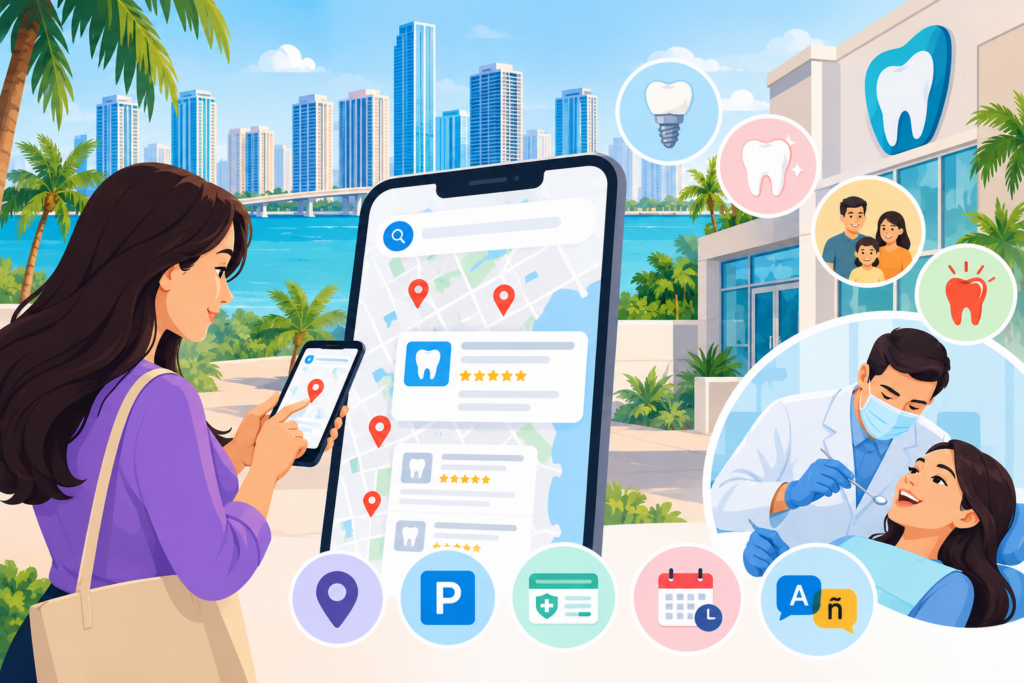
A patient in Fontainebleau looking for a dentist does not search once and call. They search, open three or four practice websites in new tabs, check if their insurance is listed, check the map for drive time, and then call whichever one answers clearly. If your site is slow, vague about insurance, or missing from that first page of results, you are not in the comparison.
Strategic Web Designs builds the local presence that wins that side-by-side moment: fast pages, clear insurance and new-patient details, visible hours, and location pages built for Fontainebleau and nearby neighborhoods. We pair that with search visibility and review management so your practice shows up, looks trustworthy, and gets the call before a competitor does.

How Fontainebleau Dental Practices buyers search
Most dental searches in Fontainebleau are not brand searches. People type “dentist near me,” “dentista cerca de mi,” “emergency dentist Fontainebleau,” or “dentist that takes [insurance name].” A meaningful share of that volume is in Spanish, which matters because Fontainebleau and the surrounding Fontainebleau-Dade corridor has one of the higher concentrations of Spanish-speaking households in the county. A practice that only ranks for English terms is invisible to a real slice of its own neighborhood, and it’s also competing with practices that have bilingual staff listed right in their Google Business Profile and website copy.
The buyer is almost always a homeowner or renter searching for themselves or a family member, not a business doing B2B research. That changes what the page needs to prove fast: insurance accepted, how soon you can be seen, and whether the location is actually convenient to reach from the Flagler Street corridor, the Palmetto, or the surrounding apartment complexes. Visitors decide within seconds whether to call or keep scrolling to the next listing, so vague phrases like “quality care you can trust” do nothing compared to specifics.
Search volume also moves with the calendar. It spikes in January when insurance benefits reset and deductibles are fresh, again before the school year starts as parents book kids’ checkups in a short window, and once more toward December as people try to use up remaining annual maximums before they expire. A practice that only updates its site once a year misses the chance to capture that seasonal intent with timely offers or scheduling pushes.
Common search patterns worth planning content around include:
- “Emergency dentist Fontainebleau” or “dentista de emergencia” for same-day pain and trauma visits
- “Dentist near me open Saturday” from people searching outside typical work hours
- “[Insurance name] dentist Fontainebleau” from shoppers filtering by coverage before they ever consider the practice’s reputation
- “Pediatric dentist Fontainebleau” from parents comparing offices before enrollment deadlines
Ranking for these specific, intent-heavy phrases matters far more than chasing generic traffic that never converts into booked appointments.
The competition here
Fontainebleau sits inside one of the denser concentrations of dental practices in Fontainebleau-Dade County, mixed in with the retail and office parks along Flagler Street and SW 8th Street. Within a two-mile radius of most addresses here, a patient can usually find somewhere between a handful and a couple dozen general and specialty practices, depending on the exact location. That is the honest range. Nobody searching for a dentist in this zip code is choosing between you and one competitor. They are choosing between you and three or four others they found on the same results page, often within the same shopping plaza.
The map pack, the three-listing block tied to Google Maps, tends to decide who gets the call for “near me” searches, because most people never scroll past it on mobile. Organic results below the map pack still matter for procedure-specific searches like “Invisalign Fontainebleau,” “emergency dentist near Dolphin Mall,” or “root canal cost,” where patients are doing more research before they call rather than tapping the first pin they see. Winning the map pack takes a complete, consistently-updated Google Business Profile, a steady cluster of recent reviews, and a site that matches what the listing promises down to the services and hours. Winning organic for procedure terms takes dedicated pages for each treatment, not one page that tries to mention every service once and ranks for none of them.
A few things make this market harder than it looks on the surface:
- Many nearby practices already run bilingual sites and ads, so English-only pages quietly lose a real share of local traffic
- Insurance and payment-plan pages get compared directly, patients screenshot and cross-reference before calling
- Review velocity matters more than total count, a practice with fewer but fresher reviews can outrank one sitting on an old total

What we build for Dental Practices in this market
We do not build one page that lists “general dentistry, cosmetic dentistry, implants, Invisalign, pediatric” and call it a services page. A page that mentions five procedures in passing cannot outrank a page built around one procedure with its own content, its own FAQ, and its own calls to action. So we build a dedicated page per high-value procedure, structured around what that specific patient needs to know before calling.
For Fontainebleau specifically, that includes a Spanish-language layer on the pages where it will actually get used: the homepage, new patient information, and whichever two or three procedures show meaningful Spanish search volume for your practice, often implants, dentures, or emergency care. This is not a Google Translate plug-in bolted onto every page. It is written content for the specific pages where Spanish-speaking patients are actually searching, with its own insurance language and its own calls to action, because a direct translation of English marketing copy reads stiff and loses the phrases people actually type.
We also build out the insurance-filter problem directly. Most dental sites either bury their accepted-insurance list on a PDF nobody opens or leave it off entirely, which means a patient who can’t quickly confirm their plan is accepted just moves to the next tab. We put that information where the patient is already looking, written in plain terms, in both languages where it matters.
Local SEO
Improve relevant website content, location signals, internal links, and service information to support local search visibility.
Google Business Profile
Review profile accuracy, categories, services, contact details, and other eligible information. Changes should follow Google's Business Profile guidelines.
Treatment pages
Build or improve pages for services such as general dentistry, cosmetic treatments, implants, or emergency appointments when those services are offered.
Paid search campaigns
Target relevant searches, refine location settings, and review search terms to reduce spend on enquiries that do not match the practice.
Conversion tracking
Measure available actions such as appointment-form submissions, calls, and clicks on booking links.
Website improvements
Make service information, insurance details, contact options, and booking steps easier to find on desktop and mobile.
What we measure
We track new patient calls and form submissions back to the specific page, ad, or search term that generated them, using call tracking numbers that swap based on channel. That means we can tell you whether a call came from a Google Ads campaign, an organic search for “dentist Fontainebleau,” or your Google Business Profile listing, instead of one phone number getting credit for everything.
We report on what actually moved: ranking position for the procedure terms we targeted, call volume by source, cost per call where ads are running, and conversion rate from call to booked appointment where that data is available to us. We do not report vanity numbers like total impressions with no context, because impressions do not pay staff.

What it costs
Cost depends on what’s already working. A dental practice with a solid site needing procedure pages, Google Business Profile cleanup, and a Spanish layer for two pages costs less than one starting from a template site with no tracking. We quote after reviewing your current site, rankings, and Fontainebleau competitors, not before. A number thrown out before anyone’s looked at your site is a guess, not a quote.
Ask for a written, line-by-line breakdown of what’s included before you sign anything, not a bundled package price with no detail behind it.
- Organic search visibility and relevant website visits.
- Google Business Profile interactions and available performance data.
- Paid campaign clicks, search terms, and advertising costs.
- Tracked calls, appointment-form submissions, and booking actions.
- Enquiry quality, where the practice can reliably share and categorize that information.
- Changes made, issues identified, and recommended next steps.
Get an audit
If you want to know where your practice actually stands against the other dental sites competing for Fontainebleau searches, in both English and Spanish, ask us for an audit. We will look at your current site, your Google Business Profile, your review profile, and who is ranking above you for the procedures you want more of, such as implants, Invisalign, or cosmetic work.

Questions
Dental practice owners weigh the same handful of things before they commit to any marketing work: is the Spanish-language piece real content or a thin translation, can they actually track which patients came from which effort, and how long before a new page or a new site shows up for the procedures that pay the bills. There’s no guesswork in how we answer these. Below are the questions we hear most from practices in this part of Fontainebleau-Dade.
Do you build a separate Spanish-language site for a Fontainebleau dental practice?
No. We add a Spanish layer on top of the main site for the pages that get Spanish-language search volume here, usually the homepage, the new patient page, and two or three service pages like implants or emergency care. Translating a 40-page site when only a handful of pages get Spanish search traffic wastes budget.
How long before a new dental website in Fontainebleau shows up in search results?
A new site needs to be indexed, crawled, and compared against practices that have been live for years. We do not give a fixed timeline because it depends on how competitive your specific procedures and zip codes are. We can tell you what's realistic for your situation once we've looked at your current site and your competitors.
We already have a website. Do we need a new one or just marketing?
Depends on what's broken. If your site loads slowly, has one page trying to cover every procedure, or has no way to track which calls came from which campaign, that's a site problem. If the site is fine but nobody sees it, that's a visibility problem. We look at both before recommending either.
Do you only work with dental practices that take insurance?
No. We build the page structure and messaging around how your practice actually operates, whether that's PPO-heavy, fee-for-service, or a mix. The insurance-accepted filter matters most for new patient search intent, so we make sure it's answered clearly regardless of what your answer is.
Can you track which patients actually called from the ads versus found us another way?
Yes, with call tracking numbers tied to each channel, so a Google Ads call, an organic search call, and a Facebook call each show up separately in reporting instead of getting lumped into one phone line.