
- Home
- Services
- Portfolio
- About
- Service AreasFort Lauderdale, FL
- Web Design
- Redesign
- WordPress
- Ecommerce
- Landing Pages
- SEO Services
- Local SEO
- GBP
- Google Ads
- PPC
- Digital Marketing
- Internet Marketing
- Advertising
- Tracking
- Dental Marketing
- Medical Marketing
- HVAC Marketing
- Roofing Marketing
- Pest Control Marketing
- Home Services Marketing
- Plumbing Marketing
- Electrical Marketing
- Landscaping Marketing
- Remodeling Marketing
Pembroke Pines, FL- Web Design
- Redesign
- WordPress
- Ecommerce
- Landing Pages
- SEO Services
- Local SEO
- GBP
- Google Ads
- PPC
- Digital Marketing
- Internet Marketing
- Advertising
- Tracking
- Dental Marketing
- Medical Marketing
- HVAC Marketing
- Roofing Marketing
- Pest Control Marketing
- Home Services Marketing
- Plumbing Marketing
- Electrical Marketing
- Landscaping Marketing
- Remodeling Marketing
Hialeah, FL- Web Design
- Redesign
- WordPress
- Ecommerce
- Landing Pages
- SEO Services
- Local SEO
- GBP
- Google Ads
- PPC
- Digital Marketing
- Internet Marketing
- Advertising
- Tracking
- Dental Marketing
- Medical Marketing
- HVAC Marketing
- Roofing Marketing
- Pest Control Marketing
- Home Services Marketing
- Plumbing Marketing
- Electrical Marketing
- Landscaping Marketing
- Remodeling Marketing
Hollywood, FL- Web Design
- Redesign
- WordPress
- Ecommerce
- Landing Pages
- SEO Services
- Local SEO
- GBP
- Google Ads
- PPC
- Digital Marketing
- Internet Marketing
- Advertising
- Tracking
- Dental Marketing
- Medical Marketing
- HVAC Marketing
- Roofing Marketing
- Pest Control Marketing
- Home Services Marketing
- Plumbing Marketing
- Electrical Marketing
- Landscaping Marketing
- Remodeling Marketing
Miramar, FL- Web Design
- Redesign
- WordPress
- Ecommerce
- Landing Pages
- SEO Services
- Local SEO
- GBP
- Google Ads
- PPC
- Digital Marketing
- Internet Marketing
- Advertising
- Tracking
- Dental Marketing
- Medical Marketing
- HVAC Marketing
- Roofing Marketing
- Pest Control Marketing
- Home Services Marketing
- Plumbing Marketing
- Electrical Marketing
- Landscaping Marketing
- Remodeling Marketing
Coral Springs, FL- Web Design
- Redesign
- WordPress
- Ecommerce
- Landing Pages
- SEO Services
- Local SEO
- GBP
- Google Ads
- PPC
- Digital Marketing
- Internet Marketing
- Advertising
- Tracking
- Dental Marketing
- Medical Marketing
- HVAC Marketing
- Roofing Marketing
- Pest Control Marketing
- Home Services Marketing
- Plumbing Marketing
- Electrical Marketing
- Landscaping Marketing
- Remodeling Marketing
Pompano Beach, FL- Web Design
- Redesign
- WordPress
- Ecommerce
- Landing Pages
- SEO Services
- Local SEO
- GBP
- Google Ads
- PPC
- Digital Marketing
- Internet Marketing
- Advertising
- Tracking
- Dental Marketing
- Medical Marketing
- HVAC Marketing
- Roofing Marketing
- Pest Control Marketing
- Home Services Marketing
- Plumbing Marketing
- Electrical Marketing
- Landscaping Marketing
- Remodeling Marketing
Davie, FL- Web Design
- Redesign
- WordPress
- Ecommerce
- Landing Pages
- SEO Services
- Local SEO
- GBP
- Google Ads
- PPC
- Digital Marketing
- Internet Marketing
- Advertising
- Tracking
- Dental Marketing
- Medical Marketing
- HVAC Marketing
- Roofing Marketing
- Pest Control Marketing
- Home Services Marketing
- Plumbing Marketing
- Electrical Marketing
- Landscaping Marketing
- Remodeling Marketing
Sunrise, FL- Web Design
- Redesign
- WordPress
- Ecommerce
- Landing Pages
- SEO Services
- Local SEO
- GBP
- Google Ads
- PPC
- Digital Marketing
- Internet Marketing
- Advertising
- Tracking
- Dental Marketing
- Medical Marketing
- HVAC Marketing
- Roofing Marketing
- Pest Control Marketing
- Home Services Marketing
- Plumbing Marketing
- Electrical Marketing
- Landscaping Marketing
- Remodeling Marketing
Plantation, FL- Web Design
- Redesign
- WordPress
- Ecommerce
- Landing Pages
- SEO Services
- Local SEO
- GBP
- Google Ads
- PPC
- Digital Marketing
- Internet Marketing
- Advertising
- Tracking
- Dental Marketing
- Medical Marketing
- HVAC Marketing
- Roofing Marketing
- Pest Control Marketing
- Home Services Marketing
- Plumbing Marketing
- Electrical Marketing
- Landscaping Marketing
- Remodeling Marketing
Deerfield Beach, FL- Web Design
- Redesign
- WordPress
- Ecommerce
- Landing Pages
- SEO Services
- Local SEO
- GBP
- Google Ads
- PPC
- Digital Marketing
- Internet Marketing
- Advertising
- Tracking
- Dental Marketing
- Medical Marketing
- HVAC Marketing
- Roofing Marketing
- Pest Control Marketing
- Home Services Marketing
- Plumbing Marketing
- Electrical Marketing
- Landscaping Marketing
- Remodeling Marketing
Miami Gardens, FL- Web Design
- Redesign
- WordPress
- Ecommerce
- Landing Pages
- SEO Services
- Local SEO
- GBP
- Google Ads
- PPC
- Digital Marketing
- Internet Marketing
- Advertising
- Tracking
- Dental Marketing
- Medical Marketing
- HVAC Marketing
- Roofing Marketing
- Pest Control Marketing
- Home Services Marketing
- Plumbing Marketing
- Electrical Marketing
- Landscaping Marketing
- Remodeling Marketing
Lauderhill, FL- Web Design
- Redesign
- WordPress
- Ecommerce
- Landing Pages
- SEO Services
- Local SEO
- GBP
- Google Ads
- PPC
- Digital Marketing
- Internet Marketing
- Advertising
- Tracking
- Dental Marketing
- Medical Marketing
- HVAC Marketing
- Roofing Marketing
- Pest Control Marketing
- Home Services Marketing
- Plumbing Marketing
- Electrical Marketing
- Landscaping Marketing
- Remodeling Marketing
West Palm Beach, FL- Web Design
- Redesign
- WordPress
- Ecommerce
- Landing Pages
- SEO Services
- Local SEO
- GBP
- Google Ads
- PPC
- Digital Marketing
- Internet Marketing
- Advertising
- Tracking
- Dental Marketing
- Medical Marketing
- HVAC Marketing
- Roofing Marketing
- Pest Control Marketing
- Home Services Marketing
- Plumbing Marketing
- Electrical Marketing
- Landscaping Marketing
- Remodeling Marketing
Tamarac, FL- Web Design
- Redesign
- WordPress
- Ecommerce
- Landing Pages
- SEO Services
- Local SEO
- GBP
- Google Ads
- PPC
- Digital Marketing
- Internet Marketing
- Advertising
- Tracking
- Dental Marketing
- Medical Marketing
- HVAC Marketing
- Roofing Marketing
- Pest Control Marketing
- Home Services Marketing
- Plumbing Marketing
- Electrical Marketing
- Landscaping Marketing
- Remodeling Marketing
Weston, FL- Web Design
- Redesign
- WordPress
- Ecommerce
- Landing Pages
- SEO Services
- Local SEO
- GBP
- Google Ads
- PPC
- Digital Marketing
- Internet Marketing
- Advertising
- Tracking
- Dental Marketing
- Medical Marketing
- HVAC Marketing
- Roofing Marketing
- Pest Control Marketing
- Home Services Marketing
- Plumbing Marketing
- Electrical Marketing
- Landscaping Marketing
- Remodeling Marketing
Boca Raton, FLMargate, FLCoconut Creek, FLMiami Beach, FLHomestead, FLKendall, FLDoral, FLBoynton Beach, FLThe Hammocks, FLNorth Lauderdale, FLOakland Park, FLDelray Beach, FLNorth Miami, FLHallandale Beach, FLFontainebleau, FLKendale Lakes, FLWellington, FLJupiter, FLTamiami, FLPalm Beach Gardens, FLLauderdale Lakes, FLCooper City, FLCountry Club, FLParkland, FLCoral Gables, FLDania Beach, FLCutler Bay, FLNorth Miami Beach, FLGreenacres, FLLake Worth Beach, FLPrinceton, FLRoyal Palm Beach, FLSouth Miami Heights, FLRichmond West, FLRiviera Beach, FLWest Little River, FLGolden Glades, FLAventura, FLMiami Lakes, FLWestchester, FLLeisure City, FLCoral Terrace, FLPalm Springs, FLPalmetto Bay, FLHialeah Gardens, FLSunny Isles Beach, FLIves Estates, FLWest Park, FLSweetwater, FLPinecrest, FLSunset, FLPinewood, FLWilton Manors, FLOpa-locka, FLLighthouse Point, FLBelle Glade, FLNaranja, FLPalmetto Estates, FLBrownsville, FLKey Biscayne, FLOlympia Heights, FLMiami Springs, FLFlorida City, FLSouth Miami, FLThree Lakes, FLGladeview, FLNorth Palm Beach, FLMiami Shores, FLSouthwest Ranches, FLKings Point, FLLauderdale-by-the-Sea, FLHillsboro Beach, FLSea Ranch Lakes, FLLazy Lake, FL - Blog
- Contact
Marketing for Dental Practices in Wellington, Florida
Wellington homeowners do not pick a dentist the way they pick a plumber. Most moved into a planned community in the last twenty years, their HOA handles half their decisions already, and when a tooth hurts they open their phone and compare three practices within two miles before they call any of them. That search happens on a map, not a homepage. If your Google Business Profile is thin, your reviews are stale, or your site does not answer the insurance question in the first screen, you are already out of the comparison before the patient dials.

How Wellington Dental Practices buyers search
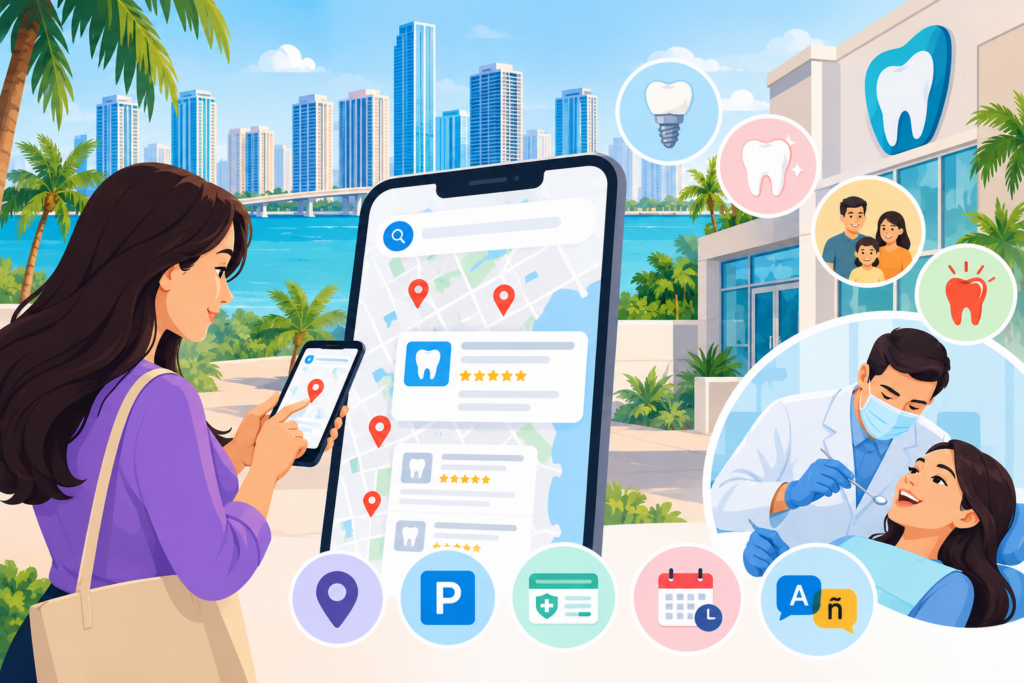
The search almost always starts with a need, not a brand: “dentist near me,” “emergency dentist Wellington,” “pediatric dentist Wellington FL,” or a plan name like “dentist that takes Cigna Wellington.” Google answers that with the map pack first, three listings, before it shows any organic result. That means your Google Business Profile often does more work than your homepage for a first-time searcher, and a thin or outdated profile quietly costs you patients who never even reach your website.
Insurance is the filter. A buyer in this market will screen out a practice in the first ten seconds if the accepted-plans information is missing or buried. Families in Wellington’s newer developments, Olympia, Versailles, the areas around Wellington Trace, tend to search in the evening after school pickup and dinner, and they tend to book the first practice that answers clearly, not the one with the nicest photography. The same pattern holds for retirees near Binks Forest and South Shore, who search with more specific terms, often naming a procedure, a sedation option, or a particular plan, because they’ve already done some comparison shopping on the phone with their insurer.
Timing and intent matter as much as keywords. Searches spike on Monday mornings, when pain from the weekend finally gets addressed, and again in late summer, when back-to-school checkups and sports physicals push parents to book for the whole family at once. Mobile searches dominate across all of these moments, which means slow load times or a booking form that doesn’t work well on a phone will lose the click before it ever becomes a call. Reviews carry outsized weight too: a Wellington buyer comparing two practices with similar ratings will usually pick the one with recent, specific reviews, mentioning wait times, staff by name, or how a child was treated, over one with generic five-star comments. None of this is about chasing more traffic. It’s about matching the page, the profile, and the booking path to the exact question a nervous or rushed patient is typing at that moment, so the decision feels easy rather than effortful.
The competition here
Wellington is not an easy map pack to win and it is not an impossible one either. It sits inside a Palm Beach County dental market where several well-established practices along routes like State Road 7 and Forest Hill Boulevard have had their Google Business Profiles and review counts in place for years. A new or under-optimized profile will not out-rank those on authority alone, no matter how good the dentistry behind it actually is.
What makes Wellington different from a denser city is that almost every business here, dental included, functions more like a service-area business in how patients discover it than a storefront with walk-in traffic. People do not stumble onto a dental office between other errands the way they might in an older downtown grid. They search first, often from a phone, filter by distance and insurance accepted, then drive. That shifts the weight of the work toward the profile itself, the velocity of new reviews coming in, and the service-specific pages that match exactly what someone typed, rather than toward foot traffic or signage near Wellington Green Mall.
In practice, that means the practices winning the three map pack seats for a given search are usually doing a specific, repeatable set of things well:
- A Google Business Profile with every relevant category filled in, not just “Dentist”
- Dedicated pages for high-intent services like implants, Invisalign, or emergency care, built for Wellington specifically rather than a generic city template
- A steady cadence of new reviews month over month, not a single burst requested once and forgotten
- Consistent name, address, and phone details across directories so nothing undermines local trust signals
The honest read: the map pack has three seats, several practices are already contesting them, and the way in is a profile built out completely, categories matched to actual services offered, and a steady, real pace of new reviews earned over time rather than a one-time push before giving up.

What we build for Dental Practices in this market
We do not build one page and hope it ranks for every term a patient might type. A practice offering implants, Invisalign, emergency care, and pediatric visits needs a separate page for each service, because one page cannot hold the keyword weight, the FAQs, and the insurance detail that each of those searches requires. We build those pages around the actual questions Wellington patients ask: which plans you take, whether you see children, whether you have same-day emergency slots.
Alongside the site, we build out the Google Business Profile completely, correct categories, service list matched to what you actually do, photos that are current, and a structure for collecting reviews after each visit rather than in occasional batches. A profile that gains reviews steadily tends to hold its map pack position better than one that gets a burst of twenty reviews once a year.
Local SEO
Improve relevant website content, location signals, internal links, and service information to support local search visibility.
Google Business Profile
Review profile accuracy, categories, services, contact details, and other eligible information. Changes should follow Google's Business Profile guidelines.
Treatment pages
Build or improve pages for services such as general dentistry, cosmetic treatments, implants, or emergency appointments when those services are offered.
Paid search campaigns
Target relevant searches, refine location settings, and review search terms to reduce spend on enquiries that do not match the practice.
Conversion tracking
Measure available actions such as appointment-form submissions, calls, and clicks on booking links.
Website improvements
Make service information, insurance details, contact options, and booking steps easier to find on desktop and mobile.
We also run call tracking on every number we publish, so you can see whether a call came from a Google Business Profile view, an organic search result, or a paid ad, and whether that caller booked. For a dental practice that pays for insurance verification staff time per new patient inquiry, knowing which channel actually produces booked appointments, not just phone rings, changes where the next month’s budget goes.
For practices that want faster visibility while the organic and map pack work builds, we run Google Ads campaigns targeted to Wellington and the surrounding zip codes, with ad copy that states accepted insurance plans up front, since that is the first filter a Wellington patient applies anyway. We also build out service pages in neighboring Royal Palm Beach and Loxahatchee when a practice draws patients from both sides of the county line, which most Wellington practices do given how spread out dental offices are in this part of Palm Beach County.

What we measure
We track map pack position for your core terms across Wellington suburbs, organic rankings for each service page, call volume by source, and form submissions, all tied to the same dashboard. We also watch new patient bookings attributed to each channel, not just leads, so you can see which campaigns actually fill the chair. We do not report page views as a success metric on their own. A page view that does not lead to a call, a form, or a booked appointment is not worth much to a dental practice, however good it looks in a report.
- Organic search visibility and relevant website visits.
- Google Business Profile interactions and available performance data.
- Paid campaign clicks, search terms, and advertising costs.
- Tracked calls, appointment-form submissions, and booking actions.
- Enquiry quality, where the practice can reliably share and categorize that information.
- Changes made, issues identified, and recommended next steps.
Every call we track gets attributed back to the keyword and campaign that generated it, so you can see, for example, whether "emergency dentist Wellington" is producing bookings or just curiosity clicks. That attribution is what lets us cut spend on terms that generate calls but not patients, and put more budget behind the ones that do.

What it costs
Cost depends on how much of the work is site build versus ongoing SEO versus paid ads, and on how competitive your specific service lines are in this market. A practice chasing “Invisalign Wellington” is bidding and ranking in a different tier than one targeting general cleanings or check-ups, where competition is thinner but so is the margin per patient. Suburb matters too — a CBD practice competing against a dozen others needs a different budget split than one serving a quieter residential pocket with less search volume but less competition as well.
FAQ's
These are the 5 questions Wellington homeowners ask us most about dental practice marketing, answered plainly so you know what to expect before any work starts. If yours isn't covered here, get in touch and we'll walk you through it.
Does my dental practice need a physical office in Wellington to show up in the map pack?
Yes, for a dental practice the map pack is tied to a service address where patients are actually seen, unlike a pure service-area business that hides its address. What matters for ranking in that pack is category accuracy, completeness of your profile, and review signals, not how long you have had the listing.
How long does it take to see movement in map pack rankings?
We do not give a fixed timeframe because it depends on how established your current competitors are and how much work your profile needs. What we can tell you is what the work involves and report on actual position changes as they happen, not promise a date.
Do you handle the insurance plan information on my website for me?
We build the structure and the pages that display accepted plans clearly, but you provide the current list since plan participation changes and we are not positioned to verify your contracts with each insurer.
Is Google Ads worth it for a dental practice in a market like Wellington?
It depends on your current organic and map pack visibility. If you are not yet showing up for core terms, ads can fill that gap while the other work builds. If you already hold map pack seats for your top terms, the budget may be better spent on review generation instead.
Can you work with my practice if I also see patients from Royal Palm Beach or Loxahatchee?
Yes. Many Wellington dental practices draw from both sides of the county line, so we often build service pages for those neighboring areas alongside the Wellington pages rather than treating the practice as single-city.
Get an audit
We will look at your Google Business Profile, your site’s service pages, and your current map pack position for the terms Wellington patients actually search, then tell you plainly where the gaps are. No obligation attached to the audit itself. Call (754) 704-4727 to set it up.