
- Home
- Services
- Portfolio
- About
- Service AreasFort Lauderdale, FL
- Web Design
- Redesign
- WordPress
- Ecommerce
- Landing Pages
- SEO Services
- Local SEO
- GBP
- Google Ads
- PPC
- Digital Marketing
- Internet Marketing
- Advertising
- Tracking
- Dental Marketing
- Medical Marketing
- HVAC Marketing
- Roofing Marketing
- Pest Control Marketing
- Home Services Marketing
- Plumbing Marketing
- Electrical Marketing
- Landscaping Marketing
- Remodeling Marketing
Pembroke Pines, FL- Web Design
- Redesign
- WordPress
- Ecommerce
- Landing Pages
- SEO Services
- Local SEO
- GBP
- Google Ads
- PPC
- Digital Marketing
- Internet Marketing
- Advertising
- Tracking
- Dental Marketing
- Medical Marketing
- HVAC Marketing
- Roofing Marketing
- Pest Control Marketing
- Home Services Marketing
- Plumbing Marketing
- Electrical Marketing
- Landscaping Marketing
- Remodeling Marketing
Hialeah, FL- Web Design
- Redesign
- WordPress
- Ecommerce
- Landing Pages
- SEO Services
- Local SEO
- GBP
- Google Ads
- PPC
- Digital Marketing
- Internet Marketing
- Advertising
- Tracking
- Dental Marketing
- Medical Marketing
- HVAC Marketing
- Roofing Marketing
- Pest Control Marketing
- Home Services Marketing
- Plumbing Marketing
- Electrical Marketing
- Landscaping Marketing
- Remodeling Marketing
Hollywood, FL- Web Design
- Redesign
- WordPress
- Ecommerce
- Landing Pages
- SEO Services
- Local SEO
- GBP
- Google Ads
- PPC
- Digital Marketing
- Internet Marketing
- Advertising
- Tracking
- Dental Marketing
- Medical Marketing
- HVAC Marketing
- Roofing Marketing
- Pest Control Marketing
- Home Services Marketing
- Plumbing Marketing
- Electrical Marketing
- Landscaping Marketing
- Remodeling Marketing
Miramar, FL- Web Design
- Redesign
- WordPress
- Ecommerce
- Landing Pages
- SEO Services
- Local SEO
- GBP
- Google Ads
- PPC
- Digital Marketing
- Internet Marketing
- Advertising
- Tracking
- Dental Marketing
- Medical Marketing
- HVAC Marketing
- Roofing Marketing
- Pest Control Marketing
- Home Services Marketing
- Plumbing Marketing
- Electrical Marketing
- Landscaping Marketing
- Remodeling Marketing
Coral Springs, FL- Web Design
- Redesign
- WordPress
- Ecommerce
- Landing Pages
- SEO Services
- Local SEO
- GBP
- Google Ads
- PPC
- Digital Marketing
- Internet Marketing
- Advertising
- Tracking
- Dental Marketing
- Medical Marketing
- HVAC Marketing
- Roofing Marketing
- Pest Control Marketing
- Home Services Marketing
- Plumbing Marketing
- Electrical Marketing
- Landscaping Marketing
- Remodeling Marketing
Pompano Beach, FL- Web Design
- Redesign
- WordPress
- Ecommerce
- Landing Pages
- SEO Services
- Local SEO
- GBP
- Google Ads
- PPC
- Digital Marketing
- Internet Marketing
- Advertising
- Tracking
- Dental Marketing
- Medical Marketing
- HVAC Marketing
- Roofing Marketing
- Pest Control Marketing
- Home Services Marketing
- Plumbing Marketing
- Electrical Marketing
- Landscaping Marketing
- Remodeling Marketing
Davie, FL- Web Design
- Redesign
- WordPress
- Ecommerce
- Landing Pages
- SEO Services
- Local SEO
- GBP
- Google Ads
- PPC
- Digital Marketing
- Internet Marketing
- Advertising
- Tracking
- Dental Marketing
- Medical Marketing
- HVAC Marketing
- Roofing Marketing
- Pest Control Marketing
- Home Services Marketing
- Plumbing Marketing
- Electrical Marketing
- Landscaping Marketing
- Remodeling Marketing
Sunrise, FL- Web Design
- Redesign
- WordPress
- Ecommerce
- Landing Pages
- SEO Services
- Local SEO
- GBP
- Google Ads
- PPC
- Digital Marketing
- Internet Marketing
- Advertising
- Tracking
- Dental Marketing
- Medical Marketing
- HVAC Marketing
- Roofing Marketing
- Pest Control Marketing
- Home Services Marketing
- Plumbing Marketing
- Electrical Marketing
- Landscaping Marketing
- Remodeling Marketing
Plantation, FL- Web Design
- Redesign
- WordPress
- Ecommerce
- Landing Pages
- SEO Services
- Local SEO
- GBP
- Google Ads
- PPC
- Digital Marketing
- Internet Marketing
- Advertising
- Tracking
- Dental Marketing
- Medical Marketing
- HVAC Marketing
- Roofing Marketing
- Pest Control Marketing
- Home Services Marketing
- Plumbing Marketing
- Electrical Marketing
- Landscaping Marketing
- Remodeling Marketing
Deerfield Beach, FL- Web Design
- Redesign
- WordPress
- Ecommerce
- Landing Pages
- SEO Services
- Local SEO
- GBP
- Google Ads
- PPC
- Digital Marketing
- Internet Marketing
- Advertising
- Tracking
- Dental Marketing
- Medical Marketing
- HVAC Marketing
- Roofing Marketing
- Pest Control Marketing
- Home Services Marketing
- Plumbing Marketing
- Electrical Marketing
- Landscaping Marketing
- Remodeling Marketing
Miami Gardens, FL- Web Design
- Redesign
- WordPress
- Ecommerce
- Landing Pages
- SEO Services
- Local SEO
- GBP
- Google Ads
- PPC
- Digital Marketing
- Internet Marketing
- Advertising
- Tracking
- Dental Marketing
- Medical Marketing
- HVAC Marketing
- Roofing Marketing
- Pest Control Marketing
- Home Services Marketing
- Plumbing Marketing
- Electrical Marketing
- Landscaping Marketing
- Remodeling Marketing
Lauderhill, FL- Web Design
- Redesign
- WordPress
- Ecommerce
- Landing Pages
- SEO Services
- Local SEO
- GBP
- Google Ads
- PPC
- Digital Marketing
- Internet Marketing
- Advertising
- Tracking
- Dental Marketing
- Medical Marketing
- HVAC Marketing
- Roofing Marketing
- Pest Control Marketing
- Home Services Marketing
- Plumbing Marketing
- Electrical Marketing
- Landscaping Marketing
- Remodeling Marketing
West Palm Beach, FL- Web Design
- Redesign
- WordPress
- Ecommerce
- Landing Pages
- SEO Services
- Local SEO
- GBP
- Google Ads
- PPC
- Digital Marketing
- Internet Marketing
- Advertising
- Tracking
- Dental Marketing
- Medical Marketing
- HVAC Marketing
- Roofing Marketing
- Pest Control Marketing
- Home Services Marketing
- Plumbing Marketing
- Electrical Marketing
- Landscaping Marketing
- Remodeling Marketing
Tamarac, FL- Web Design
- Redesign
- WordPress
- Ecommerce
- Landing Pages
- SEO Services
- Local SEO
- GBP
- Google Ads
- PPC
- Digital Marketing
- Internet Marketing
- Advertising
- Tracking
- Dental Marketing
- Medical Marketing
- HVAC Marketing
- Roofing Marketing
- Pest Control Marketing
- Home Services Marketing
- Plumbing Marketing
- Electrical Marketing
- Landscaping Marketing
- Remodeling Marketing
Weston, FL- Web Design
- Redesign
- WordPress
- Ecommerce
- Landing Pages
- SEO Services
- Local SEO
- GBP
- Google Ads
- PPC
- Digital Marketing
- Internet Marketing
- Advertising
- Tracking
- Dental Marketing
- Medical Marketing
- HVAC Marketing
- Roofing Marketing
- Pest Control Marketing
- Home Services Marketing
- Plumbing Marketing
- Electrical Marketing
- Landscaping Marketing
- Remodeling Marketing
Boca Raton, FLMargate, FLCoconut Creek, FLMiami Beach, FLHomestead, FLKendall, FLDoral, FLBoynton Beach, FLThe Hammocks, FLNorth Lauderdale, FLOakland Park, FLDelray Beach, FLNorth Miami, FLHallandale Beach, FLFontainebleau, FLKendale Lakes, FLWellington, FLJupiter, FLTamiami, FLPalm Beach Gardens, FLLauderdale Lakes, FLCooper City, FLCountry Club, FLParkland, FLCoral Gables, FLDania Beach, FLCutler Bay, FLNorth Miami Beach, FLGreenacres, FLLake Worth Beach, FLPrinceton, FLRoyal Palm Beach, FLSouth Miami Heights, FLRichmond West, FLRiviera Beach, FLWest Little River, FLGolden Glades, FLAventura, FLMiami Lakes, FLWestchester, FLLeisure City, FLCoral Terrace, FLPalm Springs, FLPalmetto Bay, FLHialeah Gardens, FLSunny Isles Beach, FLIves Estates, FLWest Park, FLSweetwater, FLPinecrest, FLSunset, FLPinewood, FLWilton Manors, FLOpa-locka, FLLighthouse Point, FLBelle Glade, FLNaranja, FLPalmetto Estates, FLBrownsville, FLKey Biscayne, FLOlympia Heights, FLMiami Springs, FLFlorida City, FLSouth Miami, FLThree Lakes, FLGladeview, FLNorth Palm Beach, FLMiami Shores, FLSouthwest Ranches, FLKings Point, FLLauderdale-by-the-Sea, FLHillsboro Beach, FLSea Ranch Lakes, FLLazy Lake, FL - Blog
- Contact
Marketing for Dental Practices in West Palm Beach, Florida
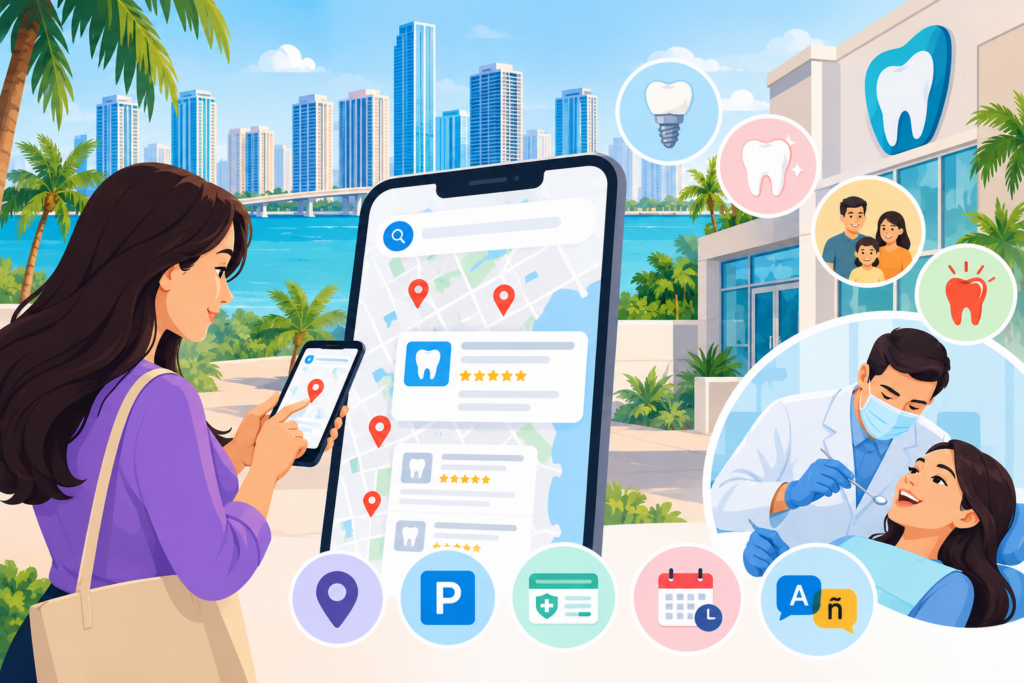
A patient looking for a dentist in West Palm Beach rarely searches once and calls. They search, scroll the map pack, open two or three websites in new tabs, check which ones take their insurance, and compare before they pick up the phone. That’s the real buying pattern downtown, where office workers on Clematis Street and Okeechobee Boulevard search on desktop during lunch breaks and compare practices within a two-mile radius. Your marketing has to win that three-way comparison, not just get clicked once.
We build websites and run search campaigns for dental practices with that comparison in mind: clear insurance information, fast load times, and call tracking that tells you which keyword actually produced the patient, not just the click.

How West Palm Beach Dental Practices buyers search
Dental searches in West Palm Beach split into two patterns, and most practices only optimize for one. The first is immediate: “emergency dentist West Palm Beach” or “dentist open now 33401,” usually from a phone, usually answered by the map pack. The second is comparison-driven: “best dentist West Palm Beach,” “dentist that takes Delta Dental West Palm Beach,” or a specific procedure plus the city name. That second pattern dominates during business hours, because this is a desktop-heavy downtown. Office towers along Flagler Drive and the Northwood corridor mean a large share of dental searches happen from a work computer between 9 and 5, not from a phone on a couch at night the way it works in more residential ZIP codes further west.
Insurance is the filter that decides which of the three open tabs gets the call. If your site does not say which PPO networks you accept, or buries it in a PDF, you lose patients to the practice that puts it on the homepage. We write insurance and new-patient pages the way the searcher actually phrases the question, including plan names, because “in-network dentist” is not how people search but “does Dr. Smith take Cigna” is. The same logic applies to procedure pages: a searcher typing “Invisalign West Palm Beach cost” wants a straight answer near the top, not a form gate three scrolls down.
Snowbird traffic adds a wrinkle unique to this market. Part-time residents search for a dentist the way they search for a storage unit or a mail service, wanting someone who can see them on a compressed visit and coordinate records with a provider up north. Pages that speak to that situation, rather than assuming every patient is local year-round, pick up bookings competitors miss entirely.
The competition here
West Palm Beach’s dental map pack is genuinely crowded. Downtown and the near suburbs (West Palm proper, plus overlap into Lake Worth, Royal Palm Beach, and even Palm Beach Gardens search radiuses) put a dense cluster of general and cosmetic practices within a short drive of each other, and several are backed by multi-location groups or DSOs with in-house marketing teams and five- and six-figure monthly ad budgets. If you are a single-location or two-location practice, you are not going to outspend that model, and you should not try to.
What you can do is out-specify them. Large group practices tend to run generic, templated sites across every location they own, with the same stock photography, the same stock bios, and the same thin service pages copied city to city. That leaves room for a practice that writes real, procedure-specific pages (a page for Invisalign, a page for implants, a page for same-day crowns, a page for sedation options) with real content about how the procedure is actually done at your office, who performs it, your hours, and your actual insurance list. Google and patients both reward the page that answers the specific question over the page that generically mentions the topic in a paragraph of boilerplate.
Reviews are the other place smaller practices can win outright. A newer location with 40 reviews and a 4.9 average will frequently outrank an older, bigger-budget competitor sitting at a 3.8, because review velocity and rating both feed directly into map pack position. A simple, consistent system for asking satisfied patients to leave a review will often move the needle faster than any amount of ad spend.
Organic and paid both matter here, but they do different jobs. The map pack and organic listings catch the comparison shoppers doing research during the day, reading reviews and checking insurance before they ever pick up the phone. Google Ads catches the person searching “emergency dentist near me” right now with a toothache, who will call whoever shows up first and looks legitimate. A practice that only invests in one is leaving the other type of patient, and the revenue that comes with them, on the table.

What we build for Dental Practices in this market
The build starts with the site itself. A dental site competing in downtown West Palm Beach needs separate pages for each major procedure (general, cosmetic, implants, orthodontics, emergency) because one page cannot rank for all of those terms at once, and it needs an insurance page that lists plans by name, not a vague “we accept most insurance” line. We also build in structured review requests after appointments, scheduling that works on a phone in one thumb, and page speed that holds up on a laptop over office wifi, since that’s where a lot of your research traffic is coming from.
For visibility, we handle the Google Business Profile the way it actually needs to be run: correct categories, procedure-specific posts, photos updated on a schedule, and review responses that address what the patient actually said instead of a copy-pasted thank you. For paid search, we build campaigns around the keyword groups that match intent: emergency and same-day terms for people in pain right now, procedure plus insurance terms for comparison shoppers, and brand-defense terms if a rolled-up competitor is bidding on your practice name, which happens in this market more than owners expect.
Local SEO
Improve relevant website content, location signals, internal links, and service information to support local search visibility.
Google Business Profile
Review profile accuracy, categories, services, contact details, and other eligible information. Changes should follow Google's Business Profile guidelines.
Treatment pages
Build or improve pages for services such as general dentistry, cosmetic treatments, implants, or emergency appointments when those services are offered.
Paid search campaigns
Target relevant searches, refine location settings, and review search terms to reduce spend on enquiries that do not match the practice.
Conversion tracking
Measure available actions such as appointment-form submissions, calls, and clicks on booking links.
Website improvements
Make service information, insurance details, contact options, and booking steps easier to find on desktop and mobile.
What we measure
Every campaign gets call tracking with a number specific to each channel, so a call from your Google Business Profile is logged separately from a call generated by a paid search ad or an organic page visit. We record calls so you can hear whether the front desk actually converted the caller into a scheduled visit, because a marketing team cannot fix a scheduling problem it can’t see.
Multi-touchpoint attribution matters more in dentistry than in a lot of other local services, because the patient journey has steps: someone sees an ad, checks reviews two days later, then searches your practice name by brand before calling. Last-click tracking would credit the brand search and miss the ad that started it. We report what happened across that whole path, including which keywords and which pages produced the calls, how many of those calls turned into new-patient appointments, and what each new patient costs to acquire through that channel. That’s the number that tells you whether the campaign is working, not clicks or impressions.

What it costs
Dental marketing costs more in a competitive downtown market like West Palm Beach than in a quieter suburb, since the keyword auction is crowded and SEO demands more procedure-specific content to compete with multi-location groups. Exact pricing depends on your number of locations, how competitive your procedures are, and whether you need a new site or improvements to an existing one. We review your current site and ad accounts and give you a specific figure before anything is signed, rather than quoting a flat rate that ignores what your practice actually needs.
- Organic search visibility and relevant website visits.
- Google Business Profile interactions and available performance data.
- Paid campaign clicks, search terms, and advertising costs.
- Tracked calls, appointment-form submissions, and booking actions.
- Enquiry quality, where the practice can reliably share and categorize that information.
- Changes made, issues identified, and recommended next steps.
Get an audit
If you want a plain read on where your practice stands against the other dental listings in your part of West Palm Beach, we'll run an audit of your site, your Google Business Profile, and your current ad spend if you're running any.

FAQ's
These are the 5 questions West Palm Beach homeowners ask us most about dental practice marketing, answered plainly so you know what to expect before any work starts. If yours isn't covered here, get in touch and we'll walk you through it.
How long does dental SEO take to show results in West Palm Beach?
It depends on how competitive your specific procedures and ZIP codes are and what your current site and Google Business Profile look like when we start. We don't promise a timeline or a ranking position upfront; we'll tell you what the current gaps are and what addressing them typically involves.
Do you work with multi-location dental groups or just single practices?
Both. The approach differs: a single practice needs depth on fewer procedure pages, while a multi-location group needs a page built for each service in each location, since one page can't rank for every city and procedure combination.
Is Google Ads or SEO better for a new dental practice?
They serve different moments. Ads catch someone searching right now with urgent need; SEO and your Google Business Profile catch the comparison shoppers doing research over a few days. Most practices in a market this competitive need both running at once.
How do you handle insurance information on our website?
We list accepted plans by name on a dedicated page and work the plan names into the copy the way patients actually search, instead of a generic 'we accept most insurance' line that doesn't answer the question or help you rank for it.
Can you stop a competitor from bidding on our practice name?
We can set up brand-defense campaigns that keep your own ad showing when someone searches your practice name directly, and monitor for competitors bidding on it. We won't claim to eliminate competitor bidding entirely since Google allows it within its ad policies.