
- Home
- Services
- Portfolio
- About
- Service AreasFort Lauderdale, FL
- Web Design
- Redesign
- WordPress
- Ecommerce
- Landing Pages
- SEO Services
- Local SEO
- GBP
- Google Ads
- PPC
- Digital Marketing
- Internet Marketing
- Advertising
- Tracking
- Dental Marketing
- Medical Marketing
- HVAC Marketing
- Roofing Marketing
- Pest Control Marketing
- Home Services Marketing
- Plumbing Marketing
- Electrical Marketing
- Landscaping Marketing
- Remodeling Marketing
Pembroke Pines, FL- Web Design
- Redesign
- WordPress
- Ecommerce
- Landing Pages
- SEO Services
- Local SEO
- GBP
- Google Ads
- PPC
- Digital Marketing
- Internet Marketing
- Advertising
- Tracking
- Dental Marketing
- Medical Marketing
- HVAC Marketing
- Roofing Marketing
- Pest Control Marketing
- Home Services Marketing
- Plumbing Marketing
- Electrical Marketing
- Landscaping Marketing
- Remodeling Marketing
Hialeah, FL- Web Design
- Redesign
- WordPress
- Ecommerce
- Landing Pages
- SEO Services
- Local SEO
- GBP
- Google Ads
- PPC
- Digital Marketing
- Internet Marketing
- Advertising
- Tracking
- Dental Marketing
- Medical Marketing
- HVAC Marketing
- Roofing Marketing
- Pest Control Marketing
- Home Services Marketing
- Plumbing Marketing
- Electrical Marketing
- Landscaping Marketing
- Remodeling Marketing
Hollywood, FL- Web Design
- Redesign
- WordPress
- Ecommerce
- Landing Pages
- SEO Services
- Local SEO
- GBP
- Google Ads
- PPC
- Digital Marketing
- Internet Marketing
- Advertising
- Tracking
- Dental Marketing
- Medical Marketing
- HVAC Marketing
- Roofing Marketing
- Pest Control Marketing
- Home Services Marketing
- Plumbing Marketing
- Electrical Marketing
- Landscaping Marketing
- Remodeling Marketing
Miramar, FL- Web Design
- Redesign
- WordPress
- Ecommerce
- Landing Pages
- SEO Services
- Local SEO
- GBP
- Google Ads
- PPC
- Digital Marketing
- Internet Marketing
- Advertising
- Tracking
- Dental Marketing
- Medical Marketing
- HVAC Marketing
- Roofing Marketing
- Pest Control Marketing
- Home Services Marketing
- Plumbing Marketing
- Electrical Marketing
- Landscaping Marketing
- Remodeling Marketing
Coral Springs, FL- Web Design
- Redesign
- WordPress
- Ecommerce
- Landing Pages
- SEO Services
- Local SEO
- GBP
- Google Ads
- PPC
- Digital Marketing
- Internet Marketing
- Advertising
- Tracking
- Dental Marketing
- Medical Marketing
- HVAC Marketing
- Roofing Marketing
- Pest Control Marketing
- Home Services Marketing
- Plumbing Marketing
- Electrical Marketing
- Landscaping Marketing
- Remodeling Marketing
Pompano Beach, FL- Web Design
- Redesign
- WordPress
- Ecommerce
- Landing Pages
- SEO Services
- Local SEO
- GBP
- Google Ads
- PPC
- Digital Marketing
- Internet Marketing
- Advertising
- Tracking
- Dental Marketing
- Medical Marketing
- HVAC Marketing
- Roofing Marketing
- Pest Control Marketing
- Home Services Marketing
- Plumbing Marketing
- Electrical Marketing
- Landscaping Marketing
- Remodeling Marketing
Davie, FL- Web Design
- Redesign
- WordPress
- Ecommerce
- Landing Pages
- SEO Services
- Local SEO
- GBP
- Google Ads
- PPC
- Digital Marketing
- Internet Marketing
- Advertising
- Tracking
- Dental Marketing
- Medical Marketing
- HVAC Marketing
- Roofing Marketing
- Pest Control Marketing
- Home Services Marketing
- Plumbing Marketing
- Electrical Marketing
- Landscaping Marketing
- Remodeling Marketing
Sunrise, FL- Web Design
- Redesign
- WordPress
- Ecommerce
- Landing Pages
- SEO Services
- Local SEO
- GBP
- Google Ads
- PPC
- Digital Marketing
- Internet Marketing
- Advertising
- Tracking
- Dental Marketing
- Medical Marketing
- HVAC Marketing
- Roofing Marketing
- Pest Control Marketing
- Home Services Marketing
- Plumbing Marketing
- Electrical Marketing
- Landscaping Marketing
- Remodeling Marketing
Plantation, FL- Web Design
- Redesign
- WordPress
- Ecommerce
- Landing Pages
- SEO Services
- Local SEO
- GBP
- Google Ads
- PPC
- Digital Marketing
- Internet Marketing
- Advertising
- Tracking
- Dental Marketing
- Medical Marketing
- HVAC Marketing
- Roofing Marketing
- Pest Control Marketing
- Home Services Marketing
- Plumbing Marketing
- Electrical Marketing
- Landscaping Marketing
- Remodeling Marketing
Deerfield Beach, FL- Web Design
- Redesign
- WordPress
- Ecommerce
- Landing Pages
- SEO Services
- Local SEO
- GBP
- Google Ads
- PPC
- Digital Marketing
- Internet Marketing
- Advertising
- Tracking
- Dental Marketing
- Medical Marketing
- HVAC Marketing
- Roofing Marketing
- Pest Control Marketing
- Home Services Marketing
- Plumbing Marketing
- Electrical Marketing
- Landscaping Marketing
- Remodeling Marketing
Miami Gardens, FL- Web Design
- Redesign
- WordPress
- Ecommerce
- Landing Pages
- SEO Services
- Local SEO
- GBP
- Google Ads
- PPC
- Digital Marketing
- Internet Marketing
- Advertising
- Tracking
- Dental Marketing
- Medical Marketing
- HVAC Marketing
- Roofing Marketing
- Pest Control Marketing
- Home Services Marketing
- Plumbing Marketing
- Electrical Marketing
- Landscaping Marketing
- Remodeling Marketing
Lauderhill, FL- Web Design
- Redesign
- WordPress
- Ecommerce
- Landing Pages
- SEO Services
- Local SEO
- GBP
- Google Ads
- PPC
- Digital Marketing
- Internet Marketing
- Advertising
- Tracking
- Dental Marketing
- Medical Marketing
- HVAC Marketing
- Roofing Marketing
- Pest Control Marketing
- Home Services Marketing
- Plumbing Marketing
- Electrical Marketing
- Landscaping Marketing
- Remodeling Marketing
West Palm Beach, FL- Web Design
- Redesign
- WordPress
- Ecommerce
- Landing Pages
- SEO Services
- Local SEO
- GBP
- Google Ads
- PPC
- Digital Marketing
- Internet Marketing
- Advertising
- Tracking
- Dental Marketing
- Medical Marketing
- HVAC Marketing
- Roofing Marketing
- Pest Control Marketing
- Home Services Marketing
- Plumbing Marketing
- Electrical Marketing
- Landscaping Marketing
- Remodeling Marketing
Tamarac, FL- Web Design
- Redesign
- WordPress
- Ecommerce
- Landing Pages
- SEO Services
- Local SEO
- GBP
- Google Ads
- PPC
- Digital Marketing
- Internet Marketing
- Advertising
- Tracking
- Dental Marketing
- Medical Marketing
- HVAC Marketing
- Roofing Marketing
- Pest Control Marketing
- Home Services Marketing
- Plumbing Marketing
- Electrical Marketing
- Landscaping Marketing
- Remodeling Marketing
Weston, FL- Web Design
- Redesign
- WordPress
- Ecommerce
- Landing Pages
- SEO Services
- Local SEO
- GBP
- Google Ads
- PPC
- Digital Marketing
- Internet Marketing
- Advertising
- Tracking
- Dental Marketing
- Medical Marketing
- HVAC Marketing
- Roofing Marketing
- Pest Control Marketing
- Home Services Marketing
- Plumbing Marketing
- Electrical Marketing
- Landscaping Marketing
- Remodeling Marketing
Boca Raton, FLMargate, FLCoconut Creek, FLMiami Beach, FLHomestead, FLKendall, FLDoral, FLBoynton Beach, FLThe Hammocks, FLNorth Lauderdale, FLOakland Park, FLDelray Beach, FLNorth Miami, FLHallandale Beach, FLFontainebleau, FLKendale Lakes, FLWellington, FLJupiter, FLTamiami, FLPalm Beach Gardens, FLLauderdale Lakes, FLCooper City, FLCountry Club, FLParkland, FLCoral Gables, FLDania Beach, FLCutler Bay, FLNorth Miami Beach, FLGreenacres, FLLake Worth Beach, FLPrinceton, FLRoyal Palm Beach, FLSouth Miami Heights, FLRichmond West, FLRiviera Beach, FLWest Little River, FLGolden Glades, FLAventura, FLMiami Lakes, FLWestchester, FLLeisure City, FLCoral Terrace, FLPalm Springs, FLPalmetto Bay, FLHialeah Gardens, FLSunny Isles Beach, FLIves Estates, FLWest Park, FLSweetwater, FLPinecrest, FLSunset, FLPinewood, FLWilton Manors, FLOpa-locka, FLLighthouse Point, FLBelle Glade, FLNaranja, FLPalmetto Estates, FLBrownsville, FLKey Biscayne, FLOlympia Heights, FLMiami Springs, FLFlorida City, FLSouth Miami, FLThree Lakes, FLGladeview, FLNorth Palm Beach, FLMiami Shores, FLSouthwest Ranches, FLKings Point, FLLauderdale-by-the-Sea, FLHillsboro Beach, FLSea Ranch Lakes, FLLazy Lake, FL - Blog
- Contact
Marketing for Dental Practices in Lake Worth Beach, Florida
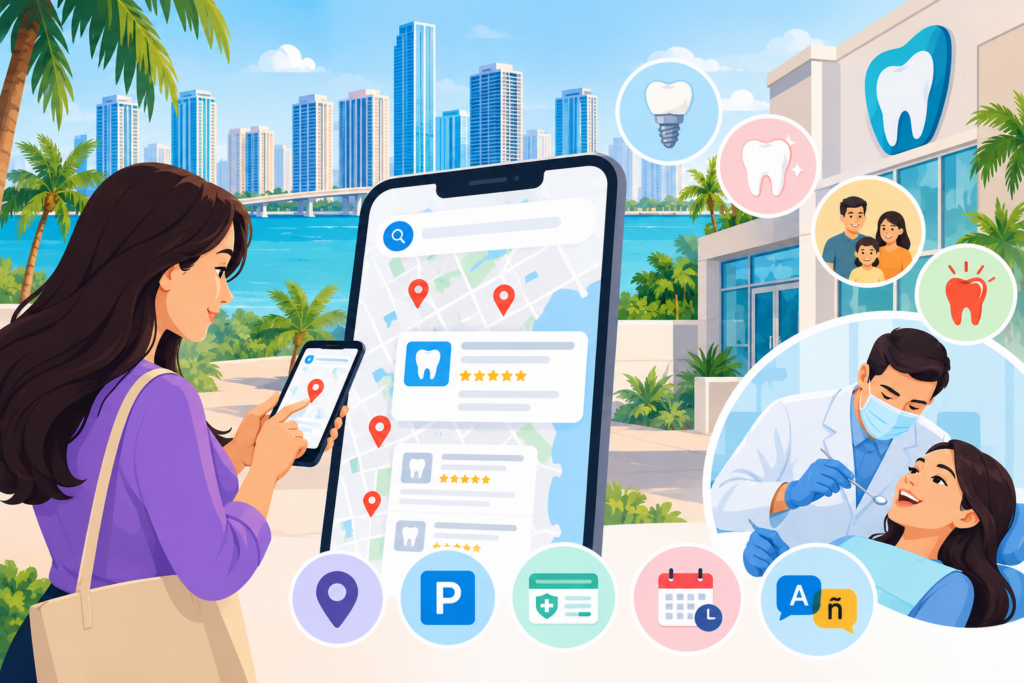
A patient in Lake Worth Beach looking for a dentist is not browsing. They are comparing. Someone searching "dentist near me" from a phone on 6th Avenue South or Lake Worth Road pulls up a map, taps three practices within two miles, and checks each site in under a minute. If your site loads slow, buries your insurance list, or makes someone hunt for new-patient forms, you are out before the second ring. That comparison window is where most practices quietly lose patients to a competitor with a cleaner site and a faster load time.

How Lake Worth Beach Dental Practices buyers search
Most dental searches in Lake Worth Beach start on a phone, not a desktop. That matters more here than in a lot of South Florida cities, because this is a dense, older housing stock with a working, value-conscious population, a lot of renters and multi-generation households, and a business mix heavy on trades, auto shops, food service, and independent retail. These are people who search during a lunch break, between shifts, or while waiting on a kid at school pickup, not at a desk with time to compare slowly. If your site takes more than a couple of seconds to load or makes someone pinch-zoom to find a phone number, they are already back on the results page looking at a competitor.
The searches break into two patterns. One is symptom-driven and urgent: “emergency dentist Lake Worth Beach,” “tooth pain dentist open now,” “dentist open Saturday near me.” The other is plan-driven: “dentist that takes [insurance name] near me,” “affordable dental Lake Worth,” “payment plan dentist.” Both patterns load weight onto the map pack, because Google shows the three closest, most relevant practices before anyone scrolls to organic results. If your Google Business Profile is thin, your categories are wrong, or your hours are out of date, you are not in that first screen, and in a city where people are comparing three options inside two miles, not being on the first screen means you are not being compared at all.
Price and insurance are not background questions here. They are the first filter, and buyers typically check for:
- Whether a specific plan or Medicaid-based program is accepted, stated plainly
- A real range or starting cost for the exact problem they have, not a vague “call for pricing”
- Same-week or same-day availability, since many can’t take unplanned time off twice
A practice that makes a buyer dig for any of this loses them to the next tab before the phone ever rings. That is a page-structure problem, not a sales problem, and it is fixable before you ever answer a call.
The competition here
Lake Worth Beach has a real cluster of dental practices along Lake Worth Road, 10th Avenue, and Dixie Highway, plus several more tucked into strip retail near the Turnpike and I-95 interchanges. It is not an empty market, and we are not going to tell you it is. What we can tell you honestly, after looking at what actually ranks here: a lot of the sites in this corridor are slow, built years ago on templates that were never updated for mobile-first indexing, and thin on real service pages. Several rank for their own practice name and almost nothing else — no visibility for “emergency dentist Lake Worth Beach,” “dental implants near me,” or any of the searches that actually bring in new patients.
That gap is an opening, not a guarantee. A newer or more aggressive competitor two blocks away can still outrank you if they publish more often, load faster, and answer the insurance and pricing question directly on the page instead of hiding it behind a “call for pricing” button. Patients comparing dentists along this stretch of Lake Worth Road typically have two or three tabs open at once, and the practice that loads fastest and answers the most questions upfront usually wins the call, not the one with the nicest logo.
Here is what we typically find when we audit a Lake Worth Beach dental site against its real local competitors:
- Missing or thin pages for high-value services like implants, Invisalign, and emergency care
- No dedicated page targeting Lake Worth Beach by name, just a generic “service area” blurb
- Slow mobile load times that push the site down in local map pack results
- Little to no fresh content, reviews, or updates signaling the practice is active
The honest read is this: the bar to be competitive in this market is not especially high right now, but it rises every year, because Google keeps increasing the weight it gives to page speed, mobile experience, and content depth. The practices that invest now, while the local competition is still mostly coasting on outdated sites, are the ones that will own the search results here in two or three years.

What we build for Dental Practices in this market
We start with the Google Business Profile, because in a dense market like this, map pack placement decides who gets considered before a search result is ever clicked. That means correct categories, service areas set to how patients actually search, and a review-request habit built into your checkout or checkout software, not bolted on later.
Then the website. We build a dedicated page for each core service: general and family dentistry, emergency extractions, cosmetic work, implants, whatever you actually do. One page trying to rank for forty different procedure and insurance terms loses to a competitor with forty focused pages. Each service page answers the price and insurance question directly in the first screen, not after three scrolls, because that is where a value-conscious buyer in this market decides to stay or leave.
Speed gets separate attention. A lot of practices in this corridor are still running image-heavy, plugin-loaded sites that take four or five seconds to load on a phone with a weak signal near the Turnpike. We compress images, strip unused scripts, and test on real mobile connections, not just a desktop broadband line, because a three-second delay here is the difference between a tapped call button and a closed tab.
For paid search, we run Google Ads campaigns aimed at the emergency and insurance-specific searches, since those are the highest-intent terms and the ones where a slow landing page wastes the click you already paid for. We set call tracking on every number we touch, so you can hear which keyword, which ad, and which page produced an actual call, not just a click.
None of this is instant. It is structural work: pages, speed, tracking, review flow. It compounds, and it starts paying off faster when the foundation is built correctly the first time.
Local SEO
Improve relevant website content, location signals, internal links, and service information to support local search visibility.
Google Business Profile
Review profile accuracy, categories, services, contact details, and other eligible information. Changes should follow Google's Business Profile guidelines.
Treatment pages
Build or improve pages for services such as general dentistry, cosmetic treatments, implants, or emergency appointments when those services are offered.
Paid search campaigns
Target relevant searches, refine location settings, and review search terms to reduce spend on enquiries that do not match the practice.
Conversion tracking
Measure available actions such as appointment-form submissions, calls, and clicks on booking links.
Website improvements
Make service information, insurance details, contact options, and booking steps easier to find on desktop and mobile.
What we measure
We track calls, form submissions, and direction requests back to the specific keyword, ad, or page that produced them, using call tracking numbers and attribution tied to each campaign. You see which service pages get traffic, which ones get calls, and where the two diverge, because a page that gets clicks but no calls usually has a price or trust problem on the page itself, not a traffic problem.
We also watch map pack position for your core local terms and organic position for your service pages, reported on a schedule you can actually read, not a 40-tab spreadsheet. If a number is not moving, we say so and explain what we are changing, rather than reframing a flat month as a win.

What it costs
Dental marketing in Lake Worth Beach is typically priced three ways: a project fee for a website build, a monthly retainer for ongoing SEO, and a managed ad spend for Google Ads, with media budget separate from our fee. The right mix depends on whether you need a new site, a rebuild, or steadier lead flow from a site that already works.
We won’t quote a flat number here — any agency that does without seeing your site, competition, and ad history is guessing. Ask us for a specific figure after a short look at what you have now.
- Organic search visibility and relevant website visits.
- Google Business Profile interactions and available performance data.
- Paid campaign clicks, search terms, and advertising costs.
- Tracked calls, appointment-form submissions, and booking actions.
- Enquiry quality, where the practice can reliably share and categorize that information.
- Changes made, issues identified, and recommended next steps.
Why a fast site matters more here
Lake Worth Beach skews mobile harder than most of the cities we work in across the tri-county. Between the housing density, the income mix, and the number of searches happening on the move between jobs or errands, a slow site costs you more here than it would in a market with more desktop traffic.

Built for how this city actually searches
We are a South Florida agency, and we work with practices in Lake Worth Beach the same way we work with clients across Palm Beach County: by looking at what the market actually does before we write a page. Here that means mobile-first design, insurance information above the fold, and map pack work that treats the two-mile radius as the real competitive set, because that is what the buyer is doing on their phone right now.
FAQ's
These are the 5 questions Lake Worth Beach homeowners ask us most about dental practice marketing, answered plainly so you know what to expect before any work starts. If yours isn't covered here, get in touch and we'll walk you through it.
How is marketing a dental practice different from a general small business here?
Dental searches in Lake Worth Beach are driven by insurance filters and urgency in a way most trades and retail searches are not. A buyer wants to know if you take their plan and how fast you can see them, and both answers need to be visible on the page, not behind a call.
Do you only work with dental practices in Lake Worth Beach?
No. We work with practices and other local businesses across Lake Worth Beach and the wider South Florida area, and the same site-speed and local search principles apply across most service businesses here.
How long before a new dental website shows results?
We will not put a timeframe on this page, because it depends on your current site, your competition, and how aggressively we run ads alongside the organic work. We can walk you through a realistic range once we see your situation.
Can you work with the insurance plans we already list on our site?
Yes. We build pages around the insurance and payment information you give us. We do not change your plans or pricing, we make sure patients can find that information in the first few seconds on the page.
What does an audit actually involve?
We look at your site's mobile load speed, your Google Business Profile setup, and where you currently rank for the terms patients search, then tell you plainly what is working and what is not.
Get an audit
If you want a plain read on where your practice stands against the two or three others a patient is comparing you to right now, we will look at your site speed, your Google Business Profile, and your current rankings and tell you what we see. No obligation, no canned report. Call (754) 704-4727 or request an audit through the form on this page.