
- Home
- Services
- Portfolio
- About
- Service AreasFort Lauderdale, FL
- Web Design
- Redesign
- WordPress
- Ecommerce
- Landing Pages
- SEO Services
- Local SEO
- GBP
- Google Ads
- PPC
- Digital Marketing
- Internet Marketing
- Advertising
- Tracking
- Dental Marketing
- Medical Marketing
- HVAC Marketing
- Roofing Marketing
- Pest Control Marketing
- Home Services Marketing
- Plumbing Marketing
- Electrical Marketing
- Landscaping Marketing
- Remodeling Marketing
Pembroke Pines, FL- Web Design
- Redesign
- WordPress
- Ecommerce
- Landing Pages
- SEO Services
- Local SEO
- GBP
- Google Ads
- PPC
- Digital Marketing
- Internet Marketing
- Advertising
- Tracking
- Dental Marketing
- Medical Marketing
- HVAC Marketing
- Roofing Marketing
- Pest Control Marketing
- Home Services Marketing
- Plumbing Marketing
- Electrical Marketing
- Landscaping Marketing
- Remodeling Marketing
Hialeah, FL- Web Design
- Redesign
- WordPress
- Ecommerce
- Landing Pages
- SEO Services
- Local SEO
- GBP
- Google Ads
- PPC
- Digital Marketing
- Internet Marketing
- Advertising
- Tracking
- Dental Marketing
- Medical Marketing
- HVAC Marketing
- Roofing Marketing
- Pest Control Marketing
- Home Services Marketing
- Plumbing Marketing
- Electrical Marketing
- Landscaping Marketing
- Remodeling Marketing
Hollywood, FL- Web Design
- Redesign
- WordPress
- Ecommerce
- Landing Pages
- SEO Services
- Local SEO
- GBP
- Google Ads
- PPC
- Digital Marketing
- Internet Marketing
- Advertising
- Tracking
- Dental Marketing
- Medical Marketing
- HVAC Marketing
- Roofing Marketing
- Pest Control Marketing
- Home Services Marketing
- Plumbing Marketing
- Electrical Marketing
- Landscaping Marketing
- Remodeling Marketing
Miramar, FL- Web Design
- Redesign
- WordPress
- Ecommerce
- Landing Pages
- SEO Services
- Local SEO
- GBP
- Google Ads
- PPC
- Digital Marketing
- Internet Marketing
- Advertising
- Tracking
- Dental Marketing
- Medical Marketing
- HVAC Marketing
- Roofing Marketing
- Pest Control Marketing
- Home Services Marketing
- Plumbing Marketing
- Electrical Marketing
- Landscaping Marketing
- Remodeling Marketing
Coral Springs, FL- Web Design
- Redesign
- WordPress
- Ecommerce
- Landing Pages
- SEO Services
- Local SEO
- GBP
- Google Ads
- PPC
- Digital Marketing
- Internet Marketing
- Advertising
- Tracking
- Dental Marketing
- Medical Marketing
- HVAC Marketing
- Roofing Marketing
- Pest Control Marketing
- Home Services Marketing
- Plumbing Marketing
- Electrical Marketing
- Landscaping Marketing
- Remodeling Marketing
Pompano Beach, FL- Web Design
- Redesign
- WordPress
- Ecommerce
- Landing Pages
- SEO Services
- Local SEO
- GBP
- Google Ads
- PPC
- Digital Marketing
- Internet Marketing
- Advertising
- Tracking
- Dental Marketing
- Medical Marketing
- HVAC Marketing
- Roofing Marketing
- Pest Control Marketing
- Home Services Marketing
- Plumbing Marketing
- Electrical Marketing
- Landscaping Marketing
- Remodeling Marketing
Davie, FL- Web Design
- Redesign
- WordPress
- Ecommerce
- Landing Pages
- SEO Services
- Local SEO
- GBP
- Google Ads
- PPC
- Digital Marketing
- Internet Marketing
- Advertising
- Tracking
- Dental Marketing
- Medical Marketing
- HVAC Marketing
- Roofing Marketing
- Pest Control Marketing
- Home Services Marketing
- Plumbing Marketing
- Electrical Marketing
- Landscaping Marketing
- Remodeling Marketing
Sunrise, FL- Web Design
- Redesign
- WordPress
- Ecommerce
- Landing Pages
- SEO Services
- Local SEO
- GBP
- Google Ads
- PPC
- Digital Marketing
- Internet Marketing
- Advertising
- Tracking
- Dental Marketing
- Medical Marketing
- HVAC Marketing
- Roofing Marketing
- Pest Control Marketing
- Home Services Marketing
- Plumbing Marketing
- Electrical Marketing
- Landscaping Marketing
- Remodeling Marketing
Plantation, FL- Web Design
- Redesign
- WordPress
- Ecommerce
- Landing Pages
- SEO Services
- Local SEO
- GBP
- Google Ads
- PPC
- Digital Marketing
- Internet Marketing
- Advertising
- Tracking
- Dental Marketing
- Medical Marketing
- HVAC Marketing
- Roofing Marketing
- Pest Control Marketing
- Home Services Marketing
- Plumbing Marketing
- Electrical Marketing
- Landscaping Marketing
- Remodeling Marketing
Deerfield Beach, FL- Web Design
- Redesign
- WordPress
- Ecommerce
- Landing Pages
- SEO Services
- Local SEO
- GBP
- Google Ads
- PPC
- Digital Marketing
- Internet Marketing
- Advertising
- Tracking
- Dental Marketing
- Medical Marketing
- HVAC Marketing
- Roofing Marketing
- Pest Control Marketing
- Home Services Marketing
- Plumbing Marketing
- Electrical Marketing
- Landscaping Marketing
- Remodeling Marketing
Miami Gardens, FL- Web Design
- Redesign
- WordPress
- Ecommerce
- Landing Pages
- SEO Services
- Local SEO
- GBP
- Google Ads
- PPC
- Digital Marketing
- Internet Marketing
- Advertising
- Tracking
- Dental Marketing
- Medical Marketing
- HVAC Marketing
- Roofing Marketing
- Pest Control Marketing
- Home Services Marketing
- Plumbing Marketing
- Electrical Marketing
- Landscaping Marketing
- Remodeling Marketing
Lauderhill, FL- Web Design
- Redesign
- WordPress
- Ecommerce
- Landing Pages
- SEO Services
- Local SEO
- GBP
- Google Ads
- PPC
- Digital Marketing
- Internet Marketing
- Advertising
- Tracking
- Dental Marketing
- Medical Marketing
- HVAC Marketing
- Roofing Marketing
- Pest Control Marketing
- Home Services Marketing
- Plumbing Marketing
- Electrical Marketing
- Landscaping Marketing
- Remodeling Marketing
West Palm Beach, FL- Web Design
- Redesign
- WordPress
- Ecommerce
- Landing Pages
- SEO Services
- Local SEO
- GBP
- Google Ads
- PPC
- Digital Marketing
- Internet Marketing
- Advertising
- Tracking
- Dental Marketing
- Medical Marketing
- HVAC Marketing
- Roofing Marketing
- Pest Control Marketing
- Home Services Marketing
- Plumbing Marketing
- Electrical Marketing
- Landscaping Marketing
- Remodeling Marketing
Tamarac, FL- Web Design
- Redesign
- WordPress
- Ecommerce
- Landing Pages
- SEO Services
- Local SEO
- GBP
- Google Ads
- PPC
- Digital Marketing
- Internet Marketing
- Advertising
- Tracking
- Dental Marketing
- Medical Marketing
- HVAC Marketing
- Roofing Marketing
- Pest Control Marketing
- Home Services Marketing
- Plumbing Marketing
- Electrical Marketing
- Landscaping Marketing
- Remodeling Marketing
Weston, FL- Web Design
- Redesign
- WordPress
- Ecommerce
- Landing Pages
- SEO Services
- Local SEO
- GBP
- Google Ads
- PPC
- Digital Marketing
- Internet Marketing
- Advertising
- Tracking
- Dental Marketing
- Medical Marketing
- HVAC Marketing
- Roofing Marketing
- Pest Control Marketing
- Home Services Marketing
- Plumbing Marketing
- Electrical Marketing
- Landscaping Marketing
- Remodeling Marketing
Boca Raton, FLMargate, FLCoconut Creek, FLMiami Beach, FLHomestead, FLKendall, FLDoral, FLBoynton Beach, FLThe Hammocks, FLNorth Lauderdale, FLOakland Park, FLDelray Beach, FLNorth Miami, FLHallandale Beach, FLFontainebleau, FLKendale Lakes, FLWellington, FLJupiter, FLTamiami, FLPalm Beach Gardens, FLLauderdale Lakes, FLCooper City, FLCountry Club, FLParkland, FLCoral Gables, FLDania Beach, FLCutler Bay, FLNorth Miami Beach, FLGreenacres, FLLake Worth Beach, FLPrinceton, FLRoyal Palm Beach, FLSouth Miami Heights, FLRichmond West, FLRiviera Beach, FLWest Little River, FLGolden Glades, FLAventura, FLMiami Lakes, FLWestchester, FLLeisure City, FLCoral Terrace, FLPalm Springs, FLPalmetto Bay, FLHialeah Gardens, FLSunny Isles Beach, FLIves Estates, FLWest Park, FLSweetwater, FLPinecrest, FLSunset, FLPinewood, FLWilton Manors, FLOpa-locka, FLLighthouse Point, FLBelle Glade, FLNaranja, FLPalmetto Estates, FLBrownsville, FLKey Biscayne, FLOlympia Heights, FLMiami Springs, FLFlorida City, FLSouth Miami, FLThree Lakes, FLGladeview, FLNorth Palm Beach, FLMiami Shores, FLSouthwest Ranches, FLKings Point, FLLauderdale-by-the-Sea, FLHillsboro Beach, FLSea Ranch Lakes, FLLazy Lake, FL - Blog
- Contact
Ecommerce Website Design in Hallandale Beach, Florida
Ecommerce Website Design for Hallandale Beach businesses
A gift shop two blocks from the Broadwalk doesn’t sell the same way in February as it does in August. A charter boat operator out of the marina takes bookings in bursts around holidays and slow trickles the rest of the year. If your online store has to carry that kind of swing, the build has to handle traffic spikes, inventory changes, and a checkout that doesn’t choke when forty people hit it in the same hour after a cruise ship docks nearby.

What the work covers
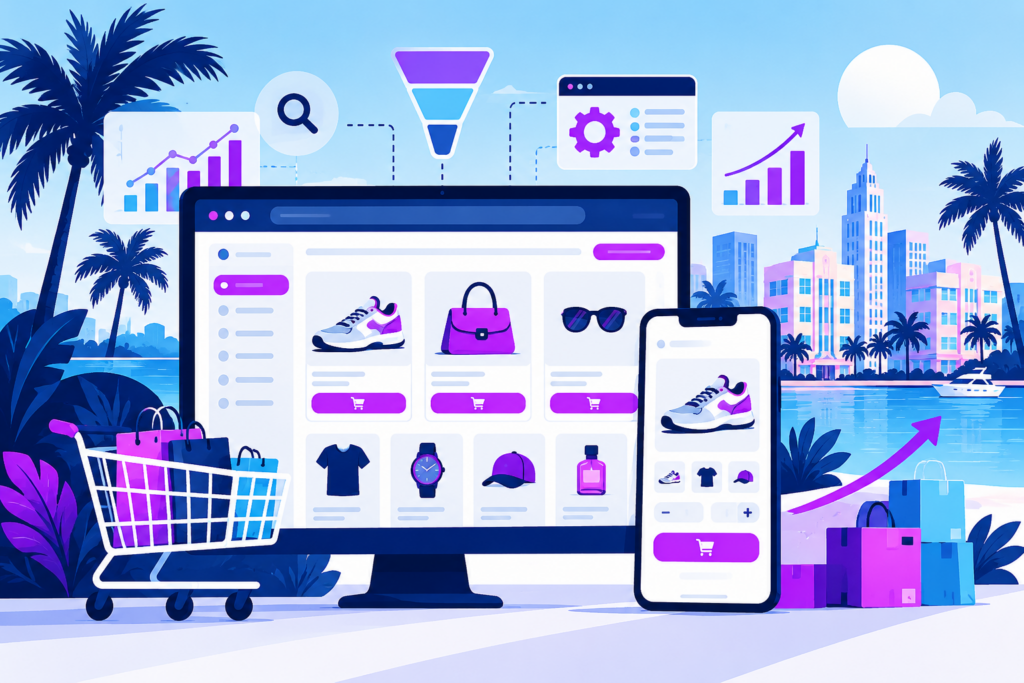
Ecommerce is not a theme you install and fill with photos. It’s a set of technical decisions that either hold up at checkout or don’t. Here is what we actually build and why each piece matters.
Product schema. Every product page gets structured data so Google can show price, availability, and review stars directly in search results. A listing with stars and a price visible before the click gets chosen over one that doesn’t, and that’s measurable in click-through data, not a guess.
Page speed at scale. A product catalog with 40 items behaves differently than one with 400. Image compression, lazy loading, and server response time all have to hold up as the catalog grows, not just on the day the site launches. We test load speed against mobile connections, not just office wifi, because that’s what a buyer standing on the beach is actually using.
Checkout flow. Every extra field, every forced account creation, every slow redirect to a payment processor is a place a buyer quits. We build checkout to minimize steps, support guest checkout, and test on actual phones before launch, not just in a browser window on a desktop.
Inventory and booking sync. If you run a rental, a charter, or a multi-location retail operation, your site needs to reflect real-time availability. Nothing kills trust faster than a customer paying for something that’s already gone, then waiting on a refund.
Review and reputation integration. For hospitality, food service, marine, and short-term rental businesses, reviews often carry more weight in the buying decision than the product photos do. We pull review content onto key pages where it’s visible at the point of decision, not buried on a separate testimonials page nobody visits.
Mobile-first layout. Built for the phone first, then adapted up to desktop, not the other way around.
What is different about this market
Hallandale Beach runs on tourism, hospitality, and the properties around Gulfstream Park and the Broadwalk, and that shapes who’s buying and how. The business mix skews toward restaurants, short-term rental operators, boutique retail near the beach corridor, marine services out of the harbor area, and event or hospitality vendors tied to the hotel and condo population along A1A. A lot of these businesses are not single-location operations. They’re managing two or three properties, a seasonal rental calendar, or multiple storefronts, and the site has to reflect that without turning into five separate websites.
Trust matters more here than price. A visitor booking a rental or ordering from a restaurant site is deciding in seconds whether this business is legitimate, current, and responsive, and reviews are doing a lot of that convincing. A product page with no reviews, a slow load, or stock photos reading as generic loses that visitor to a competitor’s listing that looks lived-in and current, even if the price is identical.
Search behavior here skews mobile hard, more than inland Broward markets, because so much of the buying happens in the moment: someone on the beach searching for a charter, a tourist in a hotel room booking a restaurant table, a renter checking availability from an airport. A site that’s slow on a phone loses that visitor before the page finishes loading.
Spanish-language search also matters in this part of Broward County. A meaningful share of local and visiting search traffic runs in Spanish, and a site with no Spanish-language product pages or checkout flow is leaving that demand for a competitor to pick up. We build bilingual product pages where the business has the catalog to support it, not as an afterthought bolted on later.

How we start
We start every Hallandale Beach ecommerce project with a discovery call to understand your products, customers, and goals. From there, we map out your site structure, research local and regional competitors along the Gold Coast corridor, and outline the features you’ll need — secure checkout, inventory management, shipping rules, and mobile-friendly browsing. We’ll review your branding and existing assets, then present a clear plan and timeline before any design work begins.
- Discovery call to define goals and target customers
- Competitive and market research specific to your niche
- Site map and feature planning (checkout, shipping, inventory)
- Clear proposal with timeline and milestones
Product pages and structured data
We organize product information so customers can understand product features, variations, pricing, and availability. Where appropriate, we implement and validate Product structured data to help search engines interpret eligible product details. Structured data does not guarantee enhanced search results, but accurate implementation can support product discovery.
Page speed and technical performance
Large catalogs, high-resolution images, third-party scripts, and complex integrations can slow an online store. We review performance bottlenecks, image delivery, mobile usability, and unnecessary scripts. Testing should cover important templates and shopping journeys rather than only the homepage.
Navigation and catalog structure
Categories, filters, internal links, and product URLs should help customers locate items without creating confusing navigation or unnecessary duplicate pages. We also consider how product variations, unavailable items, and category changes are handled.
Checkout and conversion flow
We review the steps between adding an item to the cart and placing an order. Clear shipping information, transparent costs, accessible forms, suitable payment options, and useful error messages can reduce avoidable friction. Actual checkout changes should be assessed against analytics rather than assumptions.
SEO and measurement
Relevant page titles, meta descriptions, canonical URLs, indexation controls, and XML sitemaps help establish a consistent technical foundation. Analytics and ecommerce event tracking can measure product views, add-to-cart actions, checkout progression, and completed purchases when configured correctly.
What it costs
Ecommerce build costs vary with catalog size, whether you need custom booking or rental logic, and how much integration work is required with your existing payment processor or inventory system. We’ll give you a number after we understand what you’re actually selling and how, not a flat rate pulled from a rate card. Ask about current ranges when you request an audit, and we’ll walk through what drives the cost up or down for your specific catalog.

What you get each month
Launch isn’t the end of the relationship. Every month you get a report that shows site speed trends, checkout completion rate, product page performance, and call or form tracking tied back to the pages that generated them. If a product category is converting and another isn’t, you’ll see it in the numbers, not have to ask.
We track inbound calls and attribute them to the specific page or campaign that drove them, so you know whether a sale came from a product page, a search ad, or a review someone read before calling. That attribution is what lets us (and you) make decisions based on what’s actually happening instead of what feels true.

Get a free audit
If you're running an online store or booking system in Hallandale Beach and something about checkout, speed, or mobile performance feels off, we'll look at it. A free audit shows you exactly where your site is losing sales right now, with specifics, not a generic scorecard. We dig into page load times, cart abandonment points, product page conversion, mobile usability, and how your site actually performs for shoppers browsing the Hallandale Beach area on their phones between errands or while sitting in traffic on Federal Highway. You'll get a clear breakdown of what's working, what's costing you sales, and what to fix first, prioritized by impact, not guesswork. No pressure, no jargon-filled report that sits unread. Just a straightforward look at your ecommerce site from people who build and optimize stores like yours every day.

FAQ's
These are the 6 questions Hallandale Beach homeowners ask us most about ecommerce website design, answered plainly so you know what to expect before any work starts. If yours isn't covered here, get in touch and we'll walk you through it.
Do you build sites that handle seasonal traffic spikes without crashing?
Yes. We load-test against peak-season traffic estimates, not average weekly traffic, which is the standard approach for hospitality and rental businesses in this market where winter and spring volume can be several times a summer week.
Can you integrate a booking or reservation system into the ecommerce site?
Yes, for rentals, charters, and hospitality bookings we build or integrate booking logic so availability shown on the site matches what's actually open, reducing refund requests and double-bookings.
Do you build Spanish-language product pages?
Where the catalog supports it, yes. Given the volume of Spanish-language search in this part of Broward County, bilingual product pages are something we build in from the start rather than add later.
How do reviews factor into the ecommerce build itself?
We pull review content directly onto product and category pages where buyers are deciding, since for hospitality, food service, and short-term rental businesses reviews often weigh more heavily than photos or price.
What does product schema actually do for my store?
It lets Google show price, stock status, and star ratings directly in search results before someone clicks, which affects click-through rate in ways you can measure after launch.