
- Home
- Services
- Portfolio
- About
- Service AreasFort Lauderdale, FL
- Web Design
- Redesign
- WordPress
- Ecommerce
- Landing Pages
- SEO Services
- Local SEO
- GBP
- Google Ads
- PPC
- Digital Marketing
- Internet Marketing
- Advertising
- Tracking
- Dental Marketing
- Medical Marketing
- HVAC Marketing
- Roofing Marketing
- Pest Control Marketing
- Home Services Marketing
- Plumbing Marketing
- Electrical Marketing
- Landscaping Marketing
- Remodeling Marketing
Pembroke Pines, FL- Web Design
- Redesign
- WordPress
- Ecommerce
- Landing Pages
- SEO Services
- Local SEO
- GBP
- Google Ads
- PPC
- Digital Marketing
- Internet Marketing
- Advertising
- Tracking
- Dental Marketing
- Medical Marketing
- HVAC Marketing
- Roofing Marketing
- Pest Control Marketing
- Home Services Marketing
- Plumbing Marketing
- Electrical Marketing
- Landscaping Marketing
- Remodeling Marketing
Hialeah, FL- Web Design
- Redesign
- WordPress
- Ecommerce
- Landing Pages
- SEO Services
- Local SEO
- GBP
- Google Ads
- PPC
- Digital Marketing
- Internet Marketing
- Advertising
- Tracking
- Dental Marketing
- Medical Marketing
- HVAC Marketing
- Roofing Marketing
- Pest Control Marketing
- Home Services Marketing
- Plumbing Marketing
- Electrical Marketing
- Landscaping Marketing
- Remodeling Marketing
Hollywood, FL- Web Design
- Redesign
- WordPress
- Ecommerce
- Landing Pages
- SEO Services
- Local SEO
- GBP
- Google Ads
- PPC
- Digital Marketing
- Internet Marketing
- Advertising
- Tracking
- Dental Marketing
- Medical Marketing
- HVAC Marketing
- Roofing Marketing
- Pest Control Marketing
- Home Services Marketing
- Plumbing Marketing
- Electrical Marketing
- Landscaping Marketing
- Remodeling Marketing
Miramar, FL- Web Design
- Redesign
- WordPress
- Ecommerce
- Landing Pages
- SEO Services
- Local SEO
- GBP
- Google Ads
- PPC
- Digital Marketing
- Internet Marketing
- Advertising
- Tracking
- Dental Marketing
- Medical Marketing
- HVAC Marketing
- Roofing Marketing
- Pest Control Marketing
- Home Services Marketing
- Plumbing Marketing
- Electrical Marketing
- Landscaping Marketing
- Remodeling Marketing
Coral Springs, FL- Web Design
- Redesign
- WordPress
- Ecommerce
- Landing Pages
- SEO Services
- Local SEO
- GBP
- Google Ads
- PPC
- Digital Marketing
- Internet Marketing
- Advertising
- Tracking
- Dental Marketing
- Medical Marketing
- HVAC Marketing
- Roofing Marketing
- Pest Control Marketing
- Home Services Marketing
- Plumbing Marketing
- Electrical Marketing
- Landscaping Marketing
- Remodeling Marketing
Pompano Beach, FL- Web Design
- Redesign
- WordPress
- Ecommerce
- Landing Pages
- SEO Services
- Local SEO
- GBP
- Google Ads
- PPC
- Digital Marketing
- Internet Marketing
- Advertising
- Tracking
- Dental Marketing
- Medical Marketing
- HVAC Marketing
- Roofing Marketing
- Pest Control Marketing
- Home Services Marketing
- Plumbing Marketing
- Electrical Marketing
- Landscaping Marketing
- Remodeling Marketing
Davie, FL- Web Design
- Redesign
- WordPress
- Ecommerce
- Landing Pages
- SEO Services
- Local SEO
- GBP
- Google Ads
- PPC
- Digital Marketing
- Internet Marketing
- Advertising
- Tracking
- Dental Marketing
- Medical Marketing
- HVAC Marketing
- Roofing Marketing
- Pest Control Marketing
- Home Services Marketing
- Plumbing Marketing
- Electrical Marketing
- Landscaping Marketing
- Remodeling Marketing
Sunrise, FL- Web Design
- Redesign
- WordPress
- Ecommerce
- Landing Pages
- SEO Services
- Local SEO
- GBP
- Google Ads
- PPC
- Digital Marketing
- Internet Marketing
- Advertising
- Tracking
- Dental Marketing
- Medical Marketing
- HVAC Marketing
- Roofing Marketing
- Pest Control Marketing
- Home Services Marketing
- Plumbing Marketing
- Electrical Marketing
- Landscaping Marketing
- Remodeling Marketing
Plantation, FL- Web Design
- Redesign
- WordPress
- Ecommerce
- Landing Pages
- SEO Services
- Local SEO
- GBP
- Google Ads
- PPC
- Digital Marketing
- Internet Marketing
- Advertising
- Tracking
- Dental Marketing
- Medical Marketing
- HVAC Marketing
- Roofing Marketing
- Pest Control Marketing
- Home Services Marketing
- Plumbing Marketing
- Electrical Marketing
- Landscaping Marketing
- Remodeling Marketing
Deerfield Beach, FL- Web Design
- Redesign
- WordPress
- Ecommerce
- Landing Pages
- SEO Services
- Local SEO
- GBP
- Google Ads
- PPC
- Digital Marketing
- Internet Marketing
- Advertising
- Tracking
- Dental Marketing
- Medical Marketing
- HVAC Marketing
- Roofing Marketing
- Pest Control Marketing
- Home Services Marketing
- Plumbing Marketing
- Electrical Marketing
- Landscaping Marketing
- Remodeling Marketing
Miami Gardens, FL- Web Design
- Redesign
- WordPress
- Ecommerce
- Landing Pages
- SEO Services
- Local SEO
- GBP
- Google Ads
- PPC
- Digital Marketing
- Internet Marketing
- Advertising
- Tracking
- Dental Marketing
- Medical Marketing
- HVAC Marketing
- Roofing Marketing
- Pest Control Marketing
- Home Services Marketing
- Plumbing Marketing
- Electrical Marketing
- Landscaping Marketing
- Remodeling Marketing
Lauderhill, FL- Web Design
- Redesign
- WordPress
- Ecommerce
- Landing Pages
- SEO Services
- Local SEO
- GBP
- Google Ads
- PPC
- Digital Marketing
- Internet Marketing
- Advertising
- Tracking
- Dental Marketing
- Medical Marketing
- HVAC Marketing
- Roofing Marketing
- Pest Control Marketing
- Home Services Marketing
- Plumbing Marketing
- Electrical Marketing
- Landscaping Marketing
- Remodeling Marketing
West Palm Beach, FL- Web Design
- Redesign
- WordPress
- Ecommerce
- Landing Pages
- SEO Services
- Local SEO
- GBP
- Google Ads
- PPC
- Digital Marketing
- Internet Marketing
- Advertising
- Tracking
- Dental Marketing
- Medical Marketing
- HVAC Marketing
- Roofing Marketing
- Pest Control Marketing
- Home Services Marketing
- Plumbing Marketing
- Electrical Marketing
- Landscaping Marketing
- Remodeling Marketing
Tamarac, FL- Web Design
- Redesign
- WordPress
- Ecommerce
- Landing Pages
- SEO Services
- Local SEO
- GBP
- Google Ads
- PPC
- Digital Marketing
- Internet Marketing
- Advertising
- Tracking
- Dental Marketing
- Medical Marketing
- HVAC Marketing
- Roofing Marketing
- Pest Control Marketing
- Home Services Marketing
- Plumbing Marketing
- Electrical Marketing
- Landscaping Marketing
- Remodeling Marketing
Weston, FL- Web Design
- Redesign
- WordPress
- Ecommerce
- Landing Pages
- SEO Services
- Local SEO
- GBP
- Google Ads
- PPC
- Digital Marketing
- Internet Marketing
- Advertising
- Tracking
- Dental Marketing
- Medical Marketing
- HVAC Marketing
- Roofing Marketing
- Pest Control Marketing
- Home Services Marketing
- Plumbing Marketing
- Electrical Marketing
- Landscaping Marketing
- Remodeling Marketing
Boca Raton, FLMargate, FLCoconut Creek, FLMiami Beach, FLHomestead, FLKendall, FLDoral, FLBoynton Beach, FLThe Hammocks, FLNorth Lauderdale, FLOakland Park, FLDelray Beach, FLNorth Miami, FLHallandale Beach, FLFontainebleau, FLKendale Lakes, FLWellington, FLJupiter, FLTamiami, FLPalm Beach Gardens, FLLauderdale Lakes, FLCooper City, FLCountry Club, FLParkland, FLCoral Gables, FLDania Beach, FLCutler Bay, FLNorth Miami Beach, FLGreenacres, FLLake Worth Beach, FLPrinceton, FLRoyal Palm Beach, FLSouth Miami Heights, FLRichmond West, FLRiviera Beach, FLWest Little River, FLGolden Glades, FLAventura, FLMiami Lakes, FLWestchester, FLLeisure City, FLCoral Terrace, FLPalm Springs, FLPalmetto Bay, FLHialeah Gardens, FLSunny Isles Beach, FLIves Estates, FLWest Park, FLSweetwater, FLPinecrest, FLSunset, FLPinewood, FLWilton Manors, FLOpa-locka, FLLighthouse Point, FLBelle Glade, FLNaranja, FLPalmetto Estates, FLBrownsville, FLKey Biscayne, FLOlympia Heights, FLMiami Springs, FLFlorida City, FLSouth Miami, FLThree Lakes, FLGladeview, FLNorth Palm Beach, FLMiami Shores, FLSouthwest Ranches, FLKings Point, FLLauderdale-by-the-Sea, FLHillsboro Beach, FLSea Ranch Lakes, FLLazy Lake, FL - Blog
- Contact
Local SEO in Kings Point, Florida
Local SEO for Kings Point businesses
A urologist in Kings Point and one three miles away in Lake Worth aren’t competing for the same search. One shows up when someone types “doctor near Kings Point” from a phone in a clubhouse parking lot. The other doesn’t. That’s the whole game with map pack visibility: Google is answering “near me,” not “best in Palm Beach County,” and the businesses that win are the ones whose Google Business Profile and on-page signals say Kings Point clearly and often.
What the work covers
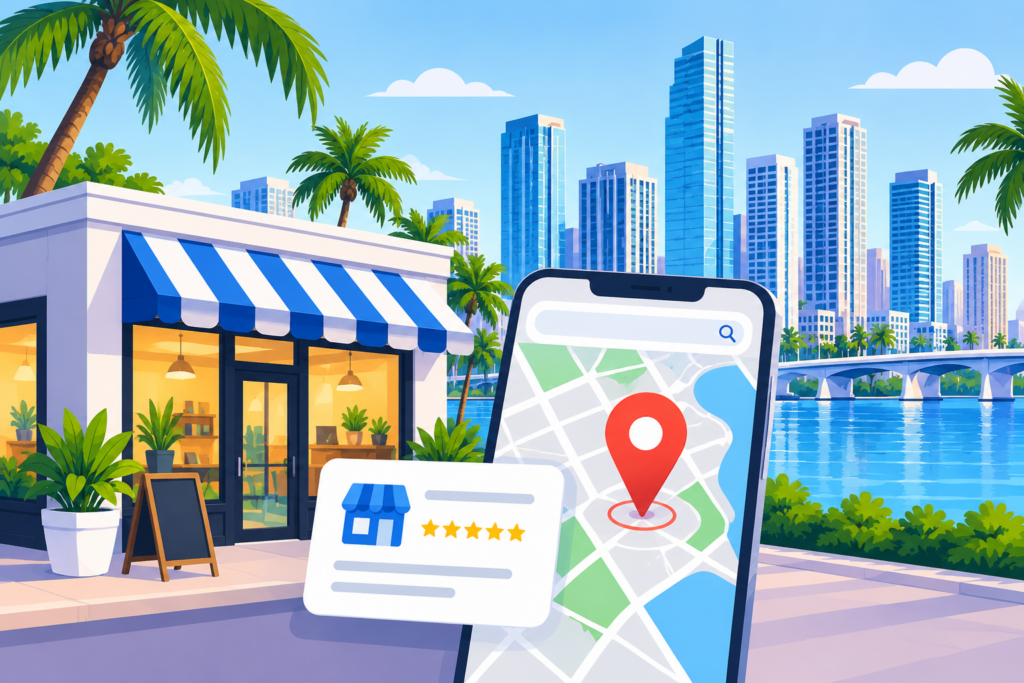
The mechanism is specific, not vague. We start with the Google Business Profile: correct primary and secondary categories, service area set to match where you actually dispatch or see patients, attributes filled out completely, and a posting cadence so the profile shows activity instead of sitting dormant. An incomplete or miscategorized profile is the single most common reason a legitimate business doesn’t appear in the map pack for searches it should win. For a business based in or near Kings Point, that also means confirming the profile reflects the right neighborhood and surrounding service radius rather than a generic citywide setting that dilutes relevance.
From there we build location-specific landing pages when a business serves multiple towns out of Kings Point, because a single “Service Areas” page listing fifteen cities ranks for none of them well. Each page gets its own locally relevant content, not a copy-paste template with the city name swapped out, since search engines increasingly flag thin, duplicated location pages and decline to rank them. We clean up and standardize your name, address, and phone number across directories, since inconsistent NAP data is a known ranking drag and often the quiet reason a competitor outranks a better business. We set up a review request workflow, because review count and recency both factor into map pack placement, and a profile with three reviews from two years ago reads as inactive to the algorithm. We also audit on-page signals: title tags, headings, and schema markup that explicitly name the service and the area, since that’s what helps search engines match a query to your business in the first place. And we track calls and form fills by source, so you can see which searches actually turn into business, not just which ones show impressions.
None of this is exotic. It’s mechanical work done correctly, applied with Kings Point’s specific geography in mind, and kept current, which is where most profiles fall down over time.

What is different about this market
Kings Point splits almost every search into two different vocabularies. A longtime resident searching for a cardiologist, an estate attorney, or a hearing aid provider often types out full phrases on a desktop or tablet, uses terms like “physician” rather than “doctor,” and reads several reviews before calling. A younger family member handling the same search, or a newer resident who moved in for the value and the amenities rather than retirement, searches on a phone, uses shorter queries, and checks star rating and photos before anything else. A business that only optimizes for one vocabulary leaves the other buyer unfound. This matters most for medical practices, legal services, and home services, where both groups search heavily but phrase it differently.
Trust carries more weight than price in this market. Home services and medical categories in particular see buyers who ask neighbors and read reviews closely before calling, which means review volume and how you respond to reviews function as ranking and conversion signals at the same time. Search here skews mobile for anything urgent, like air conditioning repair or an emergency plumber, and skews desktop for anything researched in advance, like elective procedures or legal planning. Unlike the independent retail corridors in downtown Delray Beach or Boynton Beach, Kings Point itself has very little walk-in foot traffic retail. Nearly every search here has commercial or service intent behind it, not browsing intent, which is a reason to prioritize map pack and profile work over general content marketing for most verticals in this specific area.
Google Business Profile
We review your business categories, services, description, hours, contact details, photos, and other relevant profile information. Accurate, complete details help potential customers understand what you offer and how to contact you.
Local website pages
We review service and location pages to make sure they answer local customers’ questions and explain the services available. Each page should have a clear purpose, useful content, and relevant contact options not repeated city keywords.
Business information consistency
We check key business details across relevant directories and listings. Inaccurate names, phone numbers, or other information can confuse customers and make local visibility harder to assess.
Reviews and reputation
We can review how your business requests and responds to customer feedback. Reviews should be genuine, and responses should be professional. No agency can guarantee a specific rating or review volume.
Local links and relevance
We assess relevant local organizations, directories, and other credible link opportunities. The focus is on useful connections and genuine relevance rather than collecting links from unrelated websites.
Tracking and reporting
We monitor available local search visibility, website traffic, calls, form submissions, and other agreed measures where tracking is configured. Reports should show completed work, observed changes, and the next priorities.

How we start
We start by pulling your current map pack rankings for the terms that actually bring in business, not a generic keyword list. We audit your Google Business Profile against its category options, check your NAP consistency across the directories that matter, and look at what your competitors in the actual Kings Point service radius are doing with reviews and posts. You get a plain-language writeup of what’s missing and what it would take to fix, before any commitment.

How We Start
- First, we review the current position. We assess your Google Business Profile, website, key local pages, business listings, and available performance data.
- Next, we set priorities. The plan identifies profile corrections, website improvements, local content needs, and tracking gaps. Work is based on your current situation rather than a fixed checklist applied to every business.
- Then, we implement and measure. We address the agreed priorities, review the data, and refine the plan as new information becomes available. Early work may focus on correcting information and technical issues before longer-term visibility changes can be assessed.

What it costs
Local SEO pricing for Kings Point businesses depends on how many categories and surrounding cities you’re trying to rank in, how competitive your category is here in this part of Palm Beach County, and whether the work involves building new location pages or simply cleaning up an existing Google Business Profile and citation set. A retirement-community-adjacent business competing for attention around Kings Point and neighboring Delray Beach areas often needs different work than a service business drawing from a wider county-wide radius. We quote after the audit, not before, because pricing blind is how businesses end up paying for work they never needed or missing work that actually matters. Our process typically includes:
FAQ's
These are the 6 questions Kings Point homeowners ask us most about local seo, answered plainly so you know what to expect before any work starts. If yours isn't covered here, get in touch and we'll walk you through it.
How is Local SEO different from the SEO work my website already has?
Organic SEO is about ranking a web page in the regular search results through content and backlinks. Local SEO is about ranking in the map pack and Google Business Profile results, which depend on proximity, categories, and reviews instead of page content alone. Most businesses need both, but they're separate mechanisms.
Do you need a physical office in Kings Point to rank here?
No. What matters is an accurate service area set in your Google Business Profile, consistent address and phone data across directories, and content that reflects the specific area you serve. We work with businesses in Kings Point without requiring a storefront located there.
How long does it take to see movement in the map pack?
It varies by category competition and how incomplete your current profile is. We won't promise a timeframe or a ranking position, since Google's algorithm and your competitors' activity both affect it. What we can tell you is what's being fixed and why it matters.
Can one page target every city my business serves near Kings Point?
Generally no. A single page trying to rank for ten city names usually ranks for none of them well. We build a page per service per city when that matches your actual service area, because that's how the ranking mechanism works.
Does review response actually affect ranking?
Review count, recency, and your response activity are documented factors in local ranking signals, and they also affect whether someone calls after finding you. We set up a workflow for requesting and responding to reviews as part of the work.
What do you need from me to start?
What you get each month
Ongoing work includes Google Business Profile posts and updates, review monitoring and response support, citation and NAP audits on a regular schedule, and call tracking reports tied to source. You see which searches turned into calls, which profile changes moved the needle, and what we did that month in plain terms, not a vanity metrics dashboard.
[EXTERNAL LINK: Google’s official Google Business Profile guidelines, to show how profile categories and service areas are meant to be set up] is the baseline we build against, since Google’s own documentation changes periodically and following it directly avoids guesswork.