
- Home
- Services
- Portfolio
- About
- Service AreasFort Lauderdale, FL
- Web Design
- Redesign
- WordPress
- Ecommerce
- Landing Pages
- SEO Services
- Local SEO
- GBP
- Google Ads
- PPC
- Digital Marketing
- Internet Marketing
- Advertising
- Tracking
- Dental Marketing
- Medical Marketing
- HVAC Marketing
- Roofing Marketing
- Pest Control Marketing
- Home Services Marketing
- Plumbing Marketing
- Electrical Marketing
- Landscaping Marketing
- Remodeling Marketing
Pembroke Pines, FL- Web Design
- Redesign
- WordPress
- Ecommerce
- Landing Pages
- SEO Services
- Local SEO
- GBP
- Google Ads
- PPC
- Digital Marketing
- Internet Marketing
- Advertising
- Tracking
- Dental Marketing
- Medical Marketing
- HVAC Marketing
- Roofing Marketing
- Pest Control Marketing
- Home Services Marketing
- Plumbing Marketing
- Electrical Marketing
- Landscaping Marketing
- Remodeling Marketing
Hialeah, FL- Web Design
- Redesign
- WordPress
- Ecommerce
- Landing Pages
- SEO Services
- Local SEO
- GBP
- Google Ads
- PPC
- Digital Marketing
- Internet Marketing
- Advertising
- Tracking
- Dental Marketing
- Medical Marketing
- HVAC Marketing
- Roofing Marketing
- Pest Control Marketing
- Home Services Marketing
- Plumbing Marketing
- Electrical Marketing
- Landscaping Marketing
- Remodeling Marketing
Hollywood, FL- Web Design
- Redesign
- WordPress
- Ecommerce
- Landing Pages
- SEO Services
- Local SEO
- GBP
- Google Ads
- PPC
- Digital Marketing
- Internet Marketing
- Advertising
- Tracking
- Dental Marketing
- Medical Marketing
- HVAC Marketing
- Roofing Marketing
- Pest Control Marketing
- Home Services Marketing
- Plumbing Marketing
- Electrical Marketing
- Landscaping Marketing
- Remodeling Marketing
Miramar, FL- Web Design
- Redesign
- WordPress
- Ecommerce
- Landing Pages
- SEO Services
- Local SEO
- GBP
- Google Ads
- PPC
- Digital Marketing
- Internet Marketing
- Advertising
- Tracking
- Dental Marketing
- Medical Marketing
- HVAC Marketing
- Roofing Marketing
- Pest Control Marketing
- Home Services Marketing
- Plumbing Marketing
- Electrical Marketing
- Landscaping Marketing
- Remodeling Marketing
Coral Springs, FL- Web Design
- Redesign
- WordPress
- Ecommerce
- Landing Pages
- SEO Services
- Local SEO
- GBP
- Google Ads
- PPC
- Digital Marketing
- Internet Marketing
- Advertising
- Tracking
- Dental Marketing
- Medical Marketing
- HVAC Marketing
- Roofing Marketing
- Pest Control Marketing
- Home Services Marketing
- Plumbing Marketing
- Electrical Marketing
- Landscaping Marketing
- Remodeling Marketing
Pompano Beach, FL- Web Design
- Redesign
- WordPress
- Ecommerce
- Landing Pages
- SEO Services
- Local SEO
- GBP
- Google Ads
- PPC
- Digital Marketing
- Internet Marketing
- Advertising
- Tracking
- Dental Marketing
- Medical Marketing
- HVAC Marketing
- Roofing Marketing
- Pest Control Marketing
- Home Services Marketing
- Plumbing Marketing
- Electrical Marketing
- Landscaping Marketing
- Remodeling Marketing
Davie, FL- Web Design
- Redesign
- WordPress
- Ecommerce
- Landing Pages
- SEO Services
- Local SEO
- GBP
- Google Ads
- PPC
- Digital Marketing
- Internet Marketing
- Advertising
- Tracking
- Dental Marketing
- Medical Marketing
- HVAC Marketing
- Roofing Marketing
- Pest Control Marketing
- Home Services Marketing
- Plumbing Marketing
- Electrical Marketing
- Landscaping Marketing
- Remodeling Marketing
Sunrise, FL- Web Design
- Redesign
- WordPress
- Ecommerce
- Landing Pages
- SEO Services
- Local SEO
- GBP
- Google Ads
- PPC
- Digital Marketing
- Internet Marketing
- Advertising
- Tracking
- Dental Marketing
- Medical Marketing
- HVAC Marketing
- Roofing Marketing
- Pest Control Marketing
- Home Services Marketing
- Plumbing Marketing
- Electrical Marketing
- Landscaping Marketing
- Remodeling Marketing
Plantation, FL- Web Design
- Redesign
- WordPress
- Ecommerce
- Landing Pages
- SEO Services
- Local SEO
- GBP
- Google Ads
- PPC
- Digital Marketing
- Internet Marketing
- Advertising
- Tracking
- Dental Marketing
- Medical Marketing
- HVAC Marketing
- Roofing Marketing
- Pest Control Marketing
- Home Services Marketing
- Plumbing Marketing
- Electrical Marketing
- Landscaping Marketing
- Remodeling Marketing
Deerfield Beach, FL- Web Design
- Redesign
- WordPress
- Ecommerce
- Landing Pages
- SEO Services
- Local SEO
- GBP
- Google Ads
- PPC
- Digital Marketing
- Internet Marketing
- Advertising
- Tracking
- Dental Marketing
- Medical Marketing
- HVAC Marketing
- Roofing Marketing
- Pest Control Marketing
- Home Services Marketing
- Plumbing Marketing
- Electrical Marketing
- Landscaping Marketing
- Remodeling Marketing
Miami Gardens, FL- Web Design
- Redesign
- WordPress
- Ecommerce
- Landing Pages
- SEO Services
- Local SEO
- GBP
- Google Ads
- PPC
- Digital Marketing
- Internet Marketing
- Advertising
- Tracking
- Dental Marketing
- Medical Marketing
- HVAC Marketing
- Roofing Marketing
- Pest Control Marketing
- Home Services Marketing
- Plumbing Marketing
- Electrical Marketing
- Landscaping Marketing
- Remodeling Marketing
Lauderhill, FL- Web Design
- Redesign
- WordPress
- Ecommerce
- Landing Pages
- SEO Services
- Local SEO
- GBP
- Google Ads
- PPC
- Digital Marketing
- Internet Marketing
- Advertising
- Tracking
- Dental Marketing
- Medical Marketing
- HVAC Marketing
- Roofing Marketing
- Pest Control Marketing
- Home Services Marketing
- Plumbing Marketing
- Electrical Marketing
- Landscaping Marketing
- Remodeling Marketing
West Palm Beach, FL- Web Design
- Redesign
- WordPress
- Ecommerce
- Landing Pages
- SEO Services
- Local SEO
- GBP
- Google Ads
- PPC
- Digital Marketing
- Internet Marketing
- Advertising
- Tracking
- Dental Marketing
- Medical Marketing
- HVAC Marketing
- Roofing Marketing
- Pest Control Marketing
- Home Services Marketing
- Plumbing Marketing
- Electrical Marketing
- Landscaping Marketing
- Remodeling Marketing
Tamarac, FL- Web Design
- Redesign
- WordPress
- Ecommerce
- Landing Pages
- SEO Services
- Local SEO
- GBP
- Google Ads
- PPC
- Digital Marketing
- Internet Marketing
- Advertising
- Tracking
- Dental Marketing
- Medical Marketing
- HVAC Marketing
- Roofing Marketing
- Pest Control Marketing
- Home Services Marketing
- Plumbing Marketing
- Electrical Marketing
- Landscaping Marketing
- Remodeling Marketing
Weston, FL- Web Design
- Redesign
- WordPress
- Ecommerce
- Landing Pages
- SEO Services
- Local SEO
- GBP
- Google Ads
- PPC
- Digital Marketing
- Internet Marketing
- Advertising
- Tracking
- Dental Marketing
- Medical Marketing
- HVAC Marketing
- Roofing Marketing
- Pest Control Marketing
- Home Services Marketing
- Plumbing Marketing
- Electrical Marketing
- Landscaping Marketing
- Remodeling Marketing
Boca Raton, FLMargate, FLCoconut Creek, FLMiami Beach, FLHomestead, FLKendall, FLDoral, FLBoynton Beach, FLThe Hammocks, FLNorth Lauderdale, FLOakland Park, FLDelray Beach, FLNorth Miami, FLHallandale Beach, FLFontainebleau, FLKendale Lakes, FLWellington, FLJupiter, FLTamiami, FLPalm Beach Gardens, FLLauderdale Lakes, FLCooper City, FLCountry Club, FLParkland, FLCoral Gables, FLDania Beach, FLCutler Bay, FLNorth Miami Beach, FLGreenacres, FLLake Worth Beach, FLPrinceton, FLRoyal Palm Beach, FLSouth Miami Heights, FLRichmond West, FLRiviera Beach, FLWest Little River, FLGolden Glades, FLAventura, FLMiami Lakes, FLWestchester, FLLeisure City, FLCoral Terrace, FLPalm Springs, FLPalmetto Bay, FLHialeah Gardens, FLSunny Isles Beach, FLIves Estates, FLWest Park, FLSweetwater, FLPinecrest, FLSunset, FLPinewood, FLWilton Manors, FLOpa-locka, FLLighthouse Point, FLBelle Glade, FLNaranja, FLPalmetto Estates, FLBrownsville, FLKey Biscayne, FLOlympia Heights, FLMiami Springs, FLFlorida City, FLSouth Miami, FLThree Lakes, FLGladeview, FLNorth Palm Beach, FLMiami Shores, FLSouthwest Ranches, FLKings Point, FLLauderdale-by-the-Sea, FLHillsboro Beach, FLSea Ranch Lakes, FLLazy Lake, FL - Blog
- Contact
Marketing for Dental Practices in Boynton Beach, Florida
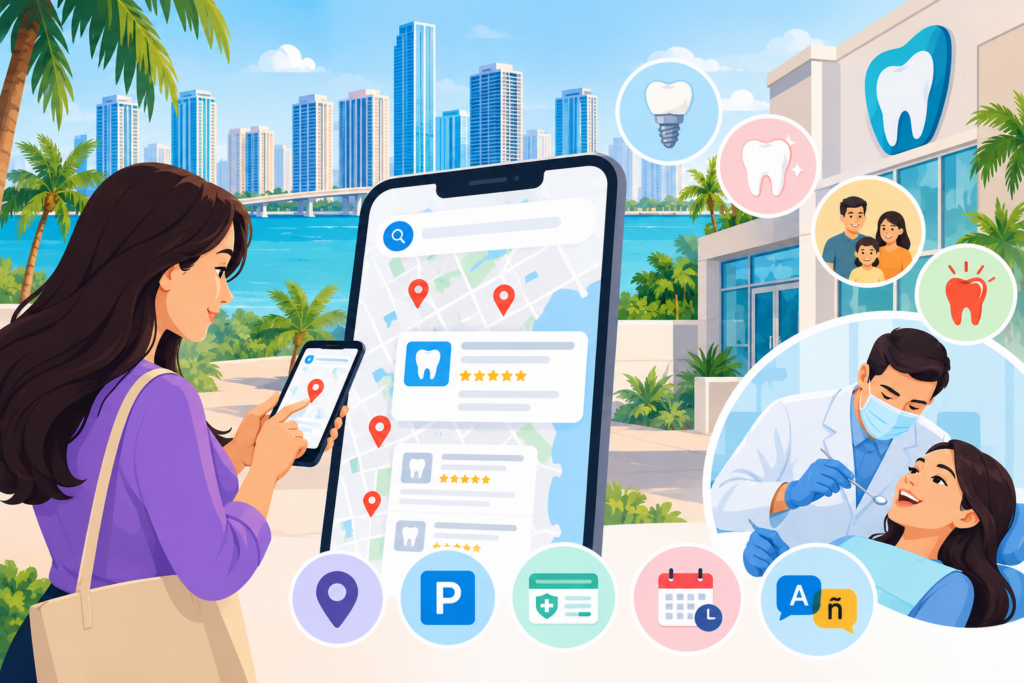
A patient searching for a dentist in Boynton Beach is not looking statewide. They are looking at a map, at three or four practices within a couple of miles, deciding based on what shows up first, what the reviews say, and whether the practice takes their insurance. That is the whole game. We build Boynton Beach dental marketing around that narrow radius instead of treating the city as one line item in a statewide plan.

How Boynton Beach dental buyers search
Two different patients type two different things into Google, and most dental websites only talk to one of them. A retiree in a 55-plus community off Gateway Boulevard or in a neighborhood near Boynton Beach Boulevard searches with Medicare language in mind: “dentist that accepts my insurance near me,” “dentures,” “implant consultation,” “same day crown for a broken tooth.” A younger family near Hunters Run or newer housing closer to Lantana Road searches for a family dentist who can see two kids and a parent on the same visit, often after hours or on a Saturday, and frequently adds “sedation” or “gentle with kids” to the search.
Both groups use “near me” and both check the map pack before they ever click through to a website. But the words after “near me” split hard by age and by what the searcher is actually worried about: cost and coverage versus convenience and kid-friendliness. A site that only speaks to one group loses the other before the phone ever rings, and in a city with this much of a mixed retiree and young-family population, that is half the market walking away unanswered.
Boynton Beach also has a heavier mix of PPO and Medicare Advantage patients than many younger South Florida cities nearby. Practices that list accepted plans clearly, by name, on the page a search leads to, get the call. Practices that just say “we accept most insurance” lose that click to the practice that named the actual plan, because an insurance search is almost always a bottom-of-funnel search from someone ready to book.
Good Boynton Beach dental marketing treats these as two separate paths rather than one generic homepage message:
- Insurance- and procedure-specific pages for retirees asking about dentures, implants, and coverage
- Family- and scheduling-focused pages for parents asking about hours, sedation, and multiple appointments
Matching the landing page to the actual search intent, plan name and all, is what turns a map-pack click into a booked patient instead of a bounce back to the search results.
The competition here
Boynton Beach is not an easy market and we are not going to pretend it is. Run a search for “dentist Boynton Beach” and you will see a mix of single-location independent practices, a few multi-location groups with marketing budgets built for volume, and the map pack dominated by whoever has the review count and the proximity to the searcher’s pin. That map pack is usually the first thing a patient sees, before any organic result, so a practice with a weak or outdated Google Business Profile is giving up visibility it never gets back with a nicer website.
Organic search still matters, but mostly for the terms the map pack does not answer well: “same day dental emergency Boynton Beach,” “sedation dentistry Boynton Beach,” “pediatric dentist near Hunters Run,” “Invisalign Boynton Beach.” Those are the searches where a practice can win with a genuinely specific page, because the big groups tend to run one generic services page for every location instead of writing for each one. A page built around a real procedure, a real patient question, and a real neighborhood will often out-rank a corporate location page that was copied and pasted across twenty cities.
Downtown Boynton and the stretch toward Delray have an independent retail and restaurant scene that does not exist in the surrounding suburban tracts off Congress Avenue and Boynton Beach Boulevard, and that shapes the kind of patient who lives and works nearby: someone comparing local businesses the way they compare a boutique to a chain. That patient reads reviews closely, looks for before-and-after photos, and checks a website for a real address, real staff, and a real phone number before they call. A thin, templated site reads as a chain to that buyer, even if the practice is independently owned and has been in the community for years.
The competitive set also includes:
- Corporate-backed groups with larger ad budgets but generic, unlocalized content
- Specialty practices competing narrowly on sedation, pediatric, or cosmetic terms
- Long-established solo practices with strong reviews but outdated websites

What we build for dental practices in this market
We do not start with a template and swap in the city name. We start with the search terms your actual patients use in Boynton Beach, split by what they are worried about, and build the site and the campaign around that split.
- A homepage and service pages written for both buyer types, with insurance plans named specifically rather than summarized as “most major insurance.”
- A Google Business Profile built out fully with service categories, photos, and a posting cadence, because that profile often outperforms the website itself in the map pack.
- Separate landing experiences for high-intent emergency and sedation searches, which behave differently from routine-checkup searches and should not share one generic page.
- Call tracking on every number published, so you know whether a call came from a Google Ads click, an organic result, or the map pack listing.
- A Google Ads structure that pauses spend on branded searches you’d win organically anyway, and puts budget toward the emergency and new-patient terms where paid actually buys something you don’t already have.
None of this is exotic. It is the work most practices pay for once and then let go stale. The split testing and the plan-by-plan page content are what make it apply to Boynton Beach specifically instead of reading like a generic dental marketing page with a city name pasted on top.
Local SEO
Improve relevant website content, location signals, internal links, and service information to support local search visibility.
Google Business Profile
Review profile accuracy, categories, services, contact details, and other eligible information. Changes should follow Google's Business Profile guidelines.
Treatment pages
Build or improve pages for services such as general dentistry, cosmetic treatments, implants, or emergency appointments when those services are offered.
Paid search campaigns
Target relevant searches, refine location settings, and review search terms to reduce spend on enquiries that do not match the practice.
Conversion tracking
Measure available actions such as appointment-form submissions, calls, and clicks on booking links.
Website improvements
Make service information, insurance details, contact options, and booking steps easier to find on desktop and mobile.
What we measure
We track calls, form submissions, and new-patient appointment requests back to the specific search term, ad, or page that produced them, using call tracking numbers and attribution tied to each channel. That means a monthly report shows which keyword brought in a call about dentures versus a call about a cracked tooth, and which channel is actually worth the spend.
We do not report on rankings alone, because a ranking with no clicks and no calls does not pay a hygienist’s wage. We report on what the phone and the contact form actually produced, and we show you the attribution so you can check it yourself.

What it costs
Cost depends on what you actually need: a website rebuild, ongoing SEO, Google Ads management, or a mix of all three. A Boynton Beach practice chasing emergency and sedation terms within a two-mile radius needs a different budget than one competing across Palm Beach County. We quote based on your current site, your map pack position, and how many practices sit within your real catchment area, not a flat package price. Call us and we’ll give you a straight number after reviewing your actual market, not a vague range meant to sound good on the phone.
- Organic search visibility and relevant website visits.
- Google Business Profile interactions and available performance data.
- Paid campaign clicks, search terms, and advertising costs.
- Tracked calls, appointment-form submissions, and booking actions.
- Enquiry quality, where the practice can reliably share and categorize that information.
- Changes made, issues identified, and recommended next steps.
Get an audit
We will look at your current Google Business Profile, your website's service and insurance pages, your review profile, and the three to five practices actually outranking you in Boynton Beach, and tell you specifically what is costing you new-patient calls. We check page speed, mobile usability, local citation consistency, and whether your scheduling and insurance information actually matches what shows up in search.

FAQ's
These are the 5 questions Boynton Beach homeowners ask us most about dental practice marketing, answered plainly so you know what to expect before any work starts. If yours isn't covered here, get in touch and we'll walk you through it.
Does my practice need a Boynton Beach-specific page, or is one statewide dental page enough?
One page cannot rank for insurance-filtered searches in a dozen cities at once. A Boynton Beach page that names the plans you accept and the neighborhoods you serve competes against practices that did the same thing. A generic statewide page competes against nobody, because it answers no specific search well.
Is the map pack or organic search more important for a dental practice here?
For most routine searches, the map pack wins first. For higher-intent searches like sedation dentistry or same-day emergencies, a well-built organic page can compete directly because fewer practices write dedicated content for those terms.
How long does dental SEO take to show movement in a market like this?
We will not put a timeframe on it, because it depends on your current site, your review count, and how many competing practices are already doing this work. What we can tell you is what we are doing each month and show you the data as it changes.
Do you work with practices that use a dental-specific scheduling or patient system?
Yes. We build around whatever scheduling, intake, or patient communication system you already use rather than asking you to switch platforms to work with us.
What does Strategic Web Designs actually report on each month?
Calls and form submissions tied to the specific keyword, ad, or page that generated them, using call tracking and attribution. You see which channel produced patient contacts, not just a ranking screenshot.