
- Home
- Services
- Portfolio
- About
- Service AreasFort Lauderdale, FL
- Web Design
- Redesign
- WordPress
- Ecommerce
- Landing Pages
- SEO Services
- Local SEO
- GBP
- Google Ads
- PPC
- Digital Marketing
- Internet Marketing
- Advertising
- Tracking
- Dental Marketing
- Medical Marketing
- HVAC Marketing
- Roofing Marketing
- Pest Control Marketing
- Home Services Marketing
- Plumbing Marketing
- Electrical Marketing
- Landscaping Marketing
- Remodeling Marketing
Pembroke Pines, FL- Web Design
- Redesign
- WordPress
- Ecommerce
- Landing Pages
- SEO Services
- Local SEO
- GBP
- Google Ads
- PPC
- Digital Marketing
- Internet Marketing
- Advertising
- Tracking
- Dental Marketing
- Medical Marketing
- HVAC Marketing
- Roofing Marketing
- Pest Control Marketing
- Home Services Marketing
- Plumbing Marketing
- Electrical Marketing
- Landscaping Marketing
- Remodeling Marketing
Hialeah, FL- Web Design
- Redesign
- WordPress
- Ecommerce
- Landing Pages
- SEO Services
- Local SEO
- GBP
- Google Ads
- PPC
- Digital Marketing
- Internet Marketing
- Advertising
- Tracking
- Dental Marketing
- Medical Marketing
- HVAC Marketing
- Roofing Marketing
- Pest Control Marketing
- Home Services Marketing
- Plumbing Marketing
- Electrical Marketing
- Landscaping Marketing
- Remodeling Marketing
Hollywood, FL- Web Design
- Redesign
- WordPress
- Ecommerce
- Landing Pages
- SEO Services
- Local SEO
- GBP
- Google Ads
- PPC
- Digital Marketing
- Internet Marketing
- Advertising
- Tracking
- Dental Marketing
- Medical Marketing
- HVAC Marketing
- Roofing Marketing
- Pest Control Marketing
- Home Services Marketing
- Plumbing Marketing
- Electrical Marketing
- Landscaping Marketing
- Remodeling Marketing
Miramar, FL- Web Design
- Redesign
- WordPress
- Ecommerce
- Landing Pages
- SEO Services
- Local SEO
- GBP
- Google Ads
- PPC
- Digital Marketing
- Internet Marketing
- Advertising
- Tracking
- Dental Marketing
- Medical Marketing
- HVAC Marketing
- Roofing Marketing
- Pest Control Marketing
- Home Services Marketing
- Plumbing Marketing
- Electrical Marketing
- Landscaping Marketing
- Remodeling Marketing
Coral Springs, FL- Web Design
- Redesign
- WordPress
- Ecommerce
- Landing Pages
- SEO Services
- Local SEO
- GBP
- Google Ads
- PPC
- Digital Marketing
- Internet Marketing
- Advertising
- Tracking
- Dental Marketing
- Medical Marketing
- HVAC Marketing
- Roofing Marketing
- Pest Control Marketing
- Home Services Marketing
- Plumbing Marketing
- Electrical Marketing
- Landscaping Marketing
- Remodeling Marketing
Pompano Beach, FL- Web Design
- Redesign
- WordPress
- Ecommerce
- Landing Pages
- SEO Services
- Local SEO
- GBP
- Google Ads
- PPC
- Digital Marketing
- Internet Marketing
- Advertising
- Tracking
- Dental Marketing
- Medical Marketing
- HVAC Marketing
- Roofing Marketing
- Pest Control Marketing
- Home Services Marketing
- Plumbing Marketing
- Electrical Marketing
- Landscaping Marketing
- Remodeling Marketing
Davie, FL- Web Design
- Redesign
- WordPress
- Ecommerce
- Landing Pages
- SEO Services
- Local SEO
- GBP
- Google Ads
- PPC
- Digital Marketing
- Internet Marketing
- Advertising
- Tracking
- Dental Marketing
- Medical Marketing
- HVAC Marketing
- Roofing Marketing
- Pest Control Marketing
- Home Services Marketing
- Plumbing Marketing
- Electrical Marketing
- Landscaping Marketing
- Remodeling Marketing
Sunrise, FL- Web Design
- Redesign
- WordPress
- Ecommerce
- Landing Pages
- SEO Services
- Local SEO
- GBP
- Google Ads
- PPC
- Digital Marketing
- Internet Marketing
- Advertising
- Tracking
- Dental Marketing
- Medical Marketing
- HVAC Marketing
- Roofing Marketing
- Pest Control Marketing
- Home Services Marketing
- Plumbing Marketing
- Electrical Marketing
- Landscaping Marketing
- Remodeling Marketing
Plantation, FL- Web Design
- Redesign
- WordPress
- Ecommerce
- Landing Pages
- SEO Services
- Local SEO
- GBP
- Google Ads
- PPC
- Digital Marketing
- Internet Marketing
- Advertising
- Tracking
- Dental Marketing
- Medical Marketing
- HVAC Marketing
- Roofing Marketing
- Pest Control Marketing
- Home Services Marketing
- Plumbing Marketing
- Electrical Marketing
- Landscaping Marketing
- Remodeling Marketing
Deerfield Beach, FL- Web Design
- Redesign
- WordPress
- Ecommerce
- Landing Pages
- SEO Services
- Local SEO
- GBP
- Google Ads
- PPC
- Digital Marketing
- Internet Marketing
- Advertising
- Tracking
- Dental Marketing
- Medical Marketing
- HVAC Marketing
- Roofing Marketing
- Pest Control Marketing
- Home Services Marketing
- Plumbing Marketing
- Electrical Marketing
- Landscaping Marketing
- Remodeling Marketing
Miami Gardens, FL- Web Design
- Redesign
- WordPress
- Ecommerce
- Landing Pages
- SEO Services
- Local SEO
- GBP
- Google Ads
- PPC
- Digital Marketing
- Internet Marketing
- Advertising
- Tracking
- Dental Marketing
- Medical Marketing
- HVAC Marketing
- Roofing Marketing
- Pest Control Marketing
- Home Services Marketing
- Plumbing Marketing
- Electrical Marketing
- Landscaping Marketing
- Remodeling Marketing
Lauderhill, FL- Web Design
- Redesign
- WordPress
- Ecommerce
- Landing Pages
- SEO Services
- Local SEO
- GBP
- Google Ads
- PPC
- Digital Marketing
- Internet Marketing
- Advertising
- Tracking
- Dental Marketing
- Medical Marketing
- HVAC Marketing
- Roofing Marketing
- Pest Control Marketing
- Home Services Marketing
- Plumbing Marketing
- Electrical Marketing
- Landscaping Marketing
- Remodeling Marketing
West Palm Beach, FL- Web Design
- Redesign
- WordPress
- Ecommerce
- Landing Pages
- SEO Services
- Local SEO
- GBP
- Google Ads
- PPC
- Digital Marketing
- Internet Marketing
- Advertising
- Tracking
- Dental Marketing
- Medical Marketing
- HVAC Marketing
- Roofing Marketing
- Pest Control Marketing
- Home Services Marketing
- Plumbing Marketing
- Electrical Marketing
- Landscaping Marketing
- Remodeling Marketing
Tamarac, FL- Web Design
- Redesign
- WordPress
- Ecommerce
- Landing Pages
- SEO Services
- Local SEO
- GBP
- Google Ads
- PPC
- Digital Marketing
- Internet Marketing
- Advertising
- Tracking
- Dental Marketing
- Medical Marketing
- HVAC Marketing
- Roofing Marketing
- Pest Control Marketing
- Home Services Marketing
- Plumbing Marketing
- Electrical Marketing
- Landscaping Marketing
- Remodeling Marketing
Weston, FL- Web Design
- Redesign
- WordPress
- Ecommerce
- Landing Pages
- SEO Services
- Local SEO
- GBP
- Google Ads
- PPC
- Digital Marketing
- Internet Marketing
- Advertising
- Tracking
- Dental Marketing
- Medical Marketing
- HVAC Marketing
- Roofing Marketing
- Pest Control Marketing
- Home Services Marketing
- Plumbing Marketing
- Electrical Marketing
- Landscaping Marketing
- Remodeling Marketing
Boca Raton, FLMargate, FLCoconut Creek, FLMiami Beach, FLHomestead, FLKendall, FLDoral, FLBoynton Beach, FLThe Hammocks, FLNorth Lauderdale, FLOakland Park, FLDelray Beach, FLNorth Miami, FLHallandale Beach, FLFontainebleau, FLKendale Lakes, FLWellington, FLJupiter, FLTamiami, FLPalm Beach Gardens, FLLauderdale Lakes, FLCooper City, FLCountry Club, FLParkland, FLCoral Gables, FLDania Beach, FLCutler Bay, FLNorth Miami Beach, FLGreenacres, FLLake Worth Beach, FLPrinceton, FLRoyal Palm Beach, FLSouth Miami Heights, FLRichmond West, FLRiviera Beach, FLWest Little River, FLGolden Glades, FLAventura, FLMiami Lakes, FLWestchester, FLLeisure City, FLCoral Terrace, FLPalm Springs, FLPalmetto Bay, FLHialeah Gardens, FLSunny Isles Beach, FLIves Estates, FLWest Park, FLSweetwater, FLPinecrest, FLSunset, FLPinewood, FLWilton Manors, FLOpa-locka, FLLighthouse Point, FLBelle Glade, FLNaranja, FLPalmetto Estates, FLBrownsville, FLKey Biscayne, FLOlympia Heights, FLMiami Springs, FLFlorida City, FLSouth Miami, FLThree Lakes, FLGladeview, FLNorth Palm Beach, FLMiami Shores, FLSouthwest Ranches, FLKings Point, FLLauderdale-by-the-Sea, FLHillsboro Beach, FLSea Ranch Lakes, FLLazy Lake, FL - Blog
- Contact
Ecommerce Website Design in Coral Springs, Florida
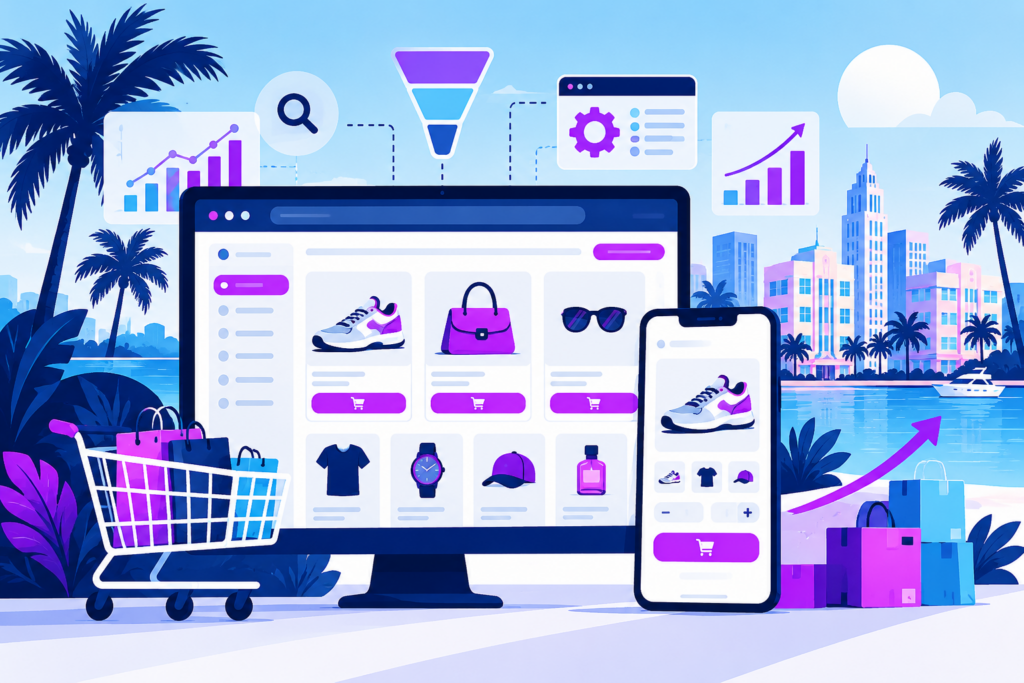
Most businesses in Coral Springs aren’t storefronts. They’re home services companies, HOA-adjacent contractors, and specialty retailers who moved their operation online after the neighborhoods north of Royal Palm Boulevard kept filling in with new rooftops. If you’re one of the few actually selling products online from here, you’re competing less on local map presence and more on whether your product pages load fast, display correctly on mobile, and get indexed the way Google expects. That’s a different problem than the one most web design pitches solve.

Ecommerce Website Design for Coral Springs businesses
An ecommerce buyer and a service buyer behave differently, and the site has to account for that. Someone hiring a lawn company near Coral Springs reads a page and calls a number. Someone buying a product compares price, reads shipping terms, checks if the size chart matches, and leaves if checkout takes more than two steps. We build for that second behavior: product schema markup so Google can show price and availability directly in search results, image and script weight kept low enough that pages load fast on a phone, and a checkout that doesn’t ask for information it doesn’t need. Every added field or forced account creation is another chance for a shopper to abandon the cart, so we trim the path from product page to confirmation down to what’s actually required.
Budget looks different here too. A service business might spend most of its budget on map pack visibility and call tracking. An ecommerce build spends more on the platform itself, on catalog structure, and on the tracking that tells you which product pages actually convert. We scope those differently because they are, in practice, different jobs wearing the same name. A Coral Springs retailer competing against national chains and marketplace listings needs a site that can hold its own on page speed, search visibility, and trust signals like reviews and clear return policies, since shoppers comparing a local shop to a big-box alternative decide fast.
We also plan for the operational side that doesn’t show up in a design mockup: inventory that stays accurate across channels, shipping rules that reflect where you actually ship, and tax settings that don’t require manual fixes every quarter. Platform choice matters here, and we pick based on catalog size, how often products change, and whether you need tight control over custom features or would rather lean on a hosted platform’s built-in tools.
- Product and category pages structured for both search engines and comparison shoppers
- Mobile checkout tested for speed and friction, not just appearance
- Inventory, shipping, and tax setup built to match how you actually run the business
The result is a store built around how people actually shop online, not a brochure site with a cart bolted onto it.
What is different about this market
Coral Springs grew in planned phases, and a lot of the housing stock near Westchester and Eagle Trace went up within the last two decades, with newer construction still filling in toward the west side near Parkland’s border. New homeowners in HOA communities tend to search for things their HOA allows and their neighbors already use: a specific patio furniture brand, a particular security system, a lawn equipment retailer that other residents mention in community Facebook groups. That word-of-mouth layer matters here more than in older, less governed cities, and it means review content and product-specific landing pages carry more weight than a generic homepage.
The business mix compounds this. Walk through the commercial corridors along Sample Road or University Drive and you’ll see far more service vans than retail storefronts. That means the local map pack here is dominated by home services, not product sellers, so an ecommerce business competing for search visibility in Coral Springs isn’t fighting other local stores for the same three map pack spots. You’re fighting nationally for product search terms, which means your product pages need to earn rank on their own technical merit; a Google Business Profile won’t carry an online store the way it carries a plumber. Search here skews heavily mobile, consistent with South Florida generally, which raises the cost of a slow-loading product page. Demand for seasonal categories, pool supplies, hurricane prep, patio goods, tends to spike ahead of summer and storm season, and a site that can’t handle a traffic spike in June loses orders it can’t get back.
What the work covers
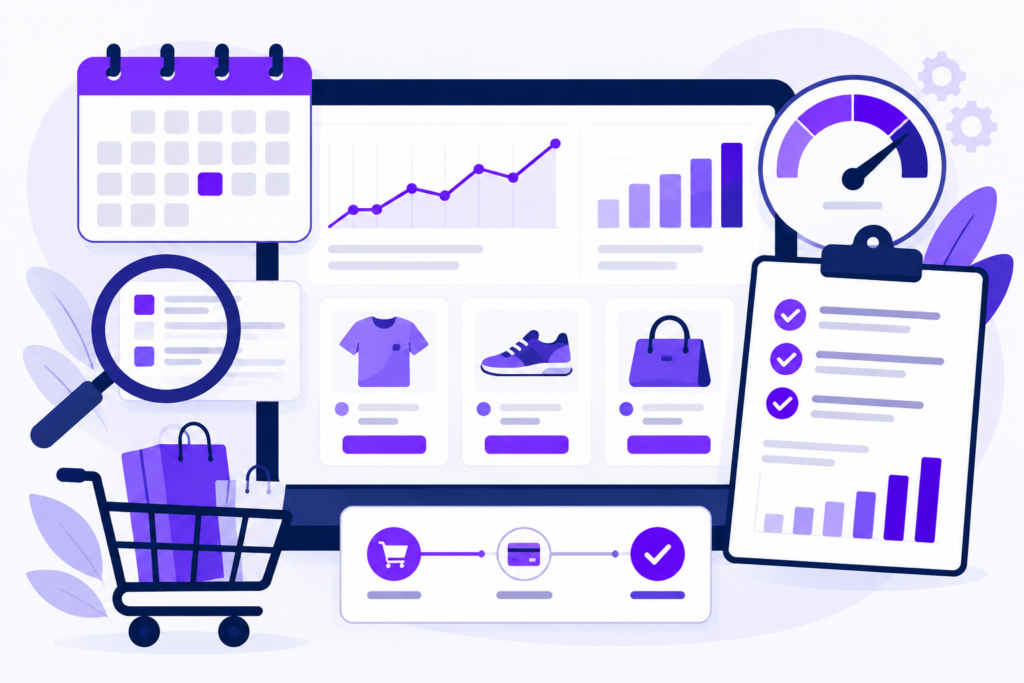
Here’s what actually goes into a build, in the order it happens.
Platform selection. Shopify, WooCommerce, BigCommerce, or a custom build, chosen based on your catalog size, your inventory system, and whether you need wholesale or subscription features. We won’t put a 3,000-SKU catalog on a platform built for 50 products, and we won’t sell you a custom build when an off-the-shelf platform does the job for less.
Product schema. This is structured data that tells Google the price, availability, and review rating of each product directly, so it can show up in search results before someone even clicks through. Without it, your product page competes on title and description alone. With it, you get the price and a star rating sitting in the search result itself. [EXTERNAL LINK: Google’s developer documentation on Product structured data, explaining the actual schema requirements] lays out exactly what fields Google expects, and we build to that spec rather than guessing.
Page speed at scale. A ten-product demo store loads fine on almost anything. A 500-product catalog with filtering, variant images, and a cart that updates live is a different engineering problem. We compress images, lazy-load product grids, and cut unused app scripts, because every extra second of load time on mobile is a measurable drop in conversion.
Checkout. Fewer fields, saved payment options where the platform supports them, and a mobile layout that doesn’t make someone pinch-zoom to hit the submit button. We also check for the quiet killers: unexpected shipping costs revealed only at the last step, forced account creation, and broken coupon fields.
Catalog structure and internal linking. Category pages, filtered views, and related-product modules built so that Google can crawl the whole catalog and so that a shopper can get from a category to checkout in three clicks or fewer.
This mechanism doesn’t change much by city. What changes is which parts matter most for your specific catalog and your specific traffic pattern, which is why the audit comes before the quote.
Product pages and structured data
We organize product information so customers can understand product features, variations, pricing, and availability. Where appropriate, we implement and validate Product structured data to help search engines interpret eligible product details. Structured data does not guarantee enhanced search results, but accurate implementation can support product discovery.
Page speed and technical performance
Large catalogs, high-resolution images, third-party scripts, and complex integrations can slow an online store. We review performance bottlenecks, image delivery, mobile usability, and unnecessary scripts. Testing should cover important templates and shopping journeys rather than only the homepage.
Navigation and catalog structure
Categories, filters, internal links, and product URLs should help customers locate items without creating confusing navigation or unnecessary duplicate pages. We also consider how product variations, unavailable items, and category changes are handled.
Checkout and conversion flow
We review the steps between adding an item to the cart and placing an order. Clear shipping information, transparent costs, accessible forms, suitable payment options, and useful error messages can reduce avoidable friction. Actual checkout changes should be assessed against analytics rather than assumptions.
SEO and measurement
Relevant page titles, meta descriptions, canonical URLs, indexation controls, and XML sitemaps help establish a consistent technical foundation. Analytics and ecommerce event tracking can measure product views, add-to-cart actions, checkout progression, and completed purchases when configured correctly.
How we start
We start every Coral Springs ecommerce project with a discovery call to understand your products, customers, and current sales bottlenecks. From there, we audit your existing store (or map out a new one) and research local competitors across Broward County to find gaps we can exploit for you.
- Define goals: catalog size, payment methods, shipping zones
- Sketch site structure and checkout flow for fast conversions
- Select a platform suited to your inventory and growth plans
You’ll get a clear project roadmap before any design work begins, so there are no surprises on timeline or scope as we build your store.

What it costs
Cost depends on three things: how many products you’re listing, whether you’re migrating an existing store or starting new, and how much custom functionality you need beyond what the platform does out of the box. A straightforward catalog on an established platform costs less than a custom build with subscription billing, multi-location inventory, or a wholesale portal bolted on.
Coral Springs businesses selling into South Florida’s retail and tourism traffic often need extras most templates don’t include: local tax handling, shipping rules for seasonal demand swings, or integrations with point-of-sale systems for stores that sell both online and in person. Each of those adds time, not just features. That’s why we give you a number after the technical audit, not before. A quote built before we’ve seen your catalog, your supplier feeds, and your existing systems is a guess, and guesses are how businesses end up paying twice.

What you get each month
Once your Coral Springs store is live, the work doesn’t stop at launch. Each month you get a report covering traffic by product category, conversion rate, cost per order if you’re running ads, and call tracking data if phone orders factor into your sales. If a product page gets traffic but doesn’t convert, that shows up in the numbers, and we fix the page rather than just flag the issue. If a category underperforms against a seasonal pattern you’d expect, we treat that as a signal to act on, not a detail to file away.
Attribution matters more for ecommerce than most service businesses, since a shopper might find you through organic search, leave, return through a paid ad, and buy days later. Multi-touchpoint tracking shows that full path instead of crediting the last click only, which is the difference between knowing a campaign works and guessing that it does.

Before you invest another dollar in an ecommerce website design project, get a free audit of your current store or your site plan. Coral Springs shoppers compare prices and reviews fast, and they abandon slow or confusing checkouts even faster, so we start by digging into exactly where your store is losing them.
We’ll review your product pages for clear pricing, strong images, and copy that actually answers buyer questions. We’ll walk through your checkout flow step by step, checking for hidden fees, unnecessary form fields, and payment options that local and regional shoppers expect. We’ll also pull your current load times, since every extra second on mobile can quietly push customers back to search results or straight to a competitor.
Once we’ve gone through it all, we’ll tell you plainly what’s working, what’s costing you orders, and what should be fixed first versus what can wait. There’s no sales script and no pressure to sign anything on the spot.
- Product page and listing review
- Checkout flow and payment options
- Mobile speed and load time check
Call (754) 704-4727 or request the audit online to get started.
FAQ's
These are the 5 questions Coral Springs homeowners ask us most about ecommerce website design, answered plainly so you know what to expect before any work starts. If yours isn't covered here, get in touch and we'll walk you through it.
Do you build on Shopify, WooCommerce, or something custom?
It depends on catalog size and what you already use for inventory. A 40-SKU home goods shop and a 4,000-SKU distributor don't belong on the same platform. We'll tell you which one fits before we quote anything, including when the honest answer is to stay where you are and fix what's broken.
Can you move my existing store without losing my product rankings?
Migrations are where most ecommerce rebuilds lose money. URL redirects, product schema, and review data all have to carry over exactly, or you start from zero in search. We map every URL before launch, not after.
How fast does my site need to load for Coral Springs shoppers?
Google's own research into mobile page speed sets the benchmarks we build to, and we'll show you your current load time and where the delay is coming from, whether that's image weight, a bloated app stack, or server response time.
What does the monthly reporting actually show me?
Which products got traffic, which converted, what each campaign cost per order, and call tracking data if phone orders matter to your business. You see the same numbers we're looking at, not a summary slide.
Do you handle PCI compliance and payment setup?
We configure the storefront to work with PCI-compliant payment processors and follow the platform's security requirements. We're not your payment processor or your compliance auditor, and any store handling cardholder data should also review requirements directly with their processor.