
- Home
- Services
- Portfolio
- About
- Service AreasFort Lauderdale, FL
- Web Design
- Redesign
- WordPress
- Ecommerce
- Landing Pages
- SEO Services
- Local SEO
- GBP
- Google Ads
- PPC
- Digital Marketing
- Internet Marketing
- Advertising
- Tracking
- Dental Marketing
- Medical Marketing
- HVAC Marketing
- Roofing Marketing
- Pest Control Marketing
- Home Services Marketing
- Plumbing Marketing
- Electrical Marketing
- Landscaping Marketing
- Remodeling Marketing
Pembroke Pines, FL- Web Design
- Redesign
- WordPress
- Ecommerce
- Landing Pages
- SEO Services
- Local SEO
- GBP
- Google Ads
- PPC
- Digital Marketing
- Internet Marketing
- Advertising
- Tracking
- Dental Marketing
- Medical Marketing
- HVAC Marketing
- Roofing Marketing
- Pest Control Marketing
- Home Services Marketing
- Plumbing Marketing
- Electrical Marketing
- Landscaping Marketing
- Remodeling Marketing
Hialeah, FL- Web Design
- Redesign
- WordPress
- Ecommerce
- Landing Pages
- SEO Services
- Local SEO
- GBP
- Google Ads
- PPC
- Digital Marketing
- Internet Marketing
- Advertising
- Tracking
- Dental Marketing
- Medical Marketing
- HVAC Marketing
- Roofing Marketing
- Pest Control Marketing
- Home Services Marketing
- Plumbing Marketing
- Electrical Marketing
- Landscaping Marketing
- Remodeling Marketing
Hollywood, FL- Web Design
- Redesign
- WordPress
- Ecommerce
- Landing Pages
- SEO Services
- Local SEO
- GBP
- Google Ads
- PPC
- Digital Marketing
- Internet Marketing
- Advertising
- Tracking
- Dental Marketing
- Medical Marketing
- HVAC Marketing
- Roofing Marketing
- Pest Control Marketing
- Home Services Marketing
- Plumbing Marketing
- Electrical Marketing
- Landscaping Marketing
- Remodeling Marketing
Miramar, FL- Web Design
- Redesign
- WordPress
- Ecommerce
- Landing Pages
- SEO Services
- Local SEO
- GBP
- Google Ads
- PPC
- Digital Marketing
- Internet Marketing
- Advertising
- Tracking
- Dental Marketing
- Medical Marketing
- HVAC Marketing
- Roofing Marketing
- Pest Control Marketing
- Home Services Marketing
- Plumbing Marketing
- Electrical Marketing
- Landscaping Marketing
- Remodeling Marketing
Coral Springs, FL- Web Design
- Redesign
- WordPress
- Ecommerce
- Landing Pages
- SEO Services
- Local SEO
- GBP
- Google Ads
- PPC
- Digital Marketing
- Internet Marketing
- Advertising
- Tracking
- Dental Marketing
- Medical Marketing
- HVAC Marketing
- Roofing Marketing
- Pest Control Marketing
- Home Services Marketing
- Plumbing Marketing
- Electrical Marketing
- Landscaping Marketing
- Remodeling Marketing
Pompano Beach, FL- Web Design
- Redesign
- WordPress
- Ecommerce
- Landing Pages
- SEO Services
- Local SEO
- GBP
- Google Ads
- PPC
- Digital Marketing
- Internet Marketing
- Advertising
- Tracking
- Dental Marketing
- Medical Marketing
- HVAC Marketing
- Roofing Marketing
- Pest Control Marketing
- Home Services Marketing
- Plumbing Marketing
- Electrical Marketing
- Landscaping Marketing
- Remodeling Marketing
Davie, FL- Web Design
- Redesign
- WordPress
- Ecommerce
- Landing Pages
- SEO Services
- Local SEO
- GBP
- Google Ads
- PPC
- Digital Marketing
- Internet Marketing
- Advertising
- Tracking
- Dental Marketing
- Medical Marketing
- HVAC Marketing
- Roofing Marketing
- Pest Control Marketing
- Home Services Marketing
- Plumbing Marketing
- Electrical Marketing
- Landscaping Marketing
- Remodeling Marketing
Sunrise, FL- Web Design
- Redesign
- WordPress
- Ecommerce
- Landing Pages
- SEO Services
- Local SEO
- GBP
- Google Ads
- PPC
- Digital Marketing
- Internet Marketing
- Advertising
- Tracking
- Dental Marketing
- Medical Marketing
- HVAC Marketing
- Roofing Marketing
- Pest Control Marketing
- Home Services Marketing
- Plumbing Marketing
- Electrical Marketing
- Landscaping Marketing
- Remodeling Marketing
Plantation, FL- Web Design
- Redesign
- WordPress
- Ecommerce
- Landing Pages
- SEO Services
- Local SEO
- GBP
- Google Ads
- PPC
- Digital Marketing
- Internet Marketing
- Advertising
- Tracking
- Dental Marketing
- Medical Marketing
- HVAC Marketing
- Roofing Marketing
- Pest Control Marketing
- Home Services Marketing
- Plumbing Marketing
- Electrical Marketing
- Landscaping Marketing
- Remodeling Marketing
Deerfield Beach, FL- Web Design
- Redesign
- WordPress
- Ecommerce
- Landing Pages
- SEO Services
- Local SEO
- GBP
- Google Ads
- PPC
- Digital Marketing
- Internet Marketing
- Advertising
- Tracking
- Dental Marketing
- Medical Marketing
- HVAC Marketing
- Roofing Marketing
- Pest Control Marketing
- Home Services Marketing
- Plumbing Marketing
- Electrical Marketing
- Landscaping Marketing
- Remodeling Marketing
Miami Gardens, FL- Web Design
- Redesign
- WordPress
- Ecommerce
- Landing Pages
- SEO Services
- Local SEO
- GBP
- Google Ads
- PPC
- Digital Marketing
- Internet Marketing
- Advertising
- Tracking
- Dental Marketing
- Medical Marketing
- HVAC Marketing
- Roofing Marketing
- Pest Control Marketing
- Home Services Marketing
- Plumbing Marketing
- Electrical Marketing
- Landscaping Marketing
- Remodeling Marketing
Lauderhill, FL- Web Design
- Redesign
- WordPress
- Ecommerce
- Landing Pages
- SEO Services
- Local SEO
- GBP
- Google Ads
- PPC
- Digital Marketing
- Internet Marketing
- Advertising
- Tracking
- Dental Marketing
- Medical Marketing
- HVAC Marketing
- Roofing Marketing
- Pest Control Marketing
- Home Services Marketing
- Plumbing Marketing
- Electrical Marketing
- Landscaping Marketing
- Remodeling Marketing
West Palm Beach, FL- Web Design
- Redesign
- WordPress
- Ecommerce
- Landing Pages
- SEO Services
- Local SEO
- GBP
- Google Ads
- PPC
- Digital Marketing
- Internet Marketing
- Advertising
- Tracking
- Dental Marketing
- Medical Marketing
- HVAC Marketing
- Roofing Marketing
- Pest Control Marketing
- Home Services Marketing
- Plumbing Marketing
- Electrical Marketing
- Landscaping Marketing
- Remodeling Marketing
Tamarac, FL- Web Design
- Redesign
- WordPress
- Ecommerce
- Landing Pages
- SEO Services
- Local SEO
- GBP
- Google Ads
- PPC
- Digital Marketing
- Internet Marketing
- Advertising
- Tracking
- Dental Marketing
- Medical Marketing
- HVAC Marketing
- Roofing Marketing
- Pest Control Marketing
- Home Services Marketing
- Plumbing Marketing
- Electrical Marketing
- Landscaping Marketing
- Remodeling Marketing
Weston, FL- Web Design
- Redesign
- WordPress
- Ecommerce
- Landing Pages
- SEO Services
- Local SEO
- GBP
- Google Ads
- PPC
- Digital Marketing
- Internet Marketing
- Advertising
- Tracking
- Dental Marketing
- Medical Marketing
- HVAC Marketing
- Roofing Marketing
- Pest Control Marketing
- Home Services Marketing
- Plumbing Marketing
- Electrical Marketing
- Landscaping Marketing
- Remodeling Marketing
Boca Raton, FLMargate, FLCoconut Creek, FLMiami Beach, FLHomestead, FLKendall, FLDoral, FLBoynton Beach, FLThe Hammocks, FLNorth Lauderdale, FLOakland Park, FLDelray Beach, FLNorth Miami, FLHallandale Beach, FLFontainebleau, FLKendale Lakes, FLWellington, FLJupiter, FLTamiami, FLPalm Beach Gardens, FLLauderdale Lakes, FLCooper City, FLCountry Club, FLParkland, FLCoral Gables, FLDania Beach, FLCutler Bay, FLNorth Miami Beach, FLGreenacres, FLLake Worth Beach, FLPrinceton, FLRoyal Palm Beach, FLSouth Miami Heights, FLRichmond West, FLRiviera Beach, FLWest Little River, FLGolden Glades, FLAventura, FLMiami Lakes, FLWestchester, FLLeisure City, FLCoral Terrace, FLPalm Springs, FLPalmetto Bay, FLHialeah Gardens, FLSunny Isles Beach, FLIves Estates, FLWest Park, FLSweetwater, FLPinecrest, FLSunset, FLPinewood, FLWilton Manors, FLOpa-locka, FLLighthouse Point, FLBelle Glade, FLNaranja, FLPalmetto Estates, FLBrownsville, FLKey Biscayne, FLOlympia Heights, FLMiami Springs, FLFlorida City, FLSouth Miami, FLThree Lakes, FLGladeview, FLNorth Palm Beach, FLMiami Shores, FLSouthwest Ranches, FLKings Point, FLLauderdale-by-the-Sea, FLHillsboro Beach, FLSea Ranch Lakes, FLLazy Lake, FL - Blog
- Contact
Ecommerce Website Design in Miami Beach, Florida
Ecommerce Website Design for Miami Beach businesses
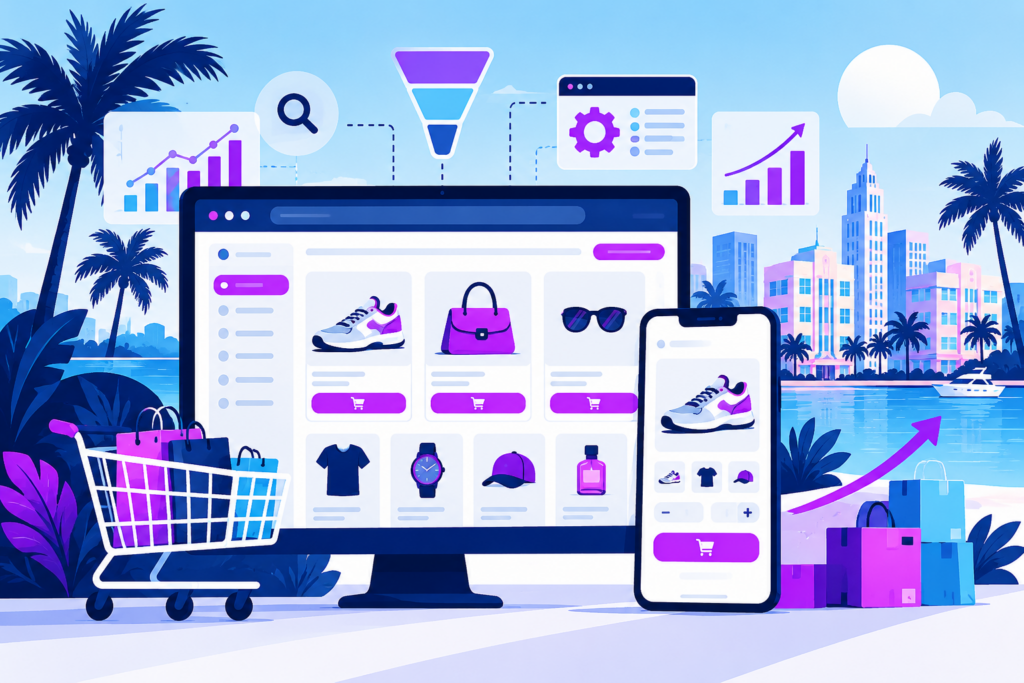
A boutique on Lincoln Road and a charter fishing outfit out of South Pointe are not selling the same way, but they share the same problem: a slow or confusing store loses the sale in the first five seconds, especially on a phone held by someone walking between a hotel and the beach. We build the store to carry the load of that moment, not just to look right in a mockup.
This page covers how we approach ecommerce for Miami Beach businesses, what the build actually includes, and what it costs to get it right.

What the work covers
Ecommerce work splits into three jobs that get lumped together too often: making the site fast, making products findable, and making checkout easy to finish. We treat each one as a separate line item, not a side effect of good design.
Product schema. Every product page gets structured data markup so Google and Bing can show price, availability and review stars directly in search results. Without it, your listing is a blue link next to a competitor’s rich result with stars and a price. That gap costs clicks before anyone sees your site.
Page speed at scale. A single product page can be made fast easily. The hard part is keeping load times down across a catalog of 200 or 2,000 SKUs, through image-heavy collection pages, filters, and a shopping cart that updates without reloading the page. We compress and serve images in modern formats, lazy-load below the fold, and keep third-party scripts (the review widget, the pixel, the chat tool) from blocking the page from rendering.
Checkout. Every field you ask for past email, shipping address and payment is a reason to abandon the cart. We build checkout flows with guest checkout on by default, autofill support, and payment options that match how your actual customers pay, whether that is a card, Apple Pay, or a split-pay option for a higher ticket item like dive gear or event packages.
Underneath that, we handle the inventory sync (so a sold-out item does not sit live on the site), the tax and shipping logic for Florida and out-of-state orders, and the analytics wiring so you can see which product pages convert and which just get traffic.
None of this is specific to Miami Beach. It is the same mechanical work whether the store is selling swimwear or surgical supplies. What changes by city is who is buying, how they search, and what they need to trust before they hand over a card number. That is the next section.
What is different about this market
Miami Beach retail and hospitality run on a tourist calendar, not a calendar year. A swimwear shop, a boat charter, a restaurant with a private dining page, a short-term rental manager with ten units: all of them see demand climb hard from December through April and drop in the slow summer months. A store built with one fixed layout and no plan for seasonal merchandising fights that swing instead of using it. We build collection pages and homepage modules that can be re-weighted by season without a developer rebuilding the template every time, so a boat rental business can push summer sunset cruise packages to the front in June and winter charter rates in January.
The buyer here is also often managing more than one location or property. A restaurant group with locations in Miami Beach and on the mainland, a rental manager with units spread across South Beach and Mid-Beach, a dive shop with a retail counter and a booking calendar: these businesses need a site structure that keeps each location or property distinct for local search while sharing one backend, not a dozen disconnected microsites.
Competition for search terms in Miami Beach is dense. Hospitality, food service, and short-term rentals compete against large national platforms as well as each other, and a lot of that competition is paid, not organic, because the ad budgets in tourism are large. That makes organic product and service pages, plus structured data that earns a rich result, worth more here than in a market where you are mainly competing with other small local businesses.
Reviews carry unusual weight in this group. A visitor deciding between two boat charters or two rental apartments is reading reviews before they read your copy, and a store or booking site that does not surface review count and rating on the product or listing page is leaving trust on the table that a competitor’s page is collecting. We treat review display as part of the ecommerce build, not a separate reputation project bolted on later.
Search behavior here skews mobile more than most mid-size Florida cities, driven by visitors searching on foot or from a hotel room rather than a desktop at a desk. Spanish-language search also matters in this market; a meaningful share of both residents and visitors in Miami-Dade County search and shop in Spanish, and a store with no Spanish product descriptions or checkout flow is invisible to that share of demand. [EXTERNAL LINK: U.S. Census Bureau QuickFacts for Miami-Dade County, for language and demographic data] We factor that into page structure from the start rather than offering it as a translation plug-in afterward.

How we start
Every Miami Beach ecommerce build starts with a working session, not a template. We dig into your product catalog, margins, and shipping logistics, then map out how locals and seasonal visitors actually shop, factoring in tourist traffic spikes and snowbird buying patterns unique to this market. We review your current storefront or sketch a fresh structure, define must-have features like inventory sync, mobile checkout, and local pickup options, then outline a realistic timeline and budget. You’ll get a clear plan covering platform choice, payment processing, and design direction before any code is written. This upfront strategy phase keeps the project focused, avoids costly rebuilds later, and ensures the final site fits how your Miami Beach customers actually browse and buy.
Product pages and structured data
We organize product information so customers can understand product features, variations, pricing, and availability. Where appropriate, we implement and validate Product structured data to help search engines interpret eligible product details. Structured data does not guarantee enhanced search results, but accurate implementation can support product discovery.
Page speed and technical performance
Large catalogs, high-resolution images, third-party scripts, and complex integrations can slow an online store. We review performance bottlenecks, image delivery, mobile usability, and unnecessary scripts. Testing should cover important templates and shopping journeys rather than only the homepage.
Navigation and catalog structure
Categories, filters, internal links, and product URLs should help customers locate items without creating confusing navigation or unnecessary duplicate pages. We also consider how product variations, unavailable items, and category changes are handled.
Checkout and conversion flow
We review the steps between adding an item to the cart and placing an order. Clear shipping information, transparent costs, accessible forms, suitable payment options, and useful error messages can reduce avoidable friction. Actual checkout changes should be assessed against analytics rather than assumptions.
SEO and measurement
Relevant page titles, meta descriptions, canonical URLs, indexation controls, and XML sitemaps help establish a consistent technical foundation. Analytics and ecommerce event tracking can measure product views, add-to-cart actions, checkout progression, and completed purchases when configured correctly.
What it costs
Ecommerce projects price out differently than a brochure site because the catalog size, the number of product variants, and the integrations (booking calendar, POS sync, shipping carrier) all move the scope. We quote a range after a short call about your product count and what the site needs to connect to, not before. If someone quotes you an ecommerce build without asking how many SKUs you have, that number is a guess.
Ask us for a free audit of your current site or draft project, and we will tell you plainly whether a number you were quoted elsewhere matches the scope of work described.

What you get each month
Launch is not the finish line. Each month we report on what actually happened on your Miami Beach store: which product pages got traffic, which converted, where carts were abandoned, and what a call or form fill cost to generate. Call tracking ties each lead to the page or campaign that produced it, so a call from a boat charter listing is not credited to the homepage by default.
We also track multi-touchpoint attribution: if someone sees a Google ad, finds you again later through organic search, then books, you see that full path instead of just the last click. For a seasonal business, that matters, a March booking may have started with a January search, and last-click credit alone hides where your marketing spend is actually working.
- Plain-language monthly report, not a dashboard full of unexplained metrics

Get a free audit
If you’re running a store, a booking site, or a vacation rental listing site in Miami Beach and it’s not converting the way you expect, send it over. We’ll dig into page speed, product schema, checkout flow, cart abandonment triggers, and mobile usability, then tell you specifically what is costing you sales. We also check how your site handles the seasonal traffic swings that come with South Florida tourism, since a slow cart or a clunky mobile checkout hurts more when visitors are browsing from the beach on a phone. No pressure, no guaranteed numbers, just a plain audit of what is working and what is not, written in plain language instead of agency jargon.
Questions
Thinking about an ecommerce site for your Miami Beach business? Merchants here tend to ask the same handful of smart questions before committing, from which platform fits their catalog to how a bilingual storefront should work for both English and Spanish-speaking shoppers. Below we cover platform choices, calendar integrations, seasonal traffic swings tied to tourism, and exactly what you’ll see in your monthly performance reports.
Do you build on Shopify, WooCommerce, or something custom?
It depends on catalog size and what you need the store to connect to. Shopify tends to fit smaller to mid-size catalogs with standard shipping needs. WooCommerce gives more control when a booking calendar, membership area, or unusual tax rule is involved. We will tell you which fits before we quote, not after.
Can you connect a booking or reservation calendar to the store?
Yes. Boat charters, rental units and restaurants with private event bookings all need a calendar that blocks sold-out dates in real time. We integrate that with the storefront so a customer sees accurate availability instead of booking a date that is already taken.
Will the site work for both English and Spanish-speaking customers?
We can build product pages and checkout flows in both languages where the business has bilingual staff to support orders. This matters in Miami-Dade County more than in most markets, since a real share of local and visitor search happens in Spanish.
How do you handle the slow season?
We build the homepage and collection pages so merchandising can shift by season without a full rebuild. A charter or rental business can push different packages to the front in peak months versus the off-season without paying for a redesign each time.
What does the monthly report actually show?
Product page traffic and conversion, cart abandonment points, call tracking tied to the page or campaign that produced the call, and multi-touchpoint attribution showing the path a customer took before they bought or booked.