
- Home
- Services
- Portfolio
- About
- Service AreasFort Lauderdale, FL
- Web Design
- Redesign
- WordPress
- Ecommerce
- Landing Pages
- SEO Services
- Local SEO
- GBP
- Google Ads
- PPC
- Digital Marketing
- Internet Marketing
- Advertising
- Tracking
- Dental Marketing
- Medical Marketing
- HVAC Marketing
- Roofing Marketing
- Pest Control Marketing
- Home Services Marketing
- Plumbing Marketing
- Electrical Marketing
- Landscaping Marketing
- Remodeling Marketing
Pembroke Pines, FL- Web Design
- Redesign
- WordPress
- Ecommerce
- Landing Pages
- SEO Services
- Local SEO
- GBP
- Google Ads
- PPC
- Digital Marketing
- Internet Marketing
- Advertising
- Tracking
- Dental Marketing
- Medical Marketing
- HVAC Marketing
- Roofing Marketing
- Pest Control Marketing
- Home Services Marketing
- Plumbing Marketing
- Electrical Marketing
- Landscaping Marketing
- Remodeling Marketing
Hialeah, FL- Web Design
- Redesign
- WordPress
- Ecommerce
- Landing Pages
- SEO Services
- Local SEO
- GBP
- Google Ads
- PPC
- Digital Marketing
- Internet Marketing
- Advertising
- Tracking
- Dental Marketing
- Medical Marketing
- HVAC Marketing
- Roofing Marketing
- Pest Control Marketing
- Home Services Marketing
- Plumbing Marketing
- Electrical Marketing
- Landscaping Marketing
- Remodeling Marketing
Hollywood, FL- Web Design
- Redesign
- WordPress
- Ecommerce
- Landing Pages
- SEO Services
- Local SEO
- GBP
- Google Ads
- PPC
- Digital Marketing
- Internet Marketing
- Advertising
- Tracking
- Dental Marketing
- Medical Marketing
- HVAC Marketing
- Roofing Marketing
- Pest Control Marketing
- Home Services Marketing
- Plumbing Marketing
- Electrical Marketing
- Landscaping Marketing
- Remodeling Marketing
Miramar, FL- Web Design
- Redesign
- WordPress
- Ecommerce
- Landing Pages
- SEO Services
- Local SEO
- GBP
- Google Ads
- PPC
- Digital Marketing
- Internet Marketing
- Advertising
- Tracking
- Dental Marketing
- Medical Marketing
- HVAC Marketing
- Roofing Marketing
- Pest Control Marketing
- Home Services Marketing
- Plumbing Marketing
- Electrical Marketing
- Landscaping Marketing
- Remodeling Marketing
Coral Springs, FL- Web Design
- Redesign
- WordPress
- Ecommerce
- Landing Pages
- SEO Services
- Local SEO
- GBP
- Google Ads
- PPC
- Digital Marketing
- Internet Marketing
- Advertising
- Tracking
- Dental Marketing
- Medical Marketing
- HVAC Marketing
- Roofing Marketing
- Pest Control Marketing
- Home Services Marketing
- Plumbing Marketing
- Electrical Marketing
- Landscaping Marketing
- Remodeling Marketing
Pompano Beach, FL- Web Design
- Redesign
- WordPress
- Ecommerce
- Landing Pages
- SEO Services
- Local SEO
- GBP
- Google Ads
- PPC
- Digital Marketing
- Internet Marketing
- Advertising
- Tracking
- Dental Marketing
- Medical Marketing
- HVAC Marketing
- Roofing Marketing
- Pest Control Marketing
- Home Services Marketing
- Plumbing Marketing
- Electrical Marketing
- Landscaping Marketing
- Remodeling Marketing
Davie, FL- Web Design
- Redesign
- WordPress
- Ecommerce
- Landing Pages
- SEO Services
- Local SEO
- GBP
- Google Ads
- PPC
- Digital Marketing
- Internet Marketing
- Advertising
- Tracking
- Dental Marketing
- Medical Marketing
- HVAC Marketing
- Roofing Marketing
- Pest Control Marketing
- Home Services Marketing
- Plumbing Marketing
- Electrical Marketing
- Landscaping Marketing
- Remodeling Marketing
Sunrise, FL- Web Design
- Redesign
- WordPress
- Ecommerce
- Landing Pages
- SEO Services
- Local SEO
- GBP
- Google Ads
- PPC
- Digital Marketing
- Internet Marketing
- Advertising
- Tracking
- Dental Marketing
- Medical Marketing
- HVAC Marketing
- Roofing Marketing
- Pest Control Marketing
- Home Services Marketing
- Plumbing Marketing
- Electrical Marketing
- Landscaping Marketing
- Remodeling Marketing
Plantation, FL- Web Design
- Redesign
- WordPress
- Ecommerce
- Landing Pages
- SEO Services
- Local SEO
- GBP
- Google Ads
- PPC
- Digital Marketing
- Internet Marketing
- Advertising
- Tracking
- Dental Marketing
- Medical Marketing
- HVAC Marketing
- Roofing Marketing
- Pest Control Marketing
- Home Services Marketing
- Plumbing Marketing
- Electrical Marketing
- Landscaping Marketing
- Remodeling Marketing
Deerfield Beach, FL- Web Design
- Redesign
- WordPress
- Ecommerce
- Landing Pages
- SEO Services
- Local SEO
- GBP
- Google Ads
- PPC
- Digital Marketing
- Internet Marketing
- Advertising
- Tracking
- Dental Marketing
- Medical Marketing
- HVAC Marketing
- Roofing Marketing
- Pest Control Marketing
- Home Services Marketing
- Plumbing Marketing
- Electrical Marketing
- Landscaping Marketing
- Remodeling Marketing
Miami Gardens, FL- Web Design
- Redesign
- WordPress
- Ecommerce
- Landing Pages
- SEO Services
- Local SEO
- GBP
- Google Ads
- PPC
- Digital Marketing
- Internet Marketing
- Advertising
- Tracking
- Dental Marketing
- Medical Marketing
- HVAC Marketing
- Roofing Marketing
- Pest Control Marketing
- Home Services Marketing
- Plumbing Marketing
- Electrical Marketing
- Landscaping Marketing
- Remodeling Marketing
Lauderhill, FL- Web Design
- Redesign
- WordPress
- Ecommerce
- Landing Pages
- SEO Services
- Local SEO
- GBP
- Google Ads
- PPC
- Digital Marketing
- Internet Marketing
- Advertising
- Tracking
- Dental Marketing
- Medical Marketing
- HVAC Marketing
- Roofing Marketing
- Pest Control Marketing
- Home Services Marketing
- Plumbing Marketing
- Electrical Marketing
- Landscaping Marketing
- Remodeling Marketing
West Palm Beach, FL- Web Design
- Redesign
- WordPress
- Ecommerce
- Landing Pages
- SEO Services
- Local SEO
- GBP
- Google Ads
- PPC
- Digital Marketing
- Internet Marketing
- Advertising
- Tracking
- Dental Marketing
- Medical Marketing
- HVAC Marketing
- Roofing Marketing
- Pest Control Marketing
- Home Services Marketing
- Plumbing Marketing
- Electrical Marketing
- Landscaping Marketing
- Remodeling Marketing
Tamarac, FL- Web Design
- Redesign
- WordPress
- Ecommerce
- Landing Pages
- SEO Services
- Local SEO
- GBP
- Google Ads
- PPC
- Digital Marketing
- Internet Marketing
- Advertising
- Tracking
- Dental Marketing
- Medical Marketing
- HVAC Marketing
- Roofing Marketing
- Pest Control Marketing
- Home Services Marketing
- Plumbing Marketing
- Electrical Marketing
- Landscaping Marketing
- Remodeling Marketing
Weston, FL- Web Design
- Redesign
- WordPress
- Ecommerce
- Landing Pages
- SEO Services
- Local SEO
- GBP
- Google Ads
- PPC
- Digital Marketing
- Internet Marketing
- Advertising
- Tracking
- Dental Marketing
- Medical Marketing
- HVAC Marketing
- Roofing Marketing
- Pest Control Marketing
- Home Services Marketing
- Plumbing Marketing
- Electrical Marketing
- Landscaping Marketing
- Remodeling Marketing
Boca Raton, FLMargate, FLCoconut Creek, FLMiami Beach, FLHomestead, FLKendall, FLDoral, FLBoynton Beach, FLThe Hammocks, FLNorth Lauderdale, FLOakland Park, FLDelray Beach, FLNorth Miami, FLHallandale Beach, FLFontainebleau, FLKendale Lakes, FLWellington, FLJupiter, FLTamiami, FLPalm Beach Gardens, FLLauderdale Lakes, FLCooper City, FLCountry Club, FLParkland, FLCoral Gables, FLDania Beach, FLCutler Bay, FLNorth Miami Beach, FLGreenacres, FLLake Worth Beach, FLPrinceton, FLRoyal Palm Beach, FLSouth Miami Heights, FLRichmond West, FLRiviera Beach, FLWest Little River, FLGolden Glades, FLAventura, FLMiami Lakes, FLWestchester, FLLeisure City, FLCoral Terrace, FLPalm Springs, FLPalmetto Bay, FLHialeah Gardens, FLSunny Isles Beach, FLIves Estates, FLWest Park, FLSweetwater, FLPinecrest, FLSunset, FLPinewood, FLWilton Manors, FLOpa-locka, FLLighthouse Point, FLBelle Glade, FLNaranja, FLPalmetto Estates, FLBrownsville, FLKey Biscayne, FLOlympia Heights, FLMiami Springs, FLFlorida City, FLSouth Miami, FLThree Lakes, FLGladeview, FLNorth Palm Beach, FLMiami Shores, FLSouthwest Ranches, FLKings Point, FLLauderdale-by-the-Sea, FLHillsboro Beach, FLSea Ranch Lakes, FLLazy Lake, FL - Blog
- Contact
Website Redesign in Hallandale Beach, Florida
Website Redesign for Hallandale Beach businesses
A restaurant on Hollywood Beach Boulevard near the Hallandale line doesn't lose business because its website looks dated. It loses business when a redesign strips out the pages Google already trusts and the phone stops ringing for two months. That's the actual risk of a redesign, and it's the part most proposals skip.

We treat a redesign as a migration project first and a design project second. Before anything gets rebuilt, we map every indexed URL, every backlink, and every page currently pulling in traffic for Hallandale Beach searches. That list becomes the blueprint for the new site’s URL structure, so a page ranking for “oceanfront suites Hallandale Beach” or “Hallandale Beach condo rentals” today still exists, under the same or a properly redirected URL, the day the new site goes live. Skipping this step is how businesses along Hallandale Beach Boulevard and the Gulfstream corridor lose years of ranking equity overnight during a redesign; we build the audit in specifically to prevent that.
Design comes after that mapping, not before it. Once we know what has to survive the move, we rebuild the site around it: faster load times, mobile-first layouts, and booking or reservation flows that don’t bury the call-to-action under three menu clicks. For Hallandale Beach businesses, that usually means:
- Streamlined booking or inquiry forms built for visitors searching on mobile from the beach, the Village, or Gulfstream Park
- Image-heavy pages optimized so property photos, menus, or galleries load quickly without tanking page speed scores
- Clear local signals, service areas, neighborhood references, and schema markup, carried over and strengthened, not stripped out during the rebuild
- A navigation structure that gets visitors to a quote, a reservation, or a contact form in one or two clicks instead of three or four
We also audit how the current site performs against the specific competitors ranking in Hallandale Beach and the surrounding Broward County market, not generic national benchmarks, so the redesign is built to outperform the sites actually competing for the same local searches. Every redirect is mapped and tested before launch, every page is checked against its old analytics data to confirm nothing valuable got dropped, and we monitor rankings closely in the weeks after launch to catch and fix any slippage immediately. The result is a site that looks and functions like a modern rebuild while keeping the search visibility, local relevance, and lead flow the old site had already earned.
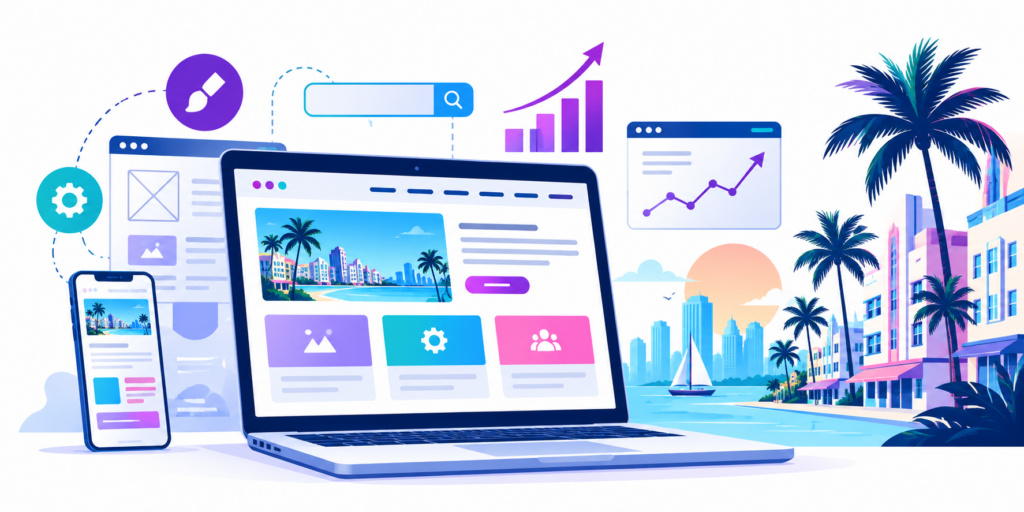
What the work covers
A redesign at this level is a defined sequence, not a reskin. Here’s what’s actually involved:
- Full site audit. We pull every indexed page, every ranking keyword, and every backlink pointing at the current site, so nothing valuable gets deleted by accident.
- 301 redirect mapping. Every old URL that carries ranking value or earned links gets mapped to its new address before launch, not after someone notices traffic dropped.
- Content and page preservation. Pages that already rank for a service or a property type get rebuilt with the same core content and intent, improved, not replaced with generic copy.
- Mobile-first rebuild. The new site is built and tested on phones first, because most hospitality and rental searches in this market happen on a phone, often while someone is standing on the beach deciding where to eat.
- Review and reputation integration. Google reviews, TripAdvisor feedback, and booking-platform ratings get pulled into the new design where they’re visible, not buried on a separate page nobody clicks.
- Call tracking and analytics setup. A new phone number or tracking line goes in from day one, so you can see which pages generate calls and which ones generate silence.
- Staged launch with monitoring. We don’t flip a switch and walk away. The new site goes live in a controlled window, and we watch indexing, redirects, and rankings daily for the weeks after.
None of this is exotic. It’s the difference between a redesign that protects what you’ve built and one that quietly resets it to zero.

What is different about this market
Hallandale Beach runs on tourism, residency turnover, and a hospitality economy that doesn’t look like most of Broward County. You’ve got oceanfront condo-hotels, Gulfstream Park and its casino traffic, a dense short-term rental supply competing with the big booking platforms, and a restaurant and nightlife scene that leans hard on walk-in and last-minute decisions. That mix means your website is competing with Airbnb, Booking.com, and TripAdvisor listings as much as with the restaurant two blocks over, and a slow or review-light site loses that fight before a visitor even calls.
Search behavior here skews heavily mobile, and it skews toward trust signals over price. Someone searching “waterfront dinner Hallandale Beach” or “pet friendly rental near Gulfstream” on their phone is deciding in seconds whether to click through, and what decides it is usually a review count, a photo, or a clear answer to “is this open now.” Demand also swings hard by season: winter and spring bring snowbirds and event traffic tied to racing and concerts at Hard Rock Stadium nearby, while the off-season requires a site that still converts the thinner local and weekday traffic. A substantial share of the local population and visiting traffic is Spanish-speaking, so a bilingual site, or at minimum bilingual key pages, isn’t a nice-to-have here the way it might be inland. Competition is also unusually dense for a city this size: with so many properties and venues within a few square miles, ranking locally takes more than a business name and an address on a page. It takes service-specific pages, structured review content, and a site built to convert on the first visit, because there often isn’t a second one before a visitor books somewhere else.
Website audit
Review existing pages, navigation, performance, and technical issues before deciding what needs to change.
URL and content mapping
Identify important existing URLs and match them to the most relevant pages on the redesigned site.
301 redirects
Redirect permanently moved URLs to appropriate replacement pages when necessary, helping users and search engines find the new destinations.
Responsive design
Improve usability across desktop computers, tablets, and mobile devices.
Speed and performance
Review oversized images, unnecessary scripts, and other factors that affect loading and interaction.
Conversion improvements
Make enquiry forms, phone links, service information, and calls to action easier to find.
SEO checks
Review page titles, headings, internal links, indexability, canonical tags, and XML sitemaps where relevant.
Launch testing
Check redirects, links, forms, important content, and key user journeys before and after launch.
How we start
We start with the audit, not a mockup. Before we design anything, we document what the current site ranks for, what links point at it, and what’s actually driving calls or bookings. That audit becomes the redesign brief. If you manage multiple properties or locations in Hallandale Beach, we also map which pages serve which location, so the new structure doesn’t collapse three properties into one generic page and lose the ability to rank each one individually.

What it costs
Redesign cost depends on how many pages, properties, or booking integrations are involved, and whether the current site needs a full content rebuild or mostly a structural and design overhaul. A small Hallandale Beach service business site runs differently than a multi-unit rental operation near the beach with live availability calendars, payment processing, and multiple property listings to migrate. We’ll give you a scoped number after the audit, not before, because quoting blind is how agencies end up redesigning the wrong things, or missing the integrations that actually matter to your guests and customers. Our audit looks at:
- Current site performance, mobile usability, and search visibility
- Booking, payment, or property-management integrations in use
- Content that can be reused versus rebuilt from scratch
Ask for a free audit and we’ll tell you what your site actually needs before we talk price.

What you get each month
A redesign isn’t a one-time handoff. After launch, we monitor indexing, rankings, and site speed, reporting what’s changed since migration. Hallandale Beach clients get real visibility into performance, not a PDF restating the same three metrics every month.
- Audit the existing site: Review important URLs, organic landing pages, technical issues, and available analytics data.
- Set priorities: Identify content to retain, pages to improve, and structural changes that support your business goals.
- Plan the migration: Map old URLs to appropriate new destinations and document required redirects.
- Redesign and test: Improve layouts, navigation, speed, and conversion paths while checking key technical elements.
- Monitor after launch: Check redirects, indexing, traffic, and enquiries to identify problems that need attention.
You also get call tracking tied to specific pages, so you know if your booking page or your menu page is the one generating phone calls. That data feeds directly into what we adjust next.

If your Hallandale Beach website still looks and functions like it did five years ago, it’s likely costing you customers to competitors with faster, cleaner, mobile-friendly sites. A website redesign from Strategic Web Designs goes beyond fresh colors and fonts — we rebuild your site’s structure, speed, and user experience to turn visitors into calls, bookings, and sales. We start by auditing your current site’s performance, identifying where visitors drop off, and benchmarking against other businesses competing for the same Hallandale Beach and Broward County customers.
From there, we design a site that loads quickly on mobile devices, guides visitors clearly toward contacting you, and reflects the quality of your business at first glance. Every redesign is built with SEO in mind, so you don’t lose the rankings and traffic you’ve already earned — you build on them.
- Mobile-first layouts built for how Hallandale Beach shoppers actually browse
- Clear calls-to-action that turn page visits into calls and bookings
- SEO-preserving migration so existing rankings carry over, not reset
FAQ's
These are the 6 questions Hallandale Beach homeowners ask us most about website redesign, answered plainly so you know what to expect before any work starts. If yours isn't covered here, get in touch and we'll walk you through it.
Will a redesign hurt my current Google rankings?
It can, if the migration is handled carelessly. Deleted pages, missing redirects, and changed URLs are the usual causes of a ranking drop after a redesign. We map every indexed page and its redirect path before launch specifically to prevent that.
How long does a redesign take for a hotel or rental property site?
It depends on how many properties, rooms, or listings need individual pages, and how much booking or reservation functionality is involved. We scope a realistic timeline after the audit rather than quoting one upfront.
Can you redesign a site that manages multiple locations or properties?
Yes. We map which pages serve which property before rebuilding, so each location keeps its own page, its own reviews, and its own ability to rank, instead of being merged into one generic page.
Do you keep my existing reviews and ratings during a redesign?
Yes. Reviews from Google, TripAdvisor, and booking platforms get pulled into the new design in visible places, since reviews are often the deciding factor for hospitality and rental searches in this market.
Should my site be bilingual?
For many Hallandale Beach businesses, yes. A large share of local residents and visitors search in Spanish, so bilingual key pages are worth building into the redesign rather than adding later.
What happens to my site during the actual launch?
Get a free audit
If your current site is costing you bookings during peak season or disappearing from search when it shouldn’t, the first step is an audit, not a redesign quote. We’ll show you what’s actually ranking, what a migration would need to protect, and what’s realistic to fix. Call (754) 704-4727 or request a free audit to see where your Hallandale Beach site stands today.