
- Home
- Services
- Portfolio
- About
- Service AreasFort Lauderdale, FL
- Web Design
- Redesign
- WordPress
- Ecommerce
- Landing Pages
- SEO Services
- Local SEO
- GBP
- Google Ads
- PPC
- Digital Marketing
- Internet Marketing
- Advertising
- Tracking
- Dental Marketing
- Medical Marketing
- HVAC Marketing
- Roofing Marketing
- Pest Control Marketing
- Home Services Marketing
- Plumbing Marketing
- Electrical Marketing
- Landscaping Marketing
- Remodeling Marketing
Pembroke Pines, FL- Web Design
- Redesign
- WordPress
- Ecommerce
- Landing Pages
- SEO Services
- Local SEO
- GBP
- Google Ads
- PPC
- Digital Marketing
- Internet Marketing
- Advertising
- Tracking
- Dental Marketing
- Medical Marketing
- HVAC Marketing
- Roofing Marketing
- Pest Control Marketing
- Home Services Marketing
- Plumbing Marketing
- Electrical Marketing
- Landscaping Marketing
- Remodeling Marketing
Hialeah, FL- Web Design
- Redesign
- WordPress
- Ecommerce
- Landing Pages
- SEO Services
- Local SEO
- GBP
- Google Ads
- PPC
- Digital Marketing
- Internet Marketing
- Advertising
- Tracking
- Dental Marketing
- Medical Marketing
- HVAC Marketing
- Roofing Marketing
- Pest Control Marketing
- Home Services Marketing
- Plumbing Marketing
- Electrical Marketing
- Landscaping Marketing
- Remodeling Marketing
Hollywood, FL- Web Design
- Redesign
- WordPress
- Ecommerce
- Landing Pages
- SEO Services
- Local SEO
- GBP
- Google Ads
- PPC
- Digital Marketing
- Internet Marketing
- Advertising
- Tracking
- Dental Marketing
- Medical Marketing
- HVAC Marketing
- Roofing Marketing
- Pest Control Marketing
- Home Services Marketing
- Plumbing Marketing
- Electrical Marketing
- Landscaping Marketing
- Remodeling Marketing
Miramar, FL- Web Design
- Redesign
- WordPress
- Ecommerce
- Landing Pages
- SEO Services
- Local SEO
- GBP
- Google Ads
- PPC
- Digital Marketing
- Internet Marketing
- Advertising
- Tracking
- Dental Marketing
- Medical Marketing
- HVAC Marketing
- Roofing Marketing
- Pest Control Marketing
- Home Services Marketing
- Plumbing Marketing
- Electrical Marketing
- Landscaping Marketing
- Remodeling Marketing
Coral Springs, FL- Web Design
- Redesign
- WordPress
- Ecommerce
- Landing Pages
- SEO Services
- Local SEO
- GBP
- Google Ads
- PPC
- Digital Marketing
- Internet Marketing
- Advertising
- Tracking
- Dental Marketing
- Medical Marketing
- HVAC Marketing
- Roofing Marketing
- Pest Control Marketing
- Home Services Marketing
- Plumbing Marketing
- Electrical Marketing
- Landscaping Marketing
- Remodeling Marketing
Pompano Beach, FL- Web Design
- Redesign
- WordPress
- Ecommerce
- Landing Pages
- SEO Services
- Local SEO
- GBP
- Google Ads
- PPC
- Digital Marketing
- Internet Marketing
- Advertising
- Tracking
- Dental Marketing
- Medical Marketing
- HVAC Marketing
- Roofing Marketing
- Pest Control Marketing
- Home Services Marketing
- Plumbing Marketing
- Electrical Marketing
- Landscaping Marketing
- Remodeling Marketing
Davie, FL- Web Design
- Redesign
- WordPress
- Ecommerce
- Landing Pages
- SEO Services
- Local SEO
- GBP
- Google Ads
- PPC
- Digital Marketing
- Internet Marketing
- Advertising
- Tracking
- Dental Marketing
- Medical Marketing
- HVAC Marketing
- Roofing Marketing
- Pest Control Marketing
- Home Services Marketing
- Plumbing Marketing
- Electrical Marketing
- Landscaping Marketing
- Remodeling Marketing
Sunrise, FL- Web Design
- Redesign
- WordPress
- Ecommerce
- Landing Pages
- SEO Services
- Local SEO
- GBP
- Google Ads
- PPC
- Digital Marketing
- Internet Marketing
- Advertising
- Tracking
- Dental Marketing
- Medical Marketing
- HVAC Marketing
- Roofing Marketing
- Pest Control Marketing
- Home Services Marketing
- Plumbing Marketing
- Electrical Marketing
- Landscaping Marketing
- Remodeling Marketing
Plantation, FL- Web Design
- Redesign
- WordPress
- Ecommerce
- Landing Pages
- SEO Services
- Local SEO
- GBP
- Google Ads
- PPC
- Digital Marketing
- Internet Marketing
- Advertising
- Tracking
- Dental Marketing
- Medical Marketing
- HVAC Marketing
- Roofing Marketing
- Pest Control Marketing
- Home Services Marketing
- Plumbing Marketing
- Electrical Marketing
- Landscaping Marketing
- Remodeling Marketing
Deerfield Beach, FL- Web Design
- Redesign
- WordPress
- Ecommerce
- Landing Pages
- SEO Services
- Local SEO
- GBP
- Google Ads
- PPC
- Digital Marketing
- Internet Marketing
- Advertising
- Tracking
- Dental Marketing
- Medical Marketing
- HVAC Marketing
- Roofing Marketing
- Pest Control Marketing
- Home Services Marketing
- Plumbing Marketing
- Electrical Marketing
- Landscaping Marketing
- Remodeling Marketing
Miami Gardens, FL- Web Design
- Redesign
- WordPress
- Ecommerce
- Landing Pages
- SEO Services
- Local SEO
- GBP
- Google Ads
- PPC
- Digital Marketing
- Internet Marketing
- Advertising
- Tracking
- Dental Marketing
- Medical Marketing
- HVAC Marketing
- Roofing Marketing
- Pest Control Marketing
- Home Services Marketing
- Plumbing Marketing
- Electrical Marketing
- Landscaping Marketing
- Remodeling Marketing
Lauderhill, FL- Web Design
- Redesign
- WordPress
- Ecommerce
- Landing Pages
- SEO Services
- Local SEO
- GBP
- Google Ads
- PPC
- Digital Marketing
- Internet Marketing
- Advertising
- Tracking
- Dental Marketing
- Medical Marketing
- HVAC Marketing
- Roofing Marketing
- Pest Control Marketing
- Home Services Marketing
- Plumbing Marketing
- Electrical Marketing
- Landscaping Marketing
- Remodeling Marketing
West Palm Beach, FL- Web Design
- Redesign
- WordPress
- Ecommerce
- Landing Pages
- SEO Services
- Local SEO
- GBP
- Google Ads
- PPC
- Digital Marketing
- Internet Marketing
- Advertising
- Tracking
- Dental Marketing
- Medical Marketing
- HVAC Marketing
- Roofing Marketing
- Pest Control Marketing
- Home Services Marketing
- Plumbing Marketing
- Electrical Marketing
- Landscaping Marketing
- Remodeling Marketing
Tamarac, FL- Web Design
- Redesign
- WordPress
- Ecommerce
- Landing Pages
- SEO Services
- Local SEO
- GBP
- Google Ads
- PPC
- Digital Marketing
- Internet Marketing
- Advertising
- Tracking
- Dental Marketing
- Medical Marketing
- HVAC Marketing
- Roofing Marketing
- Pest Control Marketing
- Home Services Marketing
- Plumbing Marketing
- Electrical Marketing
- Landscaping Marketing
- Remodeling Marketing
Weston, FL- Web Design
- Redesign
- WordPress
- Ecommerce
- Landing Pages
- SEO Services
- Local SEO
- GBP
- Google Ads
- PPC
- Digital Marketing
- Internet Marketing
- Advertising
- Tracking
- Dental Marketing
- Medical Marketing
- HVAC Marketing
- Roofing Marketing
- Pest Control Marketing
- Home Services Marketing
- Plumbing Marketing
- Electrical Marketing
- Landscaping Marketing
- Remodeling Marketing
Boca Raton, FLMargate, FLCoconut Creek, FLMiami Beach, FLHomestead, FLKendall, FLDoral, FLBoynton Beach, FLThe Hammocks, FLNorth Lauderdale, FLOakland Park, FLDelray Beach, FLNorth Miami, FLHallandale Beach, FLFontainebleau, FLKendale Lakes, FLWellington, FLJupiter, FLTamiami, FLPalm Beach Gardens, FLLauderdale Lakes, FLCooper City, FLCountry Club, FLParkland, FLCoral Gables, FLDania Beach, FLCutler Bay, FLNorth Miami Beach, FLGreenacres, FLLake Worth Beach, FLPrinceton, FLRoyal Palm Beach, FLSouth Miami Heights, FLRichmond West, FLRiviera Beach, FLWest Little River, FLGolden Glades, FLAventura, FLMiami Lakes, FLWestchester, FLLeisure City, FLCoral Terrace, FLPalm Springs, FLPalmetto Bay, FLHialeah Gardens, FLSunny Isles Beach, FLIves Estates, FLWest Park, FLSweetwater, FLPinecrest, FLSunset, FLPinewood, FLWilton Manors, FLOpa-locka, FLLighthouse Point, FLBelle Glade, FLNaranja, FLPalmetto Estates, FLBrownsville, FLKey Biscayne, FLOlympia Heights, FLMiami Springs, FLFlorida City, FLSouth Miami, FLThree Lakes, FLGladeview, FLNorth Palm Beach, FLMiami Shores, FLSouthwest Ranches, FLKings Point, FLLauderdale-by-the-Sea, FLHillsboro Beach, FLSea Ranch Lakes, FLLazy Lake, FL - Blog
- Contact
Ecommerce Website Design in Lauderdale Lakes, Florida
Ecommerce Website Design for Lauderdale Lakes businesses
State Road 7 and Oakland Park Boulevard carry a lot of foot traffic for independent shops, but most of their customers still check a phone before they drive over. If your store, parts counter, or food business does not load fast on that phone, the sale happens somewhere else. That is the problem we build for here, not a redesign of your logo.
We work with businesses in Lauderdale Lakes on ecommerce builds that handle product data, checkout, and page speed as the main job, with layout and branding second. That means clean product categories, accurate inventory counts, and a checkout that does not stall on a weak connection near I-95.

What the work covers
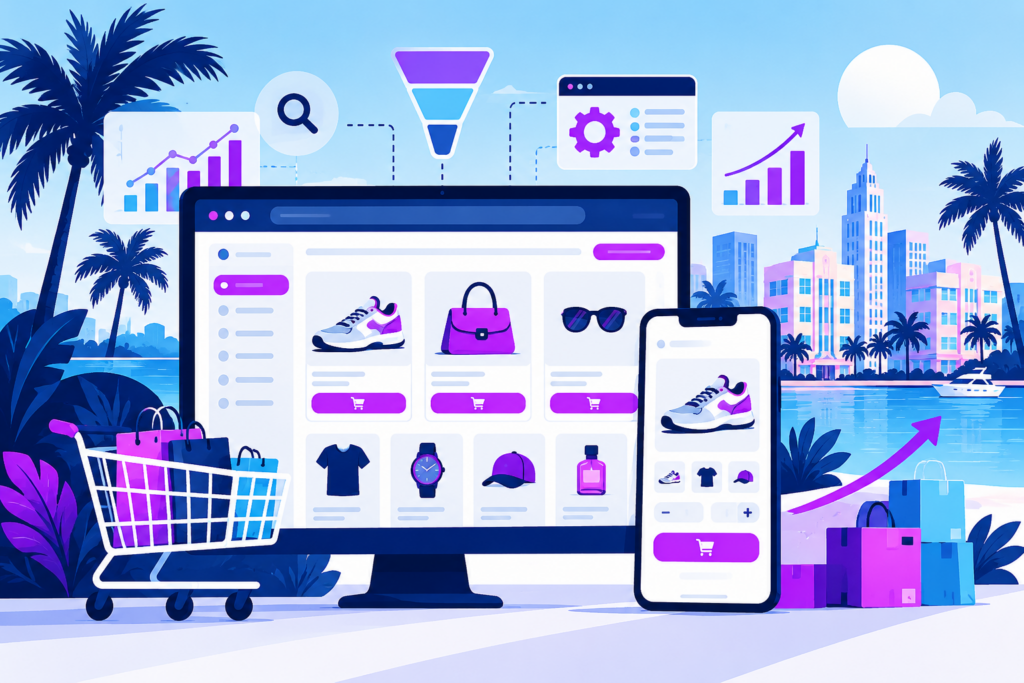
An ecommerce site is three systems wearing one skin: a product catalog, a checkout, and a page that search engines can actually read. We build in that order, and we build it for Lauderdale Lakes merchants who are competing against both big-box retailers and other South Florida shops for the same searches.
Product schema. Every product page gets structured data markup so Google can show price, stock status, and review stars directly in search results. Without it, you are competing on a plain blue link next to a competitor’s rich result. This is code, not a plugin toggle, and it has to match your actual inventory fields or Google ignores it entirely.
Page speed at scale. A ten-product store and a four-hundred-product store do not have the same speed problem. Image weight, server response time, and how many scripts load on a category page all compound as your catalog grows. We test against Google’s own Core Web Vitals thresholds, not a generic speed score, because that is what affects both ranking and whether a mobile visitor waits for your page or leaves for a competitor’s.
Checkout. Cart abandonment is usually a symptom of too many steps, surprise shipping costs, or a payment page that looks different from the rest of the site. We build checkout flows that keep the visitor on as few screens as possible and show shipping cost before the final click, not after, because that is the single most common reason a Lauderdale Lakes shopper closes the tab.
We also set up order and inventory sync so a sale on your site updates stock without someone manually editing a spreadsheet, and we wire in call tracking so phone orders and site orders both show up in one report. That matters here because a meaningful share of local buyers still call to confirm sizing, availability, or delivery before they trust a card number to a new site.
- Structured data for rich search results
- Core Web Vitals-tested speed as your catalog grows
- Low-friction checkout with upfront shipping costs
- Inventory sync and unified order reporting
What is different about this market
Lauderdale Lakes is dense and older than most of its neighbors, and the retail mix reflects that. You are more likely to be competing against an auto parts counter, a food service operator, or an independent retailer with decades of walk-in customers than against a venture-backed startup. Those customers are value conscious. Price is not something you can leave for a phone call here. If your competitor lists a price and you do not, you lose the click before you ever get the chance to explain why your product is worth more. That means product pages need visible pricing, visible shipping cost, and a clear reason to buy from you instead of the next tab over, built into the page itself.
Search behavior here skews heavily mobile. A large share of Broward County’s working population searches on a phone during a break or a commute, not at a desktop after dinner, and Lauderdale Lakes’ demographics push that further than wealthier tri-county suburbs where desktop research still holds a bigger share. That changes the build priority: a homepage carousel that looks good on a laptop and loads slow on a phone is actively costing you sales here. We design mobile-first for this market because that is where the traffic actually is, not because it is a trend.

How we start
We kick off every Lauderdale Lakes ecommerce project with a discovery call to understand your products, customers, and goals. From there, we audit your current site (or competitors’, if you’re starting fresh) and map out a sitemap built around clear navigation and fast checkout. You’ll see wireframes before a single line of code is written, so there are no surprises.
- Product catalog and category planning
- Payment and shipping setup tailored to South Florida logistics
- Mobile-first layout review
Once you approve the plan, our designers and developers build out the storefront in stages, keeping you looped in with regular check-ins until launch.
Product pages and structured data
We organize product information so customers can understand product features, variations, pricing, and availability. Where appropriate, we implement and validate Product structured data to help search engines interpret eligible product details. Structured data does not guarantee enhanced search results, but accurate implementation can support product discovery.
Page speed and technical performance
Large catalogs, high-resolution images, third-party scripts, and complex integrations can slow an online store. We review performance bottlenecks, image delivery, mobile usability, and unnecessary scripts. Testing should cover important templates and shopping journeys rather than only the homepage.
Navigation and catalog structure
Categories, filters, internal links, and product URLs should help customers locate items without creating confusing navigation or unnecessary duplicate pages. We also consider how product variations, unavailable items, and category changes are handled.
Checkout and conversion flow
We review the steps between adding an item to the cart and placing an order. Clear shipping information, transparent costs, accessible forms, suitable payment options, and useful error messages can reduce avoidable friction. Actual checkout changes should be assessed against analytics rather than assumptions.
SEO and measurement
Relevant page titles, meta descriptions, canonical URLs, indexation controls, and XML sitemaps help establish a consistent technical foundation. Analytics and ecommerce event tracking can measure product views, add-to-cart actions, checkout progression, and completed purchases when configured correctly.
What it costs
Ecommerce builds cost more than a standard business site because there is more to build: product catalog setup, payment integration, shipping logic, and schema markup are each separate work, not one feature. What you pay depends on how many products you carry, whether you need custom shipping rules, and whether you are migrating existing orders and reviews from another platform or starting fresh.
We quote a fixed project range after we see your catalog size and current setup, not a number pulled from a generic package page. If you are comparing quotes, ask what each agency includes for product schema and speed testing specifically. Those two items are where a cheap quote usually turns out to have left out the parts that actually affect whether the site ranks or sells.
Ask us for a written scope before you sign anything. If an agency will not put the deliverables on paper, that is information too.

What you get each month
A site is not finished at launch. Products change, shipping rates change, and Google changes how it reads structured data often enough that schema needs a periodic check — especially for a Lauderdale Lakes store competing with shops pulling from the same regional search traffic.
Monthly work includes speed monitoring against Core Web Vitals, schema validation so your rich results keep showing up, and a report that ties site orders and phone calls back to the traffic source that produced them, through call tracking and multi-touchpoint attribution. You see which channel paid for itself and which one did not, in plain numbers.
We also handle ongoing catalog work: new products, discontinued items, seasonal shipping updates, pricing adjustments, and image swaps. You tell us what changed, we keep the technical side correct so it does not quietly break your product listings, checkout, or search visibility while you focus on running the business.

Get a free audit
If you already sell online, our free audit gives Lauderdale Lakes merchants a clear picture of what’s really happening behind the scenes. We review your product pages for clarity and conversion, your checkout flow for abandoned-cart triggers, and your mobile page speed, since most of your South Florida shoppers are browsing on their phones. We also check your payment options, shipping messaging, and how your store handles returning customers versus new visitors. You will get specific findings, not a generic scorecard generated by software, and not a sales pitch disguised as an audit.
- Product page and checkout review
- Mobile speed and usability check
- Payment, shipping, and cart recommendations
Call (754) 704-4727 or request the audit online, and we will walk through exactly what we found with you, explain what is costing you sales, and let you decide what to do next with zero obligation or pressure.

FAQ's
These are the 5 questions Lauderdale Lakes homeowners ask us most about ecommerce website design, answered plainly so you know what to expect before any work starts. If yours isn't covered here, get in touch and we'll walk you through it.
Why does product schema matter more than how the site looks?
Schema is what lets Google show your price, stock, and reviews directly in search results. A beautifully designed page without it still shows up as a plain link next to a competitor's rich result. Looks matter after someone clicks. Schema affects whether they click at all.
How fast does an ecommerce site need to load in Lauderdale Lakes specifically?
Fast enough to pass Google's Core Web Vitals thresholds on a phone, since search here skews heavily mobile. A site that loads fine on office Wi-Fi can still fail on a phone over cellular data, which is how most Lauderdale Lakes shoppers are browsing.
Do I need a bilingual store?
It depends on your customer base. Spanish language search is relevant to a meaningful share of this market, so it is worth testing a bilingual product catalog rather than ruling it out, especially for retail and food service.
What platform do you build on?
The right platform depends on your catalog size, payment needs, and whether you are migrating existing data. We will tell you which platform fits your specific situation rather than defaulting to one option for every client.
Can you migrate my existing store without losing my products and reviews?
Yes, migration is part of the scoping conversation. We map your existing catalog, orders, and reviews before touching anything, so nothing gets lost in the move.