
- Home
- Services
- Portfolio
- About
- Service AreasFort Lauderdale, FL
- Web Design
- Redesign
- WordPress
- Ecommerce
- Landing Pages
- SEO Services
- Local SEO
- GBP
- Google Ads
- PPC
- Digital Marketing
- Internet Marketing
- Advertising
- Tracking
- Dental Marketing
- Medical Marketing
- HVAC Marketing
- Roofing Marketing
- Pest Control Marketing
- Home Services Marketing
- Plumbing Marketing
- Electrical Marketing
- Landscaping Marketing
- Remodeling Marketing
Pembroke Pines, FL- Web Design
- Redesign
- WordPress
- Ecommerce
- Landing Pages
- SEO Services
- Local SEO
- GBP
- Google Ads
- PPC
- Digital Marketing
- Internet Marketing
- Advertising
- Tracking
- Dental Marketing
- Medical Marketing
- HVAC Marketing
- Roofing Marketing
- Pest Control Marketing
- Home Services Marketing
- Plumbing Marketing
- Electrical Marketing
- Landscaping Marketing
- Remodeling Marketing
Hialeah, FL- Web Design
- Redesign
- WordPress
- Ecommerce
- Landing Pages
- SEO Services
- Local SEO
- GBP
- Google Ads
- PPC
- Digital Marketing
- Internet Marketing
- Advertising
- Tracking
- Dental Marketing
- Medical Marketing
- HVAC Marketing
- Roofing Marketing
- Pest Control Marketing
- Home Services Marketing
- Plumbing Marketing
- Electrical Marketing
- Landscaping Marketing
- Remodeling Marketing
Hollywood, FL- Web Design
- Redesign
- WordPress
- Ecommerce
- Landing Pages
- SEO Services
- Local SEO
- GBP
- Google Ads
- PPC
- Digital Marketing
- Internet Marketing
- Advertising
- Tracking
- Dental Marketing
- Medical Marketing
- HVAC Marketing
- Roofing Marketing
- Pest Control Marketing
- Home Services Marketing
- Plumbing Marketing
- Electrical Marketing
- Landscaping Marketing
- Remodeling Marketing
Miramar, FL- Web Design
- Redesign
- WordPress
- Ecommerce
- Landing Pages
- SEO Services
- Local SEO
- GBP
- Google Ads
- PPC
- Digital Marketing
- Internet Marketing
- Advertising
- Tracking
- Dental Marketing
- Medical Marketing
- HVAC Marketing
- Roofing Marketing
- Pest Control Marketing
- Home Services Marketing
- Plumbing Marketing
- Electrical Marketing
- Landscaping Marketing
- Remodeling Marketing
Coral Springs, FL- Web Design
- Redesign
- WordPress
- Ecommerce
- Landing Pages
- SEO Services
- Local SEO
- GBP
- Google Ads
- PPC
- Digital Marketing
- Internet Marketing
- Advertising
- Tracking
- Dental Marketing
- Medical Marketing
- HVAC Marketing
- Roofing Marketing
- Pest Control Marketing
- Home Services Marketing
- Plumbing Marketing
- Electrical Marketing
- Landscaping Marketing
- Remodeling Marketing
Pompano Beach, FL- Web Design
- Redesign
- WordPress
- Ecommerce
- Landing Pages
- SEO Services
- Local SEO
- GBP
- Google Ads
- PPC
- Digital Marketing
- Internet Marketing
- Advertising
- Tracking
- Dental Marketing
- Medical Marketing
- HVAC Marketing
- Roofing Marketing
- Pest Control Marketing
- Home Services Marketing
- Plumbing Marketing
- Electrical Marketing
- Landscaping Marketing
- Remodeling Marketing
Davie, FL- Web Design
- Redesign
- WordPress
- Ecommerce
- Landing Pages
- SEO Services
- Local SEO
- GBP
- Google Ads
- PPC
- Digital Marketing
- Internet Marketing
- Advertising
- Tracking
- Dental Marketing
- Medical Marketing
- HVAC Marketing
- Roofing Marketing
- Pest Control Marketing
- Home Services Marketing
- Plumbing Marketing
- Electrical Marketing
- Landscaping Marketing
- Remodeling Marketing
Sunrise, FL- Web Design
- Redesign
- WordPress
- Ecommerce
- Landing Pages
- SEO Services
- Local SEO
- GBP
- Google Ads
- PPC
- Digital Marketing
- Internet Marketing
- Advertising
- Tracking
- Dental Marketing
- Medical Marketing
- HVAC Marketing
- Roofing Marketing
- Pest Control Marketing
- Home Services Marketing
- Plumbing Marketing
- Electrical Marketing
- Landscaping Marketing
- Remodeling Marketing
Plantation, FL- Web Design
- Redesign
- WordPress
- Ecommerce
- Landing Pages
- SEO Services
- Local SEO
- GBP
- Google Ads
- PPC
- Digital Marketing
- Internet Marketing
- Advertising
- Tracking
- Dental Marketing
- Medical Marketing
- HVAC Marketing
- Roofing Marketing
- Pest Control Marketing
- Home Services Marketing
- Plumbing Marketing
- Electrical Marketing
- Landscaping Marketing
- Remodeling Marketing
Deerfield Beach, FL- Web Design
- Redesign
- WordPress
- Ecommerce
- Landing Pages
- SEO Services
- Local SEO
- GBP
- Google Ads
- PPC
- Digital Marketing
- Internet Marketing
- Advertising
- Tracking
- Dental Marketing
- Medical Marketing
- HVAC Marketing
- Roofing Marketing
- Pest Control Marketing
- Home Services Marketing
- Plumbing Marketing
- Electrical Marketing
- Landscaping Marketing
- Remodeling Marketing
Miami Gardens, FL- Web Design
- Redesign
- WordPress
- Ecommerce
- Landing Pages
- SEO Services
- Local SEO
- GBP
- Google Ads
- PPC
- Digital Marketing
- Internet Marketing
- Advertising
- Tracking
- Dental Marketing
- Medical Marketing
- HVAC Marketing
- Roofing Marketing
- Pest Control Marketing
- Home Services Marketing
- Plumbing Marketing
- Electrical Marketing
- Landscaping Marketing
- Remodeling Marketing
Lauderhill, FL- Web Design
- Redesign
- WordPress
- Ecommerce
- Landing Pages
- SEO Services
- Local SEO
- GBP
- Google Ads
- PPC
- Digital Marketing
- Internet Marketing
- Advertising
- Tracking
- Dental Marketing
- Medical Marketing
- HVAC Marketing
- Roofing Marketing
- Pest Control Marketing
- Home Services Marketing
- Plumbing Marketing
- Electrical Marketing
- Landscaping Marketing
- Remodeling Marketing
West Palm Beach, FL- Web Design
- Redesign
- WordPress
- Ecommerce
- Landing Pages
- SEO Services
- Local SEO
- GBP
- Google Ads
- PPC
- Digital Marketing
- Internet Marketing
- Advertising
- Tracking
- Dental Marketing
- Medical Marketing
- HVAC Marketing
- Roofing Marketing
- Pest Control Marketing
- Home Services Marketing
- Plumbing Marketing
- Electrical Marketing
- Landscaping Marketing
- Remodeling Marketing
Tamarac, FL- Web Design
- Redesign
- WordPress
- Ecommerce
- Landing Pages
- SEO Services
- Local SEO
- GBP
- Google Ads
- PPC
- Digital Marketing
- Internet Marketing
- Advertising
- Tracking
- Dental Marketing
- Medical Marketing
- HVAC Marketing
- Roofing Marketing
- Pest Control Marketing
- Home Services Marketing
- Plumbing Marketing
- Electrical Marketing
- Landscaping Marketing
- Remodeling Marketing
Weston, FL- Web Design
- Redesign
- WordPress
- Ecommerce
- Landing Pages
- SEO Services
- Local SEO
- GBP
- Google Ads
- PPC
- Digital Marketing
- Internet Marketing
- Advertising
- Tracking
- Dental Marketing
- Medical Marketing
- HVAC Marketing
- Roofing Marketing
- Pest Control Marketing
- Home Services Marketing
- Plumbing Marketing
- Electrical Marketing
- Landscaping Marketing
- Remodeling Marketing
Boca Raton, FLMargate, FLCoconut Creek, FLMiami Beach, FLHomestead, FLKendall, FLDoral, FLBoynton Beach, FLThe Hammocks, FLNorth Lauderdale, FLOakland Park, FLDelray Beach, FLNorth Miami, FLHallandale Beach, FLFontainebleau, FLKendale Lakes, FLWellington, FLJupiter, FLTamiami, FLPalm Beach Gardens, FLLauderdale Lakes, FLCooper City, FLCountry Club, FLParkland, FLCoral Gables, FLDania Beach, FLCutler Bay, FLNorth Miami Beach, FLGreenacres, FLLake Worth Beach, FLPrinceton, FLRoyal Palm Beach, FLSouth Miami Heights, FLRichmond West, FLRiviera Beach, FLWest Little River, FLGolden Glades, FLAventura, FLMiami Lakes, FLWestchester, FLLeisure City, FLCoral Terrace, FLPalm Springs, FLPalmetto Bay, FLHialeah Gardens, FLSunny Isles Beach, FLIves Estates, FLWest Park, FLSweetwater, FLPinecrest, FLSunset, FLPinewood, FLWilton Manors, FLOpa-locka, FLLighthouse Point, FLBelle Glade, FLNaranja, FLPalmetto Estates, FLBrownsville, FLKey Biscayne, FLOlympia Heights, FLMiami Springs, FLFlorida City, FLSouth Miami, FLThree Lakes, FLGladeview, FLNorth Palm Beach, FLMiami Shores, FLSouthwest Ranches, FLKings Point, FLLauderdale-by-the-Sea, FLHillsboro Beach, FLSea Ranch Lakes, FLLazy Lake, FL - Blog
- Contact
Marketing for Pest Control Companies in Weston, Florida
Weston homeowners do not search for "pest control." They search for what they found: "sugar ants in kitchen Weston," "whitefly treatment Bonaventure," "iguana removal near Weston." If your website and Google Business Profile only talk about "pest control services," you are invisible to the specific question someone just typed after finding a wasp nest under a screened patio. Weston's homes are newer, mostly built from the 1990s through the 2000s inside planned communities like Country Isles and Windmill Ranch, and that changes what pests show up and when: whiteflies on ficus hedges, rodents in tile roofs, and seasonal ant invasions after summer rain.

How Weston Pest Control Companies buyers search
Most Weston searches happen after a sighting, not before one. Someone sees a trail of ants near the baseboard, a wasp nest on the lanai screen, or a rodent in the garage, and they search on the phone within minutes. That means your Google Business Profile and your mobile page speed matter more than a long blog post about integrated pest management.
Searches here split into two patterns. The first is reactive and species-specific: “termite inspection Weston FL,” “get rid of whitefly,” “rat in attic.” The second is recurring and brand-aware: homeowners who already have a quarterly contract searching their provider’s name to pay a bill or reschedule. Both patterns need different pages. A species-specific page with photos of the actual pest, treatment timelines, and safety notes for kids and pets answers the first. A clean, fast-loading account or contact page with online scheduling serves the second. Mixing both intents onto one generic “pest control services” page loses conversions on both ends.
Seasonality is real but milder here than up north. Subtropical South Florida does not have a true off-season for pests. Termite swarm season spikes search volume in spring, mosquito and whitefly complaints rise with summer rain, and rodent calls tick up when it cools off enough for animals to seek shelter in attics and garages. Palm-specific pests, like weevils, generate their own steady trickle of searches year-round given how many Weston properties landscape with palms. A marketing plan that assumes one slow season and one busy season is built for the wrong climate, and budget should flex monthly rather than sit flat.

The competition here
Weston does not have many storefront pest control businesses because there is not much foot-traffic retail here to begin with. Almost every operator, from one-truck local companies to national franchises with a Weston service area, is running a service-area business: no public office, a van-based crew, and a Google Business Profile with a service radius instead of a walk-in address. That matters because it changes how the map pack ranks results. When nobody has a storefront to anchor trust, Google and searchers alike fall back on softer signals, and that is where sharper marketing wins.
When every competitor hides their address or works out of a residence, Google leans harder on profile signals it can verify: review volume and recency, category selection, posting activity, service descriptions, and how closely a listing’s stated service areas match the actual search. A company that treats its Google Business Profile as a set-and-forget listing, filled in once and never touched again, is easy to outrank on signals alone, without ever outspending it. Consistent review requests, fresh photos, and accurate categories do more here than a bigger ad budget.
Organic search for species- and problem-specific terms is less contested than the map pack itself. National franchise sites tend to build one generic page per service nationwide, not one page per pest per city, which leaves open ground for a locally focused page about, say, ghost ants in Weston, whitefly pressure near the Everglades edge, or rodent entry points common in the older tile roofs found around Bonaventure and Country Isles. Those pages rarely need to compete against a dozen rivals; they often just need to exist and be done well.
The honest read: this is not an empty market. Several established companies already rank, carry reviews, and run paid ads. But it is a market where specificity beats size. A company with five sharp, locally written pages and an actively managed profile can out-rank a franchise with fifty generic pages and a neglected listing, for the exact searches that turn into booked jobs rather than idle traffic.
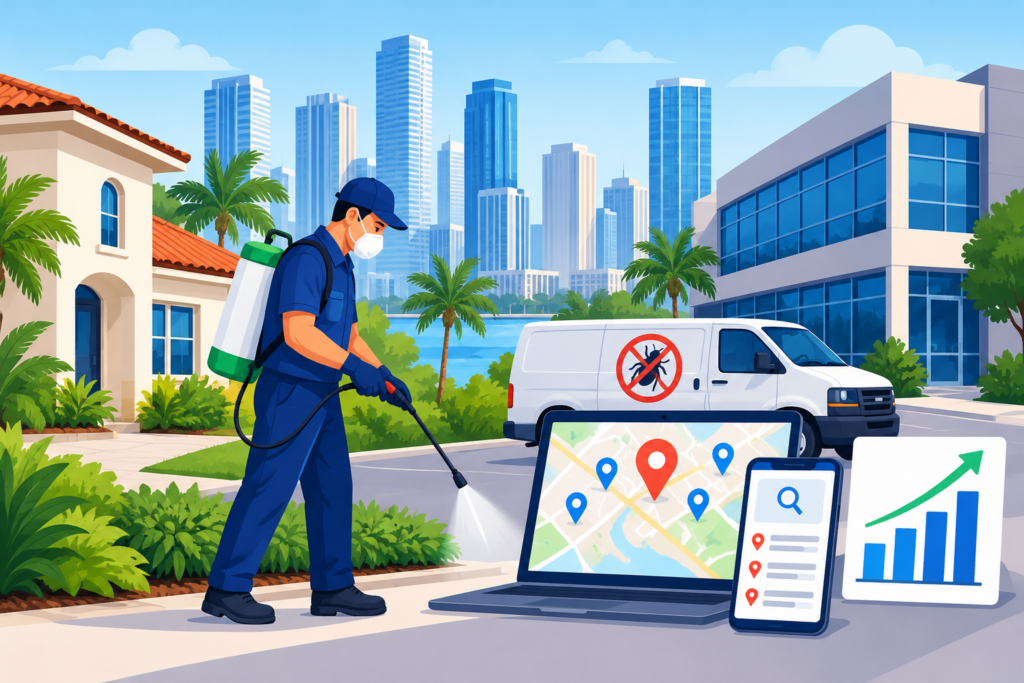
What we build for Pest Control Companies in this market
Local SEO
Review business details, service categories, service areas, and profile information to help customers find and contact your company.
Species-specific service pages
Create focused pages for services such as termite treatment, ant control, rodent control, cockroach treatment, and mosquito management. Each page should explain the service and provide a clear next step.
Recurring-service content
Explain preventive plans, included services, and how customers can request an assessment. Clear information helps potential customers compare ongoing services with one-time treatments.
Commercial pest control pages
Address the needs of offices, property managers, and other commercial clients by outlining your available services, scheduling options, and relevant documentation.
Paid search campaigns
Target relevant, high-intent searches with suitable geographic settings and landing pages. Review spending alongside enquiry quality and cost.
Conversion improvements
Make phone details, estimate forms, service information, and contact options easy to find. A straightforward website helps visitors take the next step.
We start with the Google Business Profile because, for a service-area business, it is doing more ranking work than the website in most map pack searches. That means correct service-area radius set to match where you actually dispatch trucks, the right primary and secondary categories, and a review request process built into your post-service workflow so new reviews come in steadily instead of in bursts.
On the website, we build individual pages for the pests and problems people in Weston actually search for: termites, whitefly, rodents, mosquitoes, ants, and whatever else shows up in your own call logs. One page cannot rank for fifteen different pest searches with fifteen different intents behind them. We also build a recurring-service page that speaks to the quarterly or bi-monthly contract model most pest control companies run on, because that buyer is further down the funnel than someone searching a species name for the first time.
For paid search, we run Google Ads campaigns split by intent: emergency/same-day searches get their own ad group and landing page, recurring-service searches get another. We set up call tracking so you can hear which keywords produced a real booked job versus a hang-up, and we tie that back to the ad spend that produced it. For a recurring-revenue business like pest control, the real return is not the first visit, it’s the contract value over the following year, and we build reporting that reflects that instead of counting first-visit leads as the finish line.

What we measure
Calls, form fills, and booked jobs tracked back to the keyword, ad, or map listing that produced them, plus Google Business Profile views, direction requests, and review count trend for Weston searches, so every dollar spent on pest control marketing shows a clear return.
- Organic search: Search visibility, relevant landing-page traffic, and changes in keyword performance.
- Local search: Google Business Profile interactions and available calls, website visits, or direction requests.
- Paid advertising: Spend, clicks, search terms, conversions, and cost per tracked enquiry.
- Website conversions: Phone calls, form submissions, and the pages that generate them.
- Lead quality: Where customer records are available, compare tracked enquiries with qualified opportunities and booked work.
What it costs
Cost depends on how many service lines and cities you cover and whether you need Google Ads running alongside SEO.

Get an audit
We will look at your Google Business Profile, your current website, and your top three competitors in Weston, and tell you plainly where you are losing ground. For pest control specifically, that means checking how you rank for terms like “exterminator Weston FL” and “pest control near me,” whether your service-area pages address local concerns such as termites, mosquitoes, and rodents, and how your reviews stack up against the operators already dominating the map pack.
You will get a specific, written list: what’s missing, what’s weak, and what would move the needle first — not a vague summary padded with jargon. We will flag technical issues, content gaps, and listing inconsistencies that cost you calls every week. Call (754) 704-4727 or request the audit online. No pressure, no generic report, and no obligation to work with us afterward.
FAQ's
These are the 5 questions Weston homeowners ask us most about pest control company marketing, answered plainly so you know what to expect before any work starts. If yours isn't covered here, get in touch and we'll walk you through it.
Does my pest control business need a physical address to rank in Weston?
No. Most pest control companies operating in Weston are service-area businesses without a public storefront. Google allows you to hide your address on your Business Profile and set a service-area radius instead. What matters more is matching that service area accurately to where you actually dispatch technicians and keeping your categories and reviews current.
How is marketing a pest control company different from marketing other home services in Weston?
Pest control search is driven by sightings, not routine maintenance schedules, so content and ads built around specific pests (termites, whitefly, rodents) convert better than generic "pest control" pages. It's also a recurring-revenue business, so retention messaging and account-management pages matter alongside new-customer acquisition.
Will SEO or Google Ads work faster for a new pest control company in Weston?
Google Ads can put you in front of searchers immediately once campaigns launch, while SEO and Google Business Profile optimization build over a longer period. Many pest control companies run both: ads for immediate call volume, SEO and profile work for a growing baseline of unpaid leads over time.
Do HOA rules in Weston affect how pest control should be marketed?
Yes. Many Weston neighborhoods have HOA landscaping and exterior standards, which means some residents research whether a treatment is HOA-compliant before calling. Addressing that directly in your content, rather than assuming it, removes an objection before it costs you the call.
What does Strategic Web Designs need from me to start?
Access to your Google Business Profile, your current website, and your call history or booking records if you have them. That lets us see which keywords and services are already producing jobs before we recommend changes.
HOA influence on buyer behavior
A large share of Weston is governed by homeowners associations with landscaping and exterior standards. That pushes some pest decisions (hedge treatment, palm pest issues, mosquito misting near shared common areas) into conversations between residents and HOA boards before a resident ever calls a company. Content that explains HOA-compliant treatment options, documentation for board approval, or mentions working within community landscaping rules answers an objection competitors are not addressing, and it can shorten the sales cycle considerably.