
- Home
- Services
- Portfolio
- About
- Service AreasFort Lauderdale, FL
- Web Design
- Redesign
- WordPress
- Ecommerce
- Landing Pages
- SEO Services
- Local SEO
- GBP
- Google Ads
- PPC
- Digital Marketing
- Internet Marketing
- Advertising
- Tracking
- Dental Marketing
- Medical Marketing
- HVAC Marketing
- Roofing Marketing
- Pest Control Marketing
- Home Services Marketing
- Plumbing Marketing
- Electrical Marketing
- Landscaping Marketing
- Remodeling Marketing
Pembroke Pines, FL- Web Design
- Redesign
- WordPress
- Ecommerce
- Landing Pages
- SEO Services
- Local SEO
- GBP
- Google Ads
- PPC
- Digital Marketing
- Internet Marketing
- Advertising
- Tracking
- Dental Marketing
- Medical Marketing
- HVAC Marketing
- Roofing Marketing
- Pest Control Marketing
- Home Services Marketing
- Plumbing Marketing
- Electrical Marketing
- Landscaping Marketing
- Remodeling Marketing
Hialeah, FL- Web Design
- Redesign
- WordPress
- Ecommerce
- Landing Pages
- SEO Services
- Local SEO
- GBP
- Google Ads
- PPC
- Digital Marketing
- Internet Marketing
- Advertising
- Tracking
- Dental Marketing
- Medical Marketing
- HVAC Marketing
- Roofing Marketing
- Pest Control Marketing
- Home Services Marketing
- Plumbing Marketing
- Electrical Marketing
- Landscaping Marketing
- Remodeling Marketing
Hollywood, FL- Web Design
- Redesign
- WordPress
- Ecommerce
- Landing Pages
- SEO Services
- Local SEO
- GBP
- Google Ads
- PPC
- Digital Marketing
- Internet Marketing
- Advertising
- Tracking
- Dental Marketing
- Medical Marketing
- HVAC Marketing
- Roofing Marketing
- Pest Control Marketing
- Home Services Marketing
- Plumbing Marketing
- Electrical Marketing
- Landscaping Marketing
- Remodeling Marketing
Miramar, FL- Web Design
- Redesign
- WordPress
- Ecommerce
- Landing Pages
- SEO Services
- Local SEO
- GBP
- Google Ads
- PPC
- Digital Marketing
- Internet Marketing
- Advertising
- Tracking
- Dental Marketing
- Medical Marketing
- HVAC Marketing
- Roofing Marketing
- Pest Control Marketing
- Home Services Marketing
- Plumbing Marketing
- Electrical Marketing
- Landscaping Marketing
- Remodeling Marketing
Coral Springs, FL- Web Design
- Redesign
- WordPress
- Ecommerce
- Landing Pages
- SEO Services
- Local SEO
- GBP
- Google Ads
- PPC
- Digital Marketing
- Internet Marketing
- Advertising
- Tracking
- Dental Marketing
- Medical Marketing
- HVAC Marketing
- Roofing Marketing
- Pest Control Marketing
- Home Services Marketing
- Plumbing Marketing
- Electrical Marketing
- Landscaping Marketing
- Remodeling Marketing
Pompano Beach, FL- Web Design
- Redesign
- WordPress
- Ecommerce
- Landing Pages
- SEO Services
- Local SEO
- GBP
- Google Ads
- PPC
- Digital Marketing
- Internet Marketing
- Advertising
- Tracking
- Dental Marketing
- Medical Marketing
- HVAC Marketing
- Roofing Marketing
- Pest Control Marketing
- Home Services Marketing
- Plumbing Marketing
- Electrical Marketing
- Landscaping Marketing
- Remodeling Marketing
Davie, FL- Web Design
- Redesign
- WordPress
- Ecommerce
- Landing Pages
- SEO Services
- Local SEO
- GBP
- Google Ads
- PPC
- Digital Marketing
- Internet Marketing
- Advertising
- Tracking
- Dental Marketing
- Medical Marketing
- HVAC Marketing
- Roofing Marketing
- Pest Control Marketing
- Home Services Marketing
- Plumbing Marketing
- Electrical Marketing
- Landscaping Marketing
- Remodeling Marketing
Sunrise, FL- Web Design
- Redesign
- WordPress
- Ecommerce
- Landing Pages
- SEO Services
- Local SEO
- GBP
- Google Ads
- PPC
- Digital Marketing
- Internet Marketing
- Advertising
- Tracking
- Dental Marketing
- Medical Marketing
- HVAC Marketing
- Roofing Marketing
- Pest Control Marketing
- Home Services Marketing
- Plumbing Marketing
- Electrical Marketing
- Landscaping Marketing
- Remodeling Marketing
Plantation, FL- Web Design
- Redesign
- WordPress
- Ecommerce
- Landing Pages
- SEO Services
- Local SEO
- GBP
- Google Ads
- PPC
- Digital Marketing
- Internet Marketing
- Advertising
- Tracking
- Dental Marketing
- Medical Marketing
- HVAC Marketing
- Roofing Marketing
- Pest Control Marketing
- Home Services Marketing
- Plumbing Marketing
- Electrical Marketing
- Landscaping Marketing
- Remodeling Marketing
Deerfield Beach, FL- Web Design
- Redesign
- WordPress
- Ecommerce
- Landing Pages
- SEO Services
- Local SEO
- GBP
- Google Ads
- PPC
- Digital Marketing
- Internet Marketing
- Advertising
- Tracking
- Dental Marketing
- Medical Marketing
- HVAC Marketing
- Roofing Marketing
- Pest Control Marketing
- Home Services Marketing
- Plumbing Marketing
- Electrical Marketing
- Landscaping Marketing
- Remodeling Marketing
Miami Gardens, FL- Web Design
- Redesign
- WordPress
- Ecommerce
- Landing Pages
- SEO Services
- Local SEO
- GBP
- Google Ads
- PPC
- Digital Marketing
- Internet Marketing
- Advertising
- Tracking
- Dental Marketing
- Medical Marketing
- HVAC Marketing
- Roofing Marketing
- Pest Control Marketing
- Home Services Marketing
- Plumbing Marketing
- Electrical Marketing
- Landscaping Marketing
- Remodeling Marketing
Lauderhill, FL- Web Design
- Redesign
- WordPress
- Ecommerce
- Landing Pages
- SEO Services
- Local SEO
- GBP
- Google Ads
- PPC
- Digital Marketing
- Internet Marketing
- Advertising
- Tracking
- Dental Marketing
- Medical Marketing
- HVAC Marketing
- Roofing Marketing
- Pest Control Marketing
- Home Services Marketing
- Plumbing Marketing
- Electrical Marketing
- Landscaping Marketing
- Remodeling Marketing
West Palm Beach, FL- Web Design
- Redesign
- WordPress
- Ecommerce
- Landing Pages
- SEO Services
- Local SEO
- GBP
- Google Ads
- PPC
- Digital Marketing
- Internet Marketing
- Advertising
- Tracking
- Dental Marketing
- Medical Marketing
- HVAC Marketing
- Roofing Marketing
- Pest Control Marketing
- Home Services Marketing
- Plumbing Marketing
- Electrical Marketing
- Landscaping Marketing
- Remodeling Marketing
Tamarac, FL- Web Design
- Redesign
- WordPress
- Ecommerce
- Landing Pages
- SEO Services
- Local SEO
- GBP
- Google Ads
- PPC
- Digital Marketing
- Internet Marketing
- Advertising
- Tracking
- Dental Marketing
- Medical Marketing
- HVAC Marketing
- Roofing Marketing
- Pest Control Marketing
- Home Services Marketing
- Plumbing Marketing
- Electrical Marketing
- Landscaping Marketing
- Remodeling Marketing
Weston, FL- Web Design
- Redesign
- WordPress
- Ecommerce
- Landing Pages
- SEO Services
- Local SEO
- GBP
- Google Ads
- PPC
- Digital Marketing
- Internet Marketing
- Advertising
- Tracking
- Dental Marketing
- Medical Marketing
- HVAC Marketing
- Roofing Marketing
- Pest Control Marketing
- Home Services Marketing
- Plumbing Marketing
- Electrical Marketing
- Landscaping Marketing
- Remodeling Marketing
Boca Raton, FLMargate, FLCoconut Creek, FLMiami Beach, FLHomestead, FLKendall, FLDoral, FLBoynton Beach, FLThe Hammocks, FLNorth Lauderdale, FLOakland Park, FLDelray Beach, FLNorth Miami, FLHallandale Beach, FLFontainebleau, FLKendale Lakes, FLWellington, FLJupiter, FLTamiami, FLPalm Beach Gardens, FLLauderdale Lakes, FLCooper City, FLCountry Club, FLParkland, FLCoral Gables, FLDania Beach, FLCutler Bay, FLNorth Miami Beach, FLGreenacres, FLLake Worth Beach, FLPrinceton, FLRoyal Palm Beach, FLSouth Miami Heights, FLRichmond West, FLRiviera Beach, FLWest Little River, FLGolden Glades, FLAventura, FLMiami Lakes, FLWestchester, FLLeisure City, FLCoral Terrace, FLPalm Springs, FLPalmetto Bay, FLHialeah Gardens, FLSunny Isles Beach, FLIves Estates, FLWest Park, FLSweetwater, FLPinecrest, FLSunset, FLPinewood, FLWilton Manors, FLOpa-locka, FLLighthouse Point, FLBelle Glade, FLNaranja, FLPalmetto Estates, FLBrownsville, FLKey Biscayne, FLOlympia Heights, FLMiami Springs, FLFlorida City, FLSouth Miami, FLThree Lakes, FLGladeview, FLNorth Palm Beach, FLMiami Shores, FLSouthwest Ranches, FLKings Point, FLLauderdale-by-the-Sea, FLHillsboro Beach, FLSea Ranch Lakes, FLLazy Lake, FL - Blog
- Contact
Ecommerce Website Design in Pembroke Pines, Florida
Ecommerce Website Design for Pembroke Pines businesses
Most of what gets built in Pembroke Pines is a lead-gen site for a lawn company or a roofer. An ecommerce build is a different job with a different buyer: someone comparing your checkout to Amazon’s, whether that is fair or not.
A store that sells product to a household in Pembroke Pines Lakes or Silver Lakes is judged on three things before anyone cares what it looks like: does it load fast on a phone, does the checkout work without ten fields of friction, and does the product actually show up in Google with a price and a star rating attached. That is the order we build in.

What is different about this market
Pembroke Pines is almost entirely residential and service-area commerce. Home services, medical offices, and professional services dominate the business directory, and most of them never touch a shopping cart. If you are building an actual store here, you are in a smaller pool, which cuts two ways: less local competition for product keywords, but also a market where most shoppers default to national retailers out of habit, not loyalty. Winning requires giving people a specific reason to buy from a local store instead of defaulting to a marketplace tab they already have open.
The city’s housing stock is newer, much of it built or redeveloped inside planned communities with HOA rules since the 1990s and 2000s. That matters for an ecommerce build in a specific way: households here moved in within the last two decades, skew toward families with disposable income, and are comfortable buying online already. They are not price-anchored the way an older, more price-sensitive market might be. They buy on trust signals, and a build aimed at this audience should foreground:
- Real reviews surfaced directly on the product page, not buried behind a separate tab
- A clear, visible return and exchange policy before checkout, not after
- Guest checkout, so no one is forced to create an account just to buy once
Search behavior here skews heavily mobile, consistent with a commuter population checking phones between HOA meetings and school pickup. That means page speed on a phone connection and thumb-friendly checkout buttons are not nice-to-haves, they are the baseline a competitor will beat you on if you skip them. Spanish-language content is worth testing for product descriptions and ad copy given Broward County’s demographics, but it is not a universal requirement the way it is in parts of Pembroke Pines-Dade; test it on your actual customer data rather than assuming it either way.
Demand for most product categories is steady through the year with the expected bump around November and December, not a tourist-driven seasonal swing the way a coastal city further east might see. That steadiness is an advantage for planning inventory, ad spend, and promotions on a predictable calendar rather than chasing a short tourist window.
What the work covers
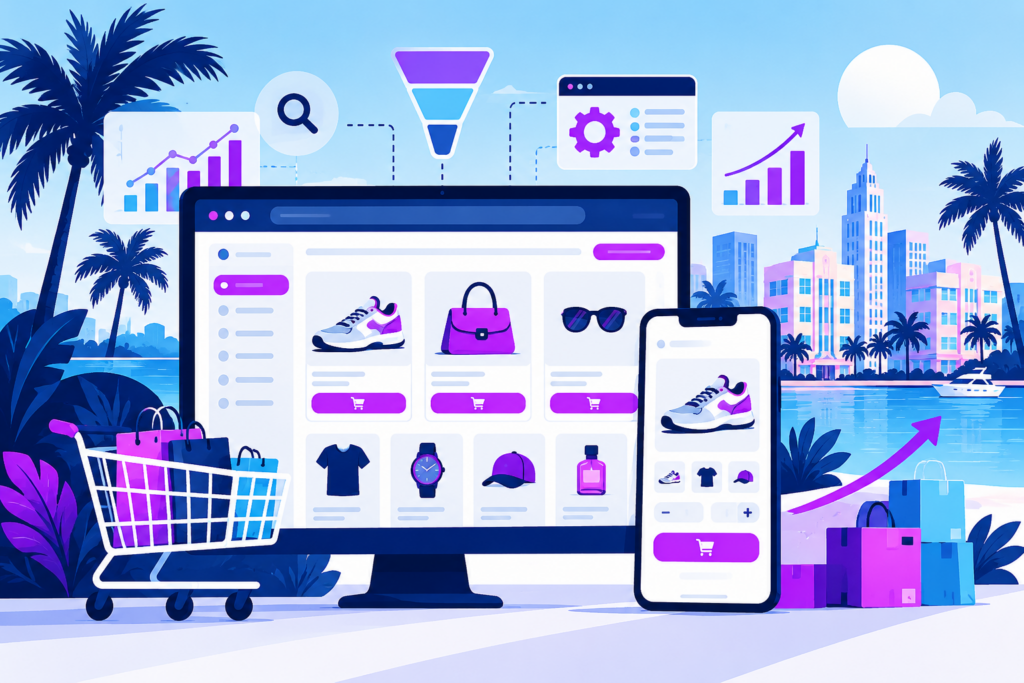
Ecommerce work breaks into four parts and we price and scope them separately so you know what you are paying for.
Platform and catalog structure. We set up Shopify or WooCommerce (the two platforms we recommend, chosen based on your catalog size and who will run the store day to day), build the category tree, configure variants, and set tax and shipping rules. A catalog with 50 products needs a different structure than one with 2,000, and getting this wrong early means re-doing it later at a much higher cost.
Product schema. Every product page gets structured data markup, meaning Google can read the price, availability, and review count directly and show them in search results without a click. A product with schema and a product without it can sit on the same page of results and get very different click rates, because one has stars and a price showing and the other is a plain blue link.
Page speed at scale. A ten-page brochure site and a 500-product store do not have the same speed problem. Image compression, lazy loading, and server response time all behave differently once you have hundreds of product pages each loading their own images, variant selectors, and review widgets. We test speed on the actual catalog size, not a demo with five sample products.
Checkout. This is where carts get abandoned. We build checkout with the fewest fields required, guest checkout as the default option, and shipping costs shown before the final page, not as a surprise at the end. We also set up abandoned cart recovery so a customer who leaves at the payment step gets a follow-up, not silence.
None of this is visual polish layered on top. It is the structural work that determines whether a product can be found, loaded, and purchased. Design comes after these decisions, not before.

How we start
We start with your catalog, not your color scheme. Before any design conversation, we want to know how many products you carry, how often inventory changes, whether you ship nationally or deliver locally, and what platform (if any) you are already using. That tells us whether this is a two-week setup or a multi-month build.
If you have an existing store, we audit it first: page speed on mobile, checkout drop-off points, and whether your products currently have any structured data. That audit tells you what is actually broken before we propose fixing it. We do not rebuild a store that only needs its checkout fixed.
Product pages and structured data
We organize product information so customers can understand product features, variations, pricing, and availability. Where appropriate, we implement and validate Product structured data to help search engines interpret eligible product details. Structured data does not guarantee enhanced search results, but accurate implementation can support product discovery.
Page speed and technical performance
Large catalogs, high-resolution images, third-party scripts, and complex integrations can slow an online store. We review performance bottlenecks, image delivery, mobile usability, and unnecessary scripts. Testing should cover important templates and shopping journeys rather than only the homepage.
Navigation and catalog structure
Categories, filters, internal links, and product URLs should help customers locate items without creating confusing navigation or unnecessary duplicate pages. We also consider how product variations, unavailable items, and category changes are handled.
Checkout and conversion flow
We review the steps between adding an item to the cart and placing an order. Clear shipping information, transparent costs, accessible forms, suitable payment options, and useful error messages can reduce avoidable friction. Actual checkout changes should be assessed against analytics rather than assumptions.
SEO and measurement
Relevant page titles, meta descriptions, canonical URLs, indexation controls, and XML sitemaps help establish a consistent technical foundation. Analytics and ecommerce event tracking can measure product views, add-to-cart actions, checkout progression, and completed purchases when configured correctly.
What it costs
Ecommerce builds cost more than a standard business website because there are more moving parts: payment gateway integration, shipping logic, inventory sync, and product schema across potentially hundreds of pages. Cost depends on catalog size, whether you need custom shipping rules, and whether we are migrating existing product data or starting clean.
We will not quote a number before we have seen your catalog, because a 30-product store and a 1,500-product store are different projects with different timelines and different ongoing maintenance needs. Ask us for a scoped quote and we will tell you what drives the cost up or down for your specific case.

What you get each month
Once your Pembroke Pines store is live, ongoing work each month usually covers platform and plugin updates, new product additions, speed monitoring as the catalog grows, and checkout testing after any payment gateway or shipping carrier change. We also check cart abandonment flows, product page load times on mobile, and search functionality to make sure customers can actually find what they’re shopping for. If you run paid search or social ads alongside the store, we report on that too, with call tracking and attribution so you can see which channel actually produced a completed order, not just a click.
You get a monthly report showing what changed on the site, what broke and got fixed, inventory or catalog updates made, and how the store performed against the prior month. No dashboard full of vanity metrics disconnected from actual orders placed.

Get a free audit
If you already run a store, we will dig into your checkout flow, your page speed on mobile, and whether your product pages carry proper schema markup, then tell you plainly what is costing you sales. Many Pembroke Pines retailers lose carts to slow mobile load times or confusing checkout steps long before a shopper ever reaches payment, and those are fixable problems once someone actually looks for them. If you do not have a store yet, we will walk through what platform realistically fits your catalog size, your shipping setup, and your growth plans, and what the build actually involves before you commit to anything or sign a contract.
- Checkout flow and cart abandonment points
- Mobile page speed and load times
- Product schema and search visibility
- Platform fit for your catalog and goals
Send over your current site, or tell us what you are picturing, and we will start there with a straight answer.

FAQ's
These are the 5 questions Pembroke Pines homeowners ask us most about ecommerce website design, answered plainly so you know what to expect before any work starts. If yours isn't covered here, get in touch and we'll walk you through it.
Do you design the store or just set up the platform?
Both, but they are separate line items. Platform setup is the technical build: product catalog structure, variant handling, tax and shipping rules, payment gateway connections. Design is the storefront layer on top of that. You can also bring an existing Shopify or WooCommerce store and have us rebuild specific parts, like checkout or product pages, without a full rebuild.
Can you work with a store that already has inventory loaded?
Yes. We map your existing product data and media before touching anything, then migrate in a staging environment so your live store keeps taking orders during the build. The cutover happens after you have approved the new site, not before.
What platform do you recommend for a Pembroke Pines business?
It depends on catalog size and who manages the store day to day. Shopify works well for a smaller catalog with one or two people running it. WooCommerce fits a business that wants more control over hosting and plugins and has someone comfortable with WordPress. We will tell you which one fits before we quote anything.
How do you handle shipping zones for local pickup versus delivery?
We set up separate shipping rules for local pickup, in-county delivery, and national shipping, each with its own rates and cutoff times. If you run a hybrid model, local delivery plus national shipping, the checkout needs to present the right options based on the customer's address, and that logic gets built and tested before launch.
Do you handle PCI compliance and payment processing?
We configure the store to use a PCI-compliant payment gateway (Stripe, Shopify Payments, Square, or similar), which keeps card data off your server entirely. We do not act as your compliance officer or legal advisor, but the technical setup follows the gateway's required standards.