
- Home
- Services
- Portfolio
- About
- Service AreasFort Lauderdale, FL
- Web Design
- Redesign
- WordPress
- Ecommerce
- Landing Pages
- SEO Services
- Local SEO
- GBP
- Google Ads
- PPC
- Digital Marketing
- Internet Marketing
- Advertising
- Tracking
- Dental Marketing
- Medical Marketing
- HVAC Marketing
- Roofing Marketing
- Pest Control Marketing
- Home Services Marketing
- Plumbing Marketing
- Electrical Marketing
- Landscaping Marketing
- Remodeling Marketing
Pembroke Pines, FL- Web Design
- Redesign
- WordPress
- Ecommerce
- Landing Pages
- SEO Services
- Local SEO
- GBP
- Google Ads
- PPC
- Digital Marketing
- Internet Marketing
- Advertising
- Tracking
- Dental Marketing
- Medical Marketing
- HVAC Marketing
- Roofing Marketing
- Pest Control Marketing
- Home Services Marketing
- Plumbing Marketing
- Electrical Marketing
- Landscaping Marketing
- Remodeling Marketing
Hialeah, FL- Web Design
- Redesign
- WordPress
- Ecommerce
- Landing Pages
- SEO Services
- Local SEO
- GBP
- Google Ads
- PPC
- Digital Marketing
- Internet Marketing
- Advertising
- Tracking
- Dental Marketing
- Medical Marketing
- HVAC Marketing
- Roofing Marketing
- Pest Control Marketing
- Home Services Marketing
- Plumbing Marketing
- Electrical Marketing
- Landscaping Marketing
- Remodeling Marketing
Hollywood, FL- Web Design
- Redesign
- WordPress
- Ecommerce
- Landing Pages
- SEO Services
- Local SEO
- GBP
- Google Ads
- PPC
- Digital Marketing
- Internet Marketing
- Advertising
- Tracking
- Dental Marketing
- Medical Marketing
- HVAC Marketing
- Roofing Marketing
- Pest Control Marketing
- Home Services Marketing
- Plumbing Marketing
- Electrical Marketing
- Landscaping Marketing
- Remodeling Marketing
Miramar, FL- Web Design
- Redesign
- WordPress
- Ecommerce
- Landing Pages
- SEO Services
- Local SEO
- GBP
- Google Ads
- PPC
- Digital Marketing
- Internet Marketing
- Advertising
- Tracking
- Dental Marketing
- Medical Marketing
- HVAC Marketing
- Roofing Marketing
- Pest Control Marketing
- Home Services Marketing
- Plumbing Marketing
- Electrical Marketing
- Landscaping Marketing
- Remodeling Marketing
Coral Springs, FL- Web Design
- Redesign
- WordPress
- Ecommerce
- Landing Pages
- SEO Services
- Local SEO
- GBP
- Google Ads
- PPC
- Digital Marketing
- Internet Marketing
- Advertising
- Tracking
- Dental Marketing
- Medical Marketing
- HVAC Marketing
- Roofing Marketing
- Pest Control Marketing
- Home Services Marketing
- Plumbing Marketing
- Electrical Marketing
- Landscaping Marketing
- Remodeling Marketing
Pompano Beach, FL- Web Design
- Redesign
- WordPress
- Ecommerce
- Landing Pages
- SEO Services
- Local SEO
- GBP
- Google Ads
- PPC
- Digital Marketing
- Internet Marketing
- Advertising
- Tracking
- Dental Marketing
- Medical Marketing
- HVAC Marketing
- Roofing Marketing
- Pest Control Marketing
- Home Services Marketing
- Plumbing Marketing
- Electrical Marketing
- Landscaping Marketing
- Remodeling Marketing
Davie, FL- Web Design
- Redesign
- WordPress
- Ecommerce
- Landing Pages
- SEO Services
- Local SEO
- GBP
- Google Ads
- PPC
- Digital Marketing
- Internet Marketing
- Advertising
- Tracking
- Dental Marketing
- Medical Marketing
- HVAC Marketing
- Roofing Marketing
- Pest Control Marketing
- Home Services Marketing
- Plumbing Marketing
- Electrical Marketing
- Landscaping Marketing
- Remodeling Marketing
Sunrise, FL- Web Design
- Redesign
- WordPress
- Ecommerce
- Landing Pages
- SEO Services
- Local SEO
- GBP
- Google Ads
- PPC
- Digital Marketing
- Internet Marketing
- Advertising
- Tracking
- Dental Marketing
- Medical Marketing
- HVAC Marketing
- Roofing Marketing
- Pest Control Marketing
- Home Services Marketing
- Plumbing Marketing
- Electrical Marketing
- Landscaping Marketing
- Remodeling Marketing
Plantation, FL- Web Design
- Redesign
- WordPress
- Ecommerce
- Landing Pages
- SEO Services
- Local SEO
- GBP
- Google Ads
- PPC
- Digital Marketing
- Internet Marketing
- Advertising
- Tracking
- Dental Marketing
- Medical Marketing
- HVAC Marketing
- Roofing Marketing
- Pest Control Marketing
- Home Services Marketing
- Plumbing Marketing
- Electrical Marketing
- Landscaping Marketing
- Remodeling Marketing
Deerfield Beach, FL- Web Design
- Redesign
- WordPress
- Ecommerce
- Landing Pages
- SEO Services
- Local SEO
- GBP
- Google Ads
- PPC
- Digital Marketing
- Internet Marketing
- Advertising
- Tracking
- Dental Marketing
- Medical Marketing
- HVAC Marketing
- Roofing Marketing
- Pest Control Marketing
- Home Services Marketing
- Plumbing Marketing
- Electrical Marketing
- Landscaping Marketing
- Remodeling Marketing
Miami Gardens, FL- Web Design
- Redesign
- WordPress
- Ecommerce
- Landing Pages
- SEO Services
- Local SEO
- GBP
- Google Ads
- PPC
- Digital Marketing
- Internet Marketing
- Advertising
- Tracking
- Dental Marketing
- Medical Marketing
- HVAC Marketing
- Roofing Marketing
- Pest Control Marketing
- Home Services Marketing
- Plumbing Marketing
- Electrical Marketing
- Landscaping Marketing
- Remodeling Marketing
Lauderhill, FL- Web Design
- Redesign
- WordPress
- Ecommerce
- Landing Pages
- SEO Services
- Local SEO
- GBP
- Google Ads
- PPC
- Digital Marketing
- Internet Marketing
- Advertising
- Tracking
- Dental Marketing
- Medical Marketing
- HVAC Marketing
- Roofing Marketing
- Pest Control Marketing
- Home Services Marketing
- Plumbing Marketing
- Electrical Marketing
- Landscaping Marketing
- Remodeling Marketing
West Palm Beach, FL- Web Design
- Redesign
- WordPress
- Ecommerce
- Landing Pages
- SEO Services
- Local SEO
- GBP
- Google Ads
- PPC
- Digital Marketing
- Internet Marketing
- Advertising
- Tracking
- Dental Marketing
- Medical Marketing
- HVAC Marketing
- Roofing Marketing
- Pest Control Marketing
- Home Services Marketing
- Plumbing Marketing
- Electrical Marketing
- Landscaping Marketing
- Remodeling Marketing
Tamarac, FL- Web Design
- Redesign
- WordPress
- Ecommerce
- Landing Pages
- SEO Services
- Local SEO
- GBP
- Google Ads
- PPC
- Digital Marketing
- Internet Marketing
- Advertising
- Tracking
- Dental Marketing
- Medical Marketing
- HVAC Marketing
- Roofing Marketing
- Pest Control Marketing
- Home Services Marketing
- Plumbing Marketing
- Electrical Marketing
- Landscaping Marketing
- Remodeling Marketing
Weston, FL- Web Design
- Redesign
- WordPress
- Ecommerce
- Landing Pages
- SEO Services
- Local SEO
- GBP
- Google Ads
- PPC
- Digital Marketing
- Internet Marketing
- Advertising
- Tracking
- Dental Marketing
- Medical Marketing
- HVAC Marketing
- Roofing Marketing
- Pest Control Marketing
- Home Services Marketing
- Plumbing Marketing
- Electrical Marketing
- Landscaping Marketing
- Remodeling Marketing
Boca Raton, FLMargate, FLCoconut Creek, FLMiami Beach, FLHomestead, FLKendall, FLDoral, FLBoynton Beach, FLThe Hammocks, FLNorth Lauderdale, FLOakland Park, FLDelray Beach, FLNorth Miami, FLHallandale Beach, FLFontainebleau, FLKendale Lakes, FLWellington, FLJupiter, FLTamiami, FLPalm Beach Gardens, FLLauderdale Lakes, FLCooper City, FLCountry Club, FLParkland, FLCoral Gables, FLDania Beach, FLCutler Bay, FLNorth Miami Beach, FLGreenacres, FLLake Worth Beach, FLPrinceton, FLRoyal Palm Beach, FLSouth Miami Heights, FLRichmond West, FLRiviera Beach, FLWest Little River, FLGolden Glades, FLAventura, FLMiami Lakes, FLWestchester, FLLeisure City, FLCoral Terrace, FLPalm Springs, FLPalmetto Bay, FLHialeah Gardens, FLSunny Isles Beach, FLIves Estates, FLWest Park, FLSweetwater, FLPinecrest, FLSunset, FLPinewood, FLWilton Manors, FLOpa-locka, FLLighthouse Point, FLBelle Glade, FLNaranja, FLPalmetto Estates, FLBrownsville, FLKey Biscayne, FLOlympia Heights, FLMiami Springs, FLFlorida City, FLSouth Miami, FLThree Lakes, FLGladeview, FLNorth Palm Beach, FLMiami Shores, FLSouthwest Ranches, FLKings Point, FLLauderdale-by-the-Sea, FLHillsboro Beach, FLSea Ranch Lakes, FLLazy Lake, FL - Blog
- Contact
Ecommerce Website Design in The Hammocks, Florida
Ecommerce Website Design for The Hammocks businesses
Kendall Drive and SW 137th Avenue run through a grid of gated communities packed tighter than almost anywhere else in The Hammocks-Dade, and the independent retailers tucked into those strip plazas off Hammocks Boulevard are competing with national directories for search terms, not with each other. If your online store loads slow on a phone at a red light on 157th Avenue, the sale goes to whichever competitor’s product page finished rendering first.

What the work covers
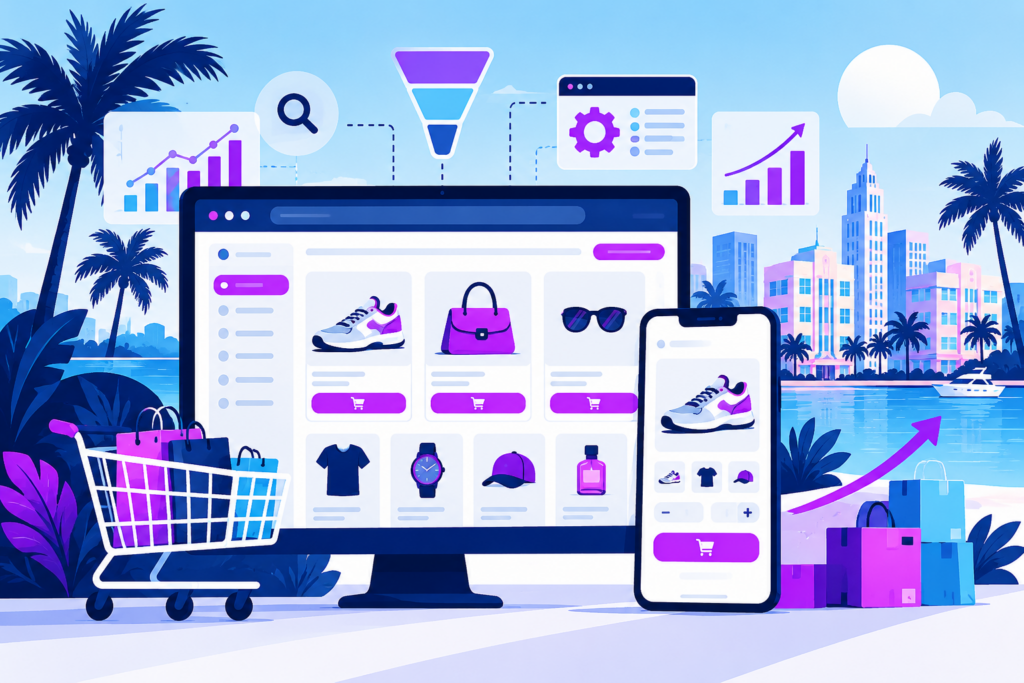
An ecommerce build has three parts that matter and a long list of parts that do not. The three that matter: product data structured so Google and Google Shopping can read it, a hosting and caching setup that keeps pages fast as your catalog grows, and a checkout flow with as few steps as the payment processor allows. Everything else is a layer on top of those three.
Product schema markup tells search engines the price, availability, brand, and review count for every item you sell, formatted the way Google’s structured data guidelines specify. Without it, your products compete in plain blue-link search results. With it, they can show up with price and stock status attached, which is what shoppers in The Hammocks click when they’re comparing options on a phone between errands.
Page speed at scale is a different problem than page speed for a five-page brochure site. A store with 200 or 2,000 SKUs needs image compression, lazy loading, and a content delivery setup that does not slow down as inventory grows. We build for the catalog size you will have in a year, not just the one you launch with, so you are not rebuilding the platform the first time a product line expands.
Checkout is where most ecommerce builds lose money without anyone noticing. Every extra field, every forced account creation, every slow payment redirect costs you a percentage of carts. We build checkout flows with guest checkout enabled, saved payment options where the processor supports it, and mobile-first form fields, because most of this traffic is going to arrive on a phone, often on the same connection shoppers use at the shopping centers along Kendall Drive and SW 137th Ave.
On top of that, the work covers:
- Inventory sync across channels if you sell on multiple platforms
- Tax and shipping rule configuration for Florida and out-of-state orders
- Analytics showing which products convert versus which just get views
- Call tracking and attribution by channel – organic search, Google Ads, social
That last piece matters most once orders start arriving: you need to know which channel actually sent them, instead of guessing and reallocating budget based on a hunch.
What is different about this market
The Hammocks is dense and built almost entirely around planned residential development, which means your customer base lives within a few square miles of you but also has a dozen other options within the same few square miles. Competition for search visibility here is moderate and comes mostly from national chains and directory sites, less from other local agencies building custom stores, which means a well-built ecommerce site does not need to out-muscle a hundred local competitors. It needs to out-rank Amazon listings and generic marketplace pages for specific, local-intent searches.
The business mix leans toward home services, medical and dental practices, and independent retail serving a large captive population that does not leave the area often for errands. For the retailers in that mix, the buyer here is split: price-led for commodity goods, trust-led for anything higher-ticket or health-related. A furniture store or appliance retailer needs transparent pricing and fast shipping information on the product page. A specialty retailer selling imported goods or services tied to medical equipment needs reviews, clear return policy, and a site that does not feel like it was assembled overnight.
The Hammocks is majority Hispanic, and a meaningful share of product searches here happen in Spanish or in a mix of English and Spanish. A store that only has an English product catalog is leaving search volume on the table. We build bilingual product pages where it matters for the catalog, not as a bolted-on translation plugin but as actual indexed Spanish-language content with its own metadata. Search behavior in this zip code skews heavily mobile, more than the The Hammocks-Dade average for suburban areas, because of how much time residents spend in cars and how commercial corridors here are built for drive-by and phone-in-hand browsing rather than walk-in foot traffic. Seasonal demand follows the general South Florida pattern – a lift around the winter holidays and back-to-school in August – but home services and medical-adjacent retail stay comparatively steady year-round because the demand is driven by a resident population rather than tourism.

How we start
We start every Hammocks ecommerce project with a short discovery call to understand your products, customers, and growth goals. From there, we map out your site structure, research competitors in the local market, and define the shopping experience that fits your brand.
Next comes a clear project plan covering design, product catalog setup, payment and shipping integrations, and timeline milestones so you always know what’s happening and when. We build on a secure, scalable platform suited to your inventory size and sales volume.
- Discovery call and goal-setting
- Site map and UX planning
- Platform selection and setup
- Timeline and milestone agreement
Product pages and structured data
We organize product information so customers can understand product features, variations, pricing, and availability. Where appropriate, we implement and validate Product structured data to help search engines interpret eligible product details. Structured data does not guarantee enhanced search results, but accurate implementation can support product discovery.
Page speed and technical performance
Large catalogs, high-resolution images, third-party scripts, and complex integrations can slow an online store. We review performance bottlenecks, image delivery, mobile usability, and unnecessary scripts. Testing should cover important templates and shopping journeys rather than only the homepage.
Navigation and catalog structure
Categories, filters, internal links, and product URLs should help customers locate items without creating confusing navigation or unnecessary duplicate pages. We also consider how product variations, unavailable items, and category changes are handled.
Checkout and conversion flow
We review the steps between adding an item to the cart and placing an order. Clear shipping information, transparent costs, accessible forms, suitable payment options, and useful error messages can reduce avoidable friction. Actual checkout changes should be assessed against analytics rather than assumptions.
SEO and measurement
Relevant page titles, meta descriptions, canonical URLs, indexation controls, and XML sitemaps help establish a consistent technical foundation. Analytics and ecommerce event tracking can measure product views, add-to-cart actions, checkout progression, and completed purchases when configured correctly.
What it costs
Ecommerce builds cost more than a brochure website because there is more structural work: product catalog setup, payment gateway integration, shipping and tax logic, and testing across devices before anything goes live. Pricing depends on catalog size, whether you need custom product variants, and whether you are migrating from an existing store or starting fresh. Call (754) 704-4727 and tell us how many products you are selling and we will give you a specific number, not a range pulled from a rate card.
Monthly costs after launch cover hosting built for ecommerce traffic, security patching, and whatever ongoing SEO or Google Ads management you choose to run. None of that is bundled into one flat fee by default, because a store that needs five hours of SEO work a month should not pay for twenty.

What you get each month
Once your store is live, the work does not stop. Every month you get a report showing organic traffic to product and category pages, conversion rate by traffic source, and call tracking data if phone orders or consultations factor into your sales process. We flag products getting search impressions but no clicks, usually a sign the title tag or price needs adjusting, plus pages losing visitors before checkout.
Multi-touchpoint attribution shows us that a customer found a product via organic search last week and converted this week after clicking a remarketing ad, instead of crediting whichever channel touched the sale last. That matters when deciding where to put next month’s ad budget.
- Plugin and platform updates
- Uptime monitoring
- Checkout testing after payment processor changes
A broken checkout nobody notices for a week is the costliest bug an ecommerce store can have.

Get a free audit
If you already have a store selling to customers in The Hammocks and you are not sure why traffic is not converting, we will look at it. A free audit covers your product schema markup, your page speed on mobile, your checkout flow, and how your category pages are structured for search, and tells you specifically what is costing you sales. We check whether your product images are compressed properly, whether your cart abandons visitors with unexpected shipping costs, and whether local shoppers searching from nearby can even find you against competitors. No obligation attached, and no generic checklist – we look at your actual site, on actual devices, and give you a plain-English list of fixes ranked by impact.
Call (754) 704-4727 or request the audit online and we will walk through what we find, what it is likely costing you in lost sales, and which fixes to prioritize first.

FAQ's
These are the 6 questions The Hammocks homeowners ask us most about ecommerce website design, answered plainly so you know what to expect before any work starts. If yours isn't covered here, get in touch and we'll walk you through it.
Do you build on Shopify, WooCommerce, or something else?
We build on whichever platform fits your catalog size, budget, and whether you need custom product logic. For most independent retailers in The Hammocks that means WooCommerce or Shopify. We will tell you which one fits before we start, and why.
Can my store have both English and Spanish product pages?
Yes, and in this market we recommend it. We build bilingual product pages as separate indexed pages with their own metadata, not a plugin that swaps text on the fly, because search engines need to see real Spanish-language content to rank it.
How long does an ecommerce build take?
It depends on catalog size and whether you are migrating existing products or starting new. A store with a smaller, well-organized catalog moves faster than one needing hundreds of products photographed, written, and tagged from scratch. We give you a timeline once we see your catalog.
Do you handle payment processing setup?
Yes. We integrate the payment gateway, configure Florida sales tax rules and any out-of-state tax obligations that apply to you, and set up shipping rules before launch.
What happens if my checkout breaks after launch?
That is part of ongoing maintenance. We monitor uptime and test checkout periodically because payment processors push updates that can quietly break a flow, and we catch it before it costs you a week of lost orders.