
- Home
- Services
- Portfolio
- About
- Service AreasFort Lauderdale, FL
- Web Design
- Redesign
- WordPress
- Ecommerce
- Landing Pages
- SEO Services
- Local SEO
- GBP
- Google Ads
- PPC
- Digital Marketing
- Internet Marketing
- Advertising
- Tracking
- Dental Marketing
- Medical Marketing
- HVAC Marketing
- Roofing Marketing
- Pest Control Marketing
- Home Services Marketing
- Plumbing Marketing
- Electrical Marketing
- Landscaping Marketing
- Remodeling Marketing
Pembroke Pines, FL- Web Design
- Redesign
- WordPress
- Ecommerce
- Landing Pages
- SEO Services
- Local SEO
- GBP
- Google Ads
- PPC
- Digital Marketing
- Internet Marketing
- Advertising
- Tracking
- Dental Marketing
- Medical Marketing
- HVAC Marketing
- Roofing Marketing
- Pest Control Marketing
- Home Services Marketing
- Plumbing Marketing
- Electrical Marketing
- Landscaping Marketing
- Remodeling Marketing
Hialeah, FL- Web Design
- Redesign
- WordPress
- Ecommerce
- Landing Pages
- SEO Services
- Local SEO
- GBP
- Google Ads
- PPC
- Digital Marketing
- Internet Marketing
- Advertising
- Tracking
- Dental Marketing
- Medical Marketing
- HVAC Marketing
- Roofing Marketing
- Pest Control Marketing
- Home Services Marketing
- Plumbing Marketing
- Electrical Marketing
- Landscaping Marketing
- Remodeling Marketing
Hollywood, FL- Web Design
- Redesign
- WordPress
- Ecommerce
- Landing Pages
- SEO Services
- Local SEO
- GBP
- Google Ads
- PPC
- Digital Marketing
- Internet Marketing
- Advertising
- Tracking
- Dental Marketing
- Medical Marketing
- HVAC Marketing
- Roofing Marketing
- Pest Control Marketing
- Home Services Marketing
- Plumbing Marketing
- Electrical Marketing
- Landscaping Marketing
- Remodeling Marketing
Miramar, FL- Web Design
- Redesign
- WordPress
- Ecommerce
- Landing Pages
- SEO Services
- Local SEO
- GBP
- Google Ads
- PPC
- Digital Marketing
- Internet Marketing
- Advertising
- Tracking
- Dental Marketing
- Medical Marketing
- HVAC Marketing
- Roofing Marketing
- Pest Control Marketing
- Home Services Marketing
- Plumbing Marketing
- Electrical Marketing
- Landscaping Marketing
- Remodeling Marketing
Coral Springs, FL- Web Design
- Redesign
- WordPress
- Ecommerce
- Landing Pages
- SEO Services
- Local SEO
- GBP
- Google Ads
- PPC
- Digital Marketing
- Internet Marketing
- Advertising
- Tracking
- Dental Marketing
- Medical Marketing
- HVAC Marketing
- Roofing Marketing
- Pest Control Marketing
- Home Services Marketing
- Plumbing Marketing
- Electrical Marketing
- Landscaping Marketing
- Remodeling Marketing
Pompano Beach, FL- Web Design
- Redesign
- WordPress
- Ecommerce
- Landing Pages
- SEO Services
- Local SEO
- GBP
- Google Ads
- PPC
- Digital Marketing
- Internet Marketing
- Advertising
- Tracking
- Dental Marketing
- Medical Marketing
- HVAC Marketing
- Roofing Marketing
- Pest Control Marketing
- Home Services Marketing
- Plumbing Marketing
- Electrical Marketing
- Landscaping Marketing
- Remodeling Marketing
Davie, FL- Web Design
- Redesign
- WordPress
- Ecommerce
- Landing Pages
- SEO Services
- Local SEO
- GBP
- Google Ads
- PPC
- Digital Marketing
- Internet Marketing
- Advertising
- Tracking
- Dental Marketing
- Medical Marketing
- HVAC Marketing
- Roofing Marketing
- Pest Control Marketing
- Home Services Marketing
- Plumbing Marketing
- Electrical Marketing
- Landscaping Marketing
- Remodeling Marketing
Sunrise, FL- Web Design
- Redesign
- WordPress
- Ecommerce
- Landing Pages
- SEO Services
- Local SEO
- GBP
- Google Ads
- PPC
- Digital Marketing
- Internet Marketing
- Advertising
- Tracking
- Dental Marketing
- Medical Marketing
- HVAC Marketing
- Roofing Marketing
- Pest Control Marketing
- Home Services Marketing
- Plumbing Marketing
- Electrical Marketing
- Landscaping Marketing
- Remodeling Marketing
Plantation, FL- Web Design
- Redesign
- WordPress
- Ecommerce
- Landing Pages
- SEO Services
- Local SEO
- GBP
- Google Ads
- PPC
- Digital Marketing
- Internet Marketing
- Advertising
- Tracking
- Dental Marketing
- Medical Marketing
- HVAC Marketing
- Roofing Marketing
- Pest Control Marketing
- Home Services Marketing
- Plumbing Marketing
- Electrical Marketing
- Landscaping Marketing
- Remodeling Marketing
Deerfield Beach, FL- Web Design
- Redesign
- WordPress
- Ecommerce
- Landing Pages
- SEO Services
- Local SEO
- GBP
- Google Ads
- PPC
- Digital Marketing
- Internet Marketing
- Advertising
- Tracking
- Dental Marketing
- Medical Marketing
- HVAC Marketing
- Roofing Marketing
- Pest Control Marketing
- Home Services Marketing
- Plumbing Marketing
- Electrical Marketing
- Landscaping Marketing
- Remodeling Marketing
Miami Gardens, FL- Web Design
- Redesign
- WordPress
- Ecommerce
- Landing Pages
- SEO Services
- Local SEO
- GBP
- Google Ads
- PPC
- Digital Marketing
- Internet Marketing
- Advertising
- Tracking
- Dental Marketing
- Medical Marketing
- HVAC Marketing
- Roofing Marketing
- Pest Control Marketing
- Home Services Marketing
- Plumbing Marketing
- Electrical Marketing
- Landscaping Marketing
- Remodeling Marketing
Lauderhill, FL- Web Design
- Redesign
- WordPress
- Ecommerce
- Landing Pages
- SEO Services
- Local SEO
- GBP
- Google Ads
- PPC
- Digital Marketing
- Internet Marketing
- Advertising
- Tracking
- Dental Marketing
- Medical Marketing
- HVAC Marketing
- Roofing Marketing
- Pest Control Marketing
- Home Services Marketing
- Plumbing Marketing
- Electrical Marketing
- Landscaping Marketing
- Remodeling Marketing
West Palm Beach, FL- Web Design
- Redesign
- WordPress
- Ecommerce
- Landing Pages
- SEO Services
- Local SEO
- GBP
- Google Ads
- PPC
- Digital Marketing
- Internet Marketing
- Advertising
- Tracking
- Dental Marketing
- Medical Marketing
- HVAC Marketing
- Roofing Marketing
- Pest Control Marketing
- Home Services Marketing
- Plumbing Marketing
- Electrical Marketing
- Landscaping Marketing
- Remodeling Marketing
Tamarac, FL- Web Design
- Redesign
- WordPress
- Ecommerce
- Landing Pages
- SEO Services
- Local SEO
- GBP
- Google Ads
- PPC
- Digital Marketing
- Internet Marketing
- Advertising
- Tracking
- Dental Marketing
- Medical Marketing
- HVAC Marketing
- Roofing Marketing
- Pest Control Marketing
- Home Services Marketing
- Plumbing Marketing
- Electrical Marketing
- Landscaping Marketing
- Remodeling Marketing
Weston, FL- Web Design
- Redesign
- WordPress
- Ecommerce
- Landing Pages
- SEO Services
- Local SEO
- GBP
- Google Ads
- PPC
- Digital Marketing
- Internet Marketing
- Advertising
- Tracking
- Dental Marketing
- Medical Marketing
- HVAC Marketing
- Roofing Marketing
- Pest Control Marketing
- Home Services Marketing
- Plumbing Marketing
- Electrical Marketing
- Landscaping Marketing
- Remodeling Marketing
Boca Raton, FLMargate, FLCoconut Creek, FLMiami Beach, FLHomestead, FLKendall, FLDoral, FLBoynton Beach, FLThe Hammocks, FLNorth Lauderdale, FLOakland Park, FLDelray Beach, FLNorth Miami, FLHallandale Beach, FLFontainebleau, FLKendale Lakes, FLWellington, FLJupiter, FLTamiami, FLPalm Beach Gardens, FLLauderdale Lakes, FLCooper City, FLCountry Club, FLParkland, FLCoral Gables, FLDania Beach, FLCutler Bay, FLNorth Miami Beach, FLGreenacres, FLLake Worth Beach, FLPrinceton, FLRoyal Palm Beach, FLSouth Miami Heights, FLRichmond West, FLRiviera Beach, FLWest Little River, FLGolden Glades, FLAventura, FLMiami Lakes, FLWestchester, FLLeisure City, FLCoral Terrace, FLPalm Springs, FLPalmetto Bay, FLHialeah Gardens, FLSunny Isles Beach, FLIves Estates, FLWest Park, FLSweetwater, FLPinecrest, FLSunset, FLPinewood, FLWilton Manors, FLOpa-locka, FLLighthouse Point, FLBelle Glade, FLNaranja, FLPalmetto Estates, FLBrownsville, FLKey Biscayne, FLOlympia Heights, FLMiami Springs, FLFlorida City, FLSouth Miami, FLThree Lakes, FLGladeview, FLNorth Palm Beach, FLMiami Shores, FLSouthwest Ranches, FLKings Point, FLLauderdale-by-the-Sea, FLHillsboro Beach, FLSea Ranch Lakes, FLLazy Lake, FL - Blog
- Contact
Marketing for Medical Practices in Hallandale Beach, Florida
Hallandale Beach runs on tourism, condo residents, and a steady flow of snowbirds who need a doctor fast and have no history with anyone local. That’s a different patient than the one who grew up fifteen minutes away and picked a pediatrician by word of mouth. Your marketing has to answer for both, often within the same week.
We build sites and campaigns for medical practices in Hallandale Beach with that split audience in mind: fast-decision visitors who need credentials, insurance accepted, and same-week availability on the first screen, and long-term residents who are comparing providers over weeks before ever calling. Both groups read reviews before they read anything else you’ve written about yourself — which means your Google Business Profile and reputation management matter as much as your website copy.

How Hallandale Beach medical practices buyers search
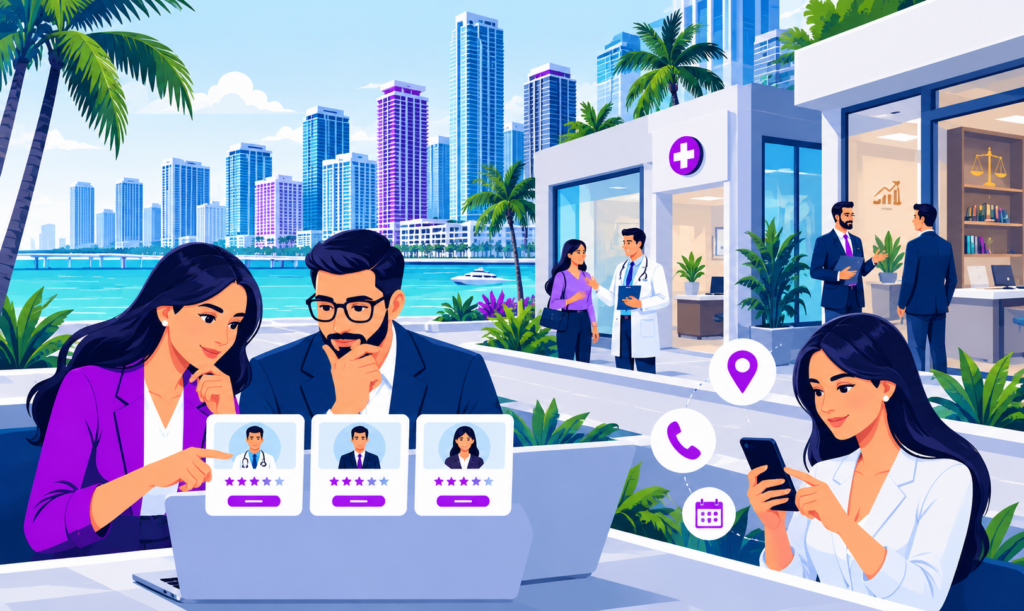
Searches here split into two clear patterns. The first is urgent and local: “urgent care Hallandale Beach,” “doctor near me open now,” “walk in clinic Hallandale Beach Blvd.” These queries come from tourists staying at the beach, condo guests at the oceanfront towers, and seasonal residents who have no existing relationship with a provider. They click the map pack, they call, and they decide in minutes. If your Google Business Profile isn’t accurate down to current hours and accepted insurance, that click goes to the next listing down.
The second pattern is slower and more specific: “dermatologist Hallandale Beach reviews,” “best OBGYN near Aventura,” “pain management Gulfstream Park area.” These searchers are comparing two or three practices, reading bios, checking insurance acceptance, and reading reviews in detail before they call. A snowbird who splits time between Hallandale Beach and a northern state searches differently in January than in July, and search volume for most specialties swings hard with that seasonal population. Practices that only optimize for peak season traffic lose ground when the off-season patients they could still capture never find them.
Spanish-language search also matters more here than in many Broward cities, given the concentration of Spanish-speaking residents and snowbirds from Latin America. “Médico cerca de mí” and specialty-specific Spanish queries show real volume, and a practice with no Spanish content is invisible to a share of the local market that isn’t small. Bilingual staff mentioned on the page, Spanish-language service descriptions, and even a Spanish-toggle on the site can move a practice into searches that English-only competitors never appear in.
Because Hallandale Beach sits between Aventura and Hollywood, a lot of this traffic isn’t city-bound in its intent. People search “near me” and let Google decide the city based on proximity and relevance, not on municipal boundaries. That means your map listing accuracy, review volume, and page relevance matter more than whether your printed address happens to say Hallandale Beach. A practice three blocks over the Hollywood line can still outrank you locally if its listing is stronger.
Specialties also carry different intent signals worth building pages around:
- Urgent/walk-in care: speed and current availability
- Specialists (dermatology, OBGYN, pain management): credentials, reviews, insurance
- Bilingual practices: Spanish-language proof points throughout the site
The competition here
Hallandale Beach is small in land area but dense in competing practices, partly because Aventura and Hollywood providers also show up for Hallandale Beach searches. The map pack is crowded for anything generic: family medicine, dermatology, dentistry, urgent care. Three to five practices usually hold those top map spots for any given specialty, and they tend to hold them because of review volume and review recency, not because their website is better built.
Organic results below the map pack are less crowded and, for most specialties, easier to earn a real position in. A practice with a genuinely built-out site, one page per service rather than one page trying to cover everything, can compete there even against larger groups with bigger ad budgets.
Paid search (Google Ads) for medical terms in this corridor is active but not saturated the way it is in, say, Aventura proper. Cost per click for specialties like dental implants or cosmetic dermatology runs higher than for general practice, which is normal given the value of a patient in those specialties.
The honest read: if your reviews are thin or stale, you are not getting into the map pack regardless of how good your site is. If your reviews are solid, the opportunity is in organic content and in making sure your Google Business Profile reflects every service you actually offer, not just your specialty name.
What we build for Medical Practices in this market
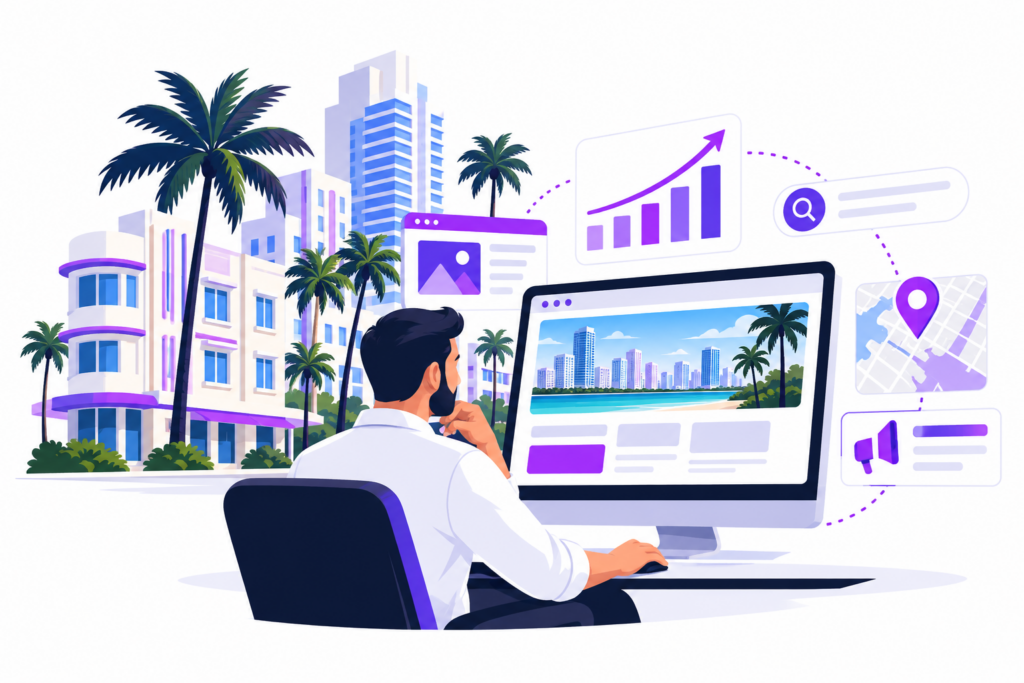
Provider bio pages, built for trust and for search. Each physician gets a dedicated page with credentials, board certifications, education, and photo, because patients click through to the doctor before they book, and because Google treats medical content differently than a restaurant menu. This is YMYL content, “your money or your life,” and thin, generic bios hurt your rankings as well as your conversion.
Google’s own guidance on what it calls E-E-A-T, experience, expertise, authoritativeness, and trust, applies directly to medical sites. [EXTERNAL LINK: Google Search Central’s page on E-E-A-T and quality rater guidelines, to show the standard medical content is actually held to] We write bio and service pages against that standard, not against a template built for a plumber.
HIPAA-aware form handling. Contact forms and appointment request forms on a medical site cannot leak patient information into general-purpose marketing tools the way a lead form for a landscaper can. We set up forms, call tracking, and intake so patient-submitted information routes only where it is supposed to, and we document how that routing works so your compliance officer isn’t guessing.
One page per service, not one page per specialty. A dermatology practice offering Mohs surgery, cosmetic Botox, and acne treatment needs three separate pages, because those three services have three different search audiences and three different intents. One page trying to rank for all three usually ranks for none of them well.
Multi-location structure, if you have more than one site. Several Hallandale Beach practices operate a second location in Aventura, Hollywood, or Sunny Isles. Each location needs its own page with its own address, hours, and provider list, not a single “locations” page listing both as an afterthought. Google ranks location pages separately, and patients searching “near me” need the nearest one to surface, not whichever one is listed first.
Reputation and review infrastructure. In a seasonal, tourism-adjacent market like this one, reviews carry more weight than almost anywhere else, because so many searchers have zero prior relationship with any provider in town and are deciding cold. We set up review request workflows tied to patient visits (within whatever compliance boundaries your practice operates under) and we track review volume and rating trend over time, the same way we track rankings.
Spanish-language page parity where it matters. For practices serving a bilingual patient base, we build Spanish versions of key service pages rather than relying on a browser translate plugin, which Google does not treat as equivalent content.
Legal and professional services
Explain practice areas, relevant experience, service locations, and consultation options. Organize pages around the specific services potential clients search for.
Medical and healthcare practices
Make treatment information, provider details, location information, and appointment options easy to find. Review health-related claims carefully.
Financial services
Present services, qualifications, and contact pathways clearly while respecting applicable advertising and compliance requirements.
Technology and business services
Explain complex offerings in plain language, demonstrate practical value, and create landing pages for distinct solutions.
Local service businesses
Build relevant service and location pages, improve Google Business Profile information, and make calls and enquiry forms easy to use.
What we measure
We report on what you can verify: call tracking numbers so you can hear which calls came from search versus from a referral, form submissions tagged by source page, and ranking position for the specific terms we targeted, checked against Hallandale Beach and the surrounding zip codes rather than a generic national snapshot.
We also track review count and review velocity, since that is the metric most tied to map pack position in this specific market. If review growth stalls, that shows up before rankings do, and it’s something we flag rather than let sit.
Multi-touchpoint attribution matters more for medical practices than most verticals, because the patient journey is longer. A patient might find you through an organic search in November, read reviews in December, and call in January once their insurance resets. We tie that path together where the data allows it, instead of crediting the whole decision to whichever channel happened last.
None of this comes with a promised ranking, a promised call volume, or a promised timeline. We will tell you what moved, what didn’t, and what we’re changing because of it.

What it costs
Medical marketing costs more than marketing for most local service businesses, mainly because content requirements are higher. A provider bio page, a HIPAA-aware form setup, and a service page written to YMYL standards take more research and review than a generic page, and that shows up in the quote.
Costs also vary by how many providers and locations you have, and whether you need Spanish-language pages alongside English ones. A single-provider practice with one location costs less to build and maintain than a multi-location group with several providers and bilingual content needs.
Paid search budgets for medical terms in Hallandale Beach vary by specialty too, since cost per click for cosmetic and elective procedures runs well above general or urgent care. We’ll walk through real numbers for your specialty and location count on a call, rather than quote a flat rate that doesn’t fit your practice.

Get an audit
We’ll look at your current site, your Google Business Profile, and your review count against the other practices showing up in your specialty and zip code around Hallandale Beach, and tell you plainly where the gaps are. No obligation, no canned report generated by software that’s never seen a medical practice before.
We’ll check whether your site actually loads fast on a phone in a waiting room, whether your contact forms are HIPAA-appropriate, whether patients searching for your specialty near Hallandale Beach can actually find you before a competitor three blocks over, and whether your scheduling process is costing you patients who give up and call someone else instead.
- Website speed and mobile usability
- Google Business Profile accuracy and ranking
- Review volume compared to nearby competitors
Send us your site and your specialty. We’ll tell you honestly whether the work is worth doing now or whether something more basic needs fixing first.

FAQ's
These are the 6 questions Hallandale Beach homeowners ask us most about medical practice marketing, answered plainly so you know what to expect before any work starts. If yours isn't covered here, get in touch and we'll walk you through it.
Can you build a medical site that stays HIPAA-compliant?
We build forms and intake flows that avoid routing patient information through general marketing tools, and we document how data moves through the site. We are not a compliance auditor, so for a full HIPAA risk assessment we recommend pairing this with your compliance officer or legal counsel.
Do you write the provider bios or do we?
We draft them from information you give us (education, board certifications, specialties, bio details) and you review and approve before anything publishes. Medical content needs your sign-off, not just ours.
We have two locations, one in Hallandale Beach and one in Aventura. Does that change the build?
Yes. Each location gets its own page with its own address, hours, and provider list, because Google ranks locations separately and patients searching nearby need the closer one to surface first.
How much do reviews actually matter for a medical practice here?
In a tourism-heavy, seasonal market like Hallandale Beach, a large share of searchers have no prior relationship with any local provider. Reviews are often the only trust signal they have, and they carry more weight in the map pack here than in many inland markets.
Do you handle Spanish-language pages?
We can build Spanish versions of key service pages for practices with a bilingual patient base. We write them as separate, real pages rather than relying on an automatic translation plugin, since Google treats those differently.