
- Home
- Services
- Portfolio
- About
- Service AreasFort Lauderdale, FL
- Web Design
- Redesign
- WordPress
- Ecommerce
- Landing Pages
- SEO Services
- Local SEO
- GBP
- Google Ads
- PPC
- Digital Marketing
- Internet Marketing
- Advertising
- Tracking
- Dental Marketing
- Medical Marketing
- HVAC Marketing
- Roofing Marketing
- Pest Control Marketing
- Home Services Marketing
- Plumbing Marketing
- Electrical Marketing
- Landscaping Marketing
- Remodeling Marketing
Pembroke Pines, FL- Web Design
- Redesign
- WordPress
- Ecommerce
- Landing Pages
- SEO Services
- Local SEO
- GBP
- Google Ads
- PPC
- Digital Marketing
- Internet Marketing
- Advertising
- Tracking
- Dental Marketing
- Medical Marketing
- HVAC Marketing
- Roofing Marketing
- Pest Control Marketing
- Home Services Marketing
- Plumbing Marketing
- Electrical Marketing
- Landscaping Marketing
- Remodeling Marketing
Hialeah, FL- Web Design
- Redesign
- WordPress
- Ecommerce
- Landing Pages
- SEO Services
- Local SEO
- GBP
- Google Ads
- PPC
- Digital Marketing
- Internet Marketing
- Advertising
- Tracking
- Dental Marketing
- Medical Marketing
- HVAC Marketing
- Roofing Marketing
- Pest Control Marketing
- Home Services Marketing
- Plumbing Marketing
- Electrical Marketing
- Landscaping Marketing
- Remodeling Marketing
Hollywood, FL- Web Design
- Redesign
- WordPress
- Ecommerce
- Landing Pages
- SEO Services
- Local SEO
- GBP
- Google Ads
- PPC
- Digital Marketing
- Internet Marketing
- Advertising
- Tracking
- Dental Marketing
- Medical Marketing
- HVAC Marketing
- Roofing Marketing
- Pest Control Marketing
- Home Services Marketing
- Plumbing Marketing
- Electrical Marketing
- Landscaping Marketing
- Remodeling Marketing
Miramar, FL- Web Design
- Redesign
- WordPress
- Ecommerce
- Landing Pages
- SEO Services
- Local SEO
- GBP
- Google Ads
- PPC
- Digital Marketing
- Internet Marketing
- Advertising
- Tracking
- Dental Marketing
- Medical Marketing
- HVAC Marketing
- Roofing Marketing
- Pest Control Marketing
- Home Services Marketing
- Plumbing Marketing
- Electrical Marketing
- Landscaping Marketing
- Remodeling Marketing
Coral Springs, FL- Web Design
- Redesign
- WordPress
- Ecommerce
- Landing Pages
- SEO Services
- Local SEO
- GBP
- Google Ads
- PPC
- Digital Marketing
- Internet Marketing
- Advertising
- Tracking
- Dental Marketing
- Medical Marketing
- HVAC Marketing
- Roofing Marketing
- Pest Control Marketing
- Home Services Marketing
- Plumbing Marketing
- Electrical Marketing
- Landscaping Marketing
- Remodeling Marketing
Pompano Beach, FL- Web Design
- Redesign
- WordPress
- Ecommerce
- Landing Pages
- SEO Services
- Local SEO
- GBP
- Google Ads
- PPC
- Digital Marketing
- Internet Marketing
- Advertising
- Tracking
- Dental Marketing
- Medical Marketing
- HVAC Marketing
- Roofing Marketing
- Pest Control Marketing
- Home Services Marketing
- Plumbing Marketing
- Electrical Marketing
- Landscaping Marketing
- Remodeling Marketing
Davie, FL- Web Design
- Redesign
- WordPress
- Ecommerce
- Landing Pages
- SEO Services
- Local SEO
- GBP
- Google Ads
- PPC
- Digital Marketing
- Internet Marketing
- Advertising
- Tracking
- Dental Marketing
- Medical Marketing
- HVAC Marketing
- Roofing Marketing
- Pest Control Marketing
- Home Services Marketing
- Plumbing Marketing
- Electrical Marketing
- Landscaping Marketing
- Remodeling Marketing
Sunrise, FL- Web Design
- Redesign
- WordPress
- Ecommerce
- Landing Pages
- SEO Services
- Local SEO
- GBP
- Google Ads
- PPC
- Digital Marketing
- Internet Marketing
- Advertising
- Tracking
- Dental Marketing
- Medical Marketing
- HVAC Marketing
- Roofing Marketing
- Pest Control Marketing
- Home Services Marketing
- Plumbing Marketing
- Electrical Marketing
- Landscaping Marketing
- Remodeling Marketing
Plantation, FL- Web Design
- Redesign
- WordPress
- Ecommerce
- Landing Pages
- SEO Services
- Local SEO
- GBP
- Google Ads
- PPC
- Digital Marketing
- Internet Marketing
- Advertising
- Tracking
- Dental Marketing
- Medical Marketing
- HVAC Marketing
- Roofing Marketing
- Pest Control Marketing
- Home Services Marketing
- Plumbing Marketing
- Electrical Marketing
- Landscaping Marketing
- Remodeling Marketing
Deerfield Beach, FL- Web Design
- Redesign
- WordPress
- Ecommerce
- Landing Pages
- SEO Services
- Local SEO
- GBP
- Google Ads
- PPC
- Digital Marketing
- Internet Marketing
- Advertising
- Tracking
- Dental Marketing
- Medical Marketing
- HVAC Marketing
- Roofing Marketing
- Pest Control Marketing
- Home Services Marketing
- Plumbing Marketing
- Electrical Marketing
- Landscaping Marketing
- Remodeling Marketing
Miami Gardens, FL- Web Design
- Redesign
- WordPress
- Ecommerce
- Landing Pages
- SEO Services
- Local SEO
- GBP
- Google Ads
- PPC
- Digital Marketing
- Internet Marketing
- Advertising
- Tracking
- Dental Marketing
- Medical Marketing
- HVAC Marketing
- Roofing Marketing
- Pest Control Marketing
- Home Services Marketing
- Plumbing Marketing
- Electrical Marketing
- Landscaping Marketing
- Remodeling Marketing
Lauderhill, FL- Web Design
- Redesign
- WordPress
- Ecommerce
- Landing Pages
- SEO Services
- Local SEO
- GBP
- Google Ads
- PPC
- Digital Marketing
- Internet Marketing
- Advertising
- Tracking
- Dental Marketing
- Medical Marketing
- HVAC Marketing
- Roofing Marketing
- Pest Control Marketing
- Home Services Marketing
- Plumbing Marketing
- Electrical Marketing
- Landscaping Marketing
- Remodeling Marketing
West Palm Beach, FL- Web Design
- Redesign
- WordPress
- Ecommerce
- Landing Pages
- SEO Services
- Local SEO
- GBP
- Google Ads
- PPC
- Digital Marketing
- Internet Marketing
- Advertising
- Tracking
- Dental Marketing
- Medical Marketing
- HVAC Marketing
- Roofing Marketing
- Pest Control Marketing
- Home Services Marketing
- Plumbing Marketing
- Electrical Marketing
- Landscaping Marketing
- Remodeling Marketing
Tamarac, FL- Web Design
- Redesign
- WordPress
- Ecommerce
- Landing Pages
- SEO Services
- Local SEO
- GBP
- Google Ads
- PPC
- Digital Marketing
- Internet Marketing
- Advertising
- Tracking
- Dental Marketing
- Medical Marketing
- HVAC Marketing
- Roofing Marketing
- Pest Control Marketing
- Home Services Marketing
- Plumbing Marketing
- Electrical Marketing
- Landscaping Marketing
- Remodeling Marketing
Weston, FL- Web Design
- Redesign
- WordPress
- Ecommerce
- Landing Pages
- SEO Services
- Local SEO
- GBP
- Google Ads
- PPC
- Digital Marketing
- Internet Marketing
- Advertising
- Tracking
- Dental Marketing
- Medical Marketing
- HVAC Marketing
- Roofing Marketing
- Pest Control Marketing
- Home Services Marketing
- Plumbing Marketing
- Electrical Marketing
- Landscaping Marketing
- Remodeling Marketing
Boca Raton, FLMargate, FLCoconut Creek, FLMiami Beach, FLHomestead, FLKendall, FLDoral, FLBoynton Beach, FLThe Hammocks, FLNorth Lauderdale, FLOakland Park, FLDelray Beach, FLNorth Miami, FLHallandale Beach, FLFontainebleau, FLKendale Lakes, FLWellington, FLJupiter, FLTamiami, FLPalm Beach Gardens, FLLauderdale Lakes, FLCooper City, FLCountry Club, FLParkland, FLCoral Gables, FLDania Beach, FLCutler Bay, FLNorth Miami Beach, FLGreenacres, FLLake Worth Beach, FLPrinceton, FLRoyal Palm Beach, FLSouth Miami Heights, FLRichmond West, FLRiviera Beach, FLWest Little River, FLGolden Glades, FLAventura, FLMiami Lakes, FLWestchester, FLLeisure City, FLCoral Terrace, FLPalm Springs, FLPalmetto Bay, FLHialeah Gardens, FLSunny Isles Beach, FLIves Estates, FLWest Park, FLSweetwater, FLPinecrest, FLSunset, FLPinewood, FLWilton Manors, FLOpa-locka, FLLighthouse Point, FLBelle Glade, FLNaranja, FLPalmetto Estates, FLBrownsville, FLKey Biscayne, FLOlympia Heights, FLMiami Springs, FLFlorida City, FLSouth Miami, FLThree Lakes, FLGladeview, FLNorth Palm Beach, FLMiami Shores, FLSouthwest Ranches, FLKings Point, FLLauderdale-by-the-Sea, FLHillsboro Beach, FLSea Ranch Lakes, FLLazy Lake, FL - Blog
- Contact
Web Design and Marketing in Parkland, Florida
The business landscape in Parkland
Parkland sits at the far western edge of Broward County, buffered from sprawl by conservation land and the Everglades. It’s a planned city: most of its roughly 34,670 residents live in HOA-governed communities built since the 1990s, with rules covering everything down to mailbox color. There’s no real downtown strip — commerce runs along University Drive and State Road 7, and much of it is licensed contractors, tutors, pediatric therapists, landscapers, and pool companies working from home to serve surrounding zip codes.

What we do for Parkland businesses
For most Parkland clients we start with the website, because a service-area business needs a site that can state clearly what it does and where it goes, not just who it is. A homeowner comparing three companies in one sitting from Parkland down to Coral Springs or up toward Coconut Creek shouldn’t have to dig through a menu to figure out if you cover their zip code, what you charge for, and whether you’ll actually pick up the phone. From there the work splits into three connected disciplines.
Web design here is built to convert that comparison-shopping visitor fast: clear service pages, visible proof of local work, and calls-to-action that don’t make someone hunt for a phone number on a mobile screen. SEO is aimed at the specific neighborhoods and developments a business actually serves, not a vague “Parkland and surrounding areas” line that search engines and customers both ignore. That means pages built around the communities and road corridors people actually search from, plus the citation and review groundwork that gets a map listing taken seriously against competitors who’ve been running the same playbook for years. Google Ads covers the jobs that need calls this week, not this quarter, with campaigns structured tightly enough that a search for emergency or same-day service doesn’t land on the same ad as someone browsing for a future estimate.
We layer in call tracking on top of all three, because none of it means much if you can’t tell which keyword, which ad, or which page actually produced a phone call. Tracked numbers by source let us see, in plain numbers, whether the SEO work is earning calls from the neighborhoods it’s targeting, whether a given ad group is paying for itself, and where the website itself is quietly losing people before they ever dial. That feedback loop is what keeps the three services working together instead of running as separate, unaccountable line items. For a Parkland business, it also means decisions about budget get made from real call data instead of guesswork about what “feels” like it’s working.
Which industries we work with here
Parkland’s business mix is narrower than a larger city’s, and that is useful. Home services dominate: roofing, HVAC, pool construction and repair, landscaping, pest control, and general contracting, almost all of it tied to the newer housing stock going through its first or second round of maintenance and renovation. Behind that sits a cluster of professional and personal services aimed at families: pediatric dentists, orthodontists, tutoring centers, youth sports and enrichment programs, and estate planning attorneys serving a population with a higher-than-average concentration of homeowners. We also work with a smaller group of medical and wellness practices, where the competition is less about volume of searches and more about trust signals once someone clicks through. Across all of these, the common thread is that the customer is searching before they are calling, and the business that answers the search clearly and fast tends to win the job, not necessarily the business that has been established longest.

Within these categories, the businesses that struggle online are usually the ones still treating their website as a brochure instead of a lead source. A roofer with a five-page site built in 2016 and a pool contractor with a one-page Wix site with no service breakdown both lose to a competitor who has a page for roof replacement, a separate page for roof repair, and a separate page for storm damage, because Google and the searcher both want specificity, not a general claim to “serve all your needs.”
Website structure
Organize service pages, supporting content, navigation, and contact information so visitors can find relevant details.
Responsive layouts
Make pages usable across desktop computers, tablets, and mobile devices.
Speed and performance
Review image sizes, scripts, and other factors that can slow pages or affect user experience.
Conversion-focused design
Make phone links, enquiry forms, appointment options, and calls to action easy to find.
SEO foundations
Structure headings, page titles, meta descriptions, internal links, and page content around relevant search intent.
Technical checks
Test links, forms, indexing accessibility, and key user journeys before launch.
How local search works in this market
Parkland has almost no commercial strip, which changes how the Google map pack behaves compared to a city built around a main street. In a dense commercial corridor, proximity to the searcher usually decides who shows up in the top three map results. In Parkland, where the searcher is standing in a residential subdivision three miles from the nearest business license, Google leans harder on other signals: how complete and active the Google Business Profile is, how many reviews it has and how recent they are, whether the category and service area are set correctly, and whether the website content actually matches what’s being searched.
This is why a business based in Coral Springs or even Boynton Beach can out-rank a business technically closer to the searcher, and why a business sitting right in Parkland can still lose the map pack to one three miles off if its profile is thin. For a service-area business, the service-area setting in the Business Profile, paired with city-specific landing pages that name Parkland and its subdivisions by name, does more work than the physical pin. We set these up to reflect where the business actually drives and works, not just where it is registered, because that’s what the algorithm is trying to match in the first place.
Review velocity plays a bigger role here than in most cities we work in. Because the population turns over service providers often (new homeowners replacing a system they inherited, swapping a landscaper within the first year), a steady trickle of recent reviews signals current activity in a way that a large pile of old reviews does not. We build review requests into the workflow rather than leaving it to chance.

What it costs
Pricing for Parkland work depends on the service and how competitive your corner of the market is. A new website runs in a range tied to the number of pages, service areas, and features like booking tools, financing calculators, or galleries that need regular updates. SEO is typically a monthly retainer scaled to how many services and surrounding cities you compete in, since a contractor serving only Parkland needs far less than one also targeting Coral Springs, Coconut Creek, and Margate. Google Ads has two separate costs: our management fee and the ad spend itself, which you control directly, adjust month to month, and can scale up or down as leads come in. We’ll give you an actual number once we understand your services, your goals, and how many areas you’re trying to win, not a generic package price pulled from somewhere else that doesn’t reflect your market.

Why an agency outside Parkland is fine, and when it is not
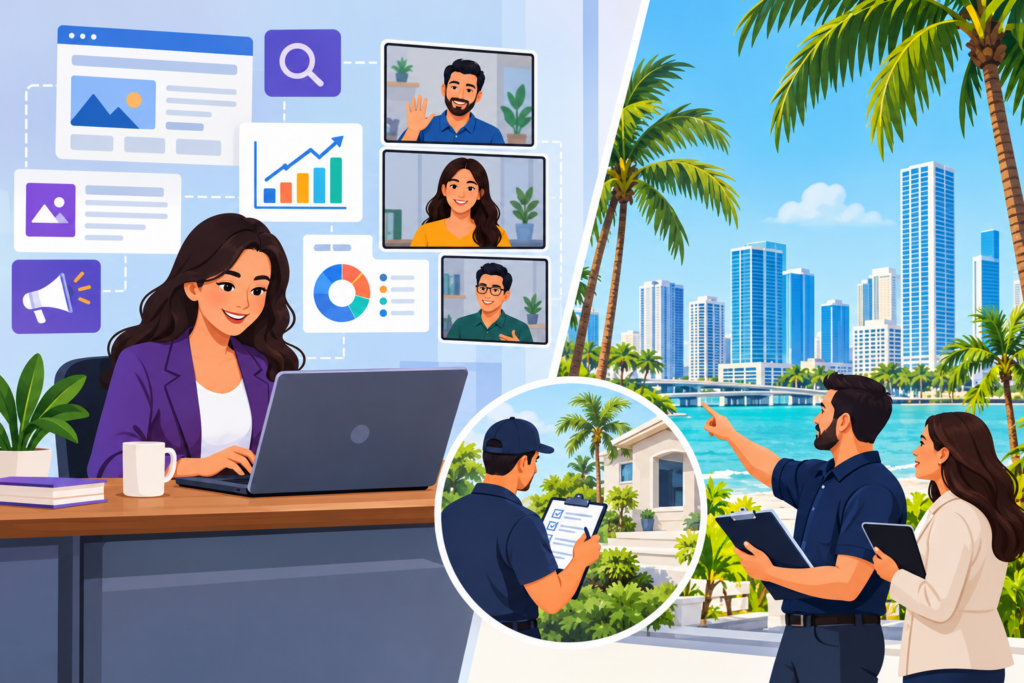
We’re South Florida-based, not Parkland-based, and that’s fine: Google Business Profiles rank on service-area settings and reviews, not your agency’s zip code. What matters is local knowledge—naming Heron Bay or Parkland Golf & Country Club, knowing HOA signage rules. Physical presence matters for your business, like inspections; not for who builds your website.
- Review: Assess the existing website, available analytics, and primary business goals.
- Plan: Define the page structure, content requirements, design direction, and desired visitor actions.
- Build or improve: Develop the agreed pages and functionality with attention to speed, usability, and search accessibility.
- Test: Check layouts, links, forms, and important user journeys before launch.
- Measure: Review available performance data and identify opportunities for continued improvement.
If a competitor tells you that only a Parkland-based agency can market a Parkland business, ask them to explain the mechanism. If they can’t point to something specific the address itself does for your rankings, it’s a sales line, not a fact.
We’d rather show you what’s already happening with your site and profile than talk in generalities about what we could do. A free audit for Parkland businesses looks at your current Google Business Profile setup, your website’s service-area pages, and your review activity, and tells you specifically what’s missing and what’s working against you.
We check whether your site actually loads fast and reads well on mobile, since most local searches around Parkland happen on a phone in the car or on a job site. We look at whether your Google Ads account, if you’re running one, is burning budget on broad match keywords that bring in clicks from outside your real service radius. We check your on-page SEO against what competitors ranking above you are doing, and whether your citations and directory listings are consistent across the web.
- Google Business Profile accuracy and categories
- Service-area page coverage and local keyword targeting
- Review volume, response rate, and reputation signals
- Site speed, mobile usability, and Google Ads waste
No obligation attached, and no pressure to sign anything to get the findings.
FAQ's
These are the 5 questions Parkland homeowners ask us most about web design, seo & google ads (all services), answered plainly so you know what to expect before any work starts. If yours isn't covered here, get in touch and we'll walk you through it.
Do you need to be located in Parkland to manage our Google Business Profile?
No. The profile is managed through Google's dashboard from anywhere, and what affects ranking is the service-area setting, category, and review activity, not where the agency sits. We manage profiles for businesses across South Florida the same way.
How long does SEO take to show movement in a market like Parkland?
It varies by how much competition exists for your specific services and how complete your existing profile and site are. We won't promise a timeframe, but we will show you month over month what's changed in rankings, calls, and form submissions so you can judge progress yourself.
Our business serves Parkland and three other cities. Do we need separate pages for each?
Generally yes. A single page trying to rank for Parkland, Coral Springs, and Coconut Creek at once dilutes relevance for all three. Separate, specific pages for each city and service combination perform better in search.
Is Google Ads worth it for a home services business in a smaller market like Parkland?
It depends on your margin per job and how fast you need calls. Ads produce calls faster than SEO but cost per click as long as the campaign runs. We'll look at your numbers before recommending it.
What does the free audit actually include?
A look at your current Google Business Profile completeness and category setup, your website's service-area page structure, and your review volume and recency, with specific findings, not a generic scorecard.
Call (754) 704-4727 or request the audit online and we’ll walk through what we find on a short call, in plain terms, pointing at your actual profile and site rather than a template checklist.