
- Home
- Services
- Portfolio
- About
- Service AreasFort Lauderdale, FL
- Web Design
- Redesign
- WordPress
- Ecommerce
- Landing Pages
- SEO Services
- Local SEO
- GBP
- Google Ads
- PPC
- Digital Marketing
- Internet Marketing
- Advertising
- Tracking
- Dental Marketing
- Medical Marketing
- HVAC Marketing
- Roofing Marketing
- Pest Control Marketing
- Home Services Marketing
- Plumbing Marketing
- Electrical Marketing
- Landscaping Marketing
- Remodeling Marketing
Pembroke Pines, FL- Web Design
- Redesign
- WordPress
- Ecommerce
- Landing Pages
- SEO Services
- Local SEO
- GBP
- Google Ads
- PPC
- Digital Marketing
- Internet Marketing
- Advertising
- Tracking
- Dental Marketing
- Medical Marketing
- HVAC Marketing
- Roofing Marketing
- Pest Control Marketing
- Home Services Marketing
- Plumbing Marketing
- Electrical Marketing
- Landscaping Marketing
- Remodeling Marketing
Hialeah, FL- Web Design
- Redesign
- WordPress
- Ecommerce
- Landing Pages
- SEO Services
- Local SEO
- GBP
- Google Ads
- PPC
- Digital Marketing
- Internet Marketing
- Advertising
- Tracking
- Dental Marketing
- Medical Marketing
- HVAC Marketing
- Roofing Marketing
- Pest Control Marketing
- Home Services Marketing
- Plumbing Marketing
- Electrical Marketing
- Landscaping Marketing
- Remodeling Marketing
Hollywood, FL- Web Design
- Redesign
- WordPress
- Ecommerce
- Landing Pages
- SEO Services
- Local SEO
- GBP
- Google Ads
- PPC
- Digital Marketing
- Internet Marketing
- Advertising
- Tracking
- Dental Marketing
- Medical Marketing
- HVAC Marketing
- Roofing Marketing
- Pest Control Marketing
- Home Services Marketing
- Plumbing Marketing
- Electrical Marketing
- Landscaping Marketing
- Remodeling Marketing
Miramar, FL- Web Design
- Redesign
- WordPress
- Ecommerce
- Landing Pages
- SEO Services
- Local SEO
- GBP
- Google Ads
- PPC
- Digital Marketing
- Internet Marketing
- Advertising
- Tracking
- Dental Marketing
- Medical Marketing
- HVAC Marketing
- Roofing Marketing
- Pest Control Marketing
- Home Services Marketing
- Plumbing Marketing
- Electrical Marketing
- Landscaping Marketing
- Remodeling Marketing
Coral Springs, FL- Web Design
- Redesign
- WordPress
- Ecommerce
- Landing Pages
- SEO Services
- Local SEO
- GBP
- Google Ads
- PPC
- Digital Marketing
- Internet Marketing
- Advertising
- Tracking
- Dental Marketing
- Medical Marketing
- HVAC Marketing
- Roofing Marketing
- Pest Control Marketing
- Home Services Marketing
- Plumbing Marketing
- Electrical Marketing
- Landscaping Marketing
- Remodeling Marketing
Pompano Beach, FL- Web Design
- Redesign
- WordPress
- Ecommerce
- Landing Pages
- SEO Services
- Local SEO
- GBP
- Google Ads
- PPC
- Digital Marketing
- Internet Marketing
- Advertising
- Tracking
- Dental Marketing
- Medical Marketing
- HVAC Marketing
- Roofing Marketing
- Pest Control Marketing
- Home Services Marketing
- Plumbing Marketing
- Electrical Marketing
- Landscaping Marketing
- Remodeling Marketing
Davie, FL- Web Design
- Redesign
- WordPress
- Ecommerce
- Landing Pages
- SEO Services
- Local SEO
- GBP
- Google Ads
- PPC
- Digital Marketing
- Internet Marketing
- Advertising
- Tracking
- Dental Marketing
- Medical Marketing
- HVAC Marketing
- Roofing Marketing
- Pest Control Marketing
- Home Services Marketing
- Plumbing Marketing
- Electrical Marketing
- Landscaping Marketing
- Remodeling Marketing
Sunrise, FL- Web Design
- Redesign
- WordPress
- Ecommerce
- Landing Pages
- SEO Services
- Local SEO
- GBP
- Google Ads
- PPC
- Digital Marketing
- Internet Marketing
- Advertising
- Tracking
- Dental Marketing
- Medical Marketing
- HVAC Marketing
- Roofing Marketing
- Pest Control Marketing
- Home Services Marketing
- Plumbing Marketing
- Electrical Marketing
- Landscaping Marketing
- Remodeling Marketing
Plantation, FL- Web Design
- Redesign
- WordPress
- Ecommerce
- Landing Pages
- SEO Services
- Local SEO
- GBP
- Google Ads
- PPC
- Digital Marketing
- Internet Marketing
- Advertising
- Tracking
- Dental Marketing
- Medical Marketing
- HVAC Marketing
- Roofing Marketing
- Pest Control Marketing
- Home Services Marketing
- Plumbing Marketing
- Electrical Marketing
- Landscaping Marketing
- Remodeling Marketing
Deerfield Beach, FL- Web Design
- Redesign
- WordPress
- Ecommerce
- Landing Pages
- SEO Services
- Local SEO
- GBP
- Google Ads
- PPC
- Digital Marketing
- Internet Marketing
- Advertising
- Tracking
- Dental Marketing
- Medical Marketing
- HVAC Marketing
- Roofing Marketing
- Pest Control Marketing
- Home Services Marketing
- Plumbing Marketing
- Electrical Marketing
- Landscaping Marketing
- Remodeling Marketing
Miami Gardens, FL- Web Design
- Redesign
- WordPress
- Ecommerce
- Landing Pages
- SEO Services
- Local SEO
- GBP
- Google Ads
- PPC
- Digital Marketing
- Internet Marketing
- Advertising
- Tracking
- Dental Marketing
- Medical Marketing
- HVAC Marketing
- Roofing Marketing
- Pest Control Marketing
- Home Services Marketing
- Plumbing Marketing
- Electrical Marketing
- Landscaping Marketing
- Remodeling Marketing
Lauderhill, FL- Web Design
- Redesign
- WordPress
- Ecommerce
- Landing Pages
- SEO Services
- Local SEO
- GBP
- Google Ads
- PPC
- Digital Marketing
- Internet Marketing
- Advertising
- Tracking
- Dental Marketing
- Medical Marketing
- HVAC Marketing
- Roofing Marketing
- Pest Control Marketing
- Home Services Marketing
- Plumbing Marketing
- Electrical Marketing
- Landscaping Marketing
- Remodeling Marketing
West Palm Beach, FL- Web Design
- Redesign
- WordPress
- Ecommerce
- Landing Pages
- SEO Services
- Local SEO
- GBP
- Google Ads
- PPC
- Digital Marketing
- Internet Marketing
- Advertising
- Tracking
- Dental Marketing
- Medical Marketing
- HVAC Marketing
- Roofing Marketing
- Pest Control Marketing
- Home Services Marketing
- Plumbing Marketing
- Electrical Marketing
- Landscaping Marketing
- Remodeling Marketing
Tamarac, FL- Web Design
- Redesign
- WordPress
- Ecommerce
- Landing Pages
- SEO Services
- Local SEO
- GBP
- Google Ads
- PPC
- Digital Marketing
- Internet Marketing
- Advertising
- Tracking
- Dental Marketing
- Medical Marketing
- HVAC Marketing
- Roofing Marketing
- Pest Control Marketing
- Home Services Marketing
- Plumbing Marketing
- Electrical Marketing
- Landscaping Marketing
- Remodeling Marketing
Weston, FL- Web Design
- Redesign
- WordPress
- Ecommerce
- Landing Pages
- SEO Services
- Local SEO
- GBP
- Google Ads
- PPC
- Digital Marketing
- Internet Marketing
- Advertising
- Tracking
- Dental Marketing
- Medical Marketing
- HVAC Marketing
- Roofing Marketing
- Pest Control Marketing
- Home Services Marketing
- Plumbing Marketing
- Electrical Marketing
- Landscaping Marketing
- Remodeling Marketing
Boca Raton, FLMargate, FLCoconut Creek, FLMiami Beach, FLHomestead, FLKendall, FLDoral, FLBoynton Beach, FLThe Hammocks, FLNorth Lauderdale, FLOakland Park, FLDelray Beach, FLNorth Miami, FLHallandale Beach, FLFontainebleau, FLKendale Lakes, FLWellington, FLJupiter, FLTamiami, FLPalm Beach Gardens, FLLauderdale Lakes, FLCooper City, FLCountry Club, FLParkland, FLCoral Gables, FLDania Beach, FLCutler Bay, FLNorth Miami Beach, FLGreenacres, FLLake Worth Beach, FLPrinceton, FLRoyal Palm Beach, FLSouth Miami Heights, FLRichmond West, FLRiviera Beach, FLWest Little River, FLGolden Glades, FLAventura, FLMiami Lakes, FLWestchester, FLLeisure City, FLCoral Terrace, FLPalm Springs, FLPalmetto Bay, FLHialeah Gardens, FLSunny Isles Beach, FLIves Estates, FLWest Park, FLSweetwater, FLPinecrest, FLSunset, FLPinewood, FLWilton Manors, FLOpa-locka, FLLighthouse Point, FLBelle Glade, FLNaranja, FLPalmetto Estates, FLBrownsville, FLKey Biscayne, FLOlympia Heights, FLMiami Springs, FLFlorida City, FLSouth Miami, FLThree Lakes, FLGladeview, FLNorth Palm Beach, FLMiami Shores, FLSouthwest Ranches, FLKings Point, FLLauderdale-by-the-Sea, FLHillsboro Beach, FLSea Ranch Lakes, FLLazy Lake, FL - Blog
- Contact
Ecommerce Website Design in Weston, Florida
Ecommerce Website Design for Weston businesses
Most businesses in Weston are service area businesses. Lawn care, home remodeling, pediatric dentistry, tutoring. They send a van or take an appointment, they don’t ship a box. So when a Weston business actually sells products online, it’s competing with a different set of problems than the home services company down the road in The Bonaventure or Weston Hills: cart abandonment, shipping logic, product schema, and page load times that hold up when traffic spikes around a promotion.

An ecommerce site lives or dies on three mechanics, and visual design isn’t one of them. The first is product schema: structured data that tells Google the price, availability, and review count for every product page, so that information can show up directly in search results before someone even clicks. The second is page speed at scale, meaning a product page with a dozen images and a variant selector still loads in under a couple of seconds on a mid-range phone, not just a laptop in your office. The third is checkout: how many fields someone has to fill in, whether guest checkout exists, and whether the payment step works the first time on a phone with one bar of signal.
Get any of these three wrong and the rest of the site barely matters. A beautiful homepage doesn’t recover a shopper who gave up at a checkout form that asked for their account to be created before they could pay. We build in that order: schema and speed first, checkout second, visual polish last. That’s the opposite of how a lot of agencies pitch this kind of project, because a mockup sells easier than a Lighthouse score. But the mockup doesn’t convert traffic. The mechanics underneath it do.
There’s also the back-office side that rarely makes it into a sales pitch but decides whether the store is sustainable to run. Inventory sync between the site and whatever system tracks stock, so a product doesn’t sell out twice. Shipping rules that account for weight, zone, and the carriers that actually serve Weston reliably. Tax calculation that doesn’t require someone manually checking rates every quarter. Return and refund workflows that a customer can complete without emailing a person and waiting two days. None of this shows up in a screenshot, but all of it shows up in how many hours a week the store owner spends on admin instead of product.
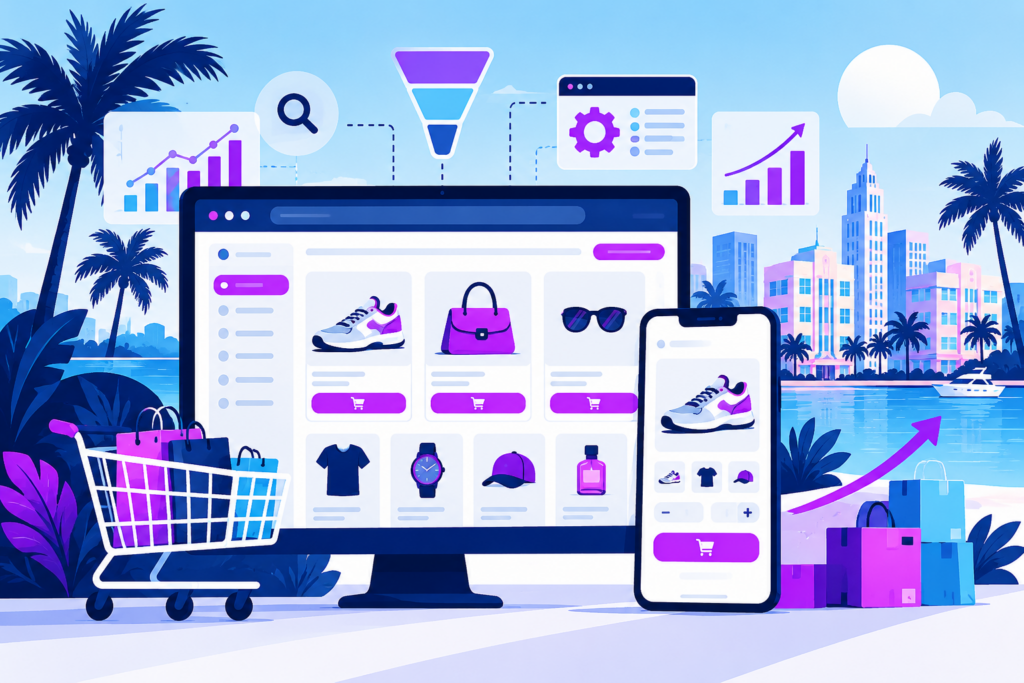
For a Weston business, this also means making a call on whether the store needs to carry its own weight in search or whether it’s primarily a destination you drive traffic to through paid campaigns and email. Both are legitimate strategies, and they lead to different site structures:
What is different about this market
Weston is a planned city. Almost every neighborhood here, from Weston Hills to Bonaventure to Country Isles, was built out under a master development plan with HOA governance attached to most residential parcels. That shapes the local business mix more than people realize. Homeowners associations restrict what can operate out of a home or a garage, which pushes commerce toward licensed storefronts in planned retail centers along Weston Road and Royal Palm Boulevard, or toward service businesses that come to the homeowner rather than the other way around. The result is a market saturated with home services companies competing for the same map pack, and comparatively few retail or ecommerce operations.
That scarcity cuts two ways for an ecommerce business here. On one hand, there’s less direct local competition for a Weston-based online store selling a physical product, because most of the businesses around you are structured as service area businesses optimizing a Google Business Profile instead of a storefront. On the other hand, it means your customers in Weston are used to researching before they buy. Weston households skew toward higher household incomes and longer tenure in a single home, many having moved in within the past fifteen to twenty years as the planned communities filled in. That’s a trust-led buyer, not a price-led one. They comparison shop, they read reviews, and they expect a site that looks like it was built by people who know what they’re doing, not a template with their logo dropped in.
Search behavior here skews heavily mobile, consistent with South Florida generally, and a meaningful share of Weston’s population is Hispanic or Latino, so a bilingual product catalog or at least bilingual customer service messaging is worth testing if your catalog has broad appeal. Demand for most product categories isn’t sharply seasonal in Weston the way it might be in a snowbird-heavy coastal city, since the population here is largely year-round residents rather than seasonal visitors. That’s actually an advantage: it means your traffic and sales data build a cleaner picture faster, without six months of noise from visitors who leave every spring.

How we start
We start with an audit, not a sales deck. If you already have a store, we run it through a speed test, check whether product schema is implemented correctly, and walk the checkout ourselves on a phone to see where it breaks. If you’re starting from nothing, we start with your catalog: how many products, how often it changes, what platform fits that volume, and what shipping or fulfillment logic has to be built in from day one rather than bolted on later.
Either way, you get a written list of what’s wrong or what’s needed before you get a quote, so you can see the reasoning, not just a number.
Product pages and structured data
We organize product information so customers can understand product features, variations, pricing, and availability. Where appropriate, we implement and validate Product structured data to help search engines interpret eligible product details. Structured data does not guarantee enhanced search results, but accurate implementation can support product discovery.
Page speed and technical performance
Large catalogs, high-resolution images, third-party scripts, and complex integrations can slow an online store. We review performance bottlenecks, image delivery, mobile usability, and unnecessary scripts. Testing should cover important templates and shopping journeys rather than only the homepage.
Navigation and catalog structure
Categories, filters, internal links, and product URLs should help customers locate items without creating confusing navigation or unnecessary duplicate pages. We also consider how product variations, unavailable items, and category changes are handled.
Checkout and conversion flow
We review the steps between adding an item to the cart and placing an order. Clear shipping information, transparent costs, accessible forms, suitable payment options, and useful error messages can reduce avoidable friction. Actual checkout changes should be assessed against analytics rather than assumptions.
SEO and measurement
Relevant page titles, meta descriptions, canonical URLs, indexation controls, and XML sitemaps help establish a consistent technical foundation. Analytics and ecommerce event tracking can measure product views, add-to-cart actions, checkout progression, and completed purchases when configured correctly.
What it costs
Ecommerce builds cost more than a standard business site because there’s more to build correctly: product schema for every item, a checkout flow, payment integration, and usually some inventory or shipping logic. Pricing depends on catalog size, platform, and how much of the checkout needs custom work versus off-the-shelf integration. We’ll give you a specific number after the audit, not before it, because quoting a flat fee before seeing your catalog is how projects end up underscoped and over budget.

What you get each month
Once a Weston store is live, the work doesn’t stop. Every month you get a report that shows what actually happened: organic traffic to product and category pages, checkout completion rate, cart abandonment points, and where people dropped off if they didn’t convert. If you’re running Google Ads alongside the store, we track which keywords and campaigns led to an actual purchase, not just a click, using call tracking and multi-touchpoint attribution so a sale gets credited to the channel that produced it.

For Weston specifically, we also keep an eye on how your product pages perform for bilingual search terms if that applies to your catalog, and we track mobile checkout completion separately from desktop, since the gap between the two tells you more about where to fix things than a blended average ever will. We look at shipping thresholds, local pickup options, and how your cart behaves on the mid-range phones a lot of shoppers in the area actually carry, not just the latest flagship devices.
None of this is guesswork dressed up as strategy. It’s a monthly number, compared to last month’s number, with a note on what changed and why. We build the store on a platform that won’t trap you later, set up payment and tax settings correctly from day one, and make sure product search actually surfaces what people are looking for instead of burying it three pages deep.

FAQ's
These are the 5 questions Weston homeowners ask us most about ecommerce website design, answered plainly so you know what to expect before any work starts. If yours isn't covered here, get in touch and we'll walk you through it.
Does an ecommerce site need to be different from a regular business website in Weston?
Yes. A service area business needs a strong Google Business Profile and local pages. An ecommerce site needs product pages that load fast at scale, a checkout that doesn't lose people on mobile, and schema markup so Google can show price and stock in search results. Different problem, different build.
Can you work with Shopify, WooCommerce, or a custom cart?
Yes. The platform matters less than whether product schema, page speed, and checkout tracking are set up correctly. We've built and fixed stores on all three. We'll tell you if your current platform is holding you back before we recommend switching.
We already have a store. Can you just fix what's broken?
Often, yes. We start with an audit of your product pages, checkout flow, and site speed before recommending a rebuild. If the fix is adding schema and compressing images, that's a smaller job than a new site, and we'll say so.
How do you handle Spanish-speaking shoppers if we sell to a mixed audience?
If your sales data or site traffic shows meaningful Spanish-language demand, we can build bilingual product pages or a language toggle. We only recommend this when there's evidence it will matter for your specific catalog, not as a default add-on.
Do you guarantee a ranking or a sales number?
No. Nobody can honestly guarantee a ranking position or a sales figure, and we won't tell you otherwise. We can tell you what the work is, show you the tracking, and let the monthly numbers speak for themselves.