
- Home
- Services
- Portfolio
- About
- Service AreasFort Lauderdale, FL
- Web Design
- Redesign
- WordPress
- Ecommerce
- Landing Pages
- SEO Services
- Local SEO
- GBP
- Google Ads
- PPC
- Digital Marketing
- Internet Marketing
- Advertising
- Tracking
- Dental Marketing
- Medical Marketing
- HVAC Marketing
- Roofing Marketing
- Pest Control Marketing
- Home Services Marketing
- Plumbing Marketing
- Electrical Marketing
- Landscaping Marketing
- Remodeling Marketing
Pembroke Pines, FL- Web Design
- Redesign
- WordPress
- Ecommerce
- Landing Pages
- SEO Services
- Local SEO
- GBP
- Google Ads
- PPC
- Digital Marketing
- Internet Marketing
- Advertising
- Tracking
- Dental Marketing
- Medical Marketing
- HVAC Marketing
- Roofing Marketing
- Pest Control Marketing
- Home Services Marketing
- Plumbing Marketing
- Electrical Marketing
- Landscaping Marketing
- Remodeling Marketing
Hialeah, FL- Web Design
- Redesign
- WordPress
- Ecommerce
- Landing Pages
- SEO Services
- Local SEO
- GBP
- Google Ads
- PPC
- Digital Marketing
- Internet Marketing
- Advertising
- Tracking
- Dental Marketing
- Medical Marketing
- HVAC Marketing
- Roofing Marketing
- Pest Control Marketing
- Home Services Marketing
- Plumbing Marketing
- Electrical Marketing
- Landscaping Marketing
- Remodeling Marketing
Hollywood, FL- Web Design
- Redesign
- WordPress
- Ecommerce
- Landing Pages
- SEO Services
- Local SEO
- GBP
- Google Ads
- PPC
- Digital Marketing
- Internet Marketing
- Advertising
- Tracking
- Dental Marketing
- Medical Marketing
- HVAC Marketing
- Roofing Marketing
- Pest Control Marketing
- Home Services Marketing
- Plumbing Marketing
- Electrical Marketing
- Landscaping Marketing
- Remodeling Marketing
Miramar, FL- Web Design
- Redesign
- WordPress
- Ecommerce
- Landing Pages
- SEO Services
- Local SEO
- GBP
- Google Ads
- PPC
- Digital Marketing
- Internet Marketing
- Advertising
- Tracking
- Dental Marketing
- Medical Marketing
- HVAC Marketing
- Roofing Marketing
- Pest Control Marketing
- Home Services Marketing
- Plumbing Marketing
- Electrical Marketing
- Landscaping Marketing
- Remodeling Marketing
Coral Springs, FL- Web Design
- Redesign
- WordPress
- Ecommerce
- Landing Pages
- SEO Services
- Local SEO
- GBP
- Google Ads
- PPC
- Digital Marketing
- Internet Marketing
- Advertising
- Tracking
- Dental Marketing
- Medical Marketing
- HVAC Marketing
- Roofing Marketing
- Pest Control Marketing
- Home Services Marketing
- Plumbing Marketing
- Electrical Marketing
- Landscaping Marketing
- Remodeling Marketing
Pompano Beach, FL- Web Design
- Redesign
- WordPress
- Ecommerce
- Landing Pages
- SEO Services
- Local SEO
- GBP
- Google Ads
- PPC
- Digital Marketing
- Internet Marketing
- Advertising
- Tracking
- Dental Marketing
- Medical Marketing
- HVAC Marketing
- Roofing Marketing
- Pest Control Marketing
- Home Services Marketing
- Plumbing Marketing
- Electrical Marketing
- Landscaping Marketing
- Remodeling Marketing
Davie, FL- Web Design
- Redesign
- WordPress
- Ecommerce
- Landing Pages
- SEO Services
- Local SEO
- GBP
- Google Ads
- PPC
- Digital Marketing
- Internet Marketing
- Advertising
- Tracking
- Dental Marketing
- Medical Marketing
- HVAC Marketing
- Roofing Marketing
- Pest Control Marketing
- Home Services Marketing
- Plumbing Marketing
- Electrical Marketing
- Landscaping Marketing
- Remodeling Marketing
Sunrise, FL- Web Design
- Redesign
- WordPress
- Ecommerce
- Landing Pages
- SEO Services
- Local SEO
- GBP
- Google Ads
- PPC
- Digital Marketing
- Internet Marketing
- Advertising
- Tracking
- Dental Marketing
- Medical Marketing
- HVAC Marketing
- Roofing Marketing
- Pest Control Marketing
- Home Services Marketing
- Plumbing Marketing
- Electrical Marketing
- Landscaping Marketing
- Remodeling Marketing
Plantation, FL- Web Design
- Redesign
- WordPress
- Ecommerce
- Landing Pages
- SEO Services
- Local SEO
- GBP
- Google Ads
- PPC
- Digital Marketing
- Internet Marketing
- Advertising
- Tracking
- Dental Marketing
- Medical Marketing
- HVAC Marketing
- Roofing Marketing
- Pest Control Marketing
- Home Services Marketing
- Plumbing Marketing
- Electrical Marketing
- Landscaping Marketing
- Remodeling Marketing
Deerfield Beach, FL- Web Design
- Redesign
- WordPress
- Ecommerce
- Landing Pages
- SEO Services
- Local SEO
- GBP
- Google Ads
- PPC
- Digital Marketing
- Internet Marketing
- Advertising
- Tracking
- Dental Marketing
- Medical Marketing
- HVAC Marketing
- Roofing Marketing
- Pest Control Marketing
- Home Services Marketing
- Plumbing Marketing
- Electrical Marketing
- Landscaping Marketing
- Remodeling Marketing
Miami Gardens, FL- Web Design
- Redesign
- WordPress
- Ecommerce
- Landing Pages
- SEO Services
- Local SEO
- GBP
- Google Ads
- PPC
- Digital Marketing
- Internet Marketing
- Advertising
- Tracking
- Dental Marketing
- Medical Marketing
- HVAC Marketing
- Roofing Marketing
- Pest Control Marketing
- Home Services Marketing
- Plumbing Marketing
- Electrical Marketing
- Landscaping Marketing
- Remodeling Marketing
Lauderhill, FL- Web Design
- Redesign
- WordPress
- Ecommerce
- Landing Pages
- SEO Services
- Local SEO
- GBP
- Google Ads
- PPC
- Digital Marketing
- Internet Marketing
- Advertising
- Tracking
- Dental Marketing
- Medical Marketing
- HVAC Marketing
- Roofing Marketing
- Pest Control Marketing
- Home Services Marketing
- Plumbing Marketing
- Electrical Marketing
- Landscaping Marketing
- Remodeling Marketing
West Palm Beach, FL- Web Design
- Redesign
- WordPress
- Ecommerce
- Landing Pages
- SEO Services
- Local SEO
- GBP
- Google Ads
- PPC
- Digital Marketing
- Internet Marketing
- Advertising
- Tracking
- Dental Marketing
- Medical Marketing
- HVAC Marketing
- Roofing Marketing
- Pest Control Marketing
- Home Services Marketing
- Plumbing Marketing
- Electrical Marketing
- Landscaping Marketing
- Remodeling Marketing
Tamarac, FL- Web Design
- Redesign
- WordPress
- Ecommerce
- Landing Pages
- SEO Services
- Local SEO
- GBP
- Google Ads
- PPC
- Digital Marketing
- Internet Marketing
- Advertising
- Tracking
- Dental Marketing
- Medical Marketing
- HVAC Marketing
- Roofing Marketing
- Pest Control Marketing
- Home Services Marketing
- Plumbing Marketing
- Electrical Marketing
- Landscaping Marketing
- Remodeling Marketing
Weston, FL- Web Design
- Redesign
- WordPress
- Ecommerce
- Landing Pages
- SEO Services
- Local SEO
- GBP
- Google Ads
- PPC
- Digital Marketing
- Internet Marketing
- Advertising
- Tracking
- Dental Marketing
- Medical Marketing
- HVAC Marketing
- Roofing Marketing
- Pest Control Marketing
- Home Services Marketing
- Plumbing Marketing
- Electrical Marketing
- Landscaping Marketing
- Remodeling Marketing
Boca Raton, FLMargate, FLCoconut Creek, FLMiami Beach, FLHomestead, FLKendall, FLDoral, FLBoynton Beach, FLThe Hammocks, FLNorth Lauderdale, FLOakland Park, FLDelray Beach, FLNorth Miami, FLHallandale Beach, FLFontainebleau, FLKendale Lakes, FLWellington, FLJupiter, FLTamiami, FLPalm Beach Gardens, FLLauderdale Lakes, FLCooper City, FLCountry Club, FLParkland, FLCoral Gables, FLDania Beach, FLCutler Bay, FLNorth Miami Beach, FLGreenacres, FLLake Worth Beach, FLPrinceton, FLRoyal Palm Beach, FLSouth Miami Heights, FLRichmond West, FLRiviera Beach, FLWest Little River, FLGolden Glades, FLAventura, FLMiami Lakes, FLWestchester, FLLeisure City, FLCoral Terrace, FLPalm Springs, FLPalmetto Bay, FLHialeah Gardens, FLSunny Isles Beach, FLIves Estates, FLWest Park, FLSweetwater, FLPinecrest, FLSunset, FLPinewood, FLWilton Manors, FLOpa-locka, FLLighthouse Point, FLBelle Glade, FLNaranja, FLPalmetto Estates, FLBrownsville, FLKey Biscayne, FLOlympia Heights, FLMiami Springs, FLFlorida City, FLSouth Miami, FLThree Lakes, FLGladeview, FLNorth Palm Beach, FLMiami Shores, FLSouthwest Ranches, FLKings Point, FLLauderdale-by-the-Sea, FLHillsboro Beach, FLSea Ranch Lakes, FLLazy Lake, FL - Blog
- Contact
Ecommerce Website Design in Doral, Florida
Ecommerce Website Design for Doral businesses
A home goods store near CityPlace Doral and a countertop fabricator working out of a warehouse near the Trade Center both get asked the same question by customers: can I see it and buy it without calling first. In a city built mostly in the last twenty to twenty-five years, on planned developments with HOA rules about signage and storefronts, a lot of commerce here already happens online or over the phone before anyone sets foot anywhere. An ecommerce site in Doral is less about replacing a shop and more about giving a service-area or showroom business a real transaction layer.

What the work covers
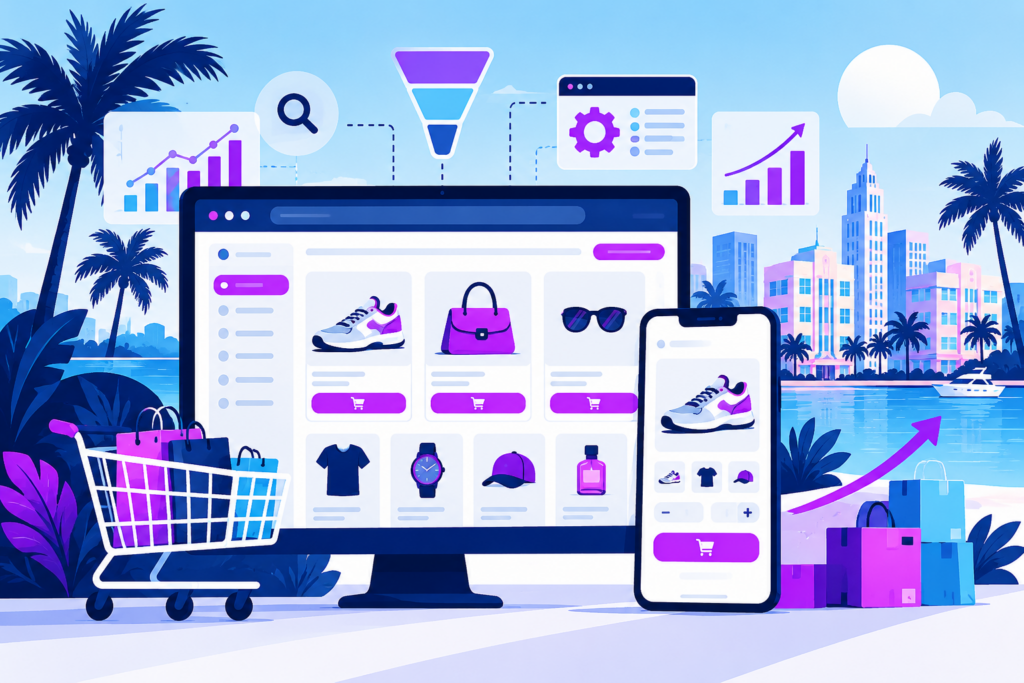
Ecommerce Website Design at Strategic Web Designs means building the parts of a store that actually move a sale forward, not just a product grid with a theme on top. Here is what that includes in practice for a Doral-based retailer selling to South Florida and beyond.
Product schema markup on every product page, so Google can show price, availability, and review stars directly in search results instead of a plain blue link. This is structured data, not a plugin you install and forget. It has to match your actual inventory fields, stay in sync when prices or stock levels change, and pass validation, or it gets flagged and the rich result disappears.
Page speed at scale. A store with 40 products and a store with 4,000 products do not behave the same way under load. We test how the catalog performs with real product counts, real image weights, and real filtering and sorting combinations, because a fast homepage with a slow category or search-results page still loses the sale. This includes image compression, lazy loading, and caching rules built for how your catalog actually grows.
Checkout flow. We look at number of steps, guest checkout availability, saved payment options, and where carts get abandoned. A two-step checkout converts differently than a five-step one, and we can usually tell you why a specific step is losing people once we see the analytics behind it.
- Mobile-first layout, since most browsing in Doral happens on a phone first
- Inventory and tax logic matching how you actually sell, including Florida sales tax handling
- Shipping rules for orders going outside Doral-Dade County, including rate tiers and delivery estimates
- Call tracking and attribution reporting across organic, paid, and direct traffic
That last piece matters more than most store owners expect: you need to see whether a sale started from an organic search, a Google Ads click, or a direct visit, and whether it closed online or over the phone, so budget actually follows what’s working rather than guesswork.
What is different about this market
Doral is not a downtown with foot traffic and storefronts. It is a collection of planned developments, many under twenty-five years old, governed by HOAs that restrict exterior signage and in some cases restrict home-based commercial activity altogether. That means the overwhelming majority of businesses operating in or around Doral are service-area businesses: home services, personal services, specialty contractors, logistics and import-export operations tied to the airport corridor. Very few are true walk-in retail. That mix changes how ecommerce behaves here. A physical storefront matters less than a Google Business Profile, a fast product catalog, and a checkout that works from a phone in a parking lot or a kitchen.
Doral’s household base is heavily shaped by relatively recent arrivals, a large share of them bilingual, with Spanish used at home as commonly as English in many neighborhoods. A product page that only exists in English is leaving a visible share of local search volume on the table. Price sensitivity here is mixed rather than uniform. Shoppers in the newer master-planned sections tend to research before buying and respond to trust signals like verified reviews and clear return policies more than to a discount banner. That means your product pages need real content, not just a price and an add-to-cart button. Competition for ecommerce-specific search terms in Doral is lower than it is in Doral proper, which is an opening if you move on it, because most of your local competitors are still running a brochure site with a shopping cart bolted on, not a store built around schema and speed.

How we start
We start with an audit of what you have now: current platform, product count, page speed under real load, and whatever analytics data already exists. We also check how your store or listings currently show up in local search, since for most Doral businesses the Google Business Profile and map pack behavior matter as much as the site itself.
From there we give you a specific build plan with a platform recommendation, a rough timeline tied to your catalog size, and a scope for schema, checkout, and tracking work. No generic proposal. The plan reflects what we actually find in your data.
Product pages and structured data
We organize product information so customers can understand product features, variations, pricing, and availability. Where appropriate, we implement and validate Product structured data to help search engines interpret eligible product details. Structured data does not guarantee enhanced search results, but accurate implementation can support product discovery.
Page speed and technical performance
Large catalogs, high-resolution images, third-party scripts, and complex integrations can slow an online store. We review performance bottlenecks, image delivery, mobile usability, and unnecessary scripts. Testing should cover important templates and shopping journeys rather than only the homepage.
Navigation and catalog structure
Categories, filters, internal links, and product URLs should help customers locate items without creating confusing navigation or unnecessary duplicate pages. We also consider how product variations, unavailable items, and category changes are handled.
Checkout and conversion flow
We review the steps between adding an item to the cart and placing an order. Clear shipping information, transparent costs, accessible forms, suitable payment options, and useful error messages can reduce avoidable friction. Actual checkout changes should be assessed against analytics rather than assumptions.
SEO and measurement
Relevant page titles, meta descriptions, canonical URLs, indexation controls, and XML sitemaps help establish a consistent technical foundation. Analytics and ecommerce event tracking can measure product views, add-to-cart actions, checkout progression, and completed purchases when configured correctly.
What it costs
Ecommerce builds vary by catalog size, platform, and how much custom checkout or integration work is needed. A twenty-product store with standard checkout costs differently than a two-thousand-product catalog with custom tax rules and a loyalty integration. We will give you a specific number once we see your catalog and requirements during the audit, not before.
What we can tell you upfront is what you are paying for: schema implementation, speed optimization tested against your real catalog size, checkout configuration, and the call tracking and attribution setup that lets you see which channel actually produced a sale.

What you get each month
After launch, ongoing work covers reporting and maintenance, not a vague retainer. Each month you get a report tied to call tracking and multi-touchpoint attribution, showing which pages, keywords, and ad campaigns produced actual purchases or calls from Doral shoppers, not just sessions. We monitor page speed as your catalog changes, since adding products without checking image weight and schema is how stores slow down over time. We also check schema validity, since Google periodically changes what it accepts for rich results, and a markup error can silently drop your product listings from search without any obvious warning.

Get a free audit
If you want a specific answer on what an ecommerce build would cost and how long it would take for your catalog, request a free audit before signing off on any Doral ecommerce website design project. We will look at your current site or marketplace listings, check page speed, mobile checkout flow, and schema markup, and tell you what we find before recommending anything.
A typical audit covers:
- Product page load times and Core Web Vitals
- Checkout and cart abandonment friction points
- Structured data and category navigation
- Payment and shipping integrations relevant to South Florida sellers
Call (754) 704-4727 or request the audit online, and we will walk through findings with you directly, no pressure to commit. For platform-specific technical requirements, Google’s own guidance on structured data for products is a useful reference point. [EXTERNAL LINK: Google Search Central documentation on Product structured data (schema.org Product markup requirements)]

Ecommerce questions from Doral business owners
Before committing to an ecommerce build, most Doral business owners want to know how it fits a market with few true storefronts, whether a bilingual catalog is worth the extra work, and what a realistic cost and timeline looks like for their catalog size.
We answer these during the audit with your actual numbers rather than general claims, since catalog size, current platform, and existing traffic all change the answer.
Can you connect our online store to the HOA-approved vendor directories some Doral developments use?
If the development publishes a vendor list or directory, we can usually get your store or booking page listed the same way we handle any directory citation. It is not part of standard ecommerce build but it is a quick add during the audit.
We already sell on a marketplace. Do we need our own ecommerce site too?
If you are only on a marketplace, you do not own the customer data, the pricing, or the page speed. A separate site gives you a channel the marketplace cannot change the rules on. Many Doral businesses run both at once.
How long does an ecommerce build take?
It depends on catalog size and how many product variants and integrations are involved. We will give you a specific timeline once we see your product count and current platform during the audit.
Do you build in Spanish as well as English?
Yes. Given how much of Doral's household and business population is bilingual, we regularly build stores with a Spanish version of product pages and checkout, not just a translated header.
What platform do you build on?
We pick based on catalog size, existing systems, and budget rather than defaulting to one platform. We will tell you which option fits during the audit and explain why.