
- Home
- Services
- Portfolio
- About
- Service AreasFort Lauderdale, FL
- Web Design
- Redesign
- WordPress
- Ecommerce
- Landing Pages
- SEO Services
- Local SEO
- GBP
- Google Ads
- PPC
- Digital Marketing
- Internet Marketing
- Advertising
- Tracking
- Dental Marketing
- Medical Marketing
- HVAC Marketing
- Roofing Marketing
- Pest Control Marketing
- Home Services Marketing
- Plumbing Marketing
- Electrical Marketing
- Landscaping Marketing
- Remodeling Marketing
Pembroke Pines, FL- Web Design
- Redesign
- WordPress
- Ecommerce
- Landing Pages
- SEO Services
- Local SEO
- GBP
- Google Ads
- PPC
- Digital Marketing
- Internet Marketing
- Advertising
- Tracking
- Dental Marketing
- Medical Marketing
- HVAC Marketing
- Roofing Marketing
- Pest Control Marketing
- Home Services Marketing
- Plumbing Marketing
- Electrical Marketing
- Landscaping Marketing
- Remodeling Marketing
Hialeah, FL- Web Design
- Redesign
- WordPress
- Ecommerce
- Landing Pages
- SEO Services
- Local SEO
- GBP
- Google Ads
- PPC
- Digital Marketing
- Internet Marketing
- Advertising
- Tracking
- Dental Marketing
- Medical Marketing
- HVAC Marketing
- Roofing Marketing
- Pest Control Marketing
- Home Services Marketing
- Plumbing Marketing
- Electrical Marketing
- Landscaping Marketing
- Remodeling Marketing
Hollywood, FL- Web Design
- Redesign
- WordPress
- Ecommerce
- Landing Pages
- SEO Services
- Local SEO
- GBP
- Google Ads
- PPC
- Digital Marketing
- Internet Marketing
- Advertising
- Tracking
- Dental Marketing
- Medical Marketing
- HVAC Marketing
- Roofing Marketing
- Pest Control Marketing
- Home Services Marketing
- Plumbing Marketing
- Electrical Marketing
- Landscaping Marketing
- Remodeling Marketing
Miramar, FL- Web Design
- Redesign
- WordPress
- Ecommerce
- Landing Pages
- SEO Services
- Local SEO
- GBP
- Google Ads
- PPC
- Digital Marketing
- Internet Marketing
- Advertising
- Tracking
- Dental Marketing
- Medical Marketing
- HVAC Marketing
- Roofing Marketing
- Pest Control Marketing
- Home Services Marketing
- Plumbing Marketing
- Electrical Marketing
- Landscaping Marketing
- Remodeling Marketing
Coral Springs, FL- Web Design
- Redesign
- WordPress
- Ecommerce
- Landing Pages
- SEO Services
- Local SEO
- GBP
- Google Ads
- PPC
- Digital Marketing
- Internet Marketing
- Advertising
- Tracking
- Dental Marketing
- Medical Marketing
- HVAC Marketing
- Roofing Marketing
- Pest Control Marketing
- Home Services Marketing
- Plumbing Marketing
- Electrical Marketing
- Landscaping Marketing
- Remodeling Marketing
Pompano Beach, FL- Web Design
- Redesign
- WordPress
- Ecommerce
- Landing Pages
- SEO Services
- Local SEO
- GBP
- Google Ads
- PPC
- Digital Marketing
- Internet Marketing
- Advertising
- Tracking
- Dental Marketing
- Medical Marketing
- HVAC Marketing
- Roofing Marketing
- Pest Control Marketing
- Home Services Marketing
- Plumbing Marketing
- Electrical Marketing
- Landscaping Marketing
- Remodeling Marketing
Davie, FL- Web Design
- Redesign
- WordPress
- Ecommerce
- Landing Pages
- SEO Services
- Local SEO
- GBP
- Google Ads
- PPC
- Digital Marketing
- Internet Marketing
- Advertising
- Tracking
- Dental Marketing
- Medical Marketing
- HVAC Marketing
- Roofing Marketing
- Pest Control Marketing
- Home Services Marketing
- Plumbing Marketing
- Electrical Marketing
- Landscaping Marketing
- Remodeling Marketing
Sunrise, FL- Web Design
- Redesign
- WordPress
- Ecommerce
- Landing Pages
- SEO Services
- Local SEO
- GBP
- Google Ads
- PPC
- Digital Marketing
- Internet Marketing
- Advertising
- Tracking
- Dental Marketing
- Medical Marketing
- HVAC Marketing
- Roofing Marketing
- Pest Control Marketing
- Home Services Marketing
- Plumbing Marketing
- Electrical Marketing
- Landscaping Marketing
- Remodeling Marketing
Plantation, FL- Web Design
- Redesign
- WordPress
- Ecommerce
- Landing Pages
- SEO Services
- Local SEO
- GBP
- Google Ads
- PPC
- Digital Marketing
- Internet Marketing
- Advertising
- Tracking
- Dental Marketing
- Medical Marketing
- HVAC Marketing
- Roofing Marketing
- Pest Control Marketing
- Home Services Marketing
- Plumbing Marketing
- Electrical Marketing
- Landscaping Marketing
- Remodeling Marketing
Deerfield Beach, FL- Web Design
- Redesign
- WordPress
- Ecommerce
- Landing Pages
- SEO Services
- Local SEO
- GBP
- Google Ads
- PPC
- Digital Marketing
- Internet Marketing
- Advertising
- Tracking
- Dental Marketing
- Medical Marketing
- HVAC Marketing
- Roofing Marketing
- Pest Control Marketing
- Home Services Marketing
- Plumbing Marketing
- Electrical Marketing
- Landscaping Marketing
- Remodeling Marketing
Miami Gardens, FL- Web Design
- Redesign
- WordPress
- Ecommerce
- Landing Pages
- SEO Services
- Local SEO
- GBP
- Google Ads
- PPC
- Digital Marketing
- Internet Marketing
- Advertising
- Tracking
- Dental Marketing
- Medical Marketing
- HVAC Marketing
- Roofing Marketing
- Pest Control Marketing
- Home Services Marketing
- Plumbing Marketing
- Electrical Marketing
- Landscaping Marketing
- Remodeling Marketing
Lauderhill, FL- Web Design
- Redesign
- WordPress
- Ecommerce
- Landing Pages
- SEO Services
- Local SEO
- GBP
- Google Ads
- PPC
- Digital Marketing
- Internet Marketing
- Advertising
- Tracking
- Dental Marketing
- Medical Marketing
- HVAC Marketing
- Roofing Marketing
- Pest Control Marketing
- Home Services Marketing
- Plumbing Marketing
- Electrical Marketing
- Landscaping Marketing
- Remodeling Marketing
West Palm Beach, FL- Web Design
- Redesign
- WordPress
- Ecommerce
- Landing Pages
- SEO Services
- Local SEO
- GBP
- Google Ads
- PPC
- Digital Marketing
- Internet Marketing
- Advertising
- Tracking
- Dental Marketing
- Medical Marketing
- HVAC Marketing
- Roofing Marketing
- Pest Control Marketing
- Home Services Marketing
- Plumbing Marketing
- Electrical Marketing
- Landscaping Marketing
- Remodeling Marketing
Tamarac, FL- Web Design
- Redesign
- WordPress
- Ecommerce
- Landing Pages
- SEO Services
- Local SEO
- GBP
- Google Ads
- PPC
- Digital Marketing
- Internet Marketing
- Advertising
- Tracking
- Dental Marketing
- Medical Marketing
- HVAC Marketing
- Roofing Marketing
- Pest Control Marketing
- Home Services Marketing
- Plumbing Marketing
- Electrical Marketing
- Landscaping Marketing
- Remodeling Marketing
Weston, FL- Web Design
- Redesign
- WordPress
- Ecommerce
- Landing Pages
- SEO Services
- Local SEO
- GBP
- Google Ads
- PPC
- Digital Marketing
- Internet Marketing
- Advertising
- Tracking
- Dental Marketing
- Medical Marketing
- HVAC Marketing
- Roofing Marketing
- Pest Control Marketing
- Home Services Marketing
- Plumbing Marketing
- Electrical Marketing
- Landscaping Marketing
- Remodeling Marketing
Boca Raton, FLMargate, FLCoconut Creek, FLMiami Beach, FLHomestead, FLKendall, FLDoral, FLBoynton Beach, FLThe Hammocks, FLNorth Lauderdale, FLOakland Park, FLDelray Beach, FLNorth Miami, FLHallandale Beach, FLFontainebleau, FLKendale Lakes, FLWellington, FLJupiter, FLTamiami, FLPalm Beach Gardens, FLLauderdale Lakes, FLCooper City, FLCountry Club, FLParkland, FLCoral Gables, FLDania Beach, FLCutler Bay, FLNorth Miami Beach, FLGreenacres, FLLake Worth Beach, FLPrinceton, FLRoyal Palm Beach, FLSouth Miami Heights, FLRichmond West, FLRiviera Beach, FLWest Little River, FLGolden Glades, FLAventura, FLMiami Lakes, FLWestchester, FLLeisure City, FLCoral Terrace, FLPalm Springs, FLPalmetto Bay, FLHialeah Gardens, FLSunny Isles Beach, FLIves Estates, FLWest Park, FLSweetwater, FLPinecrest, FLSunset, FLPinewood, FLWilton Manors, FLOpa-locka, FLLighthouse Point, FLBelle Glade, FLNaranja, FLPalmetto Estates, FLBrownsville, FLKey Biscayne, FLOlympia Heights, FLMiami Springs, FLFlorida City, FLSouth Miami, FLThree Lakes, FLGladeview, FLNorth Palm Beach, FLMiami Shores, FLSouthwest Ranches, FLKings Point, FLLauderdale-by-the-Sea, FLHillsboro Beach, FLSea Ranch Lakes, FLLazy Lake, FL - Blog
- Contact
Ecommerce Website Design in Fontainebleau, Florida
Ecommerce Website Design for Fontainebleau businesses
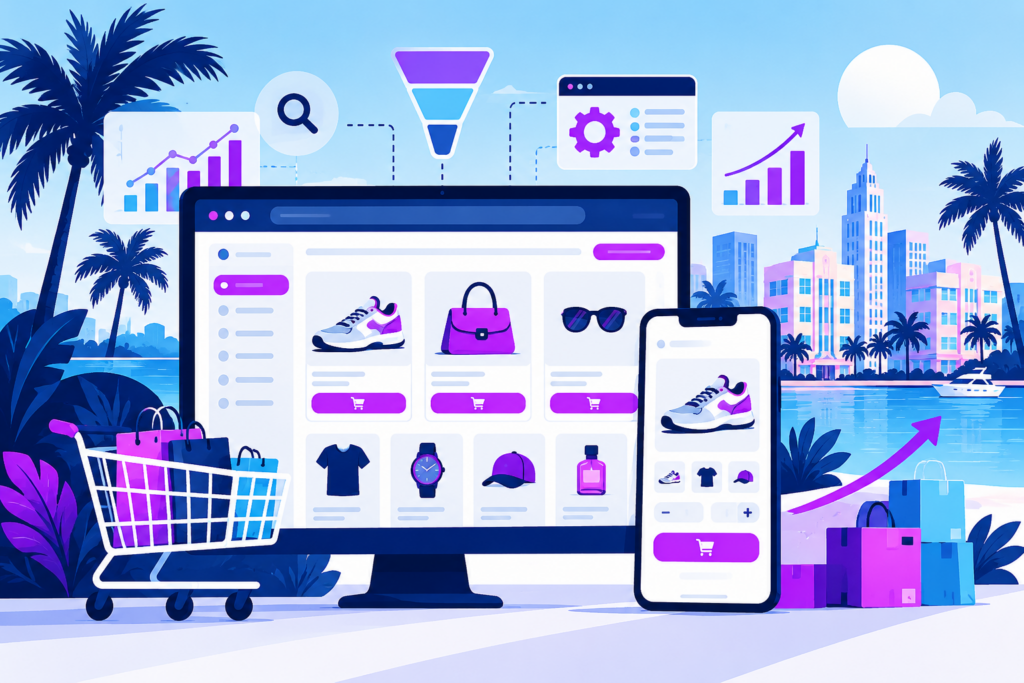
Fontainebleau runs on wholesale and family owned retail more than it runs on big box chains, and that shapes what an ecommerce site actually needs to do here. A store selling to buyers along SW 8th Street or Mall of the Americas-adjacent plazas has to load fast on a phone with a shaky connection, show accurate stock counts, and get a buyer from product page to checkout in a few taps. That is the job. Not a slideshow homepage.
We build and rebuild ecommerce sites for businesses working out of Fontainebleau with that priority order: speed, structured data, checkout, then design. Design still matters. It just does not come first.

What the work covers
Product schema markup is step one, not an afterthought. Every product page gets structured data for price, availability, and review ratings so Google can show rich results instead of a plain blue link. Without that markup, your product might rank and still get skipped over for a competitor’s listing that shows stars and a price right in the search results.
Page speed at scale is the second piece, and it is a different problem than speed on a five page brochure site. A catalog with 200 or 2,000 SKUs needs lazy-loaded images, a CDN, and a hosting setup that does not choke when ten category pages get crawled at once. We test load time on mobile connections specifically, because a desktop test tells you almost nothing about how a shopper on a phone in a parking lot off I-75 near Fontainebleau experiences your site.
Checkout is where most ecommerce builds lose money, and we treat it as its own project. That means fewer form fields, guest checkout as a real option (not buried), autofill that actually works, and payment methods that match how your customers pay, including card, PayPal, and increasingly Cash App or Zelle-adjacent options for smaller B2B transactions common among wholesale buyers in the area.
Beyond that, the build covers:
- A platform decision made on your catalog size and update frequency, not on what is trendy. WooCommerce, Shopify, or a headless build each fit different volumes, and we’ll tell you plainly which one your business has actually outgrown or not yet earned.
- Inventory sync so the site reflects real stock, which matters more for wholesale and light industrial sellers managing physical inventory than for drop shippers who never touch the product.
- Category and filter structure that matches how your actual buyers search, not a generic taxonomy copied from a template built for a different industry entirely.
- Call tracking and attribution reporting, because a meaningful share of ecommerce buyers in the Fontainebleau market still pick up the phone to confirm an order, ask about bulk pricing, or check on shipping before they’ll commit online.
- Local pickup and delivery logistics for sellers who serve nearby neighborhoods directly, since not every transaction here ends in a shipped box.
What is different about this market
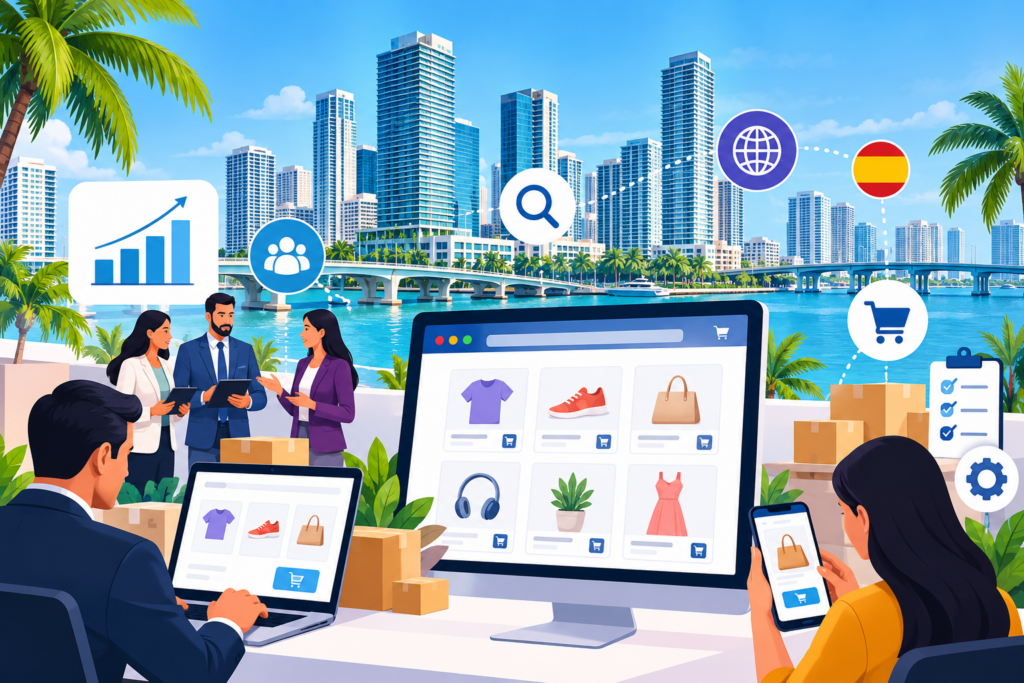
Fontainebleau is majority Spanish speaking, and that is not a demographic footnote, it changes how people search. A buyer looking for office supplies in bulk, restaurant equipment, or auto parts may type the query in Spanish, in English, or switch mid-session depending on the device. A site that only exists in English is invisible to a chunk of that search volume, not because the product is wrong but because the page never shows up for the query that was actually typed. Rather than translate an entire site line by line, which usually produces awkward, literal copy that reads like it was never written for a real person, we recommend a Spanish language layer built around the pages that actually carry commercial intent: product categories, checkout, and the pages people land on from Spanish-language search and ads. It is a real build decision, not a browser plugin bolted on top, and it is one of the few places on this site we recommend it specifically because the data for this market supports it.

How we start
We begin every Fontainebleau ecommerce project with a short discovery call to understand your products, customers, and goals. From there, we audit your current site (or market, if you’re starting fresh) and research local competitors to find opportunities to stand out. We map the customer journey from homepage to checkout, plan your product categories and navigation, and outline integrations you’ll need, like payment processing, shipping calculators, and inventory tools. You’ll get a clear project scope, timeline, and milestones before any design work begins.
- Discovery call to define goals and budget
- Audit of current site or competitor landscape
- Sitemap and customer journey planning
- Integration and platform recommendations
Product pages and structured data
We organize product information so customers can understand product features, variations, pricing, and availability. Where appropriate, we implement and validate Product structured data to help search engines interpret eligible product details. Structured data does not guarantee enhanced search results, but accurate implementation can support product discovery.
Page speed and technical performance
Large catalogs, high-resolution images, third-party scripts, and complex integrations can slow an online store. We review performance bottlenecks, image delivery, mobile usability, and unnecessary scripts. Testing should cover important templates and shopping journeys rather than only the homepage.
Navigation and catalog structure
Categories, filters, internal links, and product URLs should help customers locate items without creating confusing navigation or unnecessary duplicate pages. We also consider how product variations, unavailable items, and category changes are handled.
Checkout and conversion flow
We review the steps between adding an item to the cart and placing an order. Clear shipping information, transparent costs, accessible forms, suitable payment options, and useful error messages can reduce avoidable friction. Actual checkout changes should be assessed against analytics rather than assumptions.
SEO and measurement
Relevant page titles, meta descriptions, canonical URLs, indexation controls, and XML sitemaps help establish a consistent technical foundation. Analytics and ecommerce event tracking can measure product views, add-to-cart actions, checkout progression, and completed purchases when configured correctly.
What it costs
Ecommerce website design costs in Fontainebleau vary based on catalog size, payment and shipping integrations, and whether you need custom features like inventory syncing or subscription billing. A lean storefront with a handful of products and standard checkout tools costs less than a fully custom build with advanced filtering, multi-location inventory, or ERP integration.
We scope every Fontainebleau project around your actual product line and growth plans, not a generic template price. Before any work begins, you’ll receive a clear, itemized quote covering design, development, payment gateway setup, and testing — so there are no surprises once your store goes live.
- Catalog size and product variants
- Payment and shipping integrations
- Custom features (search, subscriptions, inventory)
What you get each month
You get a plain report, not a dashboard full of vanity metrics. It shows organic traffic to the store, conversion rate by device, and which product pages are gaining or losing position. If call tracking is part of the build, inbound calls tied to specific pages and campaigns show up too, since a real share of buyers in Fontainebleau still call to confirm an order before checking out online.
You also get a short list of what changed that month: pages re-optimized, speed fixes shipped, new products added to the schema markup, broken links or redirects cleaned up, and any checkout or cart issues flagged before they cost you sales. Each item is tied back to a result, not just logged as “completed.”
- Traffic, conversions, and ranking movement by product page
- Call and order activity tied to specific campaigns
- A clear list of fixes, additions, and next steps

We do not promise a ranking position or a sales number. What we can tell you is what we changed, what we measured, and what moved as a result, with the data to back each claim. That is the standard we hold the reporting to every month, for every ecommerce client we work with in Fontainebleau or anywhere else in South Florida.
An ecommerce site built for Fontainebleau shoppers needs more than a shopping cart bolted onto a template. We design product pages that load fast on mobile, checkout flows with fewer steps to abandon, and category structures that make sense to both buyers and search engines. We also account for the realities of local commerce: seasonal demand shifts, payment preferences, and shipping expectations that differ from a generic national audience.

Get a free audit
If you already run an ecommerce site serving Fontainebleau, we can look at what is actually slowing it down before you spend a cent on a rebuild. Most stores in the area lose sales to the same handful of problems, and a free audit pinpoints exactly which ones apply to you rather than guessing.
- Page speed on mobile, where most local shoppers browse and abandon slow-loading product pages
- Product schema and structured data, so Google can surface your catalog with pricing, availability, and reviews directly in search
- Checkout friction, including unnecessary form fields, unclear shipping costs, and payment options Fontainebleau shoppers expect
- Whether a French-language layer or added local content would realistically pull in more search volume for your specific products
Send over your site or give us a call, and we will walk through what we find in plain terms. If the honest answer is that your platform is sound and a rebuild is not the priority right now, we will tell you that too, along with what smaller fixes would move the needle instead.
Questions
Thinking about an ecommerce site for your Fontainebleau business? Every store owner we meet has a slightly different starting point, whether that’s serving bilingual shoppers, managing a sprawling product catalog, or deciding whether to rebuild from scratch. Below are some of the questions we hear most often from local merchants weighing platforms, performance, and practical next steps for their online store.
Do you build the whole site in Spanish, or just parts of it?
For Fontainebleau specifically, we usually recommend a Spanish language layer on the pages that carry buying intent, product categories, checkout, and landing pages tied to Spanish-language search or ads, rather than translating every page on the site. A full translation is sometimes the right call for a large catalog, but it is a separate decision we make based on your actual search data, not a default.
What platform do you recommend for a wholesale or B2B-heavy store?
It depends on order volume and whether you need tiered or account-based pricing. WooCommerce handles custom pricing logic well for mid-sized catalogs. Shopify works for straightforward retail. We make the call after reviewing your current catalog, not before.
How do you handle product schema if I have hundreds of SKUs?
Schema markup gets templated at the category level and applied programmatically across products, then checked for errors using Google's structured data testing tools, rather than hand-coded one product at a time.
Will a faster site actually change my sales?
We cannot promise a sales number. What we can say is that slow load times and missing schema markup are documented, measurable drags on conversion and visibility, and fixing them is a mechanical process we can show you the before-and-after data on.
Can you work with my existing site instead of a full rebuild?
Often yes. Many ecommerce sites just need schema added, speed fixes, and checkout cleanup rather than a ground-up rebuild. The audit tells us which situation you are in before we recommend anything.