
- Home
- Services
- Portfolio
- About
- Service AreasFort Lauderdale, FL
- Web Design
- Redesign
- WordPress
- Ecommerce
- Landing Pages
- SEO Services
- Local SEO
- GBP
- Google Ads
- PPC
- Digital Marketing
- Internet Marketing
- Advertising
- Tracking
- Dental Marketing
- Medical Marketing
- HVAC Marketing
- Roofing Marketing
- Pest Control Marketing
- Home Services Marketing
- Plumbing Marketing
- Electrical Marketing
- Landscaping Marketing
- Remodeling Marketing
Pembroke Pines, FL- Web Design
- Redesign
- WordPress
- Ecommerce
- Landing Pages
- SEO Services
- Local SEO
- GBP
- Google Ads
- PPC
- Digital Marketing
- Internet Marketing
- Advertising
- Tracking
- Dental Marketing
- Medical Marketing
- HVAC Marketing
- Roofing Marketing
- Pest Control Marketing
- Home Services Marketing
- Plumbing Marketing
- Electrical Marketing
- Landscaping Marketing
- Remodeling Marketing
Hialeah, FL- Web Design
- Redesign
- WordPress
- Ecommerce
- Landing Pages
- SEO Services
- Local SEO
- GBP
- Google Ads
- PPC
- Digital Marketing
- Internet Marketing
- Advertising
- Tracking
- Dental Marketing
- Medical Marketing
- HVAC Marketing
- Roofing Marketing
- Pest Control Marketing
- Home Services Marketing
- Plumbing Marketing
- Electrical Marketing
- Landscaping Marketing
- Remodeling Marketing
Hollywood, FL- Web Design
- Redesign
- WordPress
- Ecommerce
- Landing Pages
- SEO Services
- Local SEO
- GBP
- Google Ads
- PPC
- Digital Marketing
- Internet Marketing
- Advertising
- Tracking
- Dental Marketing
- Medical Marketing
- HVAC Marketing
- Roofing Marketing
- Pest Control Marketing
- Home Services Marketing
- Plumbing Marketing
- Electrical Marketing
- Landscaping Marketing
- Remodeling Marketing
Miramar, FL- Web Design
- Redesign
- WordPress
- Ecommerce
- Landing Pages
- SEO Services
- Local SEO
- GBP
- Google Ads
- PPC
- Digital Marketing
- Internet Marketing
- Advertising
- Tracking
- Dental Marketing
- Medical Marketing
- HVAC Marketing
- Roofing Marketing
- Pest Control Marketing
- Home Services Marketing
- Plumbing Marketing
- Electrical Marketing
- Landscaping Marketing
- Remodeling Marketing
Coral Springs, FL- Web Design
- Redesign
- WordPress
- Ecommerce
- Landing Pages
- SEO Services
- Local SEO
- GBP
- Google Ads
- PPC
- Digital Marketing
- Internet Marketing
- Advertising
- Tracking
- Dental Marketing
- Medical Marketing
- HVAC Marketing
- Roofing Marketing
- Pest Control Marketing
- Home Services Marketing
- Plumbing Marketing
- Electrical Marketing
- Landscaping Marketing
- Remodeling Marketing
Pompano Beach, FL- Web Design
- Redesign
- WordPress
- Ecommerce
- Landing Pages
- SEO Services
- Local SEO
- GBP
- Google Ads
- PPC
- Digital Marketing
- Internet Marketing
- Advertising
- Tracking
- Dental Marketing
- Medical Marketing
- HVAC Marketing
- Roofing Marketing
- Pest Control Marketing
- Home Services Marketing
- Plumbing Marketing
- Electrical Marketing
- Landscaping Marketing
- Remodeling Marketing
Davie, FL- Web Design
- Redesign
- WordPress
- Ecommerce
- Landing Pages
- SEO Services
- Local SEO
- GBP
- Google Ads
- PPC
- Digital Marketing
- Internet Marketing
- Advertising
- Tracking
- Dental Marketing
- Medical Marketing
- HVAC Marketing
- Roofing Marketing
- Pest Control Marketing
- Home Services Marketing
- Plumbing Marketing
- Electrical Marketing
- Landscaping Marketing
- Remodeling Marketing
Sunrise, FL- Web Design
- Redesign
- WordPress
- Ecommerce
- Landing Pages
- SEO Services
- Local SEO
- GBP
- Google Ads
- PPC
- Digital Marketing
- Internet Marketing
- Advertising
- Tracking
- Dental Marketing
- Medical Marketing
- HVAC Marketing
- Roofing Marketing
- Pest Control Marketing
- Home Services Marketing
- Plumbing Marketing
- Electrical Marketing
- Landscaping Marketing
- Remodeling Marketing
Plantation, FL- Web Design
- Redesign
- WordPress
- Ecommerce
- Landing Pages
- SEO Services
- Local SEO
- GBP
- Google Ads
- PPC
- Digital Marketing
- Internet Marketing
- Advertising
- Tracking
- Dental Marketing
- Medical Marketing
- HVAC Marketing
- Roofing Marketing
- Pest Control Marketing
- Home Services Marketing
- Plumbing Marketing
- Electrical Marketing
- Landscaping Marketing
- Remodeling Marketing
Deerfield Beach, FL- Web Design
- Redesign
- WordPress
- Ecommerce
- Landing Pages
- SEO Services
- Local SEO
- GBP
- Google Ads
- PPC
- Digital Marketing
- Internet Marketing
- Advertising
- Tracking
- Dental Marketing
- Medical Marketing
- HVAC Marketing
- Roofing Marketing
- Pest Control Marketing
- Home Services Marketing
- Plumbing Marketing
- Electrical Marketing
- Landscaping Marketing
- Remodeling Marketing
Miami Gardens, FL- Web Design
- Redesign
- WordPress
- Ecommerce
- Landing Pages
- SEO Services
- Local SEO
- GBP
- Google Ads
- PPC
- Digital Marketing
- Internet Marketing
- Advertising
- Tracking
- Dental Marketing
- Medical Marketing
- HVAC Marketing
- Roofing Marketing
- Pest Control Marketing
- Home Services Marketing
- Plumbing Marketing
- Electrical Marketing
- Landscaping Marketing
- Remodeling Marketing
Lauderhill, FL- Web Design
- Redesign
- WordPress
- Ecommerce
- Landing Pages
- SEO Services
- Local SEO
- GBP
- Google Ads
- PPC
- Digital Marketing
- Internet Marketing
- Advertising
- Tracking
- Dental Marketing
- Medical Marketing
- HVAC Marketing
- Roofing Marketing
- Pest Control Marketing
- Home Services Marketing
- Plumbing Marketing
- Electrical Marketing
- Landscaping Marketing
- Remodeling Marketing
West Palm Beach, FL- Web Design
- Redesign
- WordPress
- Ecommerce
- Landing Pages
- SEO Services
- Local SEO
- GBP
- Google Ads
- PPC
- Digital Marketing
- Internet Marketing
- Advertising
- Tracking
- Dental Marketing
- Medical Marketing
- HVAC Marketing
- Roofing Marketing
- Pest Control Marketing
- Home Services Marketing
- Plumbing Marketing
- Electrical Marketing
- Landscaping Marketing
- Remodeling Marketing
Tamarac, FL- Web Design
- Redesign
- WordPress
- Ecommerce
- Landing Pages
- SEO Services
- Local SEO
- GBP
- Google Ads
- PPC
- Digital Marketing
- Internet Marketing
- Advertising
- Tracking
- Dental Marketing
- Medical Marketing
- HVAC Marketing
- Roofing Marketing
- Pest Control Marketing
- Home Services Marketing
- Plumbing Marketing
- Electrical Marketing
- Landscaping Marketing
- Remodeling Marketing
Weston, FL- Web Design
- Redesign
- WordPress
- Ecommerce
- Landing Pages
- SEO Services
- Local SEO
- GBP
- Google Ads
- PPC
- Digital Marketing
- Internet Marketing
- Advertising
- Tracking
- Dental Marketing
- Medical Marketing
- HVAC Marketing
- Roofing Marketing
- Pest Control Marketing
- Home Services Marketing
- Plumbing Marketing
- Electrical Marketing
- Landscaping Marketing
- Remodeling Marketing
Boca Raton, FLMargate, FLCoconut Creek, FLMiami Beach, FLHomestead, FLKendall, FLDoral, FLBoynton Beach, FLThe Hammocks, FLNorth Lauderdale, FLOakland Park, FLDelray Beach, FLNorth Miami, FLHallandale Beach, FLFontainebleau, FLKendale Lakes, FLWellington, FLJupiter, FLTamiami, FLPalm Beach Gardens, FLLauderdale Lakes, FLCooper City, FLCountry Club, FLParkland, FLCoral Gables, FLDania Beach, FLCutler Bay, FLNorth Miami Beach, FLGreenacres, FLLake Worth Beach, FLPrinceton, FLRoyal Palm Beach, FLSouth Miami Heights, FLRichmond West, FLRiviera Beach, FLWest Little River, FLGolden Glades, FLAventura, FLMiami Lakes, FLWestchester, FLLeisure City, FLCoral Terrace, FLPalm Springs, FLPalmetto Bay, FLHialeah Gardens, FLSunny Isles Beach, FLIves Estates, FLWest Park, FLSweetwater, FLPinecrest, FLSunset, FLPinewood, FLWilton Manors, FLOpa-locka, FLLighthouse Point, FLBelle Glade, FLNaranja, FLPalmetto Estates, FLBrownsville, FLKey Biscayne, FLOlympia Heights, FLMiami Springs, FLFlorida City, FLSouth Miami, FLThree Lakes, FLGladeview, FLNorth Palm Beach, FLMiami Shores, FLSouthwest Ranches, FLKings Point, FLLauderdale-by-the-Sea, FLHillsboro Beach, FLSea Ranch Lakes, FLLazy Lake, FL - Blog
- Contact
Ecommerce Website Design in Parkland, Florida
Ecommerce Website Design for Parkland businesses
Most businesses in Parkland don’t sell off a shelf. They send a truck to a house in Heron Bay or Parkland Golf & Country Club. But a growing number of Parkland businesses do sell product online – boutique retailers, specialty food brands, equestrian suppliers tied to the city’s horse-country zoning, and home-services companies that now sell parts, maintenance kits, or memberships through a cart. That’s the store this page is written for.

What the work covers
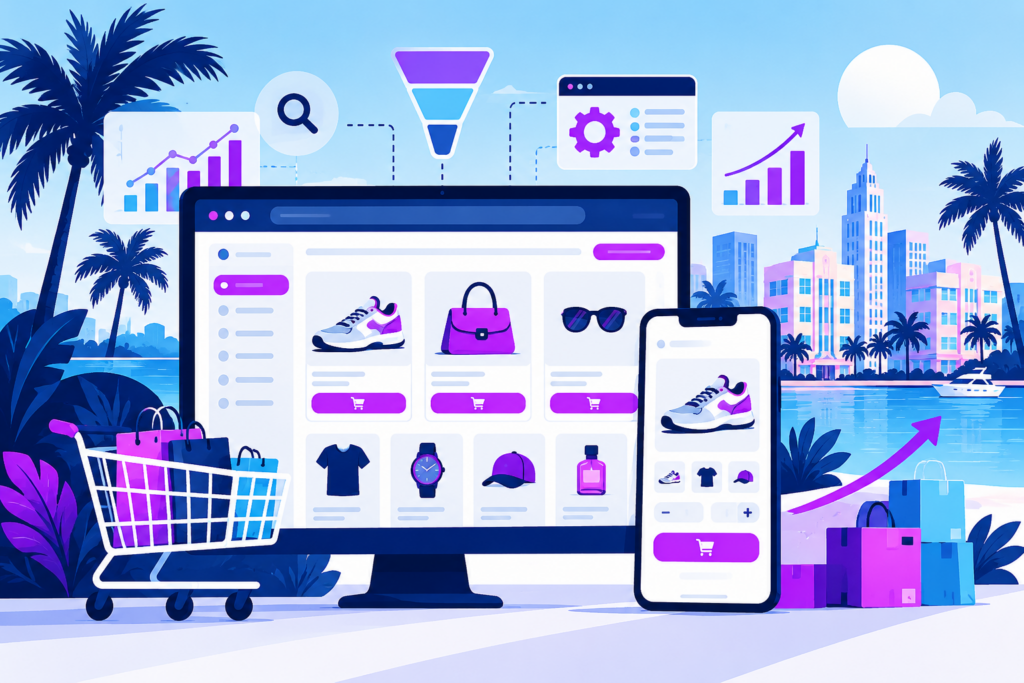
Product schema markup is the starting point, not an afterthought. Every product page gets structured data for price, availability, and review count, because without it Google has no clean way to show your products in search results with the extra detail that gets the click. We mark up variants too – size, color, finish – so a shopper searching for one specific version of a product can land directly on it instead of a generic category page. For a Parkland retailer competing against bigger regional players, that extra visibility in search results is often the difference between getting the click and getting skipped.
Page speed at scale is the second pillar. A ten-product store and a four-hundred-product store are not the same engineering problem. Image compression, lazy loading, and caching have to hold up as your catalog grows, not just at launch. We test load time on the product template itself, not just the homepage, because that’s the page a paid click or a search result actually lands on. A slow product page is the quiet killer of mobile sales, and most of your Parkland shoppers are browsing on a phone between errands.
Checkout is the third pillar, and it’s where most revenue is lost. We review:
- The number of steps between cart and confirmation
- Whether guest checkout is offered
- Whether shipping cost is disclosed before the final screen
- Whether the payment form works cleanly on a phone
Cart abandonment is usually a checkout problem before it’s a traffic problem, and no amount of ad spend fixes a broken cart.
Underneath all of it: inventory sync so a sold-out item doesn’t sit live on the site, a tax and shipping setup that matches how you actually ship from Florida, and analytics tied to actual purchases, not just page views, so you can see which products and which traffic sources are paying for themselves. We also set up alerts for low-stock items and build out collection pages that make sense for how Parkland shoppers actually search, whether that’s by brand, by use case, or by price range, so the path from homepage to cart stays short no matter which product brought them in.
What is different about this market
Parkland’s business mix skews heavily toward service-area work – landscapers, pool builders, HVAC contractors, tutoring companies – because most of the city is newer planned-development housing, much of it built or sold within the last twenty years and governed by HOAs with their own rules about signage, vendor access, and even what a contractor’s truck can look like parked on the street. That matters for ecommerce in a specific way: there are fewer true storefronts here, so an online store serving Parkland is usually competing less on local search and more on product search, meaning the store has to work on its own terms rather than ride on map-pack visibility the way a plumber does.
The buyers themselves are trust-led, not price-led, as a rule. Parkland has one of the highest household income levels in Broward County, and residents who moved into these planned communities did so on reputation – school ratings, HOA standards, a managed look to the neighborhood. That carries into how they shop online. A store with thin product descriptions, stock photography, and no clear return policy reads as low-trust to this buyer, even if the price is competitive. Reviews, clear sourcing, and a checkout that doesn’t feel like a workaround matter more here than a discount banner.
Search behavior skews mobile, consistent with most of South Florida, but Parkland’s demand curve is less seasonal than coastal cities that live and die by tourist traffic. There’s no snowbird spike or beach-season lull driving the calendar here; demand tends to track school-year rhythm and local events instead, which means a Parkland-facing store can plan inventory and ad spend around steadier patterns rather than guessing at a tourism season. Spanish-language optimization is worth testing rather than assuming either way, since Broward County overall has a significant Spanish-speaking population, but Parkland’s specific demographic mix should be checked against current census data before you build out a second-language storefront as a default.

Product pages and structured data
We organize product information so customers can understand product features, variations, pricing, and availability. Where appropriate, we implement and validate Product structured data to help search engines interpret eligible product details. Structured data does not guarantee enhanced search results, but accurate implementation can support product discovery.
Page speed and technical performance
Large catalogs, high-resolution images, third-party scripts, and complex integrations can slow an online store. We review performance bottlenecks, image delivery, mobile usability, and unnecessary scripts. Testing should cover important templates and shopping journeys rather than only the homepage.
Navigation and catalog structure
Categories, filters, internal links, and product URLs should help customers locate items without creating confusing navigation or unnecessary duplicate pages. We also consider how product variations, unavailable items, and category changes are handled.
Checkout and conversion flow
We review the steps between adding an item to the cart and placing an order. Clear shipping information, transparent costs, accessible forms, suitable payment options, and useful error messages can reduce avoidable friction. Actual checkout changes should be assessed against analytics rather than assumptions.
SEO and measurement
Relevant page titles, meta descriptions, canonical URLs, indexation controls, and XML sitemaps help establish a consistent technical foundation. Analytics and ecommerce event tracking can measure product views, add-to-cart actions, checkout progression, and completed purchases when configured correctly.
How we start
We start by asking what you’re actually selling and how. A twelve-product boutique store needs a different platform and a different checkout than a four-hundred-SKU wholesale catalog with tiered pricing. We look at your current site if you have one, pull whatever analytics exist, and find out where people are actually dropping off – at the product page, at the cart, or at payment. Then we scope the build around that specific leak, not around a generic template.

What it costs
Ecommerce builds cost more than a standard business site because there’s more engineering underneath the surface: product catalog structure, payment gateway integration, inventory sync, shipping rules, and schema markup all take build time that a five-page brochure site simply doesn’t require. For Parkland businesses, cost scales with catalog size and complexity – a small single-category store is a fundamentally different project than a multi-category store with variants, subscriptions, or custom checkout flows.
- Catalog size and number of product variants
- Payment and shipping integrations needed
- Inventory management complexity
- Custom features like subscriptions or wholesale pricing
We’ll give you a specific number after we see what you’re building, not before – because quoting blind helps no one. Expect a conversation about your products first, a proposal second.

What you get each month
Once a Parkland store is live, the work doesn’t stop. Each month you get a report tied to call tracking and purchase attribution, so you can see which traffic source actually produced revenue, not just clicks. We monitor page speed as your catalog changes, keep schema markup current when products are added or removed, and flag checkout issues before they cost you a week of lost conversions. If you’re running ads alongside the store, that spend gets reviewed against actual sales data, not just click-through rate.
- Inventory and pricing checks so listings stay accurate as stock turns over
- Cart abandonment review, with fixes suggested where friction is losing orders
- Mobile checkout testing, since most Parkland shoppers are buying from a phone
- A plain-language summary explaining what changed and why it matters

Get a free audit
If you’re running a store that serves Parkland shoppers, or you’re planning to launch one, we’ll take a close look at what you have now, free, and tell you specifically where it’s losing sales. We check the things that quietly drain revenue: slow-loading product pages, thin or missing product descriptions, broken or confusing checkout steps, poor mobile layout, and technical gaps like missing schema markup that keep your products from standing out in search results. We’ll also look at how your site handles the basics – clear calls to action, trust signals, shipping and return information – that Parkland shoppers expect before they hand over their card details.
You’ll walk away with a plain-English breakdown of what’s working, what’s costing you sales, and what to fix first for the biggest return. No jargon, no pressure to sign anything.
- A full walkthrough of your product and checkout pages
- A prioritized list of fixes, ranked by impact
- Honest advice, even if that means a few small changes rather than a full rebuild
Call (754) 704-4727 or send over your current site and we’ll go through it together.
FAQ's
These are the 5 questions Parkland homeowners ask us most about ecommerce website design, answered plainly so you know what to expect before any work starts. If yours isn't covered here, get in touch and we'll walk you through it.
Do you build ecommerce stores or just redesign the front end?
Both, but the front end is the smaller part of the job. The work that actually affects revenue is product schema, checkout flow, page speed as the catalog grows, and inventory accuracy. Visual design matters, but it's built on top of those pieces, not instead of them.
Which ecommerce platform do you recommend for a Parkland business?
It depends on catalog size, whether you need subscriptions or wholesale pricing tiers, and what you're already using for inventory or accounting. We'll tell you which platform fits your specific catalog rather than defaulting to one platform for every client.
Can you fix a store that already exists instead of rebuilding it?
Often, yes. If the checkout and platform are sound, we can fix schema markup, speed, and conversion issues without a full rebuild. We'll tell you honestly if a rebuild is actually cheaper than patching an outdated platform.
Does an ecommerce store need local SEO if most of Parkland is service-area businesses?
Less than a map-pack-dependent business, but not zero. Local search still matters for brand searches and for any buy-local intent, and the store still needs to be found on product search terms, which is a different kind of optimization than local SEO.
How long does an ecommerce build take?
It depends on catalog size and how much custom checkout or integration work is involved. A small single-category store moves faster than a multi-category catalog with variants, tax complexity, and third-party inventory sync. We'll give you a timeline once we know the scope.