
- Home
- Services
- Portfolio
- About
- Service AreasFort Lauderdale, FL
- Web Design
- Redesign
- WordPress
- Ecommerce
- Landing Pages
- SEO Services
- Local SEO
- GBP
- Google Ads
- PPC
- Digital Marketing
- Internet Marketing
- Advertising
- Tracking
- Dental Marketing
- Medical Marketing
- HVAC Marketing
- Roofing Marketing
- Pest Control Marketing
- Home Services Marketing
- Plumbing Marketing
- Electrical Marketing
- Landscaping Marketing
- Remodeling Marketing
Pembroke Pines, FL- Web Design
- Redesign
- WordPress
- Ecommerce
- Landing Pages
- SEO Services
- Local SEO
- GBP
- Google Ads
- PPC
- Digital Marketing
- Internet Marketing
- Advertising
- Tracking
- Dental Marketing
- Medical Marketing
- HVAC Marketing
- Roofing Marketing
- Pest Control Marketing
- Home Services Marketing
- Plumbing Marketing
- Electrical Marketing
- Landscaping Marketing
- Remodeling Marketing
Hialeah, FL- Web Design
- Redesign
- WordPress
- Ecommerce
- Landing Pages
- SEO Services
- Local SEO
- GBP
- Google Ads
- PPC
- Digital Marketing
- Internet Marketing
- Advertising
- Tracking
- Dental Marketing
- Medical Marketing
- HVAC Marketing
- Roofing Marketing
- Pest Control Marketing
- Home Services Marketing
- Plumbing Marketing
- Electrical Marketing
- Landscaping Marketing
- Remodeling Marketing
Hollywood, FL- Web Design
- Redesign
- WordPress
- Ecommerce
- Landing Pages
- SEO Services
- Local SEO
- GBP
- Google Ads
- PPC
- Digital Marketing
- Internet Marketing
- Advertising
- Tracking
- Dental Marketing
- Medical Marketing
- HVAC Marketing
- Roofing Marketing
- Pest Control Marketing
- Home Services Marketing
- Plumbing Marketing
- Electrical Marketing
- Landscaping Marketing
- Remodeling Marketing
Miramar, FL- Web Design
- Redesign
- WordPress
- Ecommerce
- Landing Pages
- SEO Services
- Local SEO
- GBP
- Google Ads
- PPC
- Digital Marketing
- Internet Marketing
- Advertising
- Tracking
- Dental Marketing
- Medical Marketing
- HVAC Marketing
- Roofing Marketing
- Pest Control Marketing
- Home Services Marketing
- Plumbing Marketing
- Electrical Marketing
- Landscaping Marketing
- Remodeling Marketing
Coral Springs, FL- Web Design
- Redesign
- WordPress
- Ecommerce
- Landing Pages
- SEO Services
- Local SEO
- GBP
- Google Ads
- PPC
- Digital Marketing
- Internet Marketing
- Advertising
- Tracking
- Dental Marketing
- Medical Marketing
- HVAC Marketing
- Roofing Marketing
- Pest Control Marketing
- Home Services Marketing
- Plumbing Marketing
- Electrical Marketing
- Landscaping Marketing
- Remodeling Marketing
Pompano Beach, FL- Web Design
- Redesign
- WordPress
- Ecommerce
- Landing Pages
- SEO Services
- Local SEO
- GBP
- Google Ads
- PPC
- Digital Marketing
- Internet Marketing
- Advertising
- Tracking
- Dental Marketing
- Medical Marketing
- HVAC Marketing
- Roofing Marketing
- Pest Control Marketing
- Home Services Marketing
- Plumbing Marketing
- Electrical Marketing
- Landscaping Marketing
- Remodeling Marketing
Davie, FL- Web Design
- Redesign
- WordPress
- Ecommerce
- Landing Pages
- SEO Services
- Local SEO
- GBP
- Google Ads
- PPC
- Digital Marketing
- Internet Marketing
- Advertising
- Tracking
- Dental Marketing
- Medical Marketing
- HVAC Marketing
- Roofing Marketing
- Pest Control Marketing
- Home Services Marketing
- Plumbing Marketing
- Electrical Marketing
- Landscaping Marketing
- Remodeling Marketing
Sunrise, FL- Web Design
- Redesign
- WordPress
- Ecommerce
- Landing Pages
- SEO Services
- Local SEO
- GBP
- Google Ads
- PPC
- Digital Marketing
- Internet Marketing
- Advertising
- Tracking
- Dental Marketing
- Medical Marketing
- HVAC Marketing
- Roofing Marketing
- Pest Control Marketing
- Home Services Marketing
- Plumbing Marketing
- Electrical Marketing
- Landscaping Marketing
- Remodeling Marketing
Plantation, FL- Web Design
- Redesign
- WordPress
- Ecommerce
- Landing Pages
- SEO Services
- Local SEO
- GBP
- Google Ads
- PPC
- Digital Marketing
- Internet Marketing
- Advertising
- Tracking
- Dental Marketing
- Medical Marketing
- HVAC Marketing
- Roofing Marketing
- Pest Control Marketing
- Home Services Marketing
- Plumbing Marketing
- Electrical Marketing
- Landscaping Marketing
- Remodeling Marketing
Deerfield Beach, FL- Web Design
- Redesign
- WordPress
- Ecommerce
- Landing Pages
- SEO Services
- Local SEO
- GBP
- Google Ads
- PPC
- Digital Marketing
- Internet Marketing
- Advertising
- Tracking
- Dental Marketing
- Medical Marketing
- HVAC Marketing
- Roofing Marketing
- Pest Control Marketing
- Home Services Marketing
- Plumbing Marketing
- Electrical Marketing
- Landscaping Marketing
- Remodeling Marketing
Miami Gardens, FL- Web Design
- Redesign
- WordPress
- Ecommerce
- Landing Pages
- SEO Services
- Local SEO
- GBP
- Google Ads
- PPC
- Digital Marketing
- Internet Marketing
- Advertising
- Tracking
- Dental Marketing
- Medical Marketing
- HVAC Marketing
- Roofing Marketing
- Pest Control Marketing
- Home Services Marketing
- Plumbing Marketing
- Electrical Marketing
- Landscaping Marketing
- Remodeling Marketing
Lauderhill, FL- Web Design
- Redesign
- WordPress
- Ecommerce
- Landing Pages
- SEO Services
- Local SEO
- GBP
- Google Ads
- PPC
- Digital Marketing
- Internet Marketing
- Advertising
- Tracking
- Dental Marketing
- Medical Marketing
- HVAC Marketing
- Roofing Marketing
- Pest Control Marketing
- Home Services Marketing
- Plumbing Marketing
- Electrical Marketing
- Landscaping Marketing
- Remodeling Marketing
West Palm Beach, FL- Web Design
- Redesign
- WordPress
- Ecommerce
- Landing Pages
- SEO Services
- Local SEO
- GBP
- Google Ads
- PPC
- Digital Marketing
- Internet Marketing
- Advertising
- Tracking
- Dental Marketing
- Medical Marketing
- HVAC Marketing
- Roofing Marketing
- Pest Control Marketing
- Home Services Marketing
- Plumbing Marketing
- Electrical Marketing
- Landscaping Marketing
- Remodeling Marketing
Tamarac, FL- Web Design
- Redesign
- WordPress
- Ecommerce
- Landing Pages
- SEO Services
- Local SEO
- GBP
- Google Ads
- PPC
- Digital Marketing
- Internet Marketing
- Advertising
- Tracking
- Dental Marketing
- Medical Marketing
- HVAC Marketing
- Roofing Marketing
- Pest Control Marketing
- Home Services Marketing
- Plumbing Marketing
- Electrical Marketing
- Landscaping Marketing
- Remodeling Marketing
Weston, FL- Web Design
- Redesign
- WordPress
- Ecommerce
- Landing Pages
- SEO Services
- Local SEO
- GBP
- Google Ads
- PPC
- Digital Marketing
- Internet Marketing
- Advertising
- Tracking
- Dental Marketing
- Medical Marketing
- HVAC Marketing
- Roofing Marketing
- Pest Control Marketing
- Home Services Marketing
- Plumbing Marketing
- Electrical Marketing
- Landscaping Marketing
- Remodeling Marketing
Boca Raton, FLMargate, FLCoconut Creek, FLMiami Beach, FLHomestead, FLKendall, FLDoral, FLBoynton Beach, FLThe Hammocks, FLNorth Lauderdale, FLOakland Park, FLDelray Beach, FLNorth Miami, FLHallandale Beach, FLFontainebleau, FLKendale Lakes, FLWellington, FLJupiter, FLTamiami, FLPalm Beach Gardens, FLLauderdale Lakes, FLCooper City, FLCountry Club, FLParkland, FLCoral Gables, FLDania Beach, FLCutler Bay, FLNorth Miami Beach, FLGreenacres, FLLake Worth Beach, FLPrinceton, FLRoyal Palm Beach, FLSouth Miami Heights, FLRichmond West, FLRiviera Beach, FLWest Little River, FLGolden Glades, FLAventura, FLMiami Lakes, FLWestchester, FLLeisure City, FLCoral Terrace, FLPalm Springs, FLPalmetto Bay, FLHialeah Gardens, FLSunny Isles Beach, FLIves Estates, FLWest Park, FLSweetwater, FLPinecrest, FLSunset, FLPinewood, FLWilton Manors, FLOpa-locka, FLLighthouse Point, FLBelle Glade, FLNaranja, FLPalmetto Estates, FLBrownsville, FLKey Biscayne, FLOlympia Heights, FLMiami Springs, FLFlorida City, FLSouth Miami, FLThree Lakes, FLGladeview, FLNorth Palm Beach, FLMiami Shores, FLSouthwest Ranches, FLKings Point, FLLauderdale-by-the-Sea, FLHillsboro Beach, FLSea Ranch Lakes, FLLazy Lake, FL - Blog
- Contact
Landing Page Design in Fort Lauderdale, Florida
Landing Page Design for Fort Lauderdale businesses
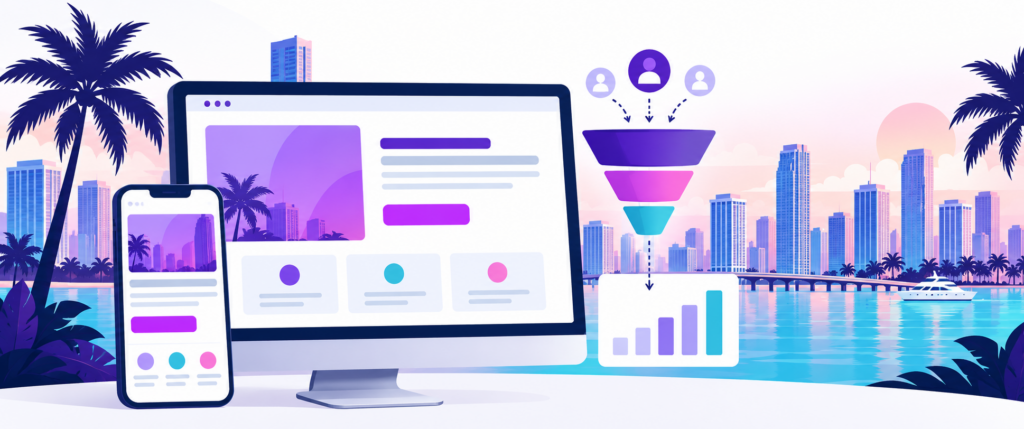
A law firm on Las Olas running a Google Ads campaign for “Fort Lauderdale DUI attorney” cannot send that click to a homepage with six practice areas and a nav bar. The click costs money. The page has one job: match the ad, state the offer, and get a phone call or a form fill before the visitor scrolls twice. That is the entire discipline of landing page design, and it is a different job from building a website.
What the work covers
A landing page built for paid traffic has a short list of jobs, and each one is testable. Here is what we actually build and why each piece exists.
Message match. The headline on the page repeats the promise in the ad. If the ad says “Free consultation, same-day appointments,” the page headline says that too, not a rebranded version of it. Google’s own Quality Score mechanics reward this because it reduces bounce, and bounce is the first thing that kills a paid campaign’s budget. [EXTERNAL LINK: Google Ads Help documentation on Quality Score and landing page experience]
Form length. Every field you add to a form drops completion rate. A medical practice asking for name, phone and reason for visit will out-convert one asking for name, phone, email, insurance provider, preferred date, and a text box. We cut the form to what the business can actually act on in the first call, nothing more. If you need the extra fields for intake, we collect them after the lead converts, not before.
One offer, one call to action. A landing page with three competing buttons – call us, book online, download a guide – forces the visitor to decide, and a visitor who has to decide usually leaves. We pick one primary action per campaign and build the page around it. A secondary, lower-commitment action can exist, but it is visually secondary.
Page speed on mobile and desktop. A landing page that takes four seconds to load on a phone loses a meaningful share of paid clicks before the page even renders. We build lean pages: compressed images, minimal third-party scripts, no page builder bloat that loads five fonts nobody asked for.
Call tracking. Every landing page gets a tracked phone number so a call from that specific page, that specific ad, that specific keyword, shows up as a line item in reporting instead of disappearing into a general business line. Without this, you are optimizing a campaign based on guesses.
Multi-touchpoint attribution. Most Fort Lauderdale buyers in professional services, legal and finance do not convert on the first visit. They see the ad, leave, search your name two days later, then call. Single-touch tracking credits the wrong channel and tells you to cut the budget line that actually started the conversion. We set up attribution that tracks the full path, not just the last click, so the reporting reflects what actually happened.
A/B structure, not a guess. Once a page is live and getting traffic, we test one variable at a time – headline, form length, button copy – and keep what the data supports. We do not redesign the whole page on a hunch and call it an improvement.

What is different about this market
Fort Lauderdale’s downtown core is not a soft market to sell into. Las Olas Boulevard, the Brickell-adjacent finance crowd that works out of the FAT Village and Himmarshee area, and the office towers along Broward Boulevard are full of law firms, wealth management shops, medical groups and B2B service companies that have already been pitched by an agency, often a national chain or a private-equity-rolled-up shop with a generic pitch deck. The business owner here has sat through that meeting. They know what a templated promise sounds like, and they have usually seen a landing page before that looked good and converted nothing, because nobody tracked it properly. Leading with adjectives in this market gets you filtered out before the second sentence. Leading with a specific mechanism – how the form length was decided, how the call gets attributed to the keyword that drove it – is what gets a reply.

How we start
We start by looking at the ad or the keyword list the page needs to serve, not at a blank design file. If you are already running campaigns, we look at what is currently converting and what is burning spend with no attribution behind it. From there we draft a single-focus page, build the tracked form and call number, and get it in front of you before it goes live. No twelve-week discovery phase. A landing page that takes three months to launch has already missed a quarter of ad spend.
Ad and page message match
Align the headline, offer, and content with the campaign so visitors find what the ad promised.
Page structure and content
Organize benefits, service details, supporting proof, and calls to action to answer buyer questions.
Forms and calls to action
Keep forms focused on essential information and clearly explain the next step.
Mobile and desktop usability
Improve readability, navigation, loading speed, and form usability across devices.
Conversion tracking
Configure analytics to measure meaningful actions, such as form submissions, calls, and bookings.
Testing and refinement
Use performance data to identify drop-off points and guide improvements. Results also depend on traffic quality and the offer.
What it costs
Landing page design cost depends on how many pages you need, how much copywriting and credential-verification work goes into professional-services pages, and whether you need ongoing A/B testing after launch. We will not quote a number here that has to be the same for a single-page legal intake form and a six-page campaign structure for a multi-location medical group. Call (754) 704-4727 and we will give you a real range based on what you are actually running.

What you get each month
Once a page is live, the relationship does not stop at launch. Each month you get a report that shows calls by source, form submissions by page, and conversion rate by variant if a test is running. You see which keyword, which ad, which page actually produced a lead for your Fort Lauderdale business, not a vague traffic summary. If a page is underperforming, we say so, show the data behind that call, and tell you exactly what we are changing next: new headline, new offer, new layout, not just that “engagement is up” with nothing to act on.

Get a free audit
If you are already running Google Ads or paid social into Fort Lauderdale and sending clicks to a homepage or a landing page nobody has touched since it launched, we will look at it and tell you specifically what is likely costing you conversions. We review it the way a paying visitor would: what they see first, how fast the page loads on a phone at a red light on Federal Highway, whether the offer matches the ad they clicked, and whether the form is asking for more than it should before someone trusts you with their information. We also check the basics that quietly sink campaigns – broken tracking, no clear next step above the fold, trust signals that are missing or buried, and page speed that is costing you budget on every click.
- Message match between your ad and your page
- Form length and friction
- Mobile load speed and layout
- Conversion tracking accuracy
- Calls-to-action and trust signals
Reach out for a free, no-obligation audit of the page you are currently sending traffic to.

FAQ's
These are the 5 questions Fort Lauderdale homeowners ask us most about landing page design, answered plainly so you know what to expect before any work starts. If yours isn't covered here, get in touch and we'll walk you through it.
Do you only build landing pages, or do you also manage the ad campaigns?
We do both. A landing page built in isolation from the campaign driving traffic to it usually underperforms, so most of our Fort Lauderdale clients have us handle the Google Ads account and the page together, with one shared set of tracking data.
How is a landing page different from just adding a page to our existing website?
A page built inside your main site inherits the navigation, the footer links, and every other distraction on the site, all of which give a paid visitor an exit that is not your call-to-action. A true landing page is a standalone page built to keep the visitor focused on one action.
Can you work with a form or CRM we already use?
In most cases yes. We connect the landing page form to whatever system you already use for intake or lead routing so the tracking data lines up with the leads your team is actually working.
How long does it take to get a landing page live?
It depends on the complexity of the offer and how much credential or compliance review a professional-services page needs, but we build to get a tested, tracked page live quickly rather than running a long design process before anything launches.
We've been burned by an agency before. What's different here?
We will not promise you a ranking or a lead number, because nobody can guarantee that honestly. What we will show you is the tracking setup before the page goes live, so you can see exactly what is being measured and verify it yourself once traffic starts.