
- Home
- Services
- Portfolio
- About
- Service AreasFort Lauderdale, FL
- Web Design
- Redesign
- WordPress
- Ecommerce
- Landing Pages
- SEO Services
- Local SEO
- GBP
- Google Ads
- PPC
- Digital Marketing
- Internet Marketing
- Advertising
- Tracking
- Dental Marketing
- Medical Marketing
- HVAC Marketing
- Roofing Marketing
- Pest Control Marketing
- Home Services Marketing
- Plumbing Marketing
- Electrical Marketing
- Landscaping Marketing
- Remodeling Marketing
Pembroke Pines, FL- Web Design
- Redesign
- WordPress
- Ecommerce
- Landing Pages
- SEO Services
- Local SEO
- GBP
- Google Ads
- PPC
- Digital Marketing
- Internet Marketing
- Advertising
- Tracking
- Dental Marketing
- Medical Marketing
- HVAC Marketing
- Roofing Marketing
- Pest Control Marketing
- Home Services Marketing
- Plumbing Marketing
- Electrical Marketing
- Landscaping Marketing
- Remodeling Marketing
Hialeah, FL- Web Design
- Redesign
- WordPress
- Ecommerce
- Landing Pages
- SEO Services
- Local SEO
- GBP
- Google Ads
- PPC
- Digital Marketing
- Internet Marketing
- Advertising
- Tracking
- Dental Marketing
- Medical Marketing
- HVAC Marketing
- Roofing Marketing
- Pest Control Marketing
- Home Services Marketing
- Plumbing Marketing
- Electrical Marketing
- Landscaping Marketing
- Remodeling Marketing
Hollywood, FL- Web Design
- Redesign
- WordPress
- Ecommerce
- Landing Pages
- SEO Services
- Local SEO
- GBP
- Google Ads
- PPC
- Digital Marketing
- Internet Marketing
- Advertising
- Tracking
- Dental Marketing
- Medical Marketing
- HVAC Marketing
- Roofing Marketing
- Pest Control Marketing
- Home Services Marketing
- Plumbing Marketing
- Electrical Marketing
- Landscaping Marketing
- Remodeling Marketing
Miramar, FL- Web Design
- Redesign
- WordPress
- Ecommerce
- Landing Pages
- SEO Services
- Local SEO
- GBP
- Google Ads
- PPC
- Digital Marketing
- Internet Marketing
- Advertising
- Tracking
- Dental Marketing
- Medical Marketing
- HVAC Marketing
- Roofing Marketing
- Pest Control Marketing
- Home Services Marketing
- Plumbing Marketing
- Electrical Marketing
- Landscaping Marketing
- Remodeling Marketing
Coral Springs, FL- Web Design
- Redesign
- WordPress
- Ecommerce
- Landing Pages
- SEO Services
- Local SEO
- GBP
- Google Ads
- PPC
- Digital Marketing
- Internet Marketing
- Advertising
- Tracking
- Dental Marketing
- Medical Marketing
- HVAC Marketing
- Roofing Marketing
- Pest Control Marketing
- Home Services Marketing
- Plumbing Marketing
- Electrical Marketing
- Landscaping Marketing
- Remodeling Marketing
Pompano Beach, FL- Web Design
- Redesign
- WordPress
- Ecommerce
- Landing Pages
- SEO Services
- Local SEO
- GBP
- Google Ads
- PPC
- Digital Marketing
- Internet Marketing
- Advertising
- Tracking
- Dental Marketing
- Medical Marketing
- HVAC Marketing
- Roofing Marketing
- Pest Control Marketing
- Home Services Marketing
- Plumbing Marketing
- Electrical Marketing
- Landscaping Marketing
- Remodeling Marketing
Davie, FL- Web Design
- Redesign
- WordPress
- Ecommerce
- Landing Pages
- SEO Services
- Local SEO
- GBP
- Google Ads
- PPC
- Digital Marketing
- Internet Marketing
- Advertising
- Tracking
- Dental Marketing
- Medical Marketing
- HVAC Marketing
- Roofing Marketing
- Pest Control Marketing
- Home Services Marketing
- Plumbing Marketing
- Electrical Marketing
- Landscaping Marketing
- Remodeling Marketing
Sunrise, FL- Web Design
- Redesign
- WordPress
- Ecommerce
- Landing Pages
- SEO Services
- Local SEO
- GBP
- Google Ads
- PPC
- Digital Marketing
- Internet Marketing
- Advertising
- Tracking
- Dental Marketing
- Medical Marketing
- HVAC Marketing
- Roofing Marketing
- Pest Control Marketing
- Home Services Marketing
- Plumbing Marketing
- Electrical Marketing
- Landscaping Marketing
- Remodeling Marketing
Plantation, FL- Web Design
- Redesign
- WordPress
- Ecommerce
- Landing Pages
- SEO Services
- Local SEO
- GBP
- Google Ads
- PPC
- Digital Marketing
- Internet Marketing
- Advertising
- Tracking
- Dental Marketing
- Medical Marketing
- HVAC Marketing
- Roofing Marketing
- Pest Control Marketing
- Home Services Marketing
- Plumbing Marketing
- Electrical Marketing
- Landscaping Marketing
- Remodeling Marketing
Deerfield Beach, FL- Web Design
- Redesign
- WordPress
- Ecommerce
- Landing Pages
- SEO Services
- Local SEO
- GBP
- Google Ads
- PPC
- Digital Marketing
- Internet Marketing
- Advertising
- Tracking
- Dental Marketing
- Medical Marketing
- HVAC Marketing
- Roofing Marketing
- Pest Control Marketing
- Home Services Marketing
- Plumbing Marketing
- Electrical Marketing
- Landscaping Marketing
- Remodeling Marketing
Miami Gardens, FL- Web Design
- Redesign
- WordPress
- Ecommerce
- Landing Pages
- SEO Services
- Local SEO
- GBP
- Google Ads
- PPC
- Digital Marketing
- Internet Marketing
- Advertising
- Tracking
- Dental Marketing
- Medical Marketing
- HVAC Marketing
- Roofing Marketing
- Pest Control Marketing
- Home Services Marketing
- Plumbing Marketing
- Electrical Marketing
- Landscaping Marketing
- Remodeling Marketing
Lauderhill, FL- Web Design
- Redesign
- WordPress
- Ecommerce
- Landing Pages
- SEO Services
- Local SEO
- GBP
- Google Ads
- PPC
- Digital Marketing
- Internet Marketing
- Advertising
- Tracking
- Dental Marketing
- Medical Marketing
- HVAC Marketing
- Roofing Marketing
- Pest Control Marketing
- Home Services Marketing
- Plumbing Marketing
- Electrical Marketing
- Landscaping Marketing
- Remodeling Marketing
West Palm Beach, FL- Web Design
- Redesign
- WordPress
- Ecommerce
- Landing Pages
- SEO Services
- Local SEO
- GBP
- Google Ads
- PPC
- Digital Marketing
- Internet Marketing
- Advertising
- Tracking
- Dental Marketing
- Medical Marketing
- HVAC Marketing
- Roofing Marketing
- Pest Control Marketing
- Home Services Marketing
- Plumbing Marketing
- Electrical Marketing
- Landscaping Marketing
- Remodeling Marketing
Tamarac, FL- Web Design
- Redesign
- WordPress
- Ecommerce
- Landing Pages
- SEO Services
- Local SEO
- GBP
- Google Ads
- PPC
- Digital Marketing
- Internet Marketing
- Advertising
- Tracking
- Dental Marketing
- Medical Marketing
- HVAC Marketing
- Roofing Marketing
- Pest Control Marketing
- Home Services Marketing
- Plumbing Marketing
- Electrical Marketing
- Landscaping Marketing
- Remodeling Marketing
Weston, FL- Web Design
- Redesign
- WordPress
- Ecommerce
- Landing Pages
- SEO Services
- Local SEO
- GBP
- Google Ads
- PPC
- Digital Marketing
- Internet Marketing
- Advertising
- Tracking
- Dental Marketing
- Medical Marketing
- HVAC Marketing
- Roofing Marketing
- Pest Control Marketing
- Home Services Marketing
- Plumbing Marketing
- Electrical Marketing
- Landscaping Marketing
- Remodeling Marketing
Boca Raton, FLMargate, FLCoconut Creek, FLMiami Beach, FLHomestead, FLKendall, FLDoral, FLBoynton Beach, FLThe Hammocks, FLNorth Lauderdale, FLOakland Park, FLDelray Beach, FLNorth Miami, FLHallandale Beach, FLFontainebleau, FLKendale Lakes, FLWellington, FLJupiter, FLTamiami, FLPalm Beach Gardens, FLLauderdale Lakes, FLCooper City, FLCountry Club, FLParkland, FLCoral Gables, FLDania Beach, FLCutler Bay, FLNorth Miami Beach, FLGreenacres, FLLake Worth Beach, FLPrinceton, FLRoyal Palm Beach, FLSouth Miami Heights, FLRichmond West, FLRiviera Beach, FLWest Little River, FLGolden Glades, FLAventura, FLMiami Lakes, FLWestchester, FLLeisure City, FLCoral Terrace, FLPalm Springs, FLPalmetto Bay, FLHialeah Gardens, FLSunny Isles Beach, FLIves Estates, FLWest Park, FLSweetwater, FLPinecrest, FLSunset, FLPinewood, FLWilton Manors, FLOpa-locka, FLLighthouse Point, FLBelle Glade, FLNaranja, FLPalmetto Estates, FLBrownsville, FLKey Biscayne, FLOlympia Heights, FLMiami Springs, FLFlorida City, FLSouth Miami, FLThree Lakes, FLGladeview, FLNorth Palm Beach, FLMiami Shores, FLSouthwest Ranches, FLKings Point, FLLauderdale-by-the-Sea, FLHillsboro Beach, FLSea Ranch Lakes, FLLazy Lake, FL - Blog
- Contact
Landing Page Design in Sunrise, Florida
Landing Page Design for Sunrise businesses
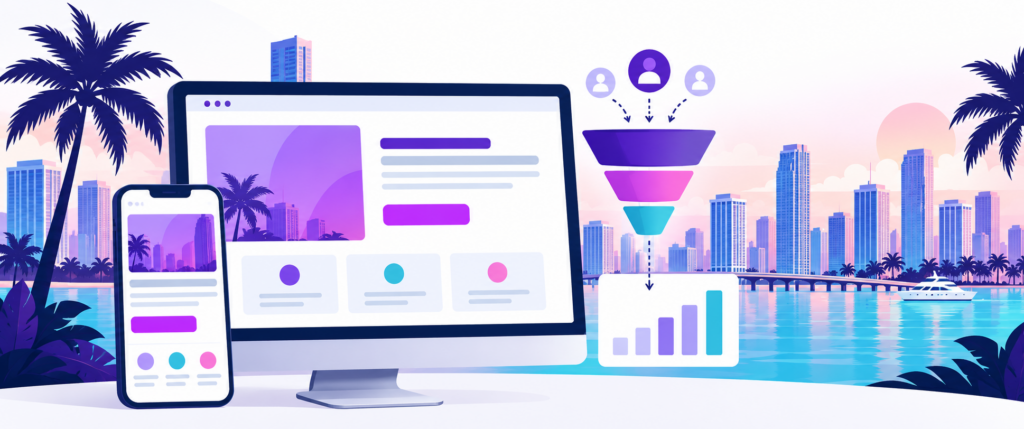
A Sunrise HVAC company we looked at recently was sending Google Ads traffic from a “24/7 emergency repair” ad straight to its homepage, with a contact form seven fields long, loading in just under six seconds on a phone. That combination loses money on every click. Landing page design for Sunrise, FL paid traffic means building one page per offer, matching the ad’s exact wording, cutting the form to what you actually need to call a lead, and loading fast enough that someone on a Sawgrass Mills parking lot Wi-Fi signal doesn’t bail before the page finishes rendering.
What the work covers
The mechanism is simple to describe and tedious to skip. Every paid ad you run points to a specific page, not a general one. If the ad says “drain cleaning, same-day,” the page headline says the same thing, in the same words, within the first screen. That’s message match. It sounds obvious until you check how many Broward County businesses still send every campaign to the homepage, where the offer is buried under a navigation menu and a slideshow. A visitor who clicks an ad promising one thing and lands on a page promising something else, or nothing in particular, closes the tab in about three seconds. That’s not a design opinion, it’s just what happens when the words don’t match.
Building a landing page for a Sunrise business starts with figuring out what the single job of that page is. Not “tell people about us,” but “get this specific type of lead to do this specific thing.” A pressure washing company advertising a spring special needs a different page than the same company advertising emergency storm cleanup, even though it’s the same business and the same general service. The headline changes, the urgency changes, the proof changes. Running both offers through one generic page means neither one performs as well as it could, and you won’t know why.
The form on that page gets shortened to the fields that matter for a first contact: name, phone, and the one detail that tells you if the lead is worth a callback. A plumber needs to know if it’s a leak or a remodel. An auto shop needs the year and model. A landscaping company might just need the zip code to know if the job is in range. Every extra field is a chance for someone to close the tab, especially on a phone, where typing is slower and patience is shorter. We’ve watched conversion rates on local service pages improve noticeably just from cutting a form from seven fields down to three, with no change to the offer itself.
Page speed gets tested on an actual mobile connection, not just on a desktop with fiber sitting in an office. We look at image weight, font loading, and whatever tracking scripts are stacked on the page, because a landing page carrying six analytics tags loads slower than one carrying two, and a slow page quietly bleeds traffic before anyone reads a word of the copy. South Florida’s mobile traffic skews heavy for local searches, people looking up a repair shop or a contractor while standing in their driveway, so a page that drags on a phone connection is losing the exact visitor it was built to catch.
Then call tracking goes on the page, so every call that comes from that specific ad and that specific page gets a number that’s different from the one on your business card or your Google Business listing. That’s how you find out if the campaign is working instead of guessing. Without a dedicated number, “the phone’s been ringing” feels like good news, but it doesn’t tell you whether the ringing came from the ad spend or from word of mouth that was happening anyway. With it, you can see call volume, call duration, and in some setups even whether the call turned into a booked job, broken out by the exact campaign and page that produced it.
Finally, multi-touchpoint attribution ties it together. If someone sees your Facebook ad on Monday, searches your business name on Thursday, and calls on Friday after clicking a Google ad, attribution shows which touchpoints were part of that path instead of handing all the credit to the last click. Without that, you can cut a campaign that was actually doing real work earlier in the chain, usually the one that introduced the business in the first place, because it never shows up as the thing that “closed” the lead. For a local service business juggling a handful of channels at once, that distinction is often the difference between a marketing budget that keeps working and one that quietly contradicts itself.
Put together, the work covers:
- Message-matched headlines and offers tied to each specific ad, not a shared homepage
- Short, purposeful forms built around the one or two details that qualify a lead
- Mobile-first speed checks, including image and script weight
- Dedicated call tracking numbers per campaign and page
- Attribution reporting that credits the full path, not just the last click
None of it is complicated on its own. What makes it worth doing carefully is that each piece covers for the others, a fast page with the wrong form still underperforms, and a well-matched headline with no call tracking still leaves you guessing.

What is different about this market
Sunrise is a dense, older suburb, built out rather than growing outward, and that shapes who’s buying and how they decide. The business mix leans trades, auto repair, food service, and independent retail along corridors like Oakland Park Boulevard, University Drive, and the streets around Sawgrass Mills. These are businesses competing on a tight radius, often against three or four nearly identical competitors within a couple of miles, and the customer comparing them is doing it on a phone, usually while already annoyed about whatever problem sent them searching in the first place.
Price is a live objection here, not a closing-call problem. A dense, value-conscious suburb means the person reading your landing page is probably also looking at two other quotes before they call anyone, which means your page needs to answer the price question honestly on the page itself, with a range or a clear explanation of what affects cost, rather than hiding it behind “contact us for a quote.” Hiding the price just means they leave and get it from the business that didn’t hide it. Trust still matters, but it gets built through specifics on the page, not sentiment, things like what’s included, how fast you respond, and what a real job typically runs.
Search here skews heavily mobile, more than in newer, car-dependent parts of Broward County, partly because of population density and partly because a large share of local searches happen in the moment, standing in a driveway or a kitchen. That makes load speed a conversion factor, not a technical nice-to-have. A landing page that takes four extra seconds to load on a mid-range Android phone loses a meaningful share of visitors before they see the offer at all. Spanish-language search also matters in Sunrise more than in some neighboring cities, given the demographic makeup, and a bilingual version of a landing page, done properly and not run through automatic translation, can widen the pool of people who find and trust the page. Demand for most of these service categories doesn’t swing wildly by season in South Florida, though AC repair spikes hard in summer and that spike is exactly when a slow page or a long form costs you the most, because everyone else’s phone is also ringing.

How we start
Every Sunrise landing page project starts with a short discovery call where we learn about your offer, your target customer, and the goal of the page, whether that’s capturing leads, booking appointments, or driving online sales. We research local competitors and review any existing analytics or ad data you have, so the design decisions are based on real information rather than guesswork. From there, we map out a simple wireframe showing headline placement, calls-to-action, and content flow before any visual design begins. This keeps the project moving quickly and keeps you involved early, so there are no surprises later. Once the structure is approved, we move into copy and visual design together.
Ad and page message match
Align the headline, offer, and content with the campaign so visitors find what the ad promised.
Page structure and content
Organize benefits, service details, supporting proof, and calls to action to answer buyer questions.
Forms and calls to action
Keep forms focused on essential information and clearly explain the next step.
Mobile and desktop usability
Improve readability, navigation, loading speed, and form usability across devices.
Conversion tracking
Configure analytics to measure meaningful actions, such as form submissions, calls, and bookings.
Testing and refinement
Use performance data to identify drop-off points and guide improvements. Results also depend on traffic quality and the offer.
We start by looking at where your traffic actually comes from, what it’s currently landing on, and what happens after someone arrives. For a Sunrise business, that usually means pulling up the existing homepage or ad destination on a phone, timing the load, counting the form fields, and checking whether the page says the same thing the ad promised. From there we build one page per offer, set up call tracking before launch rather than after, and agree on what a qualified lead looks like for your business specifically, since that number is different for a tire shop than for a restaurant taking catering orders.

What it costs
Cost depends on how many offers you’re running, whether you need bilingual versions, and how much tracking and reporting you want layered in. A single landing page for one campaign is a smaller project than a set of five pages across trades and seasons with full attribution reporting. We’ll give you a specific number after we see what you’re running and what you’re trying to prove, not before, because a flat rate quoted sight unseen usually means someone’s paying for work they don’t need or getting less than they expect.

What you get each month
Ongoing work isn’t just a page sitting live and gathering dust while leads slip through. Each month, Sunrise clients get a report tying calls and form fills back to the specific landing page and campaign that produced them, call recordings or transcripts where useful, and a short list of what we’d change next, based on what the data actually showed rather than a hunch. If a page is underperforming, we say so and explain why, whether it’s the offer, the form length, page speed, or the traffic itself sending the wrong audience to the wrong message.
- Monthly performance report tied to calls and form fills
- Call recordings or transcripts where useful for context
- Prioritized list of tested changes, not guesses
- Honest notes on what’s working and what isn’t

Get a free audit
If you're already running paid traffic to a Sunrise business — Google Ads, Facebook, or both — and you're not convinced the landing page is pulling its weight, we'll take a hard look at it, free of charge. We check message match between your ad copy and the page headline, form length versus the commitment level of the offer, mobile load speed (most Sunrise traffic is on a phone, waiting at a light or on a break), and whether your tracking actually tells you which page or campaign produced a given call or form fill. Most pages we review are losing visitors in one of those four spots, and it's rarely the one the business owner suspects. You'll get specific, written notes back — not a generic checklist — covering what's working, what's costing you conversions, and what we'd change first if it were our budget.
FAQ's
These are the 6 questions Sunrise homeowners ask us most about landing page design, answered plainly so you know what to expect before any work starts. If yours isn't covered here, get in touch and we'll walk you through it.
Do I need a separate landing page for every ad or offer I run?
If the offers are different, yes. A page built for "emergency AC repair" shouldn't also be the destination for a "free estimate on a new system" ad. Mixing offers on one page weakens message match and makes it harder to tell which campaign is actually working.
How short should the form really be?
Short enough to get a name, a phone number, and the one detail that tells you how urgent or valuable the lead is. Beyond that, every added field tends to reduce completions, especially on mobile, which is most of your Sunrise traffic.
Can you tell which specific ad or keyword led to a phone call?
Yes, with call tracking set up on the page before launch. Each landing page or campaign gets its own tracked number, so a call can be traced back to the specific ad, keyword, or source that generated it.
Do you build pages in Spanish as well as English?
We can, and for Sunrise it's often worth it given the local demographic mix. A properly written bilingual version, not an automatic translation, tends to perform better than relying on one language alone.
How fast does a landing page need to load?
Fast enough that a visitor on a phone with average mobile signal sees the offer within a couple of seconds. We test on real mobile conditions, not just a desktop connection, because that's a closer match to how most Sunrise searches actually happen.