
- Home
- Services
- Portfolio
- About
- Service AreasFort Lauderdale, FL
- Web Design
- Redesign
- WordPress
- Ecommerce
- Landing Pages
- SEO Services
- Local SEO
- GBP
- Google Ads
- PPC
- Digital Marketing
- Internet Marketing
- Advertising
- Tracking
- Dental Marketing
- Medical Marketing
- HVAC Marketing
- Roofing Marketing
- Pest Control Marketing
- Home Services Marketing
- Plumbing Marketing
- Electrical Marketing
- Landscaping Marketing
- Remodeling Marketing
Pembroke Pines, FL- Web Design
- Redesign
- WordPress
- Ecommerce
- Landing Pages
- SEO Services
- Local SEO
- GBP
- Google Ads
- PPC
- Digital Marketing
- Internet Marketing
- Advertising
- Tracking
- Dental Marketing
- Medical Marketing
- HVAC Marketing
- Roofing Marketing
- Pest Control Marketing
- Home Services Marketing
- Plumbing Marketing
- Electrical Marketing
- Landscaping Marketing
- Remodeling Marketing
Hialeah, FL- Web Design
- Redesign
- WordPress
- Ecommerce
- Landing Pages
- SEO Services
- Local SEO
- GBP
- Google Ads
- PPC
- Digital Marketing
- Internet Marketing
- Advertising
- Tracking
- Dental Marketing
- Medical Marketing
- HVAC Marketing
- Roofing Marketing
- Pest Control Marketing
- Home Services Marketing
- Plumbing Marketing
- Electrical Marketing
- Landscaping Marketing
- Remodeling Marketing
Hollywood, FL- Web Design
- Redesign
- WordPress
- Ecommerce
- Landing Pages
- SEO Services
- Local SEO
- GBP
- Google Ads
- PPC
- Digital Marketing
- Internet Marketing
- Advertising
- Tracking
- Dental Marketing
- Medical Marketing
- HVAC Marketing
- Roofing Marketing
- Pest Control Marketing
- Home Services Marketing
- Plumbing Marketing
- Electrical Marketing
- Landscaping Marketing
- Remodeling Marketing
Miramar, FL- Web Design
- Redesign
- WordPress
- Ecommerce
- Landing Pages
- SEO Services
- Local SEO
- GBP
- Google Ads
- PPC
- Digital Marketing
- Internet Marketing
- Advertising
- Tracking
- Dental Marketing
- Medical Marketing
- HVAC Marketing
- Roofing Marketing
- Pest Control Marketing
- Home Services Marketing
- Plumbing Marketing
- Electrical Marketing
- Landscaping Marketing
- Remodeling Marketing
Coral Springs, FL- Web Design
- Redesign
- WordPress
- Ecommerce
- Landing Pages
- SEO Services
- Local SEO
- GBP
- Google Ads
- PPC
- Digital Marketing
- Internet Marketing
- Advertising
- Tracking
- Dental Marketing
- Medical Marketing
- HVAC Marketing
- Roofing Marketing
- Pest Control Marketing
- Home Services Marketing
- Plumbing Marketing
- Electrical Marketing
- Landscaping Marketing
- Remodeling Marketing
Pompano Beach, FL- Web Design
- Redesign
- WordPress
- Ecommerce
- Landing Pages
- SEO Services
- Local SEO
- GBP
- Google Ads
- PPC
- Digital Marketing
- Internet Marketing
- Advertising
- Tracking
- Dental Marketing
- Medical Marketing
- HVAC Marketing
- Roofing Marketing
- Pest Control Marketing
- Home Services Marketing
- Plumbing Marketing
- Electrical Marketing
- Landscaping Marketing
- Remodeling Marketing
Davie, FL- Web Design
- Redesign
- WordPress
- Ecommerce
- Landing Pages
- SEO Services
- Local SEO
- GBP
- Google Ads
- PPC
- Digital Marketing
- Internet Marketing
- Advertising
- Tracking
- Dental Marketing
- Medical Marketing
- HVAC Marketing
- Roofing Marketing
- Pest Control Marketing
- Home Services Marketing
- Plumbing Marketing
- Electrical Marketing
- Landscaping Marketing
- Remodeling Marketing
Sunrise, FL- Web Design
- Redesign
- WordPress
- Ecommerce
- Landing Pages
- SEO Services
- Local SEO
- GBP
- Google Ads
- PPC
- Digital Marketing
- Internet Marketing
- Advertising
- Tracking
- Dental Marketing
- Medical Marketing
- HVAC Marketing
- Roofing Marketing
- Pest Control Marketing
- Home Services Marketing
- Plumbing Marketing
- Electrical Marketing
- Landscaping Marketing
- Remodeling Marketing
Plantation, FL- Web Design
- Redesign
- WordPress
- Ecommerce
- Landing Pages
- SEO Services
- Local SEO
- GBP
- Google Ads
- PPC
- Digital Marketing
- Internet Marketing
- Advertising
- Tracking
- Dental Marketing
- Medical Marketing
- HVAC Marketing
- Roofing Marketing
- Pest Control Marketing
- Home Services Marketing
- Plumbing Marketing
- Electrical Marketing
- Landscaping Marketing
- Remodeling Marketing
Deerfield Beach, FL- Web Design
- Redesign
- WordPress
- Ecommerce
- Landing Pages
- SEO Services
- Local SEO
- GBP
- Google Ads
- PPC
- Digital Marketing
- Internet Marketing
- Advertising
- Tracking
- Dental Marketing
- Medical Marketing
- HVAC Marketing
- Roofing Marketing
- Pest Control Marketing
- Home Services Marketing
- Plumbing Marketing
- Electrical Marketing
- Landscaping Marketing
- Remodeling Marketing
Miami Gardens, FL- Web Design
- Redesign
- WordPress
- Ecommerce
- Landing Pages
- SEO Services
- Local SEO
- GBP
- Google Ads
- PPC
- Digital Marketing
- Internet Marketing
- Advertising
- Tracking
- Dental Marketing
- Medical Marketing
- HVAC Marketing
- Roofing Marketing
- Pest Control Marketing
- Home Services Marketing
- Plumbing Marketing
- Electrical Marketing
- Landscaping Marketing
- Remodeling Marketing
Lauderhill, FL- Web Design
- Redesign
- WordPress
- Ecommerce
- Landing Pages
- SEO Services
- Local SEO
- GBP
- Google Ads
- PPC
- Digital Marketing
- Internet Marketing
- Advertising
- Tracking
- Dental Marketing
- Medical Marketing
- HVAC Marketing
- Roofing Marketing
- Pest Control Marketing
- Home Services Marketing
- Plumbing Marketing
- Electrical Marketing
- Landscaping Marketing
- Remodeling Marketing
West Palm Beach, FL- Web Design
- Redesign
- WordPress
- Ecommerce
- Landing Pages
- SEO Services
- Local SEO
- GBP
- Google Ads
- PPC
- Digital Marketing
- Internet Marketing
- Advertising
- Tracking
- Dental Marketing
- Medical Marketing
- HVAC Marketing
- Roofing Marketing
- Pest Control Marketing
- Home Services Marketing
- Plumbing Marketing
- Electrical Marketing
- Landscaping Marketing
- Remodeling Marketing
Tamarac, FL- Web Design
- Redesign
- WordPress
- Ecommerce
- Landing Pages
- SEO Services
- Local SEO
- GBP
- Google Ads
- PPC
- Digital Marketing
- Internet Marketing
- Advertising
- Tracking
- Dental Marketing
- Medical Marketing
- HVAC Marketing
- Roofing Marketing
- Pest Control Marketing
- Home Services Marketing
- Plumbing Marketing
- Electrical Marketing
- Landscaping Marketing
- Remodeling Marketing
Weston, FL- Web Design
- Redesign
- WordPress
- Ecommerce
- Landing Pages
- SEO Services
- Local SEO
- GBP
- Google Ads
- PPC
- Digital Marketing
- Internet Marketing
- Advertising
- Tracking
- Dental Marketing
- Medical Marketing
- HVAC Marketing
- Roofing Marketing
- Pest Control Marketing
- Home Services Marketing
- Plumbing Marketing
- Electrical Marketing
- Landscaping Marketing
- Remodeling Marketing
Boca Raton, FLMargate, FLCoconut Creek, FLMiami Beach, FLHomestead, FLKendall, FLDoral, FLBoynton Beach, FLThe Hammocks, FLNorth Lauderdale, FLOakland Park, FLDelray Beach, FLNorth Miami, FLHallandale Beach, FLFontainebleau, FLKendale Lakes, FLWellington, FLJupiter, FLTamiami, FLPalm Beach Gardens, FLLauderdale Lakes, FLCooper City, FLCountry Club, FLParkland, FLCoral Gables, FLDania Beach, FLCutler Bay, FLNorth Miami Beach, FLGreenacres, FLLake Worth Beach, FLPrinceton, FLRoyal Palm Beach, FLSouth Miami Heights, FLRichmond West, FLRiviera Beach, FLWest Little River, FLGolden Glades, FLAventura, FLMiami Lakes, FLWestchester, FLLeisure City, FLCoral Terrace, FLPalm Springs, FLPalmetto Bay, FLHialeah Gardens, FLSunny Isles Beach, FLIves Estates, FLWest Park, FLSweetwater, FLPinecrest, FLSunset, FLPinewood, FLWilton Manors, FLOpa-locka, FLLighthouse Point, FLBelle Glade, FLNaranja, FLPalmetto Estates, FLBrownsville, FLKey Biscayne, FLOlympia Heights, FLMiami Springs, FLFlorida City, FLSouth Miami, FLThree Lakes, FLGladeview, FLNorth Palm Beach, FLMiami Shores, FLSouthwest Ranches, FLKings Point, FLLauderdale-by-the-Sea, FLHillsboro Beach, FLSea Ranch Lakes, FLLazy Lake, FL - Blog
- Contact
Local SEO in Coral Gables, Florida
Local SEO for Coral Gables businesses
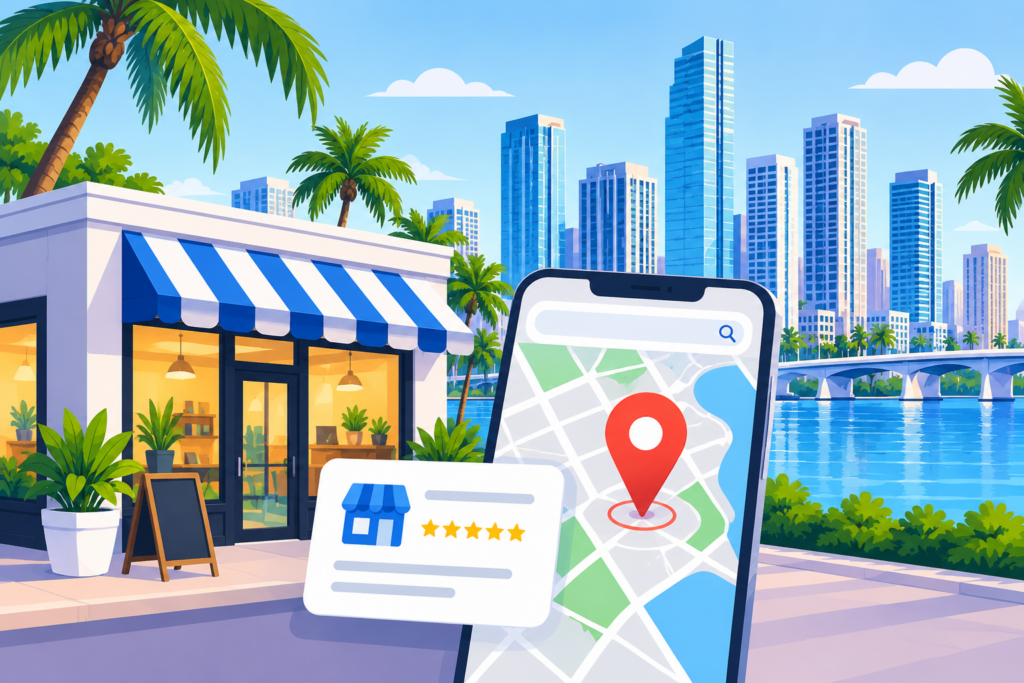
A patient searching “dermatologist near me” from a phone on Miracle Mile sees a map with three pins before they ever see a blue link. A boat detailer in the Waterway gets found by someone standing at their own marina, not by someone reading a blog post about boat care. That is the map pack, and it runs on different signals than organic SEO.
What the work covers
The work starts with the Google Business Profile itself, because that is the asset Google actually shows in the map pack, not your website. That means the primary and secondary categories are checked against what you actually sell, not what sounded closest when the profile was first set up years ago. Service areas are set to match where you actually work, down to the specific Coral Gables neighborhoods and corridors you serve rather than a generic Coral Gables-Dade radius. Photos are current. The Q&A section is not left empty for a competitor to answer for you, and posts go out on a schedule instead of sitting untouched for months.
From there it is citations: your business name, address, and phone number need to match exactly across the directories Google cross-references, from the obvious ones down to the industry-specific listings a cosmetic practice, a law office, or a marine service business actually gets found on. Inconsistent data across those listings is one of the more common reasons a profile with real reviews still does not rank, and cleaning up duplicate or outdated listings tied to an old Coral Gables address is often part of the fix.
Review strategy comes next. Not buying reviews, which gets profiles suspended, but building a repeatable way to ask real clients at the right moment, and responding to every review that comes in, because response rate and recency are both signals Google weighs. Then there is on-page local relevance: the pages on your own site need to say where you work and what you do in plain language, with the kind of structured data that tells Google your hours, your service area, and your category without ambiguity.
Finally, proximity and link signals: local backlinks, local press mentions, chamber and business association listings, and citations from sources physically tied to Coral Gables and greater Coral Gables-Dade County. All of it is reported with call tracking, so you can see which of these signals actually moved a call, not just which ones moved a ranking checker.

What is different about this market
Coral Gables is not a volume market. It is a trust market. Household incomes here support businesses that would struggle to charge the same prices in most of the county, and the buyers who search for a cosmetic surgeon, an estate attorney, a marine upholsterer, or a high-end landscaper on Alhambra Circle are not comparing five quotes to find the cheapest one. They are scanning the map pack for signals that a business looks as established and as careful as the result of the work they are about to pay for. A thin Google Business Profile with three photos and no responses to reviews reads as a mismatch against a $400 consultation fee, and buyers notice.
The business mix here skews toward categories where trust outweighs price: cosmetic and medical practices, legal services, marine and yacht-adjacent trades, and luxury home services like pool, landscape, and remodeling work. Competition for the map pack in these categories is real but not infinite, because Coral Gables is a small, affluent city bordered by much larger search volume in Coral Gables proper. That means a well-built profile with consistent citations and a genuine review cadence can hold a map pack position here in a way that would take considerably more work in a denser, lower-trust market.
Two more things distort demand. First, a meaningful share of Coral Gables residents are seasonal, generally present from around November through April, which means search volume for home services, medical aesthetics, and marine work swings through the year, and ad spend and content timing both need to account for that rather than running flat all twelve months. Second, search here skews heavily mobile, consistent with a buyer base that is searching in the car on the way somewhere, not sitting at a desktop comparing tabs, which raises the importance of click-to-call, mobile page speed, and a profile that looks complete on a small screen.
Google Business Profile
We review your business categories, services, description, hours, contact details, photos, and other relevant profile information. Accurate, complete details help potential customers understand what you offer and how to contact you.
Local website pages
We review service and location pages to make sure they answer local customers’ questions and explain the services available. Each page should have a clear purpose, useful content, and relevant contact options not repeated city keywords.
Business information consistency
We check key business details across relevant directories and listings. Inaccurate names, phone numbers, or other information can confuse customers and make local visibility harder to assess.
Reviews and reputation
We can review how your business requests and responds to customer feedback. Reviews should be genuine, and responses should be professional. No agency can guarantee a specific rating or review volume.
Local links and relevance
We assess relevant local organizations, directories, and other credible link opportunities. The focus is on useful connections and genuine relevance rather than collecting links from unrelated websites.
Tracking and reporting
We monitor available local search visibility, website traffic, calls, form submissions, and other agreed measures where tracking is configured. Reports should show completed work, observed changes, and the next priorities.

How we start
We start with an audit: your Google Business Profile against actual service categories and area, a citation check across the directories that matter, and a look at who holds the Coral Gables map pack for your core terms, since that shows what level of consistency we’re competing against. We also check whether your website gives Google clear signals about where you work, because a strong profile paired with a vague site still underperforms.
From there we build a ranked fix list, usually starting with profile and category corrections, since these are often misconfigured and cost nothing to fix.

How We Start
- First, we review the current position. We assess your Google Business Profile, website, key local pages, business listings, and available performance data.
- Next, we set priorities. The plan identifies profile corrections, website improvements, local content needs, and tracking gaps. Work is based on your current situation rather than a fixed checklist applied to every business.
- Then, we implement and measure. We address the agreed priorities, review the data, and refine the plan as new information becomes available. Early work may focus on correcting information and technical issues before longer-term visibility changes can be assessed.

What it costs
Cost depends on how many categories you compete in, how damaged or incomplete your current citation profile is, and how competitive your specific Coral Gables category already is. A single-location medical aesthetics practice with one core service and a clean existing profile costs less to manage than a multi-service marine business competing across several map pack categories at once. Pricing also shifts with how much manual cleanup is needed: duplicate listings, inconsistent NAP data across directories, and unclaimed profiles all add work before rankings can move. Ongoing management, including review generation, post updates, and listing audits, is typically scoped separately from the initial cleanup and buildout phase.
FAQ's
These are the 5 questions Coral Gables homeowners ask us most about local seo, answered plainly so you know what to expect before any work starts. If yours isn't covered here, get in touch and we'll walk you through it.
How is Local SEO different from the organic SEO work you also offer?
Organic SEO targets the standard blue-link results. Local SEO targets the three-pack map results tied to your Google Business Profile and physical proximity to the searcher. They use overlapping tactics but different ranking signals, and a business can rank well in one and not the other.
Do I need a Coral Gables address to rank in the Coral Gables map pack?
A verified address tied to Coral Gables or a clearly defined service area set correctly on your profile both matter. Service-area businesses without a storefront can still appear in the map pack if the profile and citations are configured to reflect where they actually work.
How long does Local SEO take to show movement in Coral Gables?
It varies by how competitive your category is and how damaged your current citations are. We do not promise a timeline or a ranking position, but we do report monthly on what changed and what moved, so you can judge progress against your own baseline.
Does the seasonal population swing in Coral Gables actually affect my results?
For categories like home services, medical aesthetics, and marine trades, yes. Search volume and competition both shift as seasonal residents arrive and leave, roughly November through April, and campaign and content timing should account for that rather than running flat all year.
Can you work with my business if I'm not physically located in Coral Gables but serve clients there?
Yes. We work with businesses across South Florida, including service-area businesses that serve Coral Gables without a storefront there. The profile and service area settings are configured to reflect that honestly.
What you get each month
Every month you get a report tied to call tracking and attribution, not a screenshot of rankings. That means you see which calls came from the map pack versus organic results versus paid, how your profile’s calls and direction requests trended, which citations were corrected or added, and which review responses went out. You also get a running list of what changed on the profile and why, so nothing is a black box.
The goal of the reporting is the same as the goal of the work: you should be able to see the mechanism, not just trust that something is happening in the background.