
- Home
- Services
- Portfolio
- About
- Service AreasFort Lauderdale, FL
- Web Design
- Redesign
- WordPress
- Ecommerce
- Landing Pages
- SEO Services
- Local SEO
- GBP
- Google Ads
- PPC
- Digital Marketing
- Internet Marketing
- Advertising
- Tracking
- Dental Marketing
- Medical Marketing
- HVAC Marketing
- Roofing Marketing
- Pest Control Marketing
- Home Services Marketing
- Plumbing Marketing
- Electrical Marketing
- Landscaping Marketing
- Remodeling Marketing
Pembroke Pines, FL- Web Design
- Redesign
- WordPress
- Ecommerce
- Landing Pages
- SEO Services
- Local SEO
- GBP
- Google Ads
- PPC
- Digital Marketing
- Internet Marketing
- Advertising
- Tracking
- Dental Marketing
- Medical Marketing
- HVAC Marketing
- Roofing Marketing
- Pest Control Marketing
- Home Services Marketing
- Plumbing Marketing
- Electrical Marketing
- Landscaping Marketing
- Remodeling Marketing
Hialeah, FL- Web Design
- Redesign
- WordPress
- Ecommerce
- Landing Pages
- SEO Services
- Local SEO
- GBP
- Google Ads
- PPC
- Digital Marketing
- Internet Marketing
- Advertising
- Tracking
- Dental Marketing
- Medical Marketing
- HVAC Marketing
- Roofing Marketing
- Pest Control Marketing
- Home Services Marketing
- Plumbing Marketing
- Electrical Marketing
- Landscaping Marketing
- Remodeling Marketing
Hollywood, FL- Web Design
- Redesign
- WordPress
- Ecommerce
- Landing Pages
- SEO Services
- Local SEO
- GBP
- Google Ads
- PPC
- Digital Marketing
- Internet Marketing
- Advertising
- Tracking
- Dental Marketing
- Medical Marketing
- HVAC Marketing
- Roofing Marketing
- Pest Control Marketing
- Home Services Marketing
- Plumbing Marketing
- Electrical Marketing
- Landscaping Marketing
- Remodeling Marketing
Miramar, FL- Web Design
- Redesign
- WordPress
- Ecommerce
- Landing Pages
- SEO Services
- Local SEO
- GBP
- Google Ads
- PPC
- Digital Marketing
- Internet Marketing
- Advertising
- Tracking
- Dental Marketing
- Medical Marketing
- HVAC Marketing
- Roofing Marketing
- Pest Control Marketing
- Home Services Marketing
- Plumbing Marketing
- Electrical Marketing
- Landscaping Marketing
- Remodeling Marketing
Coral Springs, FL- Web Design
- Redesign
- WordPress
- Ecommerce
- Landing Pages
- SEO Services
- Local SEO
- GBP
- Google Ads
- PPC
- Digital Marketing
- Internet Marketing
- Advertising
- Tracking
- Dental Marketing
- Medical Marketing
- HVAC Marketing
- Roofing Marketing
- Pest Control Marketing
- Home Services Marketing
- Plumbing Marketing
- Electrical Marketing
- Landscaping Marketing
- Remodeling Marketing
Pompano Beach, FL- Web Design
- Redesign
- WordPress
- Ecommerce
- Landing Pages
- SEO Services
- Local SEO
- GBP
- Google Ads
- PPC
- Digital Marketing
- Internet Marketing
- Advertising
- Tracking
- Dental Marketing
- Medical Marketing
- HVAC Marketing
- Roofing Marketing
- Pest Control Marketing
- Home Services Marketing
- Plumbing Marketing
- Electrical Marketing
- Landscaping Marketing
- Remodeling Marketing
Davie, FL- Web Design
- Redesign
- WordPress
- Ecommerce
- Landing Pages
- SEO Services
- Local SEO
- GBP
- Google Ads
- PPC
- Digital Marketing
- Internet Marketing
- Advertising
- Tracking
- Dental Marketing
- Medical Marketing
- HVAC Marketing
- Roofing Marketing
- Pest Control Marketing
- Home Services Marketing
- Plumbing Marketing
- Electrical Marketing
- Landscaping Marketing
- Remodeling Marketing
Sunrise, FL- Web Design
- Redesign
- WordPress
- Ecommerce
- Landing Pages
- SEO Services
- Local SEO
- GBP
- Google Ads
- PPC
- Digital Marketing
- Internet Marketing
- Advertising
- Tracking
- Dental Marketing
- Medical Marketing
- HVAC Marketing
- Roofing Marketing
- Pest Control Marketing
- Home Services Marketing
- Plumbing Marketing
- Electrical Marketing
- Landscaping Marketing
- Remodeling Marketing
Plantation, FL- Web Design
- Redesign
- WordPress
- Ecommerce
- Landing Pages
- SEO Services
- Local SEO
- GBP
- Google Ads
- PPC
- Digital Marketing
- Internet Marketing
- Advertising
- Tracking
- Dental Marketing
- Medical Marketing
- HVAC Marketing
- Roofing Marketing
- Pest Control Marketing
- Home Services Marketing
- Plumbing Marketing
- Electrical Marketing
- Landscaping Marketing
- Remodeling Marketing
Deerfield Beach, FL- Web Design
- Redesign
- WordPress
- Ecommerce
- Landing Pages
- SEO Services
- Local SEO
- GBP
- Google Ads
- PPC
- Digital Marketing
- Internet Marketing
- Advertising
- Tracking
- Dental Marketing
- Medical Marketing
- HVAC Marketing
- Roofing Marketing
- Pest Control Marketing
- Home Services Marketing
- Plumbing Marketing
- Electrical Marketing
- Landscaping Marketing
- Remodeling Marketing
Miami Gardens, FL- Web Design
- Redesign
- WordPress
- Ecommerce
- Landing Pages
- SEO Services
- Local SEO
- GBP
- Google Ads
- PPC
- Digital Marketing
- Internet Marketing
- Advertising
- Tracking
- Dental Marketing
- Medical Marketing
- HVAC Marketing
- Roofing Marketing
- Pest Control Marketing
- Home Services Marketing
- Plumbing Marketing
- Electrical Marketing
- Landscaping Marketing
- Remodeling Marketing
Lauderhill, FL- Web Design
- Redesign
- WordPress
- Ecommerce
- Landing Pages
- SEO Services
- Local SEO
- GBP
- Google Ads
- PPC
- Digital Marketing
- Internet Marketing
- Advertising
- Tracking
- Dental Marketing
- Medical Marketing
- HVAC Marketing
- Roofing Marketing
- Pest Control Marketing
- Home Services Marketing
- Plumbing Marketing
- Electrical Marketing
- Landscaping Marketing
- Remodeling Marketing
West Palm Beach, FL- Web Design
- Redesign
- WordPress
- Ecommerce
- Landing Pages
- SEO Services
- Local SEO
- GBP
- Google Ads
- PPC
- Digital Marketing
- Internet Marketing
- Advertising
- Tracking
- Dental Marketing
- Medical Marketing
- HVAC Marketing
- Roofing Marketing
- Pest Control Marketing
- Home Services Marketing
- Plumbing Marketing
- Electrical Marketing
- Landscaping Marketing
- Remodeling Marketing
Tamarac, FL- Web Design
- Redesign
- WordPress
- Ecommerce
- Landing Pages
- SEO Services
- Local SEO
- GBP
- Google Ads
- PPC
- Digital Marketing
- Internet Marketing
- Advertising
- Tracking
- Dental Marketing
- Medical Marketing
- HVAC Marketing
- Roofing Marketing
- Pest Control Marketing
- Home Services Marketing
- Plumbing Marketing
- Electrical Marketing
- Landscaping Marketing
- Remodeling Marketing
Weston, FL- Web Design
- Redesign
- WordPress
- Ecommerce
- Landing Pages
- SEO Services
- Local SEO
- GBP
- Google Ads
- PPC
- Digital Marketing
- Internet Marketing
- Advertising
- Tracking
- Dental Marketing
- Medical Marketing
- HVAC Marketing
- Roofing Marketing
- Pest Control Marketing
- Home Services Marketing
- Plumbing Marketing
- Electrical Marketing
- Landscaping Marketing
- Remodeling Marketing
Boca Raton, FLMargate, FLCoconut Creek, FLMiami Beach, FLHomestead, FLKendall, FLDoral, FLBoynton Beach, FLThe Hammocks, FLNorth Lauderdale, FLOakland Park, FLDelray Beach, FLNorth Miami, FLHallandale Beach, FLFontainebleau, FLKendale Lakes, FLWellington, FLJupiter, FLTamiami, FLPalm Beach Gardens, FLLauderdale Lakes, FLCooper City, FLCountry Club, FLParkland, FLCoral Gables, FLDania Beach, FLCutler Bay, FLNorth Miami Beach, FLGreenacres, FLLake Worth Beach, FLPrinceton, FLRoyal Palm Beach, FLSouth Miami Heights, FLRichmond West, FLRiviera Beach, FLWest Little River, FLGolden Glades, FLAventura, FLMiami Lakes, FLWestchester, FLLeisure City, FLCoral Terrace, FLPalm Springs, FLPalmetto Bay, FLHialeah Gardens, FLSunny Isles Beach, FLIves Estates, FLWest Park, FLSweetwater, FLPinecrest, FLSunset, FLPinewood, FLWilton Manors, FLOpa-locka, FLLighthouse Point, FLBelle Glade, FLNaranja, FLPalmetto Estates, FLBrownsville, FLKey Biscayne, FLOlympia Heights, FLMiami Springs, FLFlorida City, FLSouth Miami, FLThree Lakes, FLGladeview, FLNorth Palm Beach, FLMiami Shores, FLSouthwest Ranches, FLKings Point, FLLauderdale-by-the-Sea, FLHillsboro Beach, FLSea Ranch Lakes, FLLazy Lake, FL - Blog
- Contact
Marketing for Dental Practices in Pompano Beach, Florida
A new patient in Pompano Beach does not search for “dentist.” They search for “emergency dentist near me” at 9pm, or “dentist that takes [insurance plan] Pompano Beach” from a desk at work. That search happens on a phone, it happens fast, and it ends with a phone call or a booking form before they ever read your About page. If your site and your listings are not built around that exact behavior, the patient books with whoever answered that question first.
We build dental marketing around how people in Pompano Beach actually search, not around what a practice wants to say about itself.

How Pompano Beach Dental Practices buyers search
Most dental searches in Pompano Beach fall into three buckets: pain-driven (“tooth hurts,” “emergency dentist”), insurance-driven (“dentist that accepts [plan]”), and comparison-driven (“best dentist Pompano Beach” or “[competitor] reviews”). Each one needs a different page. A homepage that tries to answer all three at once usually answers none of them well, and Google treats it that way in the results, splitting your authority instead of concentrating it where a buyer is actually ready to act.
Insurance filtering matters more here than in most service businesses. A patient who does not see their plan named on your site assumes you do not take it and moves to the next practice in the map pack within seconds. We build insurance and payment information into pages Google can actually index, not buried in a PDF or a phone-only answer, so the filtering happens in your favor instead of against you. The same logic applies to procedure pages: implants, Invisalign, and sedation each attract a buyer with a different urgency and budget, and each deserves its own answer.
Seasonality is part of the picture too. Pompano Beach has a resident population that books routine care year-round, plus a seasonal population, snowbirds, winter renters, visiting boat crews, who show up needing a dentist on short notice and have no history with any local practice. That second group searches almost entirely on “near me” and reviews, often from a hotel or marina parking lot. If your Google Business Profile and review volume are not current, you are invisible to a segment of patients who are actively looking and ready to book same week, regardless of how strong your actual care is.
Mobile search dominates both groups. A patient comparing practices does it from a phone, usually while also looking at reviews and driving distance at the same time. The practice that loads fast, shows hours and insurance clearly, and has a map pin that matches reality wins that three-way comparison before price or even reputation gets weighed. Slow load times or a mismatched address quietly cost appointments every single day.
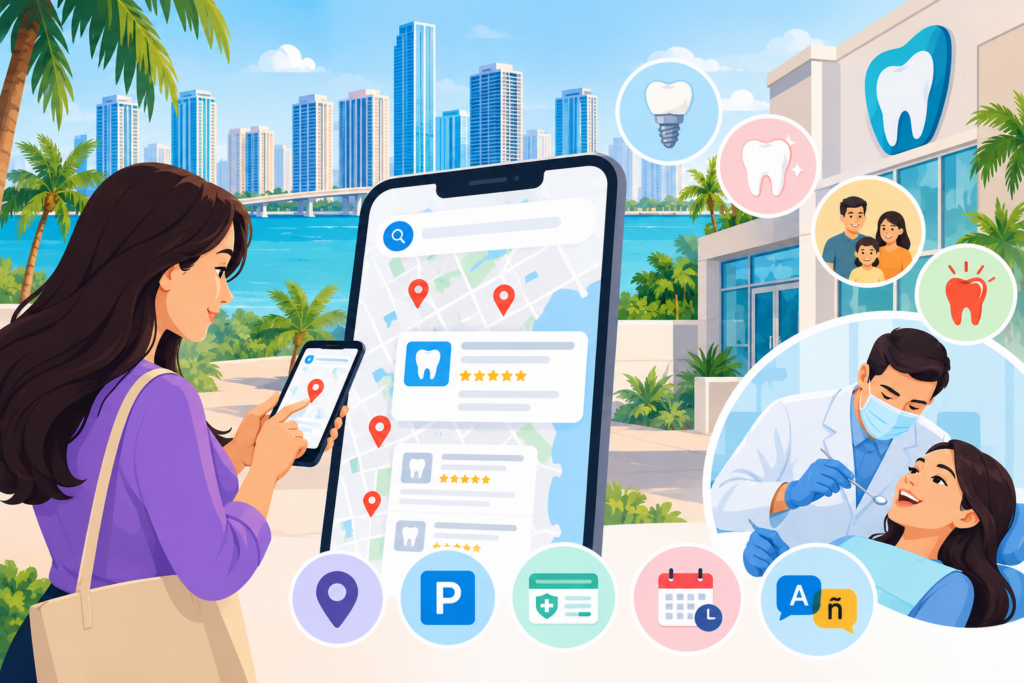
The competition here
Pompano Beach has a meaningful concentration of dental practices along Federal Highway, Atlantic Boulevard, and the pockets near Sample Road, which means a patient searching from most residential zip codes in the city will see three to six practices in the map pack before they see yours, regardless of how good your clinical work is. That is the honest starting point. The map pack is won on proximity, review count, review recency, and category match (general vs. cosmetic vs. pediatric vs. orthodontic practices often compete in the same results even though they serve different patients). A practice a mile farther from a searcher but with twice the reviews and a tighter category match will frequently outrank the closer office.
Organic results below the map pack are a slower fight but a more stable one. A practice with service-specific pages (implants, Invisalign, emergency care, sedation, periodontics) ranking on their own tends to hold position longer than a practice relying only on its Google Business Profile, because the profile can be outranked the moment a competitor runs ads or adds reviews. Thin, generic “services” pages do not hold rank in this market; pages written around the actual procedures patients search for do. We treat the map pack and organic search as two separate campaigns that need to be run together, not one tactic applied twice, because a practice that wins one and ignores the other is still losing half its available traffic.

What we build for Dental Practices in this market
We start with a site structure built around how patients search, not around how a practice lists its services internally. That means a dedicated page for each high-intent service (emergency dentistry, implants, cosmetic work, pediatric care, whatever applies to your practice) instead of one general “Services” page trying to rank for all of them. One page cannot hold position for a dozen unrelated search terms; Google needs a clear answer to a clear question, and that means one page per question.
We build insurance and payment pages that name actual plans, because “we accept most insurance” does not get indexed for anything a patient would search. If a patient is searching “dentist that takes [plan] Pompano Beach,” that phrase needs to exist on your site in readable text.
Google Business Profile management is part of the build, not an add-on. That includes category accuracy, service list alignment with your actual site pages, photo updates, and a posting cadence, because an abandoned profile is one of the clearest signals Google uses to drop a listing out of the map pack.
Review generation is structured, not hoped for. We set up a request flow that goes out after appointments, not a generic ask bolted onto an invoice. Volume and recency both matter here, and a practice bringing in new reviews every week outperforms one that got twenty reviews in 2021 and stopped.
For practices running Google Ads alongside this, we build campaigns around the same intent split: pain and emergency terms get their own campaign with their own budget logic, separate from insurance and comparison terms, because a patient in pain converts differently than a patient comparison-shopping three practices.
Local SEO
Improve relevant website content, location signals, internal links, and service information to support local search visibility.
Google Business Profile
Review profile accuracy, categories, services, contact details, and other eligible information. Changes should follow Google's Business Profile guidelines.
Treatment pages
Build or improve pages for services such as general dentistry, cosmetic treatments, implants, or emergency appointments when those services are offered.
Paid search campaigns
Target relevant searches, refine location settings, and review search terms to reduce spend on enquiries that do not match the practice.
Conversion tracking
Measure available actions such as appointment-form submissions, calls, and clicks on booking links.
Website improvements
Make service information, insurance details, contact options, and booking steps easier to find on desktop and mobile.
What we measure
We use call tracking so you can hear which page, which keyword, and which campaign produced an actual phone call, not just a click. Dental conversion often happens by phone rather than by form, especially for pain-driven and insurance searches, so form-only tracking undercounts what is actually working.
We report on new patient calls and booking form submissions by source, map pack position for the terms that matter to your practice, organic ranking movement on service pages, and review count and rating trend over time. We do not report vanity traffic numbers that do not connect to a patient in a chair.

What it costs
Dental marketing cost in Pompano Beach depends on how many service lines need pages, whether you’re rebuilding or starting fresh, and whether paid search runs alongside SEO and review work. A single-location general practice targeting a handful of terms costs less than a multi-location group competing across cosmetic, implant, and orthodontic categories throughout Broward.
We give you a specific figure after reviewing your current site, map pack position, and the actual competitors taking your patients. That conversation costs nothing and tells you more than any flat rate posted on a page.
- Organic search visibility and relevant website visits.
- Google Business Profile interactions and available performance data.
- Paid campaign clicks, search terms, and advertising costs.
- Tracked calls, appointment-form submissions, and booking actions.
- Enquiry quality, where the practice can reliably share and categorize that information.
- Changes made, issues identified, and recommended next steps.
Get an audit
We will look at your current Google Business Profile, your site’s service pages, reviews, and the three to six practices actually beating you in Pompano Beach search results right now. You get a plain-language read of what is working, what is not, and what we would do differently to win patients searching along Atlantic Boulevard, Federal Highway, and the surrounding neighborhoods.

FAQ's
These are the 6 questions Pompano Beach homeowners ask us most about dental practice marketing, answered plainly so you know what to expect before any work starts. If yours isn't covered here, get in touch and we'll walk you through it.
How long does it take to see movement in Pompano Beach dental search results?
It depends on your starting point: how old your domain is, how many competitors already have strong review counts, and whether you need new pages built or just fixes to what exists. We will not quote a timeline until we have looked at your specific site and market position, because a flat promise here would be a guess, not a plan.
Do you work with multi-location dental groups?
Yes. Multi-location dental marketing needs a page structure that separates each location and service combination clearly, so Pompano Beach patients do not land on a page built for a different city. We build that structure so each location can rank on its own.
Is the map pack or organic search more important for a dental practice?
Both matter and they behave differently. The map pack is driven by proximity, reviews, and profile accuracy; organic rankings are driven by site content and tend to be more stable once established. We run both rather than picking one.
Do you handle review generation or just ads and SEO?
Review generation is part of the work, not a separate add-on, because reviews affect both map pack ranking and whether a patient who finds you actually calls. We set up a request process tied to your appointment flow.
What does dental marketing cost in Pompano Beach?
It varies by how many service lines and locations you need to cover and whether paid search is part of the plan. We give an exact figure after reviewing your current site and competitors, not before.