
- Home
- Services
- Portfolio
- About
- Service AreasFort Lauderdale, FL
- Web Design
- Redesign
- WordPress
- Ecommerce
- Landing Pages
- SEO Services
- Local SEO
- GBP
- Google Ads
- PPC
- Digital Marketing
- Internet Marketing
- Advertising
- Tracking
- Dental Marketing
- Medical Marketing
- HVAC Marketing
- Roofing Marketing
- Pest Control Marketing
- Home Services Marketing
- Plumbing Marketing
- Electrical Marketing
- Landscaping Marketing
- Remodeling Marketing
Pembroke Pines, FL- Web Design
- Redesign
- WordPress
- Ecommerce
- Landing Pages
- SEO Services
- Local SEO
- GBP
- Google Ads
- PPC
- Digital Marketing
- Internet Marketing
- Advertising
- Tracking
- Dental Marketing
- Medical Marketing
- HVAC Marketing
- Roofing Marketing
- Pest Control Marketing
- Home Services Marketing
- Plumbing Marketing
- Electrical Marketing
- Landscaping Marketing
- Remodeling Marketing
Hialeah, FL- Web Design
- Redesign
- WordPress
- Ecommerce
- Landing Pages
- SEO Services
- Local SEO
- GBP
- Google Ads
- PPC
- Digital Marketing
- Internet Marketing
- Advertising
- Tracking
- Dental Marketing
- Medical Marketing
- HVAC Marketing
- Roofing Marketing
- Pest Control Marketing
- Home Services Marketing
- Plumbing Marketing
- Electrical Marketing
- Landscaping Marketing
- Remodeling Marketing
Hollywood, FL- Web Design
- Redesign
- WordPress
- Ecommerce
- Landing Pages
- SEO Services
- Local SEO
- GBP
- Google Ads
- PPC
- Digital Marketing
- Internet Marketing
- Advertising
- Tracking
- Dental Marketing
- Medical Marketing
- HVAC Marketing
- Roofing Marketing
- Pest Control Marketing
- Home Services Marketing
- Plumbing Marketing
- Electrical Marketing
- Landscaping Marketing
- Remodeling Marketing
Miramar, FL- Web Design
- Redesign
- WordPress
- Ecommerce
- Landing Pages
- SEO Services
- Local SEO
- GBP
- Google Ads
- PPC
- Digital Marketing
- Internet Marketing
- Advertising
- Tracking
- Dental Marketing
- Medical Marketing
- HVAC Marketing
- Roofing Marketing
- Pest Control Marketing
- Home Services Marketing
- Plumbing Marketing
- Electrical Marketing
- Landscaping Marketing
- Remodeling Marketing
Coral Springs, FL- Web Design
- Redesign
- WordPress
- Ecommerce
- Landing Pages
- SEO Services
- Local SEO
- GBP
- Google Ads
- PPC
- Digital Marketing
- Internet Marketing
- Advertising
- Tracking
- Dental Marketing
- Medical Marketing
- HVAC Marketing
- Roofing Marketing
- Pest Control Marketing
- Home Services Marketing
- Plumbing Marketing
- Electrical Marketing
- Landscaping Marketing
- Remodeling Marketing
Pompano Beach, FL- Web Design
- Redesign
- WordPress
- Ecommerce
- Landing Pages
- SEO Services
- Local SEO
- GBP
- Google Ads
- PPC
- Digital Marketing
- Internet Marketing
- Advertising
- Tracking
- Dental Marketing
- Medical Marketing
- HVAC Marketing
- Roofing Marketing
- Pest Control Marketing
- Home Services Marketing
- Plumbing Marketing
- Electrical Marketing
- Landscaping Marketing
- Remodeling Marketing
Davie, FL- Web Design
- Redesign
- WordPress
- Ecommerce
- Landing Pages
- SEO Services
- Local SEO
- GBP
- Google Ads
- PPC
- Digital Marketing
- Internet Marketing
- Advertising
- Tracking
- Dental Marketing
- Medical Marketing
- HVAC Marketing
- Roofing Marketing
- Pest Control Marketing
- Home Services Marketing
- Plumbing Marketing
- Electrical Marketing
- Landscaping Marketing
- Remodeling Marketing
Sunrise, FL- Web Design
- Redesign
- WordPress
- Ecommerce
- Landing Pages
- SEO Services
- Local SEO
- GBP
- Google Ads
- PPC
- Digital Marketing
- Internet Marketing
- Advertising
- Tracking
- Dental Marketing
- Medical Marketing
- HVAC Marketing
- Roofing Marketing
- Pest Control Marketing
- Home Services Marketing
- Plumbing Marketing
- Electrical Marketing
- Landscaping Marketing
- Remodeling Marketing
Plantation, FL- Web Design
- Redesign
- WordPress
- Ecommerce
- Landing Pages
- SEO Services
- Local SEO
- GBP
- Google Ads
- PPC
- Digital Marketing
- Internet Marketing
- Advertising
- Tracking
- Dental Marketing
- Medical Marketing
- HVAC Marketing
- Roofing Marketing
- Pest Control Marketing
- Home Services Marketing
- Plumbing Marketing
- Electrical Marketing
- Landscaping Marketing
- Remodeling Marketing
Deerfield Beach, FL- Web Design
- Redesign
- WordPress
- Ecommerce
- Landing Pages
- SEO Services
- Local SEO
- GBP
- Google Ads
- PPC
- Digital Marketing
- Internet Marketing
- Advertising
- Tracking
- Dental Marketing
- Medical Marketing
- HVAC Marketing
- Roofing Marketing
- Pest Control Marketing
- Home Services Marketing
- Plumbing Marketing
- Electrical Marketing
- Landscaping Marketing
- Remodeling Marketing
Miami Gardens, FL- Web Design
- Redesign
- WordPress
- Ecommerce
- Landing Pages
- SEO Services
- Local SEO
- GBP
- Google Ads
- PPC
- Digital Marketing
- Internet Marketing
- Advertising
- Tracking
- Dental Marketing
- Medical Marketing
- HVAC Marketing
- Roofing Marketing
- Pest Control Marketing
- Home Services Marketing
- Plumbing Marketing
- Electrical Marketing
- Landscaping Marketing
- Remodeling Marketing
Lauderhill, FL- Web Design
- Redesign
- WordPress
- Ecommerce
- Landing Pages
- SEO Services
- Local SEO
- GBP
- Google Ads
- PPC
- Digital Marketing
- Internet Marketing
- Advertising
- Tracking
- Dental Marketing
- Medical Marketing
- HVAC Marketing
- Roofing Marketing
- Pest Control Marketing
- Home Services Marketing
- Plumbing Marketing
- Electrical Marketing
- Landscaping Marketing
- Remodeling Marketing
West Palm Beach, FL- Web Design
- Redesign
- WordPress
- Ecommerce
- Landing Pages
- SEO Services
- Local SEO
- GBP
- Google Ads
- PPC
- Digital Marketing
- Internet Marketing
- Advertising
- Tracking
- Dental Marketing
- Medical Marketing
- HVAC Marketing
- Roofing Marketing
- Pest Control Marketing
- Home Services Marketing
- Plumbing Marketing
- Electrical Marketing
- Landscaping Marketing
- Remodeling Marketing
Tamarac, FL- Web Design
- Redesign
- WordPress
- Ecommerce
- Landing Pages
- SEO Services
- Local SEO
- GBP
- Google Ads
- PPC
- Digital Marketing
- Internet Marketing
- Advertising
- Tracking
- Dental Marketing
- Medical Marketing
- HVAC Marketing
- Roofing Marketing
- Pest Control Marketing
- Home Services Marketing
- Plumbing Marketing
- Electrical Marketing
- Landscaping Marketing
- Remodeling Marketing
Weston, FL- Web Design
- Redesign
- WordPress
- Ecommerce
- Landing Pages
- SEO Services
- Local SEO
- GBP
- Google Ads
- PPC
- Digital Marketing
- Internet Marketing
- Advertising
- Tracking
- Dental Marketing
- Medical Marketing
- HVAC Marketing
- Roofing Marketing
- Pest Control Marketing
- Home Services Marketing
- Plumbing Marketing
- Electrical Marketing
- Landscaping Marketing
- Remodeling Marketing
Boca Raton, FLMargate, FLCoconut Creek, FLMiami Beach, FLHomestead, FLKendall, FLDoral, FLBoynton Beach, FLThe Hammocks, FLNorth Lauderdale, FLOakland Park, FLDelray Beach, FLNorth Miami, FLHallandale Beach, FLFontainebleau, FLKendale Lakes, FLWellington, FLJupiter, FLTamiami, FLPalm Beach Gardens, FLLauderdale Lakes, FLCooper City, FLCountry Club, FLParkland, FLCoral Gables, FLDania Beach, FLCutler Bay, FLNorth Miami Beach, FLGreenacres, FLLake Worth Beach, FLPrinceton, FLRoyal Palm Beach, FLSouth Miami Heights, FLRichmond West, FLRiviera Beach, FLWest Little River, FLGolden Glades, FLAventura, FLMiami Lakes, FLWestchester, FLLeisure City, FLCoral Terrace, FLPalm Springs, FLPalmetto Bay, FLHialeah Gardens, FLSunny Isles Beach, FLIves Estates, FLWest Park, FLSweetwater, FLPinecrest, FLSunset, FLPinewood, FLWilton Manors, FLOpa-locka, FLLighthouse Point, FLBelle Glade, FLNaranja, FLPalmetto Estates, FLBrownsville, FLKey Biscayne, FLOlympia Heights, FLMiami Springs, FLFlorida City, FLSouth Miami, FLThree Lakes, FLGladeview, FLNorth Palm Beach, FLMiami Shores, FLSouthwest Ranches, FLKings Point, FLLauderdale-by-the-Sea, FLHillsboro Beach, FLSea Ranch Lakes, FLLazy Lake, FL - Blog
- Contact
Marketing for Dental Practices in Tamarac, Florida
A patient in Tamarac searching for a dentist is not browsing. They have a tooth that hurts, insurance they want checked, or a plan expiring at the end of the year. They search on a phone, usually in the evening, and they compare three practices in about the same radius before they call. Your site has only seconds to answer the two questions that matter: do you take my insurance, and can I get in this week. We build Strategic Web Designs sites that lead with same-week availability, list accepted plans plainly, and put a click-to-call button above the fold, not buried in a menu.

How Tamarac Dental Practices buyers search
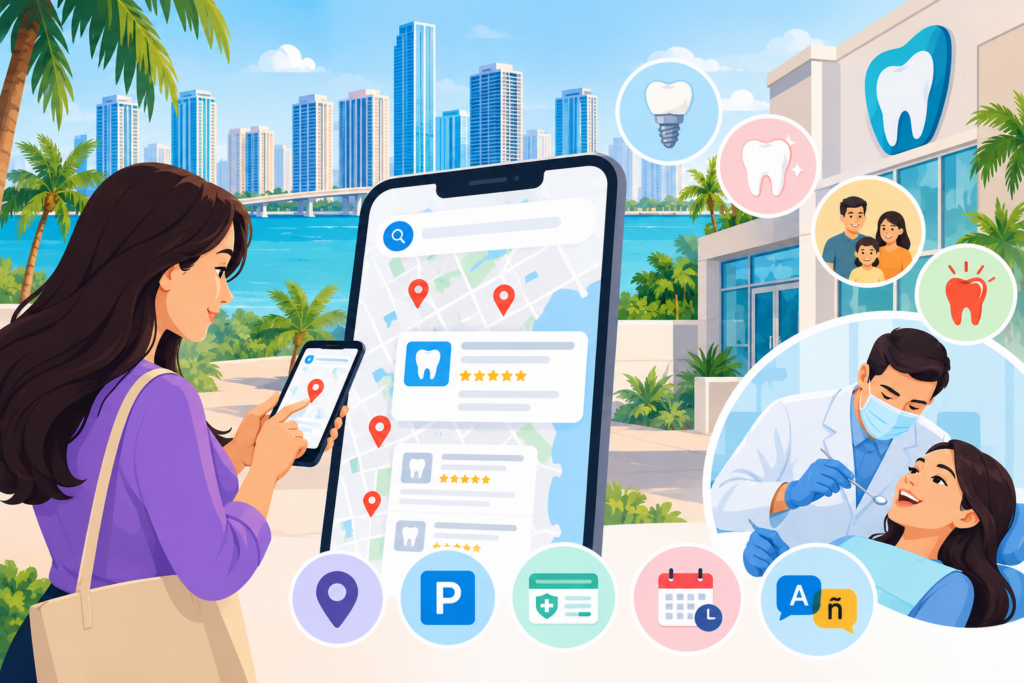
Most searches here fall into two buckets. The first is symptom-driven: “emergency dentist Tamarac,” “tooth pain dentist near me,” searched on a phone, often outside business hours, often by someone who wants to be seen today, not next week. The second is insurance-driven: “dentist that takes [plan name] Tamarac” or “dentist near me that accepts Medicaid.” Both are high intent, and both get answered by whichever page loads fastest and states insurance plainly, rather than the practice with the nicest website.
Tamarac is a dense, working, value-conscious city. Household budgets are watched closely, and a dental bill is a real expense, not an afterthought. That means price and insurance acceptance cannot sit behind a “contact us for details” wall. If a competitor’s page lists accepted plans, payment arrangements, and new-patient specials in plain text, and yours doesn’t, you lose that click before your office even gets the chance to explain financing options over the phone.
Mobile matters more here than almost anywhere else in the tri-county area. A large share of this search volume comes from phones on data connections, not home Wi-Fi, and Google’s own page experience data treats load speed as a ranking signal, not a nice-to-have. [EXTERNAL LINK: Google Search Central documentation on page experience and Core Web Vitals] A page that takes five seconds to load on a mid-range Android phone is a page that loses patients to the practice that loads in two, no matter how good the actual dentistry is.
Seasonality follows insurance cycles closely. Searches climb in the fourth quarter as patients rush to use benefits before plans reset, and again in January as new-year plans activate and deductibles restart. A practice that only markets steadily, without adjusting ad spend or content for those windows, leaves volume on the table twice a year. The practices that win in Tamarac treat these cycles as scheduled campaigns, not background noise, and build simple, fast, plan-specific landing pages well before each surge starts.
The competition here
Tamarac does not have the sheer density of dental offices you’d find along a major Fort Lauderdale corridor, but it has enough competition packed into a tight radius that the map pack is a real fight, not a formality. Most searches resolve through Google’s local three-pack before a user ever scrolls to organic results, which means your Google Business Profile, your review volume, and your proximity to the searcher often decide who gets the call before your website even comes into play. Practices sitting near University Drive, Commercial Boulevard, or the McNab corridor are often competing for the same handful of map pack slots, so small differences in profile completeness or review recency can swing visibility week to week.
Independent general and family practices dominate the Tamarac results, alongside a handful of multi-location groups with larger marketing budgets. The independents mostly compete on trust signals: reviews, photos, and how complete their profile looks. The groups compete on paid ads and volume, often running campaigns across several South Florida zip codes at once rather than focusing resources specifically on Tamarac. That split is an opening. A single well-run practice with a fast site, a complete profile, and consistent review generation can outperform a bigger group’s thin local page, because Google is matching intent and relevance, not company size. A profile with recent photos, accurate hours, and a steady trickle of new reviews often beats a competitor with ten times the ad spend but a stale listing.
Where it gets harder is organic ranking for broad terms like “dentist Tamarac.” That page competes against every practice in the city plus directory sites like Healthgrades and insurance-plan “find a dentist” tools, which rank well because they’re large, authoritative domains with far more backlinks than a single local practice will ever accumulate. Beating them outright on a generic term is a long game. Beating them on specific terms is realistic sooner, because fewer pages target that exact combination:
- A named insurance plan paired with Tamarac, where directory pages are often generic and out of date
- A specific procedure, like implants or Invisalign, paired with the city
- Neighborhood-level phrasing that broader directories rarely bother targeting at all

What we build for Dental Practices in this market
We start with the Google Business Profile, because in a market this map-pack-driven, an incomplete or stale profile is the single biggest reason a good practice loses visible rank to a worse one nearby. That means categories set correctly, services listed individually, photos current, and a review request process that runs without relying on the front desk to remember.
Then the website. We build an insurance page that names the plans you accept, not a vague “we accept most insurance” line, because that’s the exact phrase patients are typing into Google. We build separate pages for the procedures that drive calls here: emergency extractions, cleanings, crowns, dentures, and whatever else makes up your real volume. One page cannot rank for ten different procedure searches plus insurance searches plus the city name. Each page needs its own target.
Speed gets rebuilt from the ground up for this city specifically. That means compressed images, a hosting setup that doesn’t choke on mobile data connections, and a homepage that doesn’t load three tracking scripts before it loads the phone number. We test on actual mid-tier Android devices, not just a desktop browser, because that’s closer to what your patient is holding.
Call tracking sits underneath all of it, with a separate tracked number for Google Business Profile versus the website versus any paid campaign, so you can see which source is actually producing booked patients instead of guessing from a gut feeling about where the phone rang.
Local SEO
Improve relevant website content, location signals, internal links, and service information to support local search visibility.
Google Business Profile
Review profile accuracy, categories, services, contact details, and other eligible information. Changes should follow Google's Business Profile guidelines.
Treatment pages
Build or improve pages for services such as general dentistry, cosmetic treatments, implants, or emergency appointments when those services are offered.
Paid search campaigns
Target relevant searches, refine location settings, and review search terms to reduce spend on enquiries that do not match the practice.
Conversion tracking
Measure available actions such as appointment-form submissions, calls, and clicks on booking links.
Website improvements
Make service information, insurance details, contact options, and booking steps easier to find on desktop and mobile.
What we measure
- Call volume by source — Google Business Profile, organic site traffic, and paid ads tracked with separate numbers, so you know which channel a call came from before anyone picks up.
- New-patient form and call conversion rate — how many site visitors actually contact the office, broken out by page, so we can see whether the insurance page or the procedure page is doing the work.
- Map pack position for core terms — tracked for the specific searches that matter in Tamarac, not a vanity basket of keywords nobody searches.
- Page load speed on mobile — checked against Core Web Vitals thresholds on an ongoing basis, since this is the metric most likely to quietly erode rank if ignored.
- Review count and rate — tracked monthly, since review velocity is a visible, ongoing input to map pack ranking, not a one-time task.

What it costs
Price is the first question in a market like Tamarac, so we’d rather answer it here than make you call to find out. Dental marketing isn’t one flat fee — an insurance-heavy general practice with ten procedure pages needs more build work than a single-doctor office competing mainly on map pack presence. Costs depend on how many service pages you need, how competitive your procedures and insurance terms are, and whether paid ads run alongside SEO.
- Organic search visibility and relevant website visits.
- Google Business Profile interactions and available performance data.
- Paid campaign clicks, search terms, and advertising costs.
- Tracked calls, appointment-form submissions, and booking actions.
- Enquiry quality, where the practice can reliably share and categorize that information.
- Changes made, issues identified, and recommended next steps.
Serving practices across Tamarac and nearby Broward neighborhoods
We work with dental practices throughout Tamarac, from the corridor along McNab Road to the neighborhoods closer to the Sawgrass area, as well as nearby parts of Broward County, including North Lauderdale, Coconut Creek, and Lauderhill.

Why insurance pages matter more here than the homepage
In a value-conscious city like Tamarac, the insurance page often gets more traffic than the homepage, because it answers the question that decides whether someone calls at all. A visitor who can’t find their plan listed in ten seconds leaves and checks the next practice instead. We treat that page as a primary landing page, not a footer link buried behind “About Us,” and we update it the moment your accepted plans change, not months later.
- Plans listed in plain language, no insurer jargon or ambiguous “in-network” claims
- Clear notes on PPO, HMO, Medicaid, and cash-pay or membership plan options
- Direct links from Google Business Profile and ads straight to this page, skipping the homepage entirely
That structure shortens the path from search to scheduled appointment considerably.
FAQ's
These are the 6 questions Tamarac homeowners ask us most about dental practice marketing, answered plainly so you know what to expect before any work starts. If yours isn't covered here, get in touch and we'll walk you through it.
How long does it take to see movement in Tamarac dental searches?
It depends on your starting point. A Google Business Profile fix can shift map pack visibility within weeks. Organic ranking for competitive procedure and insurance terms takes longer, and we won't put a specific timeframe on it because it depends on how established your competitors already are.
Do you guarantee a ranking position?
No. No agency can honestly guarantee a specific ranking or a traffic number, and we won't tell you otherwise. We can describe the work in detail and show you what we're measuring along the way.
Can you list our insurance plans on the website?
Yes, and we recommend it. In a market like Tamarac, patients search by plan name plus city. A clear, current insurance page is one of the highest-value pages on a dental site here.
We already have a website. Do we need a new one?
Not always. Sometimes the existing site just needs new procedure pages, a faster host, and a fixed Google Business Profile. We'll tell you honestly if a rebuild isn't necessary.
Do you work with single-doctor practices or only larger groups?
Both. The approach differs: a single-doctor practice usually leans harder on map pack presence and reviews, while a multi-location group needs separate location pages built out for each office.
What does this cost?
Why we build this for dental practices specifically
We’ve built the industry hub page on dental marketing because the mechanics of patient acquisition don’t change much from city to city, but the competitive math does. Tamarac’s mix of independent practices, multi-location groups, and insurance-plan directories is different from a wealthier or less dense market, and a generic SEO package built for a different kind of business misses the insurance-page priority and the mobile-speed urgency that actually move the needle here. We also work alongside the broader Tamarac marketing work we do for other local business types, which means we already understand the local search landscape before we touch your account.