
- Home
- Services
- Portfolio
- About
- Service AreasFort Lauderdale, FL
- Web Design
- Redesign
- WordPress
- Ecommerce
- Landing Pages
- SEO Services
- Local SEO
- GBP
- Google Ads
- PPC
- Digital Marketing
- Internet Marketing
- Advertising
- Tracking
- Dental Marketing
- Medical Marketing
- HVAC Marketing
- Roofing Marketing
- Pest Control Marketing
- Home Services Marketing
- Plumbing Marketing
- Electrical Marketing
- Landscaping Marketing
- Remodeling Marketing
Pembroke Pines, FL- Web Design
- Redesign
- WordPress
- Ecommerce
- Landing Pages
- SEO Services
- Local SEO
- GBP
- Google Ads
- PPC
- Digital Marketing
- Internet Marketing
- Advertising
- Tracking
- Dental Marketing
- Medical Marketing
- HVAC Marketing
- Roofing Marketing
- Pest Control Marketing
- Home Services Marketing
- Plumbing Marketing
- Electrical Marketing
- Landscaping Marketing
- Remodeling Marketing
Hialeah, FL- Web Design
- Redesign
- WordPress
- Ecommerce
- Landing Pages
- SEO Services
- Local SEO
- GBP
- Google Ads
- PPC
- Digital Marketing
- Internet Marketing
- Advertising
- Tracking
- Dental Marketing
- Medical Marketing
- HVAC Marketing
- Roofing Marketing
- Pest Control Marketing
- Home Services Marketing
- Plumbing Marketing
- Electrical Marketing
- Landscaping Marketing
- Remodeling Marketing
Hollywood, FL- Web Design
- Redesign
- WordPress
- Ecommerce
- Landing Pages
- SEO Services
- Local SEO
- GBP
- Google Ads
- PPC
- Digital Marketing
- Internet Marketing
- Advertising
- Tracking
- Dental Marketing
- Medical Marketing
- HVAC Marketing
- Roofing Marketing
- Pest Control Marketing
- Home Services Marketing
- Plumbing Marketing
- Electrical Marketing
- Landscaping Marketing
- Remodeling Marketing
Miramar, FL- Web Design
- Redesign
- WordPress
- Ecommerce
- Landing Pages
- SEO Services
- Local SEO
- GBP
- Google Ads
- PPC
- Digital Marketing
- Internet Marketing
- Advertising
- Tracking
- Dental Marketing
- Medical Marketing
- HVAC Marketing
- Roofing Marketing
- Pest Control Marketing
- Home Services Marketing
- Plumbing Marketing
- Electrical Marketing
- Landscaping Marketing
- Remodeling Marketing
Coral Springs, FL- Web Design
- Redesign
- WordPress
- Ecommerce
- Landing Pages
- SEO Services
- Local SEO
- GBP
- Google Ads
- PPC
- Digital Marketing
- Internet Marketing
- Advertising
- Tracking
- Dental Marketing
- Medical Marketing
- HVAC Marketing
- Roofing Marketing
- Pest Control Marketing
- Home Services Marketing
- Plumbing Marketing
- Electrical Marketing
- Landscaping Marketing
- Remodeling Marketing
Pompano Beach, FL- Web Design
- Redesign
- WordPress
- Ecommerce
- Landing Pages
- SEO Services
- Local SEO
- GBP
- Google Ads
- PPC
- Digital Marketing
- Internet Marketing
- Advertising
- Tracking
- Dental Marketing
- Medical Marketing
- HVAC Marketing
- Roofing Marketing
- Pest Control Marketing
- Home Services Marketing
- Plumbing Marketing
- Electrical Marketing
- Landscaping Marketing
- Remodeling Marketing
Davie, FL- Web Design
- Redesign
- WordPress
- Ecommerce
- Landing Pages
- SEO Services
- Local SEO
- GBP
- Google Ads
- PPC
- Digital Marketing
- Internet Marketing
- Advertising
- Tracking
- Dental Marketing
- Medical Marketing
- HVAC Marketing
- Roofing Marketing
- Pest Control Marketing
- Home Services Marketing
- Plumbing Marketing
- Electrical Marketing
- Landscaping Marketing
- Remodeling Marketing
Sunrise, FL- Web Design
- Redesign
- WordPress
- Ecommerce
- Landing Pages
- SEO Services
- Local SEO
- GBP
- Google Ads
- PPC
- Digital Marketing
- Internet Marketing
- Advertising
- Tracking
- Dental Marketing
- Medical Marketing
- HVAC Marketing
- Roofing Marketing
- Pest Control Marketing
- Home Services Marketing
- Plumbing Marketing
- Electrical Marketing
- Landscaping Marketing
- Remodeling Marketing
Plantation, FL- Web Design
- Redesign
- WordPress
- Ecommerce
- Landing Pages
- SEO Services
- Local SEO
- GBP
- Google Ads
- PPC
- Digital Marketing
- Internet Marketing
- Advertising
- Tracking
- Dental Marketing
- Medical Marketing
- HVAC Marketing
- Roofing Marketing
- Pest Control Marketing
- Home Services Marketing
- Plumbing Marketing
- Electrical Marketing
- Landscaping Marketing
- Remodeling Marketing
Deerfield Beach, FL- Web Design
- Redesign
- WordPress
- Ecommerce
- Landing Pages
- SEO Services
- Local SEO
- GBP
- Google Ads
- PPC
- Digital Marketing
- Internet Marketing
- Advertising
- Tracking
- Dental Marketing
- Medical Marketing
- HVAC Marketing
- Roofing Marketing
- Pest Control Marketing
- Home Services Marketing
- Plumbing Marketing
- Electrical Marketing
- Landscaping Marketing
- Remodeling Marketing
Miami Gardens, FL- Web Design
- Redesign
- WordPress
- Ecommerce
- Landing Pages
- SEO Services
- Local SEO
- GBP
- Google Ads
- PPC
- Digital Marketing
- Internet Marketing
- Advertising
- Tracking
- Dental Marketing
- Medical Marketing
- HVAC Marketing
- Roofing Marketing
- Pest Control Marketing
- Home Services Marketing
- Plumbing Marketing
- Electrical Marketing
- Landscaping Marketing
- Remodeling Marketing
Lauderhill, FL- Web Design
- Redesign
- WordPress
- Ecommerce
- Landing Pages
- SEO Services
- Local SEO
- GBP
- Google Ads
- PPC
- Digital Marketing
- Internet Marketing
- Advertising
- Tracking
- Dental Marketing
- Medical Marketing
- HVAC Marketing
- Roofing Marketing
- Pest Control Marketing
- Home Services Marketing
- Plumbing Marketing
- Electrical Marketing
- Landscaping Marketing
- Remodeling Marketing
West Palm Beach, FL- Web Design
- Redesign
- WordPress
- Ecommerce
- Landing Pages
- SEO Services
- Local SEO
- GBP
- Google Ads
- PPC
- Digital Marketing
- Internet Marketing
- Advertising
- Tracking
- Dental Marketing
- Medical Marketing
- HVAC Marketing
- Roofing Marketing
- Pest Control Marketing
- Home Services Marketing
- Plumbing Marketing
- Electrical Marketing
- Landscaping Marketing
- Remodeling Marketing
Tamarac, FL- Web Design
- Redesign
- WordPress
- Ecommerce
- Landing Pages
- SEO Services
- Local SEO
- GBP
- Google Ads
- PPC
- Digital Marketing
- Internet Marketing
- Advertising
- Tracking
- Dental Marketing
- Medical Marketing
- HVAC Marketing
- Roofing Marketing
- Pest Control Marketing
- Home Services Marketing
- Plumbing Marketing
- Electrical Marketing
- Landscaping Marketing
- Remodeling Marketing
Weston, FL- Web Design
- Redesign
- WordPress
- Ecommerce
- Landing Pages
- SEO Services
- Local SEO
- GBP
- Google Ads
- PPC
- Digital Marketing
- Internet Marketing
- Advertising
- Tracking
- Dental Marketing
- Medical Marketing
- HVAC Marketing
- Roofing Marketing
- Pest Control Marketing
- Home Services Marketing
- Plumbing Marketing
- Electrical Marketing
- Landscaping Marketing
- Remodeling Marketing
Boca Raton, FLMargate, FLCoconut Creek, FLMiami Beach, FLHomestead, FLKendall, FLDoral, FLBoynton Beach, FLThe Hammocks, FLNorth Lauderdale, FLOakland Park, FLDelray Beach, FLNorth Miami, FLHallandale Beach, FLFontainebleau, FLKendale Lakes, FLWellington, FLJupiter, FLTamiami, FLPalm Beach Gardens, FLLauderdale Lakes, FLCooper City, FLCountry Club, FLParkland, FLCoral Gables, FLDania Beach, FLCutler Bay, FLNorth Miami Beach, FLGreenacres, FLLake Worth Beach, FLPrinceton, FLRoyal Palm Beach, FLSouth Miami Heights, FLRichmond West, FLRiviera Beach, FLWest Little River, FLGolden Glades, FLAventura, FLMiami Lakes, FLWestchester, FLLeisure City, FLCoral Terrace, FLPalm Springs, FLPalmetto Bay, FLHialeah Gardens, FLSunny Isles Beach, FLIves Estates, FLWest Park, FLSweetwater, FLPinecrest, FLSunset, FLPinewood, FLWilton Manors, FLOpa-locka, FLLighthouse Point, FLBelle Glade, FLNaranja, FLPalmetto Estates, FLBrownsville, FLKey Biscayne, FLOlympia Heights, FLMiami Springs, FLFlorida City, FLSouth Miami, FLThree Lakes, FLGladeview, FLNorth Palm Beach, FLMiami Shores, FLSouthwest Ranches, FLKings Point, FLLauderdale-by-the-Sea, FLHillsboro Beach, FLSea Ranch Lakes, FLLazy Lake, FL - Blog
- Contact
Marketing for Medical Practices in Hialeah, Florida
How Hialeah Medical Practices buyers search
Most patients in Hialeah don’t search the way a textbook assumes. A lot of them search in Spanish, some switch between Spanish and English in the same session, and many search by neighborhood rather than by “Hialeah” as a whole – Palm Springs North, West Hialeah, Hialeah Gardens, areas near Okeechobee Road or Hialeah Hospital. A query might be “doctor que hable espanol cerca de mi” right next to “primary care doctor near me” from the same household, sometimes within minutes of each other.

The competition here
Hialeah has a dense concentration of independent clinics, urgent cares, and specialist offices, many of them family owned and run out of small strip-mall suites rather than big medical campuses. That matters for two reasons. First, the map pack is crowded in almost every category – internal medicine, pediatrics, OB-GYN, dermatology, podiatry – because there are simply a lot of small practices competing for the same three-mile radius around Hialeah Hospital, Palm Springs, or West 49th Street. Second, a good number of these competitors have thin or outdated websites – a homepage, a phone number, maybe a stock photo of a stethoscope – which is an opening if yours is built correctly with real content, real reviews, and a technically sound site underneath it.
We’re not going to tell you the market is easy to win. It isn’t. But it isn’t uniformly hard either. Organic search for broad terms like “doctor in Hialeah” is dominated by directories, insurance networks, and large hospital systems with budgets no independent practice can match on a keyword-for-keyword basis. Organic search for specific, local, bilingual terms – a named condition plus neighborhood plus language, like a Spanish-language search for a pediatrician near Hialeah Gardens, or an urgent care open on Sunday near Westland Mall – has far less serious competition. That’s usually where an independent practice has the best shot, not in the broad term.
The other layer worth understanding is reputation. Patients here rely heavily on word of mouth and on Google reviews before they ever call, and many search in Spanish first. A practice with twenty genuine, recent reviews and a bilingual site routinely outperforms a competitor with a bigger ad budget but a thin, English-only web presence and a stale review profile. We look at:
- Which specific services and conditions local competitors rank for, and which they’ve left uncontested
- Where their review volume, recency, and language coverage fall short
- Which neighborhoods and search terms are genuinely winnable versus crowded past the point of quick return
What we build for Medical Practices in this market
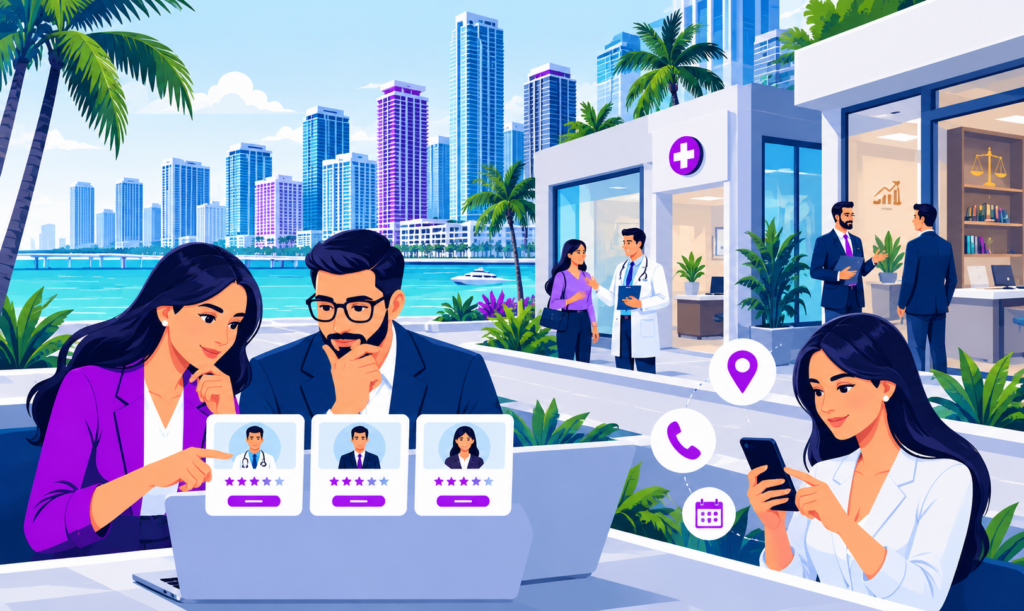
A medical practice website is not a restaurant website. It’s a YMYL site in Google’s own classification – Your Money or Your Life – which means Google holds it to a higher bar for trust signals before it will rank the page at all. That changes what we build, in concrete ways, not as a slogan.
Provider bios with real credentials. Each doctor, PA, or nurse practitioner gets a bio page with their degree, residency, board certification, languages spoken, and years in practice if you want that listed. Google’s quality guidelines for YMYL content specifically look for this kind of author and expertise information before trusting medical pages, and a bio page with nothing but a headshot and “compassionate care” does not meet that bar.
A page per service, per location, if you have more than one office. If you run a pediatrics practice with a location in Hialeah and another in Hialeah Lakes, one combined “our services” page cannot rank for both. Each location needs its own page with its own address, phone, hours, and the specific services offered at that address, because Google ranks pages for a location, not a brand name.
HIPAA-safe forms, actually configured that way. A standard contact form plugin is not HIPAA compliant out of the box, and a lot of medical websites we’ve reviewed are running appointment request forms that email patient information in plain text. We set up intake and appointment forms so patient information is handled through a secure, access-controlled path instead of landing in an open inbox, and we document what data each form collects so your compliance officer or counsel can review it rather than take our word for it.
A Spanish-language layer, not a full site translation. For Hialeah specifically, we don’t recommend translating the entire site into Spanish as a checkbox exercise. Machine-translated medical content is a liability – a mistranslated symptom description or dosage note is a real risk, not a style issue. Instead we build a Spanish layer: the pages that actually drive calls – your homepage, your top two or three service pages, your contact and appointment page, your insurance page – written in Spanish by a person, with its own metadata and its own Google Business Profile content in Spanish, sitting alongside the English version. That layer targets the share of local search that happens entirely in Spanish, which in Hialeah is a meaningful share, without committing you to maintaining two full websites forever.
Review and reputation handling that respects patient privacy. You can’t ask a patient to confirm their diagnosis in a public review, and you shouldn’t want to. We set up review requests that ask about the experience – wait time, staff, ease of scheduling – not the medical outcome, and we train front-desk staff on what to send and when, since timing right after a visit matters more than any script.
Call tracking tied to the right line. A medical practice usually has more than one phone number in play – a main line, a line for a specific provider, sometimes a separate line for a second location. We assign tracked numbers so you can see which page, which ad, and which search term produced a call, and we keep that data in a dashboard you can check yourself instead of waiting on a monthly PDF.
None of this is exotic. It’s the specific list of things a medical website needs to meet Google’s trust bar and your compliance obligations at the same time, built for a market where a real share of your patients are reading it in Spanish.
What we measure
We track calls by source, form submissions by page, and new-patient appointment requests where your scheduling system allows it to be tied back to a channel. We separate branded search (people already looking for your practice by name) from non-branded search (people looking for a type of doctor or a condition), because conflating the two hides whether new marketing is actually bringing in new patients or just capturing people who were calling you anyway.
Legal and professional services
Explain practice areas, relevant experience, service locations, and consultation options. Organize pages around the specific services potential clients search for.
Medical and healthcare practices
Make treatment information, provider details, location information, and appointment options easy to find. Review health-related claims carefully.
Financial services
Present services, qualifications, and contact pathways clearly while respecting applicable advertising and compliance requirements.
Technology and business services
Explain complex offerings in plain language, demonstrate practical value, and create landing pages for distinct solutions.
Local service businesses
Build relevant service and location pages, improve Google Business Profile information, and make calls and enquiry forms easy to use.
What it costs
Medical practice marketing in Hialeah is priced around three things: how many locations you have, whether you need the Spanish-language layer built and maintained, and whether you’re running paid search alongside the website and SEO work. A single-location practice with one provider costs less to build for than a four-location group with a dozen providers, each needing their own bio and location page. We’ll give you a number after we see your current site and your locations, not before – ask us for a free estimate and we’ll walk through it with you.
Why family-owned and multi-location practices need different builds
A solo-provider family practice in Hialeah and a four-location urgent care group are not the same build. The solo practice needs one strong set of pages, local trust signals for the neighborhood, and a clean path to “call us” or “book now.” The multi-location group needs separate, non-duplicate pages per address, consistent provider bios across locations, location-specific schema so each office ranks on its own, and a phone system that tells you which office is actually generating the call.
We size the build to match the practice, not a template. A bigger group isn’t just “the same thing times four” – it’s a different information structure from the start: separate location pages instead of one generic “locations” tab, navigation that gets a patient to the right office fast, and reporting that credits each site for its own leads.

Wholesale and logistics employers shape the patient base
Hialeah’s economy leans heavily on wholesale, logistics, and light industrial work. That shapes patient scheduling – shift workers need early, late, or weekend appointment slots, and they search for that specifically: “doctor open Saturday near me” or “clinica abierta los sabados.” If your hours and scheduling flexibility aren’t stated plainly on the page Google shows for that search, you lose the click to a competitor who did say it.
These patients also tend to book fast, often from a phone during a break at a warehouse or distribution center, so a page that loads slowly or buries hours in a PDF costs you appointments. Many searches happen in Spanish first, so bilingual staff, bilingual intake forms, and a Spanish-language version of your scheduling page aren’t a nice extra here – they’re table stakes for capturing the local audience your competitors are already chasing.

Seasonality is milder here than you'd think
Primary care and family medicine in Hialeah don’t swing as hard seasonally as, say, a dermatology practice built around sun damage further north. The steadier pattern is back-to-school physicals in August, a bump around open enrollment season for insurance-related questions in the fall, and flu season pushing through winter into early spring. Pediatric and urgent care practices also see a predictable lift around South Florida’s school calendar breaks and summer camp physical requirements, which gives us a reliable window to plan around each year.
Rather than running the same generic campaign year-round, we plan content and ad budget around those actual windows: physical-exam reminders before school starts, plain-language insurance guidance during enrollment, and flu-shot messaging timed to when Hialeah patients are actually searching. That means your marketing dollars work harder during the weeks that matter most, instead of being spread evenly across months with little search demand.
FAQ's
These are the 6 questions Hialeah homeowners ask us most about medical practice marketing, answered plainly so you know what to expect before any work starts. If yours isn't covered here, get in touch and we'll walk you through it.
Do you translate our whole medical website into Spanish?
Usually not the whole site. For Hialeah we recommend a Spanish-language layer covering the pages that drive calls – homepage, top service pages, appointment and insurance pages – written by a person, not machine-translated. A mistranslated medical page is a real risk, so we keep the scope tight and accurate rather than broad and rushed.
Is our patient intake form actually HIPAA compliant?
A standard contact form plugin typically is not, out of the box. We configure intake and appointment forms so patient data moves through a secure, access-controlled path, and we document what each form collects so your compliance officer or legal counsel can verify it directly.
How do you handle multiple office locations?
Each location gets its own page with its own address, phone number, hours, and services, because Google ranks pages to a specific location rather than to a brand name. Provider bios stay consistent across locations but each office page stands on its own.
Can you guarantee we'll rank above other Hialeah practices?
No. No one can honestly guarantee a ranking position, and you should be skeptical of anyone who does. We can tell you what we're building, why, and what we track, and we check in on actual progress rather than a promised number.
What do provider credentials have to do with SEO?
Google treats medical content as Your Money or Your Life content and holds it to a higher trust bar. Bio pages with real degrees, board certification, and languages spoken are part of what Google's own quality guidance looks for before trusting a medical page enough to rank it.