
- Home
- Services
- Portfolio
- About
- Service AreasFort Lauderdale, FL
- Web Design
- Redesign
- WordPress
- Ecommerce
- Landing Pages
- SEO Services
- Local SEO
- GBP
- Google Ads
- PPC
- Digital Marketing
- Internet Marketing
- Advertising
- Tracking
- Dental Marketing
- Medical Marketing
- HVAC Marketing
- Roofing Marketing
- Pest Control Marketing
- Home Services Marketing
- Plumbing Marketing
- Electrical Marketing
- Landscaping Marketing
- Remodeling Marketing
Pembroke Pines, FL- Web Design
- Redesign
- WordPress
- Ecommerce
- Landing Pages
- SEO Services
- Local SEO
- GBP
- Google Ads
- PPC
- Digital Marketing
- Internet Marketing
- Advertising
- Tracking
- Dental Marketing
- Medical Marketing
- HVAC Marketing
- Roofing Marketing
- Pest Control Marketing
- Home Services Marketing
- Plumbing Marketing
- Electrical Marketing
- Landscaping Marketing
- Remodeling Marketing
Hialeah, FL- Web Design
- Redesign
- WordPress
- Ecommerce
- Landing Pages
- SEO Services
- Local SEO
- GBP
- Google Ads
- PPC
- Digital Marketing
- Internet Marketing
- Advertising
- Tracking
- Dental Marketing
- Medical Marketing
- HVAC Marketing
- Roofing Marketing
- Pest Control Marketing
- Home Services Marketing
- Plumbing Marketing
- Electrical Marketing
- Landscaping Marketing
- Remodeling Marketing
Hollywood, FL- Web Design
- Redesign
- WordPress
- Ecommerce
- Landing Pages
- SEO Services
- Local SEO
- GBP
- Google Ads
- PPC
- Digital Marketing
- Internet Marketing
- Advertising
- Tracking
- Dental Marketing
- Medical Marketing
- HVAC Marketing
- Roofing Marketing
- Pest Control Marketing
- Home Services Marketing
- Plumbing Marketing
- Electrical Marketing
- Landscaping Marketing
- Remodeling Marketing
Miramar, FL- Web Design
- Redesign
- WordPress
- Ecommerce
- Landing Pages
- SEO Services
- Local SEO
- GBP
- Google Ads
- PPC
- Digital Marketing
- Internet Marketing
- Advertising
- Tracking
- Dental Marketing
- Medical Marketing
- HVAC Marketing
- Roofing Marketing
- Pest Control Marketing
- Home Services Marketing
- Plumbing Marketing
- Electrical Marketing
- Landscaping Marketing
- Remodeling Marketing
Coral Springs, FL- Web Design
- Redesign
- WordPress
- Ecommerce
- Landing Pages
- SEO Services
- Local SEO
- GBP
- Google Ads
- PPC
- Digital Marketing
- Internet Marketing
- Advertising
- Tracking
- Dental Marketing
- Medical Marketing
- HVAC Marketing
- Roofing Marketing
- Pest Control Marketing
- Home Services Marketing
- Plumbing Marketing
- Electrical Marketing
- Landscaping Marketing
- Remodeling Marketing
Pompano Beach, FL- Web Design
- Redesign
- WordPress
- Ecommerce
- Landing Pages
- SEO Services
- Local SEO
- GBP
- Google Ads
- PPC
- Digital Marketing
- Internet Marketing
- Advertising
- Tracking
- Dental Marketing
- Medical Marketing
- HVAC Marketing
- Roofing Marketing
- Pest Control Marketing
- Home Services Marketing
- Plumbing Marketing
- Electrical Marketing
- Landscaping Marketing
- Remodeling Marketing
Davie, FL- Web Design
- Redesign
- WordPress
- Ecommerce
- Landing Pages
- SEO Services
- Local SEO
- GBP
- Google Ads
- PPC
- Digital Marketing
- Internet Marketing
- Advertising
- Tracking
- Dental Marketing
- Medical Marketing
- HVAC Marketing
- Roofing Marketing
- Pest Control Marketing
- Home Services Marketing
- Plumbing Marketing
- Electrical Marketing
- Landscaping Marketing
- Remodeling Marketing
Sunrise, FL- Web Design
- Redesign
- WordPress
- Ecommerce
- Landing Pages
- SEO Services
- Local SEO
- GBP
- Google Ads
- PPC
- Digital Marketing
- Internet Marketing
- Advertising
- Tracking
- Dental Marketing
- Medical Marketing
- HVAC Marketing
- Roofing Marketing
- Pest Control Marketing
- Home Services Marketing
- Plumbing Marketing
- Electrical Marketing
- Landscaping Marketing
- Remodeling Marketing
Plantation, FL- Web Design
- Redesign
- WordPress
- Ecommerce
- Landing Pages
- SEO Services
- Local SEO
- GBP
- Google Ads
- PPC
- Digital Marketing
- Internet Marketing
- Advertising
- Tracking
- Dental Marketing
- Medical Marketing
- HVAC Marketing
- Roofing Marketing
- Pest Control Marketing
- Home Services Marketing
- Plumbing Marketing
- Electrical Marketing
- Landscaping Marketing
- Remodeling Marketing
Deerfield Beach, FL- Web Design
- Redesign
- WordPress
- Ecommerce
- Landing Pages
- SEO Services
- Local SEO
- GBP
- Google Ads
- PPC
- Digital Marketing
- Internet Marketing
- Advertising
- Tracking
- Dental Marketing
- Medical Marketing
- HVAC Marketing
- Roofing Marketing
- Pest Control Marketing
- Home Services Marketing
- Plumbing Marketing
- Electrical Marketing
- Landscaping Marketing
- Remodeling Marketing
Miami Gardens, FL- Web Design
- Redesign
- WordPress
- Ecommerce
- Landing Pages
- SEO Services
- Local SEO
- GBP
- Google Ads
- PPC
- Digital Marketing
- Internet Marketing
- Advertising
- Tracking
- Dental Marketing
- Medical Marketing
- HVAC Marketing
- Roofing Marketing
- Pest Control Marketing
- Home Services Marketing
- Plumbing Marketing
- Electrical Marketing
- Landscaping Marketing
- Remodeling Marketing
Lauderhill, FL- Web Design
- Redesign
- WordPress
- Ecommerce
- Landing Pages
- SEO Services
- Local SEO
- GBP
- Google Ads
- PPC
- Digital Marketing
- Internet Marketing
- Advertising
- Tracking
- Dental Marketing
- Medical Marketing
- HVAC Marketing
- Roofing Marketing
- Pest Control Marketing
- Home Services Marketing
- Plumbing Marketing
- Electrical Marketing
- Landscaping Marketing
- Remodeling Marketing
West Palm Beach, FL- Web Design
- Redesign
- WordPress
- Ecommerce
- Landing Pages
- SEO Services
- Local SEO
- GBP
- Google Ads
- PPC
- Digital Marketing
- Internet Marketing
- Advertising
- Tracking
- Dental Marketing
- Medical Marketing
- HVAC Marketing
- Roofing Marketing
- Pest Control Marketing
- Home Services Marketing
- Plumbing Marketing
- Electrical Marketing
- Landscaping Marketing
- Remodeling Marketing
Tamarac, FL- Web Design
- Redesign
- WordPress
- Ecommerce
- Landing Pages
- SEO Services
- Local SEO
- GBP
- Google Ads
- PPC
- Digital Marketing
- Internet Marketing
- Advertising
- Tracking
- Dental Marketing
- Medical Marketing
- HVAC Marketing
- Roofing Marketing
- Pest Control Marketing
- Home Services Marketing
- Plumbing Marketing
- Electrical Marketing
- Landscaping Marketing
- Remodeling Marketing
Weston, FL- Web Design
- Redesign
- WordPress
- Ecommerce
- Landing Pages
- SEO Services
- Local SEO
- GBP
- Google Ads
- PPC
- Digital Marketing
- Internet Marketing
- Advertising
- Tracking
- Dental Marketing
- Medical Marketing
- HVAC Marketing
- Roofing Marketing
- Pest Control Marketing
- Home Services Marketing
- Plumbing Marketing
- Electrical Marketing
- Landscaping Marketing
- Remodeling Marketing
Boca Raton, FLMargate, FLCoconut Creek, FLMiami Beach, FLHomestead, FLKendall, FLDoral, FLBoynton Beach, FLThe Hammocks, FLNorth Lauderdale, FLOakland Park, FLDelray Beach, FLNorth Miami, FLHallandale Beach, FLFontainebleau, FLKendale Lakes, FLWellington, FLJupiter, FLTamiami, FLPalm Beach Gardens, FLLauderdale Lakes, FLCooper City, FLCountry Club, FLParkland, FLCoral Gables, FLDania Beach, FLCutler Bay, FLNorth Miami Beach, FLGreenacres, FLLake Worth Beach, FLPrinceton, FLRoyal Palm Beach, FLSouth Miami Heights, FLRichmond West, FLRiviera Beach, FLWest Little River, FLGolden Glades, FLAventura, FLMiami Lakes, FLWestchester, FLLeisure City, FLCoral Terrace, FLPalm Springs, FLPalmetto Bay, FLHialeah Gardens, FLSunny Isles Beach, FLIves Estates, FLWest Park, FLSweetwater, FLPinecrest, FLSunset, FLPinewood, FLWilton Manors, FLOpa-locka, FLLighthouse Point, FLBelle Glade, FLNaranja, FLPalmetto Estates, FLBrownsville, FLKey Biscayne, FLOlympia Heights, FLMiami Springs, FLFlorida City, FLSouth Miami, FLThree Lakes, FLGladeview, FLNorth Palm Beach, FLMiami Shores, FLSouthwest Ranches, FLKings Point, FLLauderdale-by-the-Sea, FLHillsboro Beach, FLSea Ranch Lakes, FLLazy Lake, FL - Blog
- Contact
Marketing for Medical Practices in Coral Springs, Florida
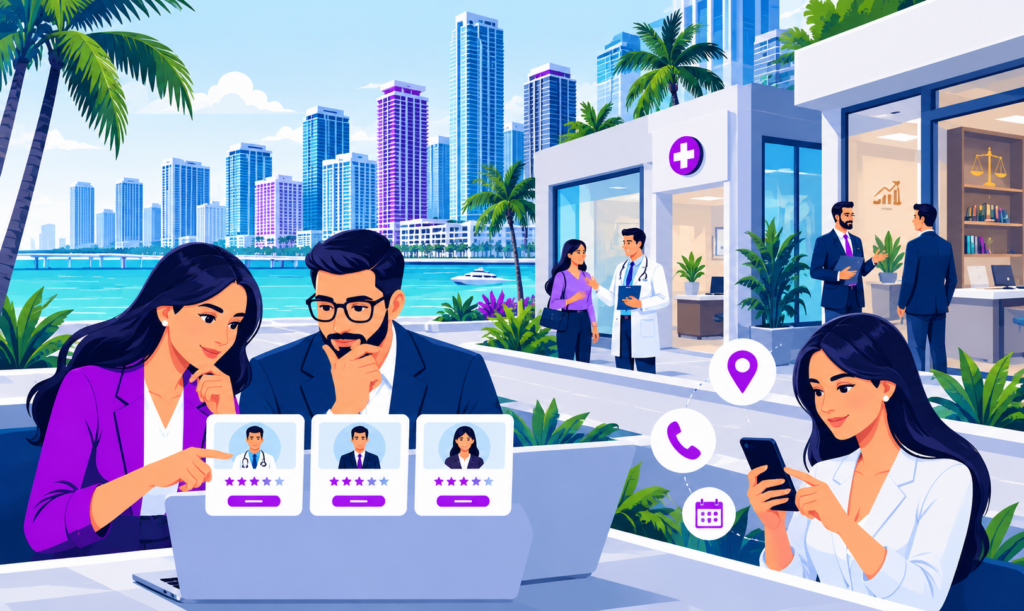
Coral Springs grew up around planned developments, not a downtown medical corridor. Most practices here are not working against a handful of storefront competitors within walking distance. They are working against every practice a resident will consider inside a 15-20 minute drive, because that is how people in HOA-governed, subdivision-style neighborhoods actually choose a provider: they search from home, compare a few names, and call.
That changes what matters. A practice’s Google Business Profile, its reviews, and its provider pages carry more weight than they would in a denser city with foot traffic. A website that reads like a brochure loses to one that answers the actual questions a new patient types into Google at 9pm: is this doctor taking new patients, do they accept my insurance, can I book without calling.
We build medical marketing for practices in this market around that reality, not around a generic template pulled from a different city.

How Coral Springs medical practice buyers search
Searches here cluster around a few patterns worth naming directly, because each one needs a different page or a different setting in your ad account rather than a one-size-fits-all homepage.
“[condition/specialty] near me” and “[specialty] Coral Springs” – these trigger the map pack first, organic results second. If your Google Business Profile is thin, unverified, or carries the wrong primary category, you are invisible before a searcher ever reaches your website, no matter how good that website is.
“[specialty] that accepts [insurance]” – a huge share of medical searches include an insurance name, often paired with a plan type. If that information is buried in a PDF, listed only over the phone, or missing from your site entirely, you lose the click to a competitor who put it directly on the page in plain text.
“Dr. [Name] reviews” – branded searches on individual providers, not just the practice name. Patients research the person, not just the clinic, which means provider bio pages are not optional content, they are a ranking and conversion asset that deserves real photos, credentials, and patient-facing language.
Seasonality shows up too. Searches for pediatric, urgent care, and physical therapy services shift around the school calendar and snowbird season, when the part-time resident population in Broward County grows noticeably. A campaign built for July behaves differently than one built for January, and budgets, keywords, and even ad copy should move with it rather than sit flat all year.
Because so much of Coral Springs is residential and service-area in nature rather than retail or tourist-driven, people also search with more trust signals attached: “best,” “top rated,” “with good reviews,” “accepting new patients.” A practice with eleven reviews is competing against one with two hundred, and the review count itself becomes a ranking and conversion factor, not just a reputation nicety. Practices that systematically ask satisfied patients for reviews, respond to every one, and surface testimonials on key pages consistently outperform practices that treat reviews as an afterthought, regardless of which has the stronger clinical reputation offline.
The competition here
An honest read of this market: Coral Springs sits inside a dense medical corridor that includes Coral Springs itself plus nearby Parkland, Margate, Coconut Creek, and the northern edge of Tamarac. Primary care, dermatology, dental, and physical therapy are particularly crowded categories here, with established multi-location groups holding a lot of the map pack real estate.
That does not mean a smaller or newer practice cannot compete. It means the competition is not won on volume of content alone. We have seen single-location practices outrank larger groups on specific, well-built provider and procedure pages, because the larger group’s site was built once and never touched again, while the smaller practice kept adding real content tied to real services.
Where it is genuinely hard to compete: broad terms like “doctor Coral Springs” or “dentist near me” in zip codes with three or four well-established multi-location groups already ranking. Where it is more winnable: specialty-specific and insurance-specific searches, provider-name searches, and condition-specific pages that bigger groups tend to skip because they are written for the practice as a whole rather than for the patient’s actual question.
The map pack behaves differently here than in a city with a commercial downtown. Because most medical addresses sit inside office parks or medical plazas rather than distinct storefronts, Google leans harder on profile completeness, category accuracy, and review signals to decide ranking order. A practice with a precisely categorized profile and a steady flow of recent reviews can outrank a practice with a better physical location but a neglected profile.

What we build for medical practices in this market
Medical marketing is YMYL territory – “Your Money or Your Life” content, in Google’s own terminology for pages that can affect someone’s health, finances, or safety. That means the baseline for what counts as acceptable content is higher than for a home services or retail site, and it means we build with that constraint from the start rather than bolting it on later.
Provider bio pages with real credentials. Each provider gets a dedicated page: degree, board certification, years practicing, hospital affiliations if applicable, and a photo. Thin, duplicated, or templated bios are one of the most common reasons medical sites underperform for branded and specialty searches, because there is no substantive content for Google to associate with that provider’s name.
Service and condition pages, not just a specialties list. If you treat ten conditions, you need pages that speak to each one in patient language, not a single paragraph that mentions all ten. One page cannot reasonably rank for forty different patient questions.
HIPAA-safe form handling. Contact and intake forms on the marketing site should not submit protected health information into a standard email inbox or a marketing CRM that was never built to handle it. We configure forms to collect only what is appropriate pre-visit – name, phone, insurance carrier, general reason for visit – and route anything more sensitive to a secure, compliant intake process rather than a shared inbox.
Multi-location structure, if you have more than one office. Each location gets its own page with its own address, phone, hours, and provider list, plus its own Google Business Profile. Treating a two-location practice as one website with an “our locations” footer link is a common mistake that splits ranking signals instead of concentrating them.
Review generation built into the patient flow. Given how much weight review count and recency carry in this market, we set up a simple, compliant request process after appointments rather than relying on patients to think of it themselves.
Google Ads with medical-safe settings. Search campaigns for medical practices need tighter negative keyword lists, HIPAA-aware conversion tracking, and ad copy that avoids guarantee-type claims Google restricts in healthcare advertising. We also apply the appropriate personalized advertising and remarketing restrictions Google requires for healthcare-related accounts so the account does not get flagged or limited.
None of this is exotic. It is the specific list of things that go wrong on medical websites built from a generic template, applied to a market where the map pack, not the storefront, decides who gets the call.
Legal and professional services
Explain practice areas, relevant experience, service locations, and consultation options. Organize pages around the specific services potential clients search for.
Medical and healthcare practices
Make treatment information, provider details, location information, and appointment options easy to find. Review health-related claims carefully.
Financial services
Present services, qualifications, and contact pathways clearly while respecting applicable advertising and compliance requirements.
Technology and business services
Explain complex offerings in plain language, demonstrate practical value, and create landing pages for distinct solutions.
Local service businesses
Build relevant service and location pages, improve Google Business Profile information, and make calls and enquiry forms easy to use.
What we measure
Call tracking so you can see which calls came from which campaign, not just a total call count. Form tracking tied to HIPAA-safe fields only. Multi-touchpoint attribution so a patient who found you on Google, read three provider bios, and called two days later gets credited correctly instead of showing up as “direct traffic.”
We report on new patient inquiries, not vanity traffic numbers. A spike in site visits with no increase in calls or form submissions tells you something is broken in the page, not that the campaign is working.

What it costs
Cost depends on how many locations and providers you have, how competitive your specialty is in this corridor, and whether you need a new site or targeted work on an existing one. A single-provider practice adding provider bios, local SEO, and a modest Google Ads budget is a different scope than a four-location group needing a full rebuild with individual location pages, patient portals, and review management across every office.
Specialties like dermatology, dental, and orthodontics tend to see steeper ad costs in Coral Springs because competition for those keywords is fierce, while primary care and lesser-contested specialties can often get strong results with a leaner budget focused on local SEO and reputation work.

Planned communities, HOA referrals, and word of mouth online
A lot of Coral Springs residents moved in within the last twenty years, into HOA-governed developments like Eagle Trace, The Isles, and Turtle Run, where neighbors talk through community Facebook groups and Nextdoor more than foot traffic. Medical recommendations travel through those channels constantly: someone asks for a pediatrician or dermatologist, and a handful of names surface based on recent experience. A practice with a strong online profile gets pulled into those conversations; one without an updated profile or recent reviews gets left out, even if the care itself is excellent.
This is part of why we treat the Google Business Profile as core infrastructure, not an afterthought. It is often the first and sometimes only thing a prospective patient checks before calling. We also pay attention to:
- Review volume and response consistency across Google and Facebook
- Accurate hours, insurance, and service listings that match what HOA residents actually search for

Why the map pack matters more here
Because Coral Springs is dominated by office parks, medical plazas, and service-area businesses rather than a retail downtown, Google relies heavily on profile signals to sort medical results: categories, attributes, review volume and recency, and photo activity. A practice can have a better location along University Drive or Sample Road and still lose the map pack to a competitor in the same plaza who simply keeps their profile active week after week.
We audit and correct profile categories, add the attributes patients filter by, such as accepting new patients, offering telehealth, or specific insurance acceptance, and keep photo and post activity current so the profile stays a working asset rather than a static listing. We also monitor review patterns and respond promptly, since recency and responsiveness weigh heavily in how Google ranks competing practices across Coral Springs and neighboring Parkland and Coconut Creek.
FAQ's
These are the 6 questions Coral Springs homeowners ask us most about medical practice marketing, answered plainly so you know what to expect before any work starts. If yours isn't covered here, get in touch and we'll walk you through it.
Is medical marketing different from marketing for other local businesses?
Yes. Google treats medical content as YMYL (Your Money or Your Life), which means it holds a higher bar for accuracy, author credentials, and page quality. Forms also need to handle patient information carefully rather than routing it into a standard marketing inbox.
Can you guarantee we'll rank above the larger practice groups in Coral Springs?
No, and any agency that promises a specific ranking is not being straight with you. We can tell you honestly which searches are realistically winnable for your specialty and budget, and build toward those.
We have multiple locations. Does that change the approach?
Yes. Each location needs its own page and its own Google Business Profile rather than sharing one page with a locations list. This keeps ranking signals tied to the right address instead of splitting them.
How do you handle HIPAA on our website forms?
We limit marketing-site forms to pre-visit information – name, phone, insurance carrier, general reason for visit – and route anything more sensitive to a secure intake process instead of a shared inbox or standard CRM.
Do you handle Google Ads for medical practices?
Yes, with the negative keyword lists, conversion tracking, and personalized advertising restrictions Google requires for healthcare-related accounts, so the account stays compliant and does not get limited.