
- Home
- Services
- Portfolio
- About
- Service AreasFort Lauderdale, FL
- Web Design
- Redesign
- WordPress
- Ecommerce
- Landing Pages
- SEO Services
- Local SEO
- GBP
- Google Ads
- PPC
- Digital Marketing
- Internet Marketing
- Advertising
- Tracking
- Dental Marketing
- Medical Marketing
- HVAC Marketing
- Roofing Marketing
- Pest Control Marketing
- Home Services Marketing
- Plumbing Marketing
- Electrical Marketing
- Landscaping Marketing
- Remodeling Marketing
Pembroke Pines, FL- Web Design
- Redesign
- WordPress
- Ecommerce
- Landing Pages
- SEO Services
- Local SEO
- GBP
- Google Ads
- PPC
- Digital Marketing
- Internet Marketing
- Advertising
- Tracking
- Dental Marketing
- Medical Marketing
- HVAC Marketing
- Roofing Marketing
- Pest Control Marketing
- Home Services Marketing
- Plumbing Marketing
- Electrical Marketing
- Landscaping Marketing
- Remodeling Marketing
Hialeah, FL- Web Design
- Redesign
- WordPress
- Ecommerce
- Landing Pages
- SEO Services
- Local SEO
- GBP
- Google Ads
- PPC
- Digital Marketing
- Internet Marketing
- Advertising
- Tracking
- Dental Marketing
- Medical Marketing
- HVAC Marketing
- Roofing Marketing
- Pest Control Marketing
- Home Services Marketing
- Plumbing Marketing
- Electrical Marketing
- Landscaping Marketing
- Remodeling Marketing
Hollywood, FL- Web Design
- Redesign
- WordPress
- Ecommerce
- Landing Pages
- SEO Services
- Local SEO
- GBP
- Google Ads
- PPC
- Digital Marketing
- Internet Marketing
- Advertising
- Tracking
- Dental Marketing
- Medical Marketing
- HVAC Marketing
- Roofing Marketing
- Pest Control Marketing
- Home Services Marketing
- Plumbing Marketing
- Electrical Marketing
- Landscaping Marketing
- Remodeling Marketing
Miramar, FL- Web Design
- Redesign
- WordPress
- Ecommerce
- Landing Pages
- SEO Services
- Local SEO
- GBP
- Google Ads
- PPC
- Digital Marketing
- Internet Marketing
- Advertising
- Tracking
- Dental Marketing
- Medical Marketing
- HVAC Marketing
- Roofing Marketing
- Pest Control Marketing
- Home Services Marketing
- Plumbing Marketing
- Electrical Marketing
- Landscaping Marketing
- Remodeling Marketing
Coral Springs, FL- Web Design
- Redesign
- WordPress
- Ecommerce
- Landing Pages
- SEO Services
- Local SEO
- GBP
- Google Ads
- PPC
- Digital Marketing
- Internet Marketing
- Advertising
- Tracking
- Dental Marketing
- Medical Marketing
- HVAC Marketing
- Roofing Marketing
- Pest Control Marketing
- Home Services Marketing
- Plumbing Marketing
- Electrical Marketing
- Landscaping Marketing
- Remodeling Marketing
Pompano Beach, FL- Web Design
- Redesign
- WordPress
- Ecommerce
- Landing Pages
- SEO Services
- Local SEO
- GBP
- Google Ads
- PPC
- Digital Marketing
- Internet Marketing
- Advertising
- Tracking
- Dental Marketing
- Medical Marketing
- HVAC Marketing
- Roofing Marketing
- Pest Control Marketing
- Home Services Marketing
- Plumbing Marketing
- Electrical Marketing
- Landscaping Marketing
- Remodeling Marketing
Davie, FL- Web Design
- Redesign
- WordPress
- Ecommerce
- Landing Pages
- SEO Services
- Local SEO
- GBP
- Google Ads
- PPC
- Digital Marketing
- Internet Marketing
- Advertising
- Tracking
- Dental Marketing
- Medical Marketing
- HVAC Marketing
- Roofing Marketing
- Pest Control Marketing
- Home Services Marketing
- Plumbing Marketing
- Electrical Marketing
- Landscaping Marketing
- Remodeling Marketing
Sunrise, FL- Web Design
- Redesign
- WordPress
- Ecommerce
- Landing Pages
- SEO Services
- Local SEO
- GBP
- Google Ads
- PPC
- Digital Marketing
- Internet Marketing
- Advertising
- Tracking
- Dental Marketing
- Medical Marketing
- HVAC Marketing
- Roofing Marketing
- Pest Control Marketing
- Home Services Marketing
- Plumbing Marketing
- Electrical Marketing
- Landscaping Marketing
- Remodeling Marketing
Plantation, FL- Web Design
- Redesign
- WordPress
- Ecommerce
- Landing Pages
- SEO Services
- Local SEO
- GBP
- Google Ads
- PPC
- Digital Marketing
- Internet Marketing
- Advertising
- Tracking
- Dental Marketing
- Medical Marketing
- HVAC Marketing
- Roofing Marketing
- Pest Control Marketing
- Home Services Marketing
- Plumbing Marketing
- Electrical Marketing
- Landscaping Marketing
- Remodeling Marketing
Deerfield Beach, FL- Web Design
- Redesign
- WordPress
- Ecommerce
- Landing Pages
- SEO Services
- Local SEO
- GBP
- Google Ads
- PPC
- Digital Marketing
- Internet Marketing
- Advertising
- Tracking
- Dental Marketing
- Medical Marketing
- HVAC Marketing
- Roofing Marketing
- Pest Control Marketing
- Home Services Marketing
- Plumbing Marketing
- Electrical Marketing
- Landscaping Marketing
- Remodeling Marketing
Miami Gardens, FL- Web Design
- Redesign
- WordPress
- Ecommerce
- Landing Pages
- SEO Services
- Local SEO
- GBP
- Google Ads
- PPC
- Digital Marketing
- Internet Marketing
- Advertising
- Tracking
- Dental Marketing
- Medical Marketing
- HVAC Marketing
- Roofing Marketing
- Pest Control Marketing
- Home Services Marketing
- Plumbing Marketing
- Electrical Marketing
- Landscaping Marketing
- Remodeling Marketing
Lauderhill, FL- Web Design
- Redesign
- WordPress
- Ecommerce
- Landing Pages
- SEO Services
- Local SEO
- GBP
- Google Ads
- PPC
- Digital Marketing
- Internet Marketing
- Advertising
- Tracking
- Dental Marketing
- Medical Marketing
- HVAC Marketing
- Roofing Marketing
- Pest Control Marketing
- Home Services Marketing
- Plumbing Marketing
- Electrical Marketing
- Landscaping Marketing
- Remodeling Marketing
West Palm Beach, FL- Web Design
- Redesign
- WordPress
- Ecommerce
- Landing Pages
- SEO Services
- Local SEO
- GBP
- Google Ads
- PPC
- Digital Marketing
- Internet Marketing
- Advertising
- Tracking
- Dental Marketing
- Medical Marketing
- HVAC Marketing
- Roofing Marketing
- Pest Control Marketing
- Home Services Marketing
- Plumbing Marketing
- Electrical Marketing
- Landscaping Marketing
- Remodeling Marketing
Tamarac, FL- Web Design
- Redesign
- WordPress
- Ecommerce
- Landing Pages
- SEO Services
- Local SEO
- GBP
- Google Ads
- PPC
- Digital Marketing
- Internet Marketing
- Advertising
- Tracking
- Dental Marketing
- Medical Marketing
- HVAC Marketing
- Roofing Marketing
- Pest Control Marketing
- Home Services Marketing
- Plumbing Marketing
- Electrical Marketing
- Landscaping Marketing
- Remodeling Marketing
Weston, FL- Web Design
- Redesign
- WordPress
- Ecommerce
- Landing Pages
- SEO Services
- Local SEO
- GBP
- Google Ads
- PPC
- Digital Marketing
- Internet Marketing
- Advertising
- Tracking
- Dental Marketing
- Medical Marketing
- HVAC Marketing
- Roofing Marketing
- Pest Control Marketing
- Home Services Marketing
- Plumbing Marketing
- Electrical Marketing
- Landscaping Marketing
- Remodeling Marketing
Boca Raton, FLMargate, FLCoconut Creek, FLMiami Beach, FLHomestead, FLKendall, FLDoral, FLBoynton Beach, FLThe Hammocks, FLNorth Lauderdale, FLOakland Park, FLDelray Beach, FLNorth Miami, FLHallandale Beach, FLFontainebleau, FLKendale Lakes, FLWellington, FLJupiter, FLTamiami, FLPalm Beach Gardens, FLLauderdale Lakes, FLCooper City, FLCountry Club, FLParkland, FLCoral Gables, FLDania Beach, FLCutler Bay, FLNorth Miami Beach, FLGreenacres, FLLake Worth Beach, FLPrinceton, FLRoyal Palm Beach, FLSouth Miami Heights, FLRichmond West, FLRiviera Beach, FLWest Little River, FLGolden Glades, FLAventura, FLMiami Lakes, FLWestchester, FLLeisure City, FLCoral Terrace, FLPalm Springs, FLPalmetto Bay, FLHialeah Gardens, FLSunny Isles Beach, FLIves Estates, FLWest Park, FLSweetwater, FLPinecrest, FLSunset, FLPinewood, FLWilton Manors, FLOpa-locka, FLLighthouse Point, FLBelle Glade, FLNaranja, FLPalmetto Estates, FLBrownsville, FLKey Biscayne, FLOlympia Heights, FLMiami Springs, FLFlorida City, FLSouth Miami, FLThree Lakes, FLGladeview, FLNorth Palm Beach, FLMiami Shores, FLSouthwest Ranches, FLKings Point, FLLauderdale-by-the-Sea, FLHillsboro Beach, FLSea Ranch Lakes, FLLazy Lake, FL - Blog
- Contact
Marketing for Medical Practices in Palm Beach Gardens, Florida
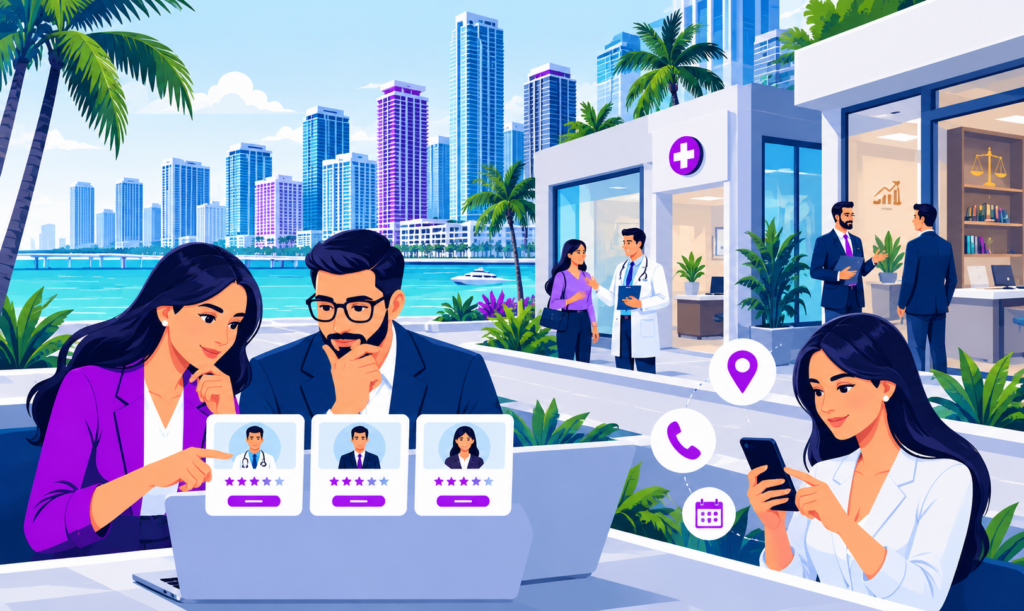
Palm Beach Gardens patients do not pick a doctor the way they pick a restaurant. They read the provider’s bio, check where they trained, look for board certification, and compare two or three practices near Legacy Place or PGA Boulevard before they ever pick up the phone. If your website does not answer those questions in the first scroll, they move to the next tab.
We build marketing for medical practices in Palm Beach Gardens around that behavior: slower decisions, higher scrutiny, and a patient who has already Googled your competitor’s name before Googling yours. That means credentials up front, HIPAA-safe intake forms, and pages built for the exact procedure or condition someone is researching, not just a generic “services” tab.
We also pay attention to the local search terms real patients use, the review responses that build trust before a first visit, and the mobile experience that matters when someone is comparing providers from a waiting room or parking lot.

How Palm Beach Gardens Medical Practices buyers search
Search behavior here looks different from a lot of Florida cities. Palm Beach Gardens skews older and wealthier, with a population that has time to research and the means to choose concierge or specialty care over whatever is closest. That shows up directly in the keywords: fewer people search “doctor near me” and more search by specific condition, procedure, or credential, things like “board certified dermatologist Palm Beach Gardens,” “orthopedic surgeon rotator cuff Palm Beach Gardens,” or “concierge internal medicine near PGA Boulevard.” These are people who already know roughly what they need and are vetting who is qualified to provide it, not just who is open.
Seasonality matters too. Between roughly November and April, the part-time resident and snowbird population swells, and with it the volume of people searching for a new provider in the area because their regular doctor is a thousand miles north. These searches often include urgency language, “accepting new patients,” “same week appointment,” “out of network dermatologist,” because the searcher needs care now and doesn’t have an existing relationship with a local practice to fall back on. A practice that only markets locally in the summer, or that lets its Google Business Profile and review volume go stagnant in the off-season, misses that window entirely and hands those patients to a competitor who stayed visible.
Map pack visibility still drives phone calls for urgent or routine care, urgent care, dentistry, optometry, pediatrics. Those searches are short, local, and conversion-ready; three listings and a handful of reviews often decide the click. But for anything higher-consideration, cosmetic procedures, orthopedics, concierge medicine, fertility, bariatric surgery, the organic result and the content behind it do more of the convincing than the map listing does. People click through to the website, read about the physician’s credentials and approach, look at before-and-after galleries or patient outcomes, and compare two or three practices before ever picking up the phone. For these buyers, a thin service page with no real detail loses to a competitor’s page that actually answers their questions, regardless of which practice ranks higher on the map.
The competition here
Palm Beach Gardens is not an easy market, and we are not going to pretend otherwise. Within a few miles you have hospital-affiliated practice groups with marketing departments and budgets, long-established independent specialists with decades of local reputation, and a growing number of concierge and med-spa style practices competing for the same affluent patient base. Several of them already rank for the obvious terms.
What that means practically: a brand-new or newly-marketed practice is unlikely to outrank a 20-year hospital-affiliated group for the single broadest term in the specialty within the first few months. That is a realistic read, not a pessimistic one. The opportunity is usually in the specific, long-tail searches, named procedures, named conditions, named insurance questions, where the big groups have not bothered to build a dedicated page, and where a well-built, specific page can compete on quality rather than age.
Multi-location practices face a separate problem. If you have a Palm Beach Gardens office and a Jupiter or West Palm Beach office, one combined “locations” page usually cannot rank for both cities. Each location generally needs its own page, with its own provider list, its own hours, and its own local signals, or you end up splitting relevance between two addresses and ranking well for neither.
What we build for Medical Practices in this market
The build starts with the structure, not the design. For a solo-provider practice, that usually means one page per condition or procedure, with the provider’s credentials, board certification, and training linked from every one of those pages, because a single generic “about us” page cannot do the credibility work on its own for a YMYL search like medicine.
For multi-location groups, each Palm Beach Gardens-area office gets its own page: its own providers, its own hours, its own patient instructions, its own local schema markup. We do this because Google and the patient both need a clear, single answer to “which location, which doctor, what do I do next,” and a shared page that tries to cover three offices usually answers none of those questions well.
Provider bios that carry weight
In medical search, the author of the content matters almost as much as the content itself. Google’s own guidance on search quality treats medical and health content as “Your Money or Your Life” material, meaning it is held to a higher bar for expertise and trustworthiness than a typical business page [EXTERNAL LINK: Google’s Search Quality Rater Guidelines or Search Central documentation on YMYL and E-E-A-T, to show the standard we are building to]. Practically, that means every provider page carries real credentials: medical school, residency, board certification, years in the specific specialty, and any hospital affiliations, written out, not just listed as initials after a name.
We also build out bios for mid-level providers, nurse practitioners and physician assistants, since a growing share of patient-facing care in multi-provider practices runs through them, and a thin or missing bio for the person a patient will actually see undercuts trust even when the supervising physician’s page looks strong.
HIPAA-safe forms, handled correctly
Intake and appointment request forms on a medical website sit in a different category than a contact form on a plumbing site. We build forms and the handling behind them with that in mind: no protected health information routed through standard unencrypted email, no analytics or ad pixels firing on pages that collect symptoms or conditions in a way that could tie identifiable health data to an ad platform, and clear separation between general appointment-request fields and anything that would require a signed business associate agreement with the form vendor. We are not your HIPAA compliance officer and we do not claim to replace one, but we do not build intake flows that create obvious exposure either, and we will tell you plainly where a form needs legal or compliance review before it goes live.
Content accuracy is handled the same way. Medical claims, outcome language, and before-and-after material get reviewed against what is actually defensible and documentable, not written to sound impressive. A page that oversells a procedure’s success rate is both a patient-trust problem and a regulatory one, and Palm Beach Gardens patients in particular tend to fact-check claims against other sources before booking.
Search and paid, working the long cycle
Because the buying cycle here is long, we do not build campaigns that assume a single-session conversion. Organic SEO work focuses on condition and procedure pages that a patient might read two or three times across several days before calling. Google Ads campaigns get built around that same pattern, with remarketing to people who visited a service page but did not fill out a form, rather than a single aggressive call-to-click campaign that burns budget on researchers who were never going to call on visit one.
Call tracking runs under a dedicated tracking number per channel, so you can see whether a call came from a Google Ads click, an organic visit, or a map listing, without guessing. For multi-location practices we track calls per office, because a lead routed to the wrong location is a lead that is effectively lost.
Legal and professional services
Explain practice areas, relevant experience, service locations, and consultation options. Organize pages around the specific services potential clients search for.
Medical and healthcare practices
Make treatment information, provider details, location information, and appointment options easy to find. Review health-related claims carefully.
Financial services
Present services, qualifications, and contact pathways clearly while respecting applicable advertising and compliance requirements.
Technology and business services
Explain complex offerings in plain language, demonstrate practical value, and create landing pages for distinct solutions.
Local service businesses
Build relevant service and location pages, improve Google Business Profile information, and make calls and enquiry forms easy to use.
What we measure
We report on what a medical practice actually needs to know, not a generic traffic dashboard. That includes tracked phone calls by source and by location, form submissions broken out by type (new patient, existing patient, prescription or records request), and which specific procedure or condition pages are generating contact rather than just pageviews. If a page gets visits but never a call or a form, that tells us the page is answering the wrong question or missing the credential signal a patient needed, and we can go fix that page specifically instead of guessing at the whole site.
We do not report vanity numbers like total impressions with no attached outcome. If a metric cannot be tied back to a call, a form, or a booked appointment in some traceable way, we do not lead with it.
What it costs
Medical marketing budgets vary by specialty and by how many locations are involved. A single-provider practice with one location needs less ongoing build-out than a multi-location group with five providers, each needing their own page and their own local presence maintained. Palm Beach Gardens’ competitive, affluent market also tends to require more content depth per page than a smaller, less-researched market would, since the buyer here reads more before calling and compares several practices before booking.

Get an audit
If you want a straight read on where your current site stands before you spend anything, we will dig into your provider pages, your intake and new-patient forms, your appointment request flow, and your visibility for the specific conditions and procedures you treat. For a Palm Beach Gardens practice, that means checking how you show up against nearby groups along Military Trail, PGA Boulevard, and the Donald Ross Road corridor, and whether patients searching from Jupiter, North Palm Beach, or Juno Beach can actually find and book with you. We look at page speed, mobile usability, review signals, and whether your content actually answers the questions patients type into Google before they call.
No generic traffic report, no guaranteed-ranking pitch, no pressure to sign anything. Call us or send over your site and we will walk through the findings with you, plainly and honestly.

FAQ's
These are the 6 questions Palm Beach Gardens homeowners ask us most about medical practice marketing, answered plainly so you know what to expect before any work starts. If yours isn't covered here, get in touch and we'll walk you through it.
Do you only work with large, multi-location medical groups?
No. We work with solo providers, small specialty practices, and multi-location groups. The build looks different depending on size, a solo dermatologist needs a different page structure than a five-location orthopedic group, but the underlying approach, credentials up front and procedure-specific pages, applies either way.
Can you guarantee our practice will rank for our specialty in Palm Beach Gardens?
No, and any agency that promises a specific ranking or a timeframe to get there is telling you something it cannot actually control. Google's own algorithm changes, and we do not have influence over it. What we can tell you is what the work involves and show you the pages and reporting as they go live.
How do you handle HIPAA on our website forms?
We build intake and appointment-request forms to avoid obvious exposure: no protected health information through unencrypted email, careful separation between general forms and anything sensitive, and no ad or analytics tracking on pages that collect health details in a way that could identify a patient. We are not a substitute for your compliance officer or attorney, and we will flag anything that needs their sign-off.
We have more than one location. Do we need a separate page for Palm Beach Gardens?
Generally, yes. One combined locations page usually cannot rank well for every city you operate in. A dedicated Palm Beach Gardens page with its own providers, hours, and local signals performs better than a shared page trying to represent multiple offices at once.
How long before we see results?
We will not give you a specific timeframe, because the honest answer depends on your specialty, your current site, and how established your competitors already are in Palm Beach Gardens search results. We can tell you what the work plan looks like and report transparently on progress month to month.