
- Home
- Services
- Portfolio
- About
- Service AreasFort Lauderdale, FL
- Web Design
- Redesign
- WordPress
- Ecommerce
- Landing Pages
- SEO Services
- Local SEO
- GBP
- Google Ads
- PPC
- Digital Marketing
- Internet Marketing
- Advertising
- Tracking
- Dental Marketing
- Medical Marketing
- HVAC Marketing
- Roofing Marketing
- Pest Control Marketing
- Home Services Marketing
- Plumbing Marketing
- Electrical Marketing
- Landscaping Marketing
- Remodeling Marketing
Pembroke Pines, FL- Web Design
- Redesign
- WordPress
- Ecommerce
- Landing Pages
- SEO Services
- Local SEO
- GBP
- Google Ads
- PPC
- Digital Marketing
- Internet Marketing
- Advertising
- Tracking
- Dental Marketing
- Medical Marketing
- HVAC Marketing
- Roofing Marketing
- Pest Control Marketing
- Home Services Marketing
- Plumbing Marketing
- Electrical Marketing
- Landscaping Marketing
- Remodeling Marketing
Hialeah, FL- Web Design
- Redesign
- WordPress
- Ecommerce
- Landing Pages
- SEO Services
- Local SEO
- GBP
- Google Ads
- PPC
- Digital Marketing
- Internet Marketing
- Advertising
- Tracking
- Dental Marketing
- Medical Marketing
- HVAC Marketing
- Roofing Marketing
- Pest Control Marketing
- Home Services Marketing
- Plumbing Marketing
- Electrical Marketing
- Landscaping Marketing
- Remodeling Marketing
Hollywood, FL- Web Design
- Redesign
- WordPress
- Ecommerce
- Landing Pages
- SEO Services
- Local SEO
- GBP
- Google Ads
- PPC
- Digital Marketing
- Internet Marketing
- Advertising
- Tracking
- Dental Marketing
- Medical Marketing
- HVAC Marketing
- Roofing Marketing
- Pest Control Marketing
- Home Services Marketing
- Plumbing Marketing
- Electrical Marketing
- Landscaping Marketing
- Remodeling Marketing
Miramar, FL- Web Design
- Redesign
- WordPress
- Ecommerce
- Landing Pages
- SEO Services
- Local SEO
- GBP
- Google Ads
- PPC
- Digital Marketing
- Internet Marketing
- Advertising
- Tracking
- Dental Marketing
- Medical Marketing
- HVAC Marketing
- Roofing Marketing
- Pest Control Marketing
- Home Services Marketing
- Plumbing Marketing
- Electrical Marketing
- Landscaping Marketing
- Remodeling Marketing
Coral Springs, FL- Web Design
- Redesign
- WordPress
- Ecommerce
- Landing Pages
- SEO Services
- Local SEO
- GBP
- Google Ads
- PPC
- Digital Marketing
- Internet Marketing
- Advertising
- Tracking
- Dental Marketing
- Medical Marketing
- HVAC Marketing
- Roofing Marketing
- Pest Control Marketing
- Home Services Marketing
- Plumbing Marketing
- Electrical Marketing
- Landscaping Marketing
- Remodeling Marketing
Pompano Beach, FL- Web Design
- Redesign
- WordPress
- Ecommerce
- Landing Pages
- SEO Services
- Local SEO
- GBP
- Google Ads
- PPC
- Digital Marketing
- Internet Marketing
- Advertising
- Tracking
- Dental Marketing
- Medical Marketing
- HVAC Marketing
- Roofing Marketing
- Pest Control Marketing
- Home Services Marketing
- Plumbing Marketing
- Electrical Marketing
- Landscaping Marketing
- Remodeling Marketing
Davie, FL- Web Design
- Redesign
- WordPress
- Ecommerce
- Landing Pages
- SEO Services
- Local SEO
- GBP
- Google Ads
- PPC
- Digital Marketing
- Internet Marketing
- Advertising
- Tracking
- Dental Marketing
- Medical Marketing
- HVAC Marketing
- Roofing Marketing
- Pest Control Marketing
- Home Services Marketing
- Plumbing Marketing
- Electrical Marketing
- Landscaping Marketing
- Remodeling Marketing
Sunrise, FL- Web Design
- Redesign
- WordPress
- Ecommerce
- Landing Pages
- SEO Services
- Local SEO
- GBP
- Google Ads
- PPC
- Digital Marketing
- Internet Marketing
- Advertising
- Tracking
- Dental Marketing
- Medical Marketing
- HVAC Marketing
- Roofing Marketing
- Pest Control Marketing
- Home Services Marketing
- Plumbing Marketing
- Electrical Marketing
- Landscaping Marketing
- Remodeling Marketing
Plantation, FL- Web Design
- Redesign
- WordPress
- Ecommerce
- Landing Pages
- SEO Services
- Local SEO
- GBP
- Google Ads
- PPC
- Digital Marketing
- Internet Marketing
- Advertising
- Tracking
- Dental Marketing
- Medical Marketing
- HVAC Marketing
- Roofing Marketing
- Pest Control Marketing
- Home Services Marketing
- Plumbing Marketing
- Electrical Marketing
- Landscaping Marketing
- Remodeling Marketing
Deerfield Beach, FL- Web Design
- Redesign
- WordPress
- Ecommerce
- Landing Pages
- SEO Services
- Local SEO
- GBP
- Google Ads
- PPC
- Digital Marketing
- Internet Marketing
- Advertising
- Tracking
- Dental Marketing
- Medical Marketing
- HVAC Marketing
- Roofing Marketing
- Pest Control Marketing
- Home Services Marketing
- Plumbing Marketing
- Electrical Marketing
- Landscaping Marketing
- Remodeling Marketing
Miami Gardens, FL- Web Design
- Redesign
- WordPress
- Ecommerce
- Landing Pages
- SEO Services
- Local SEO
- GBP
- Google Ads
- PPC
- Digital Marketing
- Internet Marketing
- Advertising
- Tracking
- Dental Marketing
- Medical Marketing
- HVAC Marketing
- Roofing Marketing
- Pest Control Marketing
- Home Services Marketing
- Plumbing Marketing
- Electrical Marketing
- Landscaping Marketing
- Remodeling Marketing
Lauderhill, FL- Web Design
- Redesign
- WordPress
- Ecommerce
- Landing Pages
- SEO Services
- Local SEO
- GBP
- Google Ads
- PPC
- Digital Marketing
- Internet Marketing
- Advertising
- Tracking
- Dental Marketing
- Medical Marketing
- HVAC Marketing
- Roofing Marketing
- Pest Control Marketing
- Home Services Marketing
- Plumbing Marketing
- Electrical Marketing
- Landscaping Marketing
- Remodeling Marketing
West Palm Beach, FL- Web Design
- Redesign
- WordPress
- Ecommerce
- Landing Pages
- SEO Services
- Local SEO
- GBP
- Google Ads
- PPC
- Digital Marketing
- Internet Marketing
- Advertising
- Tracking
- Dental Marketing
- Medical Marketing
- HVAC Marketing
- Roofing Marketing
- Pest Control Marketing
- Home Services Marketing
- Plumbing Marketing
- Electrical Marketing
- Landscaping Marketing
- Remodeling Marketing
Tamarac, FL- Web Design
- Redesign
- WordPress
- Ecommerce
- Landing Pages
- SEO Services
- Local SEO
- GBP
- Google Ads
- PPC
- Digital Marketing
- Internet Marketing
- Advertising
- Tracking
- Dental Marketing
- Medical Marketing
- HVAC Marketing
- Roofing Marketing
- Pest Control Marketing
- Home Services Marketing
- Plumbing Marketing
- Electrical Marketing
- Landscaping Marketing
- Remodeling Marketing
Weston, FL- Web Design
- Redesign
- WordPress
- Ecommerce
- Landing Pages
- SEO Services
- Local SEO
- GBP
- Google Ads
- PPC
- Digital Marketing
- Internet Marketing
- Advertising
- Tracking
- Dental Marketing
- Medical Marketing
- HVAC Marketing
- Roofing Marketing
- Pest Control Marketing
- Home Services Marketing
- Plumbing Marketing
- Electrical Marketing
- Landscaping Marketing
- Remodeling Marketing
Boca Raton, FLMargate, FLCoconut Creek, FLMiami Beach, FLHomestead, FLKendall, FLDoral, FLBoynton Beach, FLThe Hammocks, FLNorth Lauderdale, FLOakland Park, FLDelray Beach, FLNorth Miami, FLHallandale Beach, FLFontainebleau, FLKendale Lakes, FLWellington, FLJupiter, FLTamiami, FLPalm Beach Gardens, FLLauderdale Lakes, FLCooper City, FLCountry Club, FLParkland, FLCoral Gables, FLDania Beach, FLCutler Bay, FLNorth Miami Beach, FLGreenacres, FLLake Worth Beach, FLPrinceton, FLRoyal Palm Beach, FLSouth Miami Heights, FLRichmond West, FLRiviera Beach, FLWest Little River, FLGolden Glades, FLAventura, FLMiami Lakes, FLWestchester, FLLeisure City, FLCoral Terrace, FLPalm Springs, FLPalmetto Bay, FLHialeah Gardens, FLSunny Isles Beach, FLIves Estates, FLWest Park, FLSweetwater, FLPinecrest, FLSunset, FLPinewood, FLWilton Manors, FLOpa-locka, FLLighthouse Point, FLBelle Glade, FLNaranja, FLPalmetto Estates, FLBrownsville, FLKey Biscayne, FLOlympia Heights, FLMiami Springs, FLFlorida City, FLSouth Miami, FLThree Lakes, FLGladeview, FLNorth Palm Beach, FLMiami Shores, FLSouthwest Ranches, FLKings Point, FLLauderdale-by-the-Sea, FLHillsboro Beach, FLSea Ranch Lakes, FLLazy Lake, FL - Blog
- Contact
Marketing for HVAC Companies
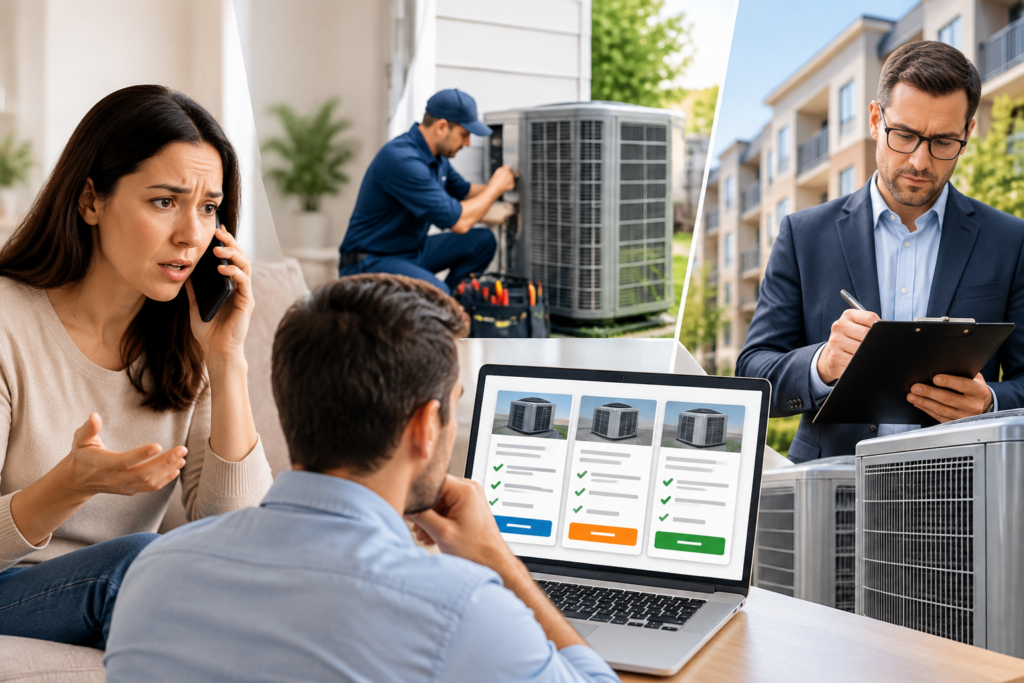
An HVAC search is not one search. The person whose air conditioner died at 2pm today is looking for a phone number. The person replacing a 14-year-old system next month is comparing three quotes. The property manager renewing a maintenance contract is comparing price per unit across a portfolio. A website and a campaign that treats all three the same way lose two of them. Here’s how we build for HVAC specifically, and where that differs from a generic “we do SEO for contractors” approach.

How buyers in this industry actually search
HVAC search intent splits into three groups, and each one needs a different page and a different ad.
- Emergency, same-day. Searches like “AC not cooling,” “emergency AC repair [city],” or “24 hour AC repair near me.” These happen on a phone, often standing next to the broken unit. The decision gets made in under an hour, and price sensitivity is lower than you'd expect — comfort and urgency outweigh it.
- Researched, considered purchase. Full system replacement is a $5,000–$15,000+ decision. These searchers spend one to three weeks comparing brands, financing terms, and multiple quotes. There's usually a second decision maker — a spouse or business partner — which is why financing and comparison pages get read on a different device than the one the search started on.
- Maintenance and service agreements. Recurring, price-led, and often decided by a facility manager or a committee rather than one owner. Searches look like “commercial HVAC maintenance contract” or “HVAC preventive maintenance plan,” and the buyer is comparing price per unit across a portfolio, not comfort.
The South Florida detail that changes the plan: cooling here is not seasonal. A Michigan HVAC contractor’s repair search volume drops off a cliff in October. Yours doesn’t — an AC unit in Coral Springs works exactly as hard in December as it does in August, and it fails on the same schedule. There’s no real “off season” to pull back ad spend during, the way a lot of national HVAC marketing playbooks assume. Budget pacing has to reflect a market running close to full demand year-round, with a modest bump around the pre-summer maintenance window rather than a hard seasonal cliff.
What that means for the site
One page cannot rank for “AC repair” and “AC installation” and “duct cleaning” across eight cities at once. Google matches a specific query to a specific page, and a visitor who searched “AC installation Coral Springs” and lands on a general “HVAC Services” page bounces, because the headline doesn’t match what they typed. The fix is structural: a page per service, per city you actually serve, each one written for the intent behind that specific search.
Emergency pages have to work differently than sales pages
- Phone number visible without scrolling, and a click-to-call button, not a link buried in a header.
- No long contact form as the only option — someone with a dead AC at 2pm will not fill out eight fields.
- A stated response window only if it's one you actually hold to — an unfulfilled promise here does more damage than no promise at all.
- License number and insurance status visible above the fold, because trust has to be established in seconds.
Installation and replacement pages have to nurture, not close instantly
- Financing terms, warranty coverage, and equipment or brand comparisons written in plain terms.
- Photos of completed jobs once you have them to use, rather than stock imagery of generic ductwork.
- A lead form that asks for a callback time, because this buyer is comparing quotes, not calling in from a dead stop.
- Site speed matters more here than in most industries because of the emergency segment specifically: a page that takes five seconds to load loses that visitor to the next result while they're standing in a hot house with a phone in hand.
See how we structure sites for multi-city service businesses on our web design services page.
What that means for the profile and the map
For “near me” and “[service] [city]” emergency searches, the map pack is often seen before the organic results are. A Google Business Profile set up generically underperforms one set up for how HVAC customers actually search and decide.
Category
Primary category set to the specific HVAC category Google offers, not a generic “contractor” category that dilutes relevance.
Service area
Configured as an actual service-area radius covering the cities you work in, not a single pin — most HVAC work happens at the customer's address, not yours.
Photos
Trucks, uniforms, and completed jobs, not stock imagery. Profiles with real photos convert map views into calls at a higher rate than ones without.
Review timing
Requests sent right after each job, while the experience is fresh — review volume and recency both factor into map pack ranking.
Q&A
Answered directly, since licensing and insurance questions often get asked here before a call ever happens.
Florida requires HVAC contractors to hold a state-issued license, and buyers increasingly check that before they call — see the state’s own contractor licensing lookup through the Florida DBPR
The campaign structure that fits this industry
Campaigns split by intent level, not just by service, because an emergency repair click and an installation research click convert at completely different rates and need different bidding.
Emergency repair campaigns
Tight geographic radius, call-focused ad extensions, dayparting matched to your actual availability, and a higher acceptable cost per click, because a repair call converts to a booked job at a high rate.
Install and replacement campaigns
Broader research keywords, landing pages built for a multi-week decision, and retargeting for people who visited a quote page but didn't call yet.
Maintenance agreement campaigns
Even without a hard seasonal cliff, many South Florida owners still book a pre-summer check-up around {MONTH_RANGE}, so a maintenance push timed to that window still outperforms running it flat all year.
None of this holds without a maintained negative keyword list. Without one, ads show for “hvac technician jobs,” “how to become an hvac tech,” and “diy ac repair” — clicks from people who were never going to hire anyone, paid for out of the same budget meant for buyers.
This is the same logic behind how we structure accounts on our Google Ads management page.

What we measure
- Call tracking. Each tracked number is tied to a specific source, campaign, and keyword, so a call can be attributed to what actually generated it instead of assumed.
- Booked calls, not just calls. A wrong number, a call from outside your service area, or a price-shopper who never books isn't the same as a booked job. We track cost per booked call, not just cost per click or cost per call.
- Multi-touch attribution. A lot of HVAC customers see an ad, don't call, then search your business name by name a week later. Crediting only that last search misses the ad that started it, so attribution needs to connect the path, not just the last click.
Under this reporting structure, recent HVAC accounts have seen movement like {RESULT_1} and {RESULT_2} — we’ll fill in real figures here once we have a client account to report on, and we won’t publish a number we can’t back with data.
Where most HVAC Companies marketing goes wrong
- One page trying to rank for every service in every city. It dilutes relevance for all of them instead of ranking well for any single one.
- No call tracking. Without it there's no way to tell which keyword produced a real job versus a wrong number, so budget decisions get made on guesses.
- Flat budget pacing that ignores demand shape. Some HVAC accounts run the same daily budget in a slow month as a peak one, in markets where that mismatch is costly.
- Repair and install keywords bid at the same target. They convert at different rates and belong in different campaigns with different bid strategies, not one blended average.
- A Google Business Profile filed under the wrong category or with an unmanaged service-area radius. This alone can mean showing up for the wrong cities, or not showing up at all.
- No negative keyword list. Budget quietly leaks to job-seekers and DIY searchers who were never going to hire anyone.
- A contact form as the only option on an emergency page. Someone with a dead AC needs a phone number, not a form to fill out and wait on.


What it costs
Cost depends mainly on how many cities and services you’re competing in — a company working three cities needs a different build and budget than one working twelve, and we scope it once we know your actual service area rather than quoting a flat number.
- SEO: $2,000–$5,000/month, scaled to the number of city and service pages being built and maintained.
- Google Ads management: $1,000–$2,500/month in management fees, plus ad spend that scales with how many emergency-intent keywords you're competing for and how competitive your market is.
- Website build: $8,000–$25,000 one-time for a multi-location HVAC site with separate service and city pages.
We won’t quote a number without knowing your service area first — the range above moves a lot depending on whether you’re competing in three cities or twelve.
Questions we get from HVAC Companies owners
How long before we see results?
It depends on the channel. Google Ads can start generating calls within days of launch, though cost and volume typically take a few weeks to settle as the account learns which keywords convert. SEO moves on a longer timeline because it depends on how competitive your market is and how much of the site needs to be built or restructured first. We won’t promise a specific number of weeks up front.
Do you guarantee we'll rank #1?
No agency can guarantee a ranking position, because the algorithm that decides it belongs to Google, not to us. What we can control is page structure, technical health, content relevance, and review activity — the inputs that influence ranking, not the ranking itself.
We already have a website. Do we need a new one?
Not always. Sometimes an existing site restructured with proper city and service pages is enough. We assess what’s there before recommending a rebuild.
Can you handle both our emergency repair calls and our installation leads in the same account?
Yes — that’s the campaign split described above. They run as separate campaigns with separate bidding and separate landing pages, under one account.
We only serve a few cities right now, not all of South Florida. Does that change anything?
Yes, and it should. Site pages and ad campaigns get scoped to your actual service area so budget isn’t spent competing for cities you don’t have trucks in.
Do you work with HVAC companies outside Florida?
Yes, we work with clients nationally. The South Florida detail about year-round cooling demand is specific to this market — outside it, campaigns get built around whatever that market’s actual seasonal pattern is, not a template.
Talk to us
If you’re deciding between fixing what you have and rebuilding, or trying to figure out why your ad spend isn’t turning into booked jobs, tell us which cities and which services you actually want to compete in and we’ll tell you what that looks like to build. Call {PHONE}, or send us what you’re working with now and we’ll go through it.